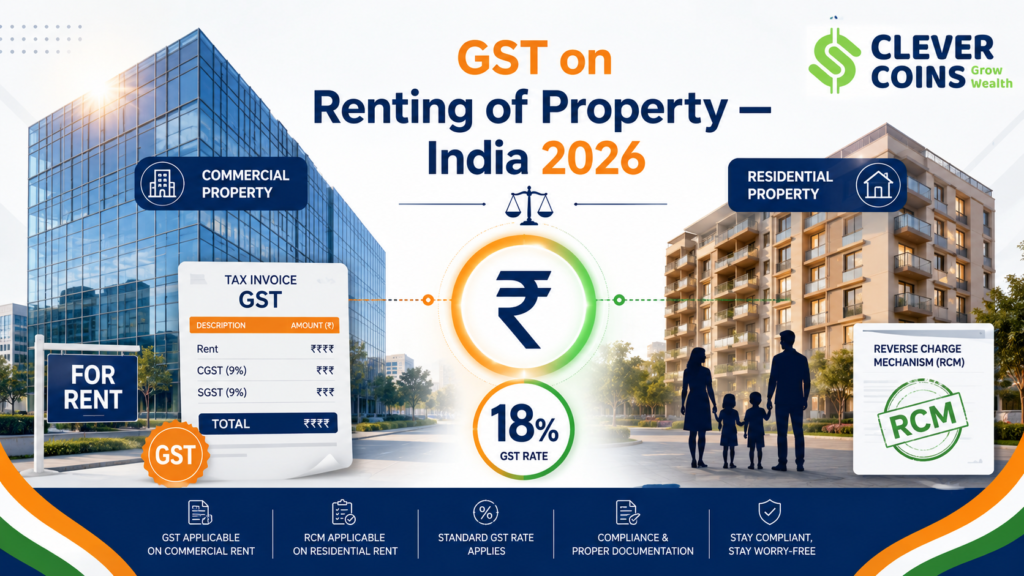
Understanding GST on Property Rentals in India
The Goods and Services Tax (GST) framework in India, introduced on 1st July 2017, has significantly transformed the taxation landscape for rental transactions. Whether you are a property owner renting out commercial spaces, a business leasing office premises, or a landlord offering residential accommodation, understanding GST on renting of property is absolutely essential to remain compliant and avoid penalties in 2026.
Renting of immovable property is treated as a ‘supply of service’ under the GST Act, making it liable to GST under specific conditions. However, not all types of rental income attract GST — the applicability depends on the nature of the property (commercial vs. residential), the status of the landlord and tenant (registered or unregistered), and the aggregate annual turnover involved.
This comprehensive guide covers every aspect of GST on property rentals — from rates and exemptions to Input Tax Credit (ITC), Reverse Charge Mechanism (RCM), registration requirements, invoicing, and compliance as updated for the financial year 2026.
Legal Framework: GST on Renting of Property Under the Law
GST on renting of property is governed under the Central Goods and Services Tax Act, 2017 (CGST Act) and the Integrated Goods and Services Tax Act, 2017 (IGST Act). The relevant provisions include:
Legal Provision | Relevance |
Section 7 of CGST Act | Defines ‘Supply’ — renting is a taxable supply of service |
Schedule II, Entry 2 | Renting of immovable property classified as supply of service |
Section 9(4) of CGST Act | Reverse Charge Mechanism applicable in certain cases |
Notification No. 12/2017-CT (Rate) | Exemptions from GST on specified rental services |
Notification No. 05/2022-CT (Rate) | Key 2022 amendment — RCM on residential dwellings |
HSN Code 9972 | Service code for real estate services including renting |
GST Council 54th Meeting (2024) | Latest clarifications on rental applicability |
Types of Rental Property Under GST
GST treatment varies significantly based on the category of property being rented. It is critical to classify the property correctly before determining tax liability.
1. Commercial Property Rental
Any property rented for business, professional, or commercial purposes — such as offices, shops, showrooms, warehouses, industrial sheds, malls, multiplexes — falls under commercial property rental. GST at 18% (9% CGST + 9% SGST or 18% IGST for inter-state) is applicable when the landlord is registered under GST and the annual rental income exceeds the threshold limit of ₹20 lakhs (₹10 lakhs for special category states).
2. Residential Property Rental
Residential dwellings such as flats, houses, bungalows, or apartments rented for use as a residence were historically exempt from GST. However, a significant amendment vide Notification No. 05/2022-CT (Rate) effective from 18th July 2022 introduced Reverse Charge Mechanism (RCM) on residential property rented by a registered business entity.
3. Mixed-Use Property
Properties used partly for commercial and partly for residential purposes need to be assessed carefully. Only the commercial portion of the rent would attract GST, while the residential portion may be exempt subject to conditions.
4. Agricultural Land
Renting of agricultural land for agricultural purposes is specifically exempt from GST under Entry 54 of the exemption notification. No GST is applicable on such transactions.
GST Rates Applicable on Renting of Property (2026)
Property Type | GST Rate | Remarks |
Commercial Property (Office/Shop/Warehouse) | 18% | If landlord is GST registered |
Residential Dwelling (to Registered Business) | 18% under RCM | Tenant pays under RCM |
Residential Dwelling (to Individual/Unregistered) | Exempt | No GST applicable |
Hotels / Guest Houses (Below ₹1,000/day) | Exempt (NIL) | As per 2026 rates |
Hotels / Guest Houses (₹1,001 to ₹7,500/day) | 12% | Applicable on room tariff |
Hotels / Guest Houses (Above ₹7,500/day) | 18% | Applicable on room tariff |
Agricultural Land (for farming) | Exempt (NIL) | Entry 54, Exemption Notification |
Co-working Spaces / Serviced Offices | 18% | Treated as commercial rental |
GST on Commercial Property Rental — Detailed Analysis
When is GST Applicable on Commercial Property?
GST is applicable on commercial property rental when the following conditions are simultaneously met:
- The landlord (service provider) is registered under GST or is liable to register
- The aggregate annual turnover of the landlord exceeds ₹20 lakhs (₹10 lakhs for special category states like Manipur, Mizoram, Nagaland, Tripura, etc.)
- The property is used for commercial, business, or non-residential purposes
- The renting transaction constitutes a ‘supply’ as per Section 7 of the CGST Act
GST Rate and SAC Code for Commercial Rental
The SAC (Service Accounting Code) applicable for renting of commercial immovable property is 997212. The GST rate is 18%, split equally as 9% CGST and 9% SGST for intra-state transactions, or 18% IGST for inter-state rentals.
GST Registration Threshold for Landlords
A property owner is required to obtain GST registration if rental income from commercial property (combined with all other taxable supplies) exceeds ₹20 lakhs per annum. For example, if a landlord earns ₹1,80,000 per month as rent from a commercial shop, the annual income of ₹21,60,000 crosses the threshold, mandating GST registration.
Example Calculation: GST on Commercial Property Rent
Particulars | Amount (₹) |
Monthly Rent (Base) | ₹1,50,000 |
CGST @ 9% | ₹13,500 |
SGST @ 9% | ₹13,500 |
Total Monthly Invoice | ₹1,77,000 |
Annual GST Payable | ₹3,24,000 |
Annual Total Payable by Tenant | ₹21,24,000 |
GST on Residential Property Rental — Post-2022 Rules
The 2022 amendment has been one of the most discussed changes in GST law relating to property. Prior to 18th July 2022, residential property rent was entirely exempt from GST. However, the GST Council in its 47th meeting recommended, and the government notified, a change that brought residential property rental under GST via Reverse Charge Mechanism under specific conditions.
The Key 2022 Amendment (Still in Effect in 2026)
Scenario | GST Applicability |
Residential dwelling rented to an INDIVIDUAL (for personal use) | EXEMPT — No GST |
Residential dwelling rented to a REGISTERED PERSON (any entity) | 18% GST under RCM — Tenant pays |
Residential dwelling rented by UNREGISTERED LANDLORD to any entity | RCM applicable if tenant is registered |
Residential dwelling used as EMPLOYEE ACCOMMODATION by employer | RCM may apply — check purpose of use |
Understanding Reverse Charge Mechanism (RCM) on Residential Rent
Under RCM, the liability to pay GST shifts from the supplier (landlord) to the recipient (tenant). This means if a GST-registered company rents a residential flat for its employee or director, the company (tenant) is liable to pay 18% GST on the rent amount. The landlord need not charge GST on the invoice in such cases.
Key points regarding RCM on residential rent in 2026:
- The tenant (registered business entity) pays GST at 18% on the full rent under RCM
- The landlord does not charge GST separately in the rental invoice
- The tenant must raise a self-invoice (payment voucher) under Section 31(3)(f) of the CGST Act
- The tenant can claim ITC on the GST paid under RCM, subject to conditions — if the property is used for business purposes
- If the flat is used exclusively as a residence for personal use by an employee (not business use), ITC may be blocked under Section 17(5)
Practical Example: RCM on Residential Rent
Particulars | Amount (₹) |
Monthly Rent paid by Company to Landlord | ₹80,000 |
GST @ 18% under RCM (paid by Company) | ₹14,400 |
Total Cost to Company | ₹94,400 |
ITC Claimed by Company (if eligible) | ₹14,400 |
Net Cost to Company (after ITC) | ₹80,000 |
Input Tax Credit (ITC) on Rented Property
Input Tax Credit is one of the most beneficial features of GST, allowing businesses to offset the tax paid on inputs against their output tax liability. However, ITC on rented property is subject to specific conditions and restrictions.
When Can ITC Be Claimed on Rent?
- The property is rented and used exclusively for business purposes (commercial use)
- The taxpayer is registered under GST and engaged in making taxable supplies
- A valid GST invoice or self-invoice (in case of RCM) is available
- The rent is not for blocked credits under Section 17(5) of CGST Act
Blocked Credits — When ITC Cannot Be Claimed
Section 17(5) of the CGST Act specifically blocks ITC in certain scenarios:
- Rent paid for a residential dwelling used for personal accommodation of employees — ITC is BLOCKED
- Rent for property used for entertainment, recreation, or hospitality (unless in the business of providing such services)
- Motor vehicle-related rental (not immovable property, but often confused)
ITC on Rent — Practical Scenarios
Scenario | ITC Available? | Remarks |
Office space rented for business operations | YES | Fully available |
Warehouse rented for storing goods | YES | Proportionate if mixed use |
Residential flat rented for employee stay | NO | Blocked u/s 17(5) |
Flat rented by company — Director uses as office | PARTIAL | Subject to dual-use apportionment |
Hotel room rented for client meeting | YES (if <₹7,500/day) | Allowed for business use |
GST Registration Requirements for Property Owners (2026)
Whether a property owner requires GST registration depends on multiple factors including aggregate turnover, nature of property rented, and whether the landlord makes any other taxable supplies.
Mandatory GST Registration Conditions
- Aggregate annual turnover from all taxable supplies (including rent) exceeds ₹20 lakhs (₹10 lakhs for special category states)
- Renting commercial property and making inter-state supply regardless of turnover
- Voluntary registration to claim ITC on property construction/renovation costs
Registration Threshold Examples (2026)
Landlord Category | Monthly Rent | Registration Required? |
Individual — commercial property | ₹2,00,000 | YES (₹24L > ₹20L limit) |
Individual — residential to individual | ₹50,000 | NO (exempt) |
Company — commercial property | ₹1,00,000 | YES (any amount) |
Individual — residential to company | ₹30,000 | RCM on tenant; landlord may not need reg. |
Individual — multiple properties mix | ₹1,80,000 | YES if combined > ₹20L/year |
GST Invoicing & Documentation for Property Rentals
Proper documentation and invoicing are critical for GST compliance in property rental transactions.
Tax Invoice Requirements (For Registered Landlord — Commercial Property)
- Name, address, and GSTIN of the landlord (supplier)
- Name, address, and GSTIN of the tenant (recipient)
- Invoice number and date
- Description of service: Renting of Immovable Property (SAC: 997212)
- Place of supply (location of property)
- Taxable value (monthly rent amount)
- GST rate and amount (CGST + SGST or IGST)
- Total invoice amount
- Signature of landlord or authorized representative
Self-Invoice for RCM (Tenant’s Obligation)
When a registered tenant pays GST under RCM on residential rent, they must prepare a self-invoice (payment voucher) containing:
- Name and address of the landlord (unregistered supplier)
- Description: Renting of Residential Dwelling
- Taxable value and GST under RCM
- Date of payment and financial year reference
GST Return Filing & Compliance for Property Rentals
Property owners registered under GST must comply with return filing requirements. Non-compliance attracts interest and penalties.
Key GST Returns for Landlords
Return Form | Purpose & Frequency |
GSTR-1 | Monthly/Quarterly — Details of outward supplies (rental invoices raised) |
GSTR-3B | Monthly/Quarterly — Summary return with tax payment |
GSTR-9 | Annual return — Comprehensive annual summary (if turnover > ₹2 Cr) |
GSTR-9C | Annual reconciliation statement (if turnover > ₹5 Cr) |
PMT-06 | Quarterly CMP-08 (if under Composition Scheme — not applicable for rent) |
Due Dates for GST Returns (2026)
- GSTR-1 (Monthly): 11th of the following month
- GSTR-1 (Quarterly under QRMP): 13th of the month following the quarter
- GSTR-3B (Monthly): 20th of the following month
- GSTR-3B (Quarterly — small taxpayers): 22nd/24th of the month following the quarter
- GSTR-9 (Annual): 31st December of the subsequent financial year
Penalties for Non-Compliance
Nature of Default | Penalty / Consequence |
Late filing of GSTR-1 / 3B | ₹50/day (₹20/day for NIL returns); Max ₹5,000 |
Non-payment of GST | 18% interest per annum on outstanding amount |
Non-registration (mandatory cases) | ₹10,000 or 10% of tax due, whichever is higher |
Fraudulent suppression of rental income | 100% to 300% of tax evaded as penalty + prosecution |
Delay in RCM payment by tenant | Interest @ 18% p.a. + late fee on filing |
Special Scenarios & FAQs on GST and Property Rent
Scenario 1: Rent from Multiple Properties
If a landlord rents out multiple commercial properties and total annual rent exceeds ₹20 lakhs, GST registration is mandatory. All rental income must be included in the aggregate turnover calculation. If some properties are residential (exempt) and others commercial (taxable), only the taxable portion counts toward the ₹20 lakh threshold for tax payment, but all income is included in aggregate turnover for registration purposes.
Scenario 2: NRI Landlords with Property in India
Non-Resident Indians (NRIs) owning property in India and receiving rental income may face GST implications if they have a fixed establishment in India and the aggregate turnover crosses the threshold. Typically, the Indian tenant (if registered) may be required to pay under RCM. NRI landlords should consult a GST practitioner to assess their liability.
Scenario 3: Co-Working Space Operators
Co-working space operators who rent commercial premises from a landlord and then sub-let desks/cabins to businesses are engaged in a separate taxable service. The operator must charge 18% GST on their service fees. They can claim ITC on the rent paid to their landlord (if GST was charged).
Scenario 4: Government Properties on Rent
Renting of immovable property by Central/State Government or Union Territory is exempt from GST under specific entries. However, if the property is given on rent by a government entity for commercial purposes, GST may apply depending on the nature of the transaction.
Scenario 5: Lease vs. Rent — Is There a Difference?
Under GST, both ‘renting’ and ‘leasing’ of immovable property are treated as supply of services under SAC 9972. Whether the agreement is called a lease deed or a rent agreement, the GST treatment remains the same based on the nature of the property and parties involved.
Place of Supply Rules for Property Rental Under GST
Place of Supply is crucial for determining whether CGST + SGST or IGST is applicable in a rental transaction.
Rule: Location of Immovable Property
As per Section 12(3) of the IGST Act, for services related to immovable property (including renting), the place of supply is the location where the immovable property is situated. This means:
- If the property is in Mumbai and the tenant is based in Delhi — Place of supply is Maharashtra — IGST @ 18% applies (inter-state supply)
- If both landlord and tenant are in Maharashtra and property is in Maharashtra — CGST 9% + SGST 9% applies
- This rule applies regardless of the addresses of the landlord or tenant
GST on Security Deposit and Advance Rent
Security Deposit
Security deposit collected by a landlord at the time of entering a rental agreement is generally NOT subject to GST, as it is a refundable amount and not a consideration for supply. However, if the security deposit is adjusted against rent at any point, GST becomes applicable on the adjusted amount at the time of such adjustment.
Advance Rent
Advance rent is a payment made upfront for future rental periods. GST becomes applicable on advance rent at the time of receipt or issue of invoice, whichever is earlier, as per the time of supply rules under Section 13 of the CGST Act. Landlords must issue a tax invoice and remit GST on advance rent received.
Lease Premium (One-Time Payment)
A lease premium or one-time upfront payment for a long-term lease of commercial property is taxable under GST at 18%. The entire premium amount is treated as consideration for the service of renting, and GST is payable at the time of receipt or invoice issuance.
Can Landlords Opt for the GST Composition Scheme?
Service providers, including those rendering rental services, are generally NOT eligible for the Composition Scheme under Section 10 of the CGST Act. The Composition Scheme is primarily available for manufacturers, traders, and restaurant businesses with turnover below ₹1.5 crore (₹75 lakhs for special category states).
However, there is a separate composition scheme for service providers under Notification No. 2/2019-CT (Rate), applicable for mixed suppliers (goods + services) with turnover up to ₹50 lakhs, who pay GST @ 6%. Pure landlords providing only rental services cannot opt for the standard composition scheme and must file regular GST returns if registered.
Recent Updates & Clarifications on GST on Rent (2024–2026)
GST Council 54th Meeting (September 2024) — Key Decisions
- Clarification issued that residential property rented to registered entities continues under RCM — no withdrawal of the 2022 amendment
- Enhanced scrutiny of ITC claims on residential property by businesses — field formations directed to verify dual-use
- No change in GST rates on commercial property rental — 18% continues
Budget 2025-26 Proposals Relevant to Property GST
- Increased infrastructure investments likely to boost industrial and warehouse rental market — GST compliance focus area
- Data Centers and technology parks rented to IT companies — confirmed 18% GST applicability
- No new exemption announced for commercial rentals as of 2026
CBIC Circulars & Advance Rulings (2024-2026)
- AAR Rajasthan (2024): Renting of residential flat to a registered company for business use — RCM applies and ITC available if used for business
- AAR Karnataka (2024): Co-working space — entire service taxable at 18%, operator can claim ITC on rent paid
- CBIC Circular No. 206/18/2023: Clarified that sub-leasing of commercial property by registered lessee also attracts GST at 18%
Practical GST Compliance Checklist for Property Owners & Tenants
For Landlords (Property Owners)
- Check if aggregate annual rental income exceeds ₹20 lakhs — if yes, register for GST immediately
- Determine the nature of property — commercial or residential — for each tenancy
- Issue proper GST invoices with SAC code 997212 for commercial rentals
- File GSTR-1 and GSTR-3B on time every month/quarter
- Maintain proper books of accounts including rental agreements, invoices, and payment records
- Do not collect GST if not registered — it is an offence under GST law
For Tenants / Businesses (Renting Property)
- Determine if your landlord is GST-registered — obtain GSTIN and verify on the GST portal
- If renting residential property — check if RCM applies; if yes, pay GST and file self-invoice
- Claim ITC only on business-use property and maintain documentation
- Ensure GST registration before claiming ITC on any rental transactions
- Reconcile ITC claimed on rent with GSTR-2B data to avoid mismatches
- Engage a GST consultant for complex multi-property or multi-state rental arrangements
Impact of GST on India’s Real Estate & Rental Market
The implementation and evolution of GST on property rental has had far-reaching implications on India’s ₹3 lakh crore organized real estate rental market:
- Increased compliance burden on individual landlords who must now track turnover and register when crossing thresholds
- Institutional landlords (REITs, large commercial developers) have largely benefited from streamlined ITC chains under GST
- Rise of co-working and managed office spaces partly driven by the ability of operators to pass on ITC benefits
- The 2022 RCM amendment on residential property created initial confusion — many small businesses renting residential flats for employee accommodation had to restructure arrangements
- Industrial and warehouse rental market has grown significantly, partly due to GST enabling a seamless ITC chain for logistics companies