GST on Slump Sale of MSME Business: How to Calculate Tax on Sale of Business
Selling a business you built from the ground up is one of the biggest financial milestones for any Micro, Small, or Medium Enterprise (MSME) founder. Whether you are retiring, pivoting to a new venture, or unlocking capital through a strategic acquisition, how you structure the exit determines how much money stays in your bank account—and how much goes to the tax department.
One of the most expensive mistakes Indian MSME owners make during a business exit is treating the sale of their company like a regular sale of machinery, stock, and furniture. If you invoice your buyer asset-by-asset, you could trigger 18% to 28% Goods and Services Tax (GST) on your equipment and inventory, alongside steep short-term business income taxes.
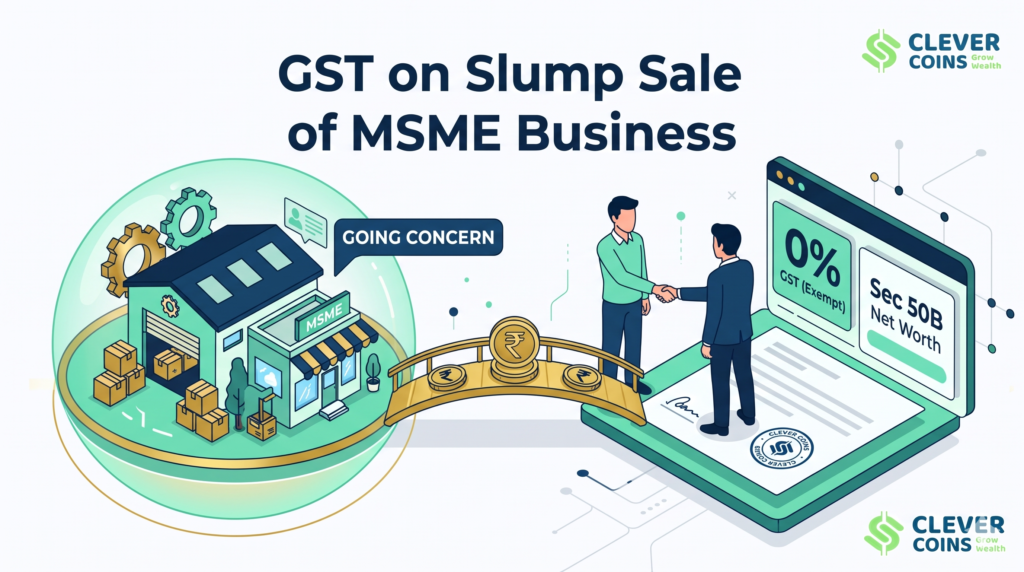
By structuring the transaction as a Slump Sale, you can legally achieve ₹0 GST liability, seamlessly transfer your unutilized Input Tax Credit (ITC) to the buyer, and optimize your Income Tax under Section 50B.
This guide breaks down every legal requirement, GST rule, Income Tax formula, and step-by-step numerical calculation you need to execute a tax-efficient slump sale of your MSME business.
What is a Slump Sale? (Legal Meaning & Core Conditions)
While the term “slump sale” is not explicitly defined inside the Central Goods and Services Tax (CGST) Act, 2017, tax authorities and Advance Ruling Authorities (AAR) rely on its well-established definition under Section 2(42C) of the Income-tax Act, 1961.
Under Section 2(42C), a slump sale means the transfer of one or more undertakings, by any means, for a lump-sum consideration without values being assigned to the individual assets and liabilities in such sales.
For an MSME transaction to legally qualify as a slump sale—and not get reclassified by tax officers as an itemized sale of goods—it must pass four strict legal tests:
Transfer of an “Undertaking” as a Whole: You must transfer an entire business, a standalone branch, a manufacturing unit, or an independent business division. Selling a pile of machines, a warehouse building, or leftover inventory without the operational apparatus does not qualify.
CAclubindia+ 1Going Concern Basis: The business unit being sold must be live, operational, and capable of being run independently by the buyer immediately after the transfer without major disruption.
CAclubindiaLump-Sum Consideration: The buyer and seller must agree on a single, composite price for the entire business unit.
CAclubindiaNo Item-Wise Pricing in the Agreement: Your Business Transfer Agreement (BTA) must not assign separate sale prices to individual assets (like ₹15 lakh for machinery, ₹10 lakh for stock, ₹5 lakh for goodwill). (Note: Assigning values solely to calculate stamp duty on immovable property or registration fees does not disqualify a slump sale, as clarified under Explanation 2 to Section 2(42C)).
CAclubindia
Slump Sale vs. Itemized Asset Sale: Why Structure Matters
Before signing a term sheet, compare how two different legal structures impact the exact same MSME exit:
| Comparison Parameter | Slump Sale (Going Concern) | Itemized Asset Sale |
|---|---|---|
| What is Sold? | Entire business undertaking or independent division as a running unit. | Individual assets (machinery, stock, computers, vehicles, goodwill). |
| Pricing Structure | Single lump-sum amount for the whole business. | Separate price assigned to every asset line item. |
| GST Applicability | Exempt (₹0 GST) under Entry No. 2 of Notification No. 12/2017-CT(Rate). | Taxable at individual HSN/SAC rates (typically 12%, 18%, or 28%). |
| Unutilized GST ITC | Can be transferred to the buyer via Form GST ITC-02. | Cannot be transferred; remains with seller or requires reversal. |
| Income Tax Computation | Special regime under Section 50B (Capital Gains on Net Worth). | Normal rules under Section 50 (Block of Assets) & Business Income on stock. |
| Tax Rate on Gains | 12.5% LTCG (if undertaking held > 36 months) without indexation, or slab/corporate rate if STCG. | Mostly taxed at slab/corporate rates (up to 30%+ surcharge) as short-term gain/business profit. |
GST on Slump Sale of an MSME Business
Many entrepreneurs assume that selling a business is completely outside the purview of GST. That is a dangerous misconception. Under GST law, a slump sale is a supply, but it is specifically exempted from paying tax if you follow the rules.
1. Is a Slump Sale a “Supply” Under GST?
Schedule II, Para 4(c) of the CGST Act, 2017: Normally, when a business owner stops carrying on business, all remaining business assets are deemed to be “supplied” and taxed under GST. However, Para 4(c)(i) carves out an explicit exception: “where the business is transferred as a going concern to another person”.
CAclubindia+ 1Supply of Service, Not Goods: Because an entire running enterprise is being transferred rather than individual physical goods, GST jurisprudence classifies the transfer of a going concern as a supply of service.
Wepsol
2. The ₹0 GST Exemption: Notification No. 12/2017-Central Tax (Rate)
Under Serial No. 2 of Notification No. 12/2017-Central Tax (Rate) dated June 28, 2017, the government grants a 100% exemption from GST for:
“Services by way of transfer of a going concern, as a whole or an independent part thereof.”
Because the rate is Nil (Exempt), you do not charge CGST, SGST, or IGST on the lump-sum consideration received from the buyer.
3. When Can GST Officers Deny the Exemption?
Tax authorities frequently scrutinize slump sales to ensure they are not disguised asset sales. Based on multiple Authority for Advance Rulings (AAR) decisions (such as M/s Rajashri Foods Pvt. Ltd. and SCV Sky Vision), your exemption can be rejected if:
The business was shut down before the sale: If your factory stopped production six months ago and you are simply selling off dormant machines and a shed, it is not a going concern.
Key operational assets are retained: If you sell the factory building and machines to Buyer A, sell the brand name to Buyer B, and keep the customer contracts yourself, no single buyer received an independent functioning business.
CAclubindiaImmediate resale: The buyer immediately liquidates the assets instead of continuing the business operations.
4. Critical Compliance: “Exempt Supply” vs. “Non-GST Supply”
A vital technical nuance every MSME accountant must remember is that a slump sale is an Exempt Supply, not a “Non-Supply”. This triggers three mandatory compliance actions:
Issuing a Bill of Supply: Do not issue a Tax Invoice. Issue a Bill of Supply under Section 31(3)(c) clearly stating: “Transfer of business undertaking as a going concern, exempt under Entry No. 2 of Notification No. 12/2017-Central Tax (Rate) dated 28.06.2017”.
CAclubindiaReporting in GST Returns: You must report the lump-sum sale value in Table 8 of GSTR-1 (Nil-rated, Exempted, and Non-GST supplies) and Table 5 of GSTR-3B.
Rule 42 / Rule 43 Common ITC Reversal: Because a slump sale is an exempt supply, any common input services used specifically to execute the slump sale (such as legal fees, valuation charges, or M&A advisory bills on which GST was charged) cannot be claimed as ITC, or proportionate reversal under Rule 42 may be triggered.
How to Transfer Unutilized Input Tax Credit (ITC) to the Buyer
Often, an MSME selling its business has ₹3 lakh, ₹10 lakh, or even ₹50 lakh sitting in its Electronic Credit Ledger on the GST portal. If you shut down your GSTIN without transferring this balance, that money is trapped forever.
Under Section 18(3) of the CGST Act, 2017, read with Rule 41 of the CGST Rules, 2017, you are legally allowed to transfer all unutilized ITC lying in your Electronic Credit Ledger to the buyer.
Step-by-Step Procedure to File Form GST ITC-02
Include a Liability Transfer Clause: Section 18(3) strictly requires that the business transfer happens “with the specific provisions for transfer of liabilities”. Ensure your Business Transfer Agreement explicitly states that liabilities of the undertaking are being transferred.
Wepsol+ 1Obtain a CA / CMA Certificate: Engage a practicing Chartered Accountant (CA) or Cost Accountant (CMA) to issue a formal certificate confirming that the transfer of business has been executed with a specific provision for the transfer of liabilities.
File Form GST ITC-02 on the GST Portal: Log into the seller’s GST portal, navigate to Services > Returns > ITC Forms > GST ITC-02, enter the buyer’s GSTIN, specify the exact CGST, SGST, IGST, and Cess amounts to be transferred, and upload the CA/CMA certificate.
Partial Transfer Formula (If Selling Only One Division): If your MSME has two units (e.g., Unit A in Thane and Unit B in Pune) and you only sell Unit A, Rule 41(1) mandates that ITC be apportioned in the ratio of the value of assets of the new unit to the total value of assets of the business (taking all assets into account, whether or not ITC was availed on them).
Buyer Acceptance: The buyer logs into their GST portal, reviews the ITC-02 filing, and clicks Accept. Once accepted, the entire credit instantly reflects in the buyer’s Electronic Credit Ledger, and the buyer must record the transferred inputs and capital goods in their books of account.
Wepsol
How to Calculate Income Tax on Slump Sale (Section 50B & Rule 11UAE)
While GST on a qualifying slump sale is ₹0, Income Tax is where the real financial calculation happens. Under Section 50B of the Income-tax Act, 1961, the entire business undertaking is treated as a single capital asset, and any profit arising from the transfer is taxed as Capital Gains.
The Master Capital Gains Formula
(Note: Unlike normal capital assets, no indexation benefit is available on the Net Worth of an undertaking under Section 50B, regardless of how many years you owned the business).
Step 1: Determine Full Value of Consideration (Rule 11UAE)
Following amendments introduced by the Finance Act, 2021, you cannot simply use whatever price is written in your contract if it is artificially undervalued. Under Rule 11UAE of the Income-tax Rules, 1962, the Full Value of Consideration is deemed to be the higher of FMV1 or FMV2 calculated on the date of the slump sale:
FMV1 (Fair Market Value of the Business Assets Transferred):
FMV1=A+B+C+D−L\text{FMV1} = A + B + C + D – LFMV1=A+B+C+D−LAAA: Book value of all other assets (excluding B, C, D below, and reducing advance tax/TDS paid net of refunds and unamortized deferred expenditure).
TaxGuruBBB: Open market value of jewellery and artistic work (based on a registered valuer’s report).
CCC: Fair market value of shares and securities (determined as per Rule 11UA).
DDD: Stamp duty value adopted by the government authority for any immovable property (land/building) transferred.
LLL: Book value of liabilities appearing in the balance sheet (excluding paid-up share capital, reserves and surplus, excess tax provisions, and unascertained/contingent liabilities).
FMV2 (Fair Market Value of the Consideration Received):
FMV2=E+F+G+H\text{FMV2} = E + F + G + HFMV2=E+F+G+HEEE: Total monetary consideration (cash/bank transfer) received or accruing.
TaxGuruFFF: Fair market value of non-monetary property received.
TaxGuruGGG: Fair market value of shares/securities received (if it’s a stock-and-cash deal).
TaxGuruHHH: Stamp duty value of any immovable property received as consideration.
TaxGuru
Whichever is higher (FMV1\text{FMV1}FMV1 or FMV2\text{FMV2}FMV2) becomes your Full Value of Consideration.
Step 2: Calculate “Net Worth” of the Undertaking (Cost of Acquisition)
Under Explanation 1 to Section 50B, the “Net Worth” of the business is deemed to be your Cost of Acquisition and Cost of Improvement. It is computed strictly as follows:
How each asset is valued for Net Worth:
Depreciable Assets (Plant, Machinery, Computers, Furniture, Building): Taken at their Written Down Value (WDV) as per Section 43(6)(c) of the Income-tax Act—not the book depreciation shown in your Companies Act balance sheet!
TaxGuruSelf-Generated Goodwill: Taken as Nil (₹0) (unless purchased, in which case WDV applies).
Section 35AD Specified Business Assets: Taken as Nil (₹0).
TaxGuruAll Other Assets (Land, Stock-in-Trade, Sundry Debtors, Cash/Bank, Loans & Advances): Taken at their Book Value.
TaxGuruRevaluation Reserve: Any upward revaluation of assets in your books must be completely ignored.
TaxGuru
(What if Net Worth is negative because liabilities exceed assets? Based on judicial precedents like DCIT v. Zuari Industries, negative net worth is taken as Nil (₹0) rather than being added to the sale price).
Step 3: Determine Holding Period & Applicable Tax Rate
Long-Term Capital Gains (LTCG): If the MSME undertaking has been owned and held by you for more than 36 months immediately preceding the date of transfer, the gain is taxed as LTCG. Under current Income Tax provisions (post-Finance Act 2024 rationalization), LTCG on slump sale is taxed at a flat rate of 12.5% (plus applicable surcharge and 4% Health & Education Cess).
Short-Term Capital Gains (STCG): If the undertaking was held for 36 months or less, the profit is taxed as STCG at your normal applicable income tax rate (e.g., 22% / 25% corporate rate for companies, or individual slab rates up to 30% for proprietors/firms).
Step 4: Mandatory Form 3CEA Audit Report
Every taxpayer executing a slump sale must obtain a report from a Chartered Accountant in Form No. 3CEA certifying the exact computation of Net Worth. This form must be filed electronically on the Income Tax e-filing portal at least one month prior to the due date for filing your Income Tax Return under Section 139(1).
Complete Numerical Case Study: MSME Slump Sale Tax Calculation
Let us walk through a realistic end-to-end calculation for an Indian MSME so you can see both GST and Income Tax working side by side.
Scenario Profile
Apex Precision Components (a proprietorship/company running for 5 years) is selling its entire manufacturing unit in Thane as a going concern to Nova Engineering Pvt. Ltd. for a lump-sum cash consideration of ₹2,50,00,000 (₹2.50 Crore).
Balance Sheet of the Undertaking on the Date of Transfer:
Freehold Land (Book Value): ₹40,00,000 (Current Stamp Duty Value = ₹65,00,000)
Factory Building & Machinery (Book Value): ₹55,00,000 (Income Tax WDV under Sec 43(6) = ₹48,00,000)
Inventory / Stock-in-Trade (Book Value): ₹32,00,000
Trade Receivables / Debtors (Book Value): ₹25,00,000
Revaluation Reserve on Land (credited 2 years ago): ₹15,00,000 (Note: Original cost of land was ₹25,00,000; book value was inflated to ₹40,00,000 via revaluation)
Unutilized GST Input Tax Credit (in Electronic Credit Ledger): ₹6,40,000
Trade Payables & Bank Term Loan Transferred: ₹30,00,000
Part A: GST Calculation & ITC Transfer
GST Output Liability: Since the entire manufacturing unit is transferred as a running going concern for a lump sum without item-wise asset pricing, it is covered under Entry No. 2 of Notification No. 12/2017-CT(Rate).
CAclubindiaGST Payable = ₹0 (Exempt).
(Had Apex sold these assets itemized instead of a slump sale, 18% GST on ₹48L machinery + ₹32L stock + goodwill would have exceeded ₹18,00,000+ in upfront GST cash outflow!)
ITC Transfer via Form GST ITC-02:
Because the ₹30,00,000 liabilities are transferred under the Business Transfer Agreement, Apex obtains a CA certificate and files Form GST ITC-02.
The entire ₹6,40,000 unutilized ITC moves directly into Nova Engineering Pvt. Ltd.’s Electronic Credit Ledger.
Part B: Income Tax Calculation under Section 50B & Rule 11UAE
1. Computing Fair Market Value (Rule 11UAE)
Calculating FMV1 (Value of Assets Transferred):
Non-immovable assets at Book Value (AAA): Inventory (₹32,00,000) + Debtors (₹25,00,000) + Building & Machinery book value (₹55,00,000) = ₹1,12,00,000
Immovable property at Stamp Duty Value (DDD): Land SDV = ₹65,00,000
Less Liabilities (LLL): ₹30,00,000
- FMV1=₹1,12,00,000+₹65,00,000−₹30,00,000=₹1,47,00,000\text{FMV1} = ₹1,12,00,000 + ₹65,00,000 – ₹30,00,000 = \mathbf{₹1,47,00,000}FMV1=₹1,12,00,000+₹65,00,000−₹30,00,000=₹1,47,00,000
Calculating FMV2 (Consideration Received):
Monetary consideration received (EEE) = ₹2,50,00,000
- FMV2=₹2,50,00,000\text{FMV2} = \mathbf{₹2,50,00,000}FMV2=₹2,50,00,000
Full Value of Consideration: Higher of FMV1 (₹1.47 Cr) or FMV2 (₹2.50 Cr) = ₹2,50,00,000.
2. Computing Net Worth (Section 50B)
Land: Original cost ignoring ₹15L revaluation = ₹25,00,000
Building & Machinery: Income Tax WDV = ₹48,00,000
Inventory: Book Value = ₹32,00,000
Trade Receivables: Book Value = ₹25,00,000
Aggregate Value of Assets: ₹25,00,000+₹48,00,000+₹32,00,000+₹25,00,000=₹1,30,00,000₹25,00,000 + ₹48,00,000 + ₹32,00,000 + ₹25,00,000 = \mathbf{₹1,30,00,000}₹25,00,000+₹48,00,000+₹32,00,000+₹25,00,000=₹1,30,00,000
Less: Liabilities Transferred: ₹30,00,000
- Net Worth=₹1,30,00,000−₹30,00,000=₹1,00,00,000\text{Net Worth} = ₹1,30,00,000 – ₹30,00,000 = \mathbf{₹1,00,00,000}Net Worth=₹1,30,00,000−₹30,00,000=₹1,00,00,000
3. Computing Capital Gains & Tax Payable
Long-Term Capital Gains (Holding period = 5 years > 36 months):
LTCG=₹2,50,00,000−₹1,00,00,000=₹1,50,00,000\text{LTCG} = ₹2,50,00,000 – ₹1,00,00,000 = \mathbf{₹1,50,00,000}LTCG=₹2,50,00,000−₹1,00,00,000=₹1,50,00,000Base LTCG Tax @ 12.5%: 12.5% of ₹1,50,00,000=₹18,75,00012.5\% \text{ of } ₹1,50,00,000 = \mathbf{₹18,75,000}12.5% of ₹1,50,00,000=₹18,75,000 (plus applicable surcharge and 4% cess).
Other Crucial Tax & Regulatory Impacts for MSMEs
1. Stamp Duty on Business Transfer Agreement (BTA)
While GST is ₹0, state Stamp Duty still applies. Stamp duty is a state subject (governed by laws such as the Maharashtra Stamp Act or Indian Stamp Act).
If the slump sale includes immovable property (land or factory building), stamp duty is levied on the conveyance deed based on the market/ready-reckoner value of the immovable property.
Movable assets (machinery, stock, debtors, goodwill) transferred by delivery of possession often attract much lower stamp duty if structured carefully—which is why state-specific BTA drafting is essential.
2. Carry Forward of Business Losses & Depreciation
Under Section 72 of the Income-tax Act, accumulated business losses and unabsorbed depreciation belong to the assessee (seller), not the undertaking. Therefore, in a slump sale (unlike an amalgamation under Section 72A), the buyer cannot carry forward the seller’s past business losses. However, the seller can continue setting off their own unabsorbed business losses against other business income if they retain another business vertical.
3. Year-of-Sale Depreciation Apportionment
Under the proviso to Section 32(1) of the Income-tax Act, total allowable depreciation for the financial year in which the slump sale occurs is apportioned between the seller and the buyer based on the exact number of days the assets were used by each party during that year.
4. MSME Udyam Registration & Past Dues
Udyam Registration is Non-Transferable: An Udyam Registration Number is tied to the PAN of the proprietor, partnership, or company. The buyer must obtain a fresh Udyam registration (or update their existing Udyam profile) to reflect the newly acquired plant, machinery, and turnover.
Section 43B(h) MSME Vendor Dues: If your MSME balance sheet has unpaid dues to Micro or Small suppliers exceeding 15/45 days on the date of transfer, ensure these are settled or explicitly accounted for in the BTA so neither party faces unexpected disallowances.
Pre-Sale Compliance Checklist for MSME Founders
Before signing the final Business Transfer Agreement, verify every item on this checklist:
Draft a watertight Business Transfer Agreement (BTA): Ensure a single lump-sum price is stated with no item-wise asset valuation in the contract clauses.
TaxGuruInclude a Specific Liability Transfer Clause: Mandatory to unlock ITC transfer under Section 18(3) and Rule 41.
Verify Going Concern Continuity: Keep operations, utilities, staff, and vendor contracts active right up to the closing date.
Obtain Registered Valuer & Stamp Duty Reports: Needed to compute FMV1 and FMV2 under Rule 11UAE accurately.
Issue a GST Bill of Supply: Cite Entry No. 2 of Notification No. 12/2017-CT(Rate) and report the value in GSTR-1 and GSTR-3B.
CAclubindiaFile Form GST ITC-02: Upload the CA/CMA certificate and ensure the buyer accepts the credit on the GST portal before you apply for GSTIN cancellation.
File Form 3CEA: Have your Chartered Accountant certify the Section 50B Net Worth calculation on the Income Tax portal at least 30 days before your ITR due date.
Frequently Asked Questions (FAQs)
1. Is GST applicable if I sell only one branch or factory of my MSME business?
No, provided that branch or factory is an independent business unit capable of operating on its own and is sold as a going concern for a lump sum. Entry No. 2 of Notification No. 12/2017-CT(Rate) explicitly exempts the transfer of a going concern “as a whole or an independent part thereof”.
2. Can I keep my factory land and sell only the running business (machinery, stock, brand, staff) as a slump sale?
Yes. Indian courts and Advance Ruling Authorities have held that retaining a single non-core asset—or leasing the factory premises to the buyer while transferring the entire operational undertaking, machinery, inventory, licenses, and employees—still qualifies as a slump sale as long as the buyer can run the business independently.
3. What happens if I sell my business via share transfer instead of a slump sale?
If your MSME is a Private Limited Company and you sell 100% of your equity shares to the buyer, the legal entity itself does not change—only the shareholders change. Shares are classified as “securities” (excluded from both goods and services under GST), so no GST applies, no ITC-02 transfer is needed, and you pay Capital Gains Tax on the sale of shares under Section 112/112A rather than Section 50B.
4. Do I need to cancel my GST registration after a slump sale?
If you sold your entire business and have no remaining business operations under that PAN, you must apply for cancellation of your GST registration in Form GST REG-16 within 30 days of the transfer—but only after filing Form GST ITC-02 and having the buyer accept your unutilized ITC. If you sold only one unit and still operate another unit, simply amend your registration to remove the sold branch’s address.
Planning to sell, restructure, or acquire an MSME business? Structuring the Business Transfer Agreement properly before signing can save lakhs in avoidable GST and Capital Gains tax. Reach out to CleverCoins for end-to-end slump sale structuring, Rule 11UAE valuation coordination, Form GST ITC-02 certification, and Form 3CEA tax audits.