Why GST on Vehicles Matters
When you walk into a car showroom or a two-wheeler dealership in India, the sticker price you see is rarely the final price you pay. Layered on top of the ex-showroom price are multiple charges — Goods and Services Tax (GST), GST Compensation Cess, road tax, registration charges, insurance, and dealer margins. Of all these, GST and Cess form the largest component after the vehicle’s base price.
India’s GST framework, introduced in July 2017 and continuously refined by the GST Council, applies a multi-tiered tax structure to motor vehicles depending on their type, engine size, fuel type, usage category, and body type. A small petrol hatchback, a luxury SUV, a diesel commercial truck, and a modest 100cc two-wheeler — each attracts a different rate of GST and cess. Understanding this structure is critical whether you are a buyer, seller, dealer, fleet operator, or GST-registered business.
In this comprehensive 2026 guide, we break down every relevant GST rate, cess structure, Input Tax Credit (ITC) eligibility, state-level charges, recent GST Council decisions, and real-world tax calculation examples — all updated to reflect the latest notifications and circulars from CBIC and the 54th GST Council meeting outcomes.
🚗 Section 1: GST Structure on Motor Vehicles — The Framework
1.1 HSN Classification of Vehicles under GST
Under the Harmonized System of Nomenclature (HSN) codes used in GST, motor vehicles are classified under Chapter 87. The key HSN codes relevant to vehicle taxation are:
HSN Code | Description | Examples |
8703 | Motor cars & vehicles for persons | Hatchbacks, Sedans, SUVs, EVs |
8704 | Motor vehicles for goods transport | Trucks, Lorries, Pick-up vans |
8705 | Special purpose motor vehicles | Ambulances, Fire trucks, Cranes |
8706 | Chassis with engines | Truck chassis, Bus chassis |
8711 | Motorcycles & Mopeds | Bikes, Scooters, Mopeds |
8712 | Bicycles & cycles | Pedal cycles (non-GST slab) |
8716 | Trailers & semi-trailers | Agricultural/industrial trailers |
1.2 The Two-Part Tax: GST + Compensation Cess
Vehicles in India attract two components of indirect tax under the GST regime:
- GST: Charged at 5%, 12%, or 28% depending on the vehicle category
- GST Compensation Cess: An additional levy ranging from 1% to 22% (or even higher for some luxury vehicles), imposed under the GST (Compensation to States) Act, 2017
- Effective Total Tax = GST Rate + Compensation Cess Rate
The Compensation Cess was originally introduced to compensate states for revenue loss during the GST transition (2017–2022). However, the GST Council extended the cess levy beyond 2022 to repay cess-backed borrowings, and it continues to apply on vehicles as of 2026. The GST Council reviews cess rates periodically.
🚙 Section 2: GST Rates on Cars — Detailed Breakdown
2.1 Small Cars (Petrol Engine up to 1200cc, Length up to 4000mm)
This category covers the most popular budget and entry-level hatchback cars in India — vehicles like the Maruti Wagon R, Hyundai Grand i10 Nios, Tata Tiago, and similar models.
Tax Component | Rate |
GST | 28% |
Compensation Cess | 1% |
Total Effective Tax | 29% |
Example Calculation: If the ex-showroom base price of a petrol hatchback is ₹5,00,000:
- GST @ 28% = ₹1,40,000
- Cess @ 1% = ₹5,000
- Total Tax = ₹1,45,000
- Ex-showroom Price (incl. GST+Cess) = ₹6,45,000
2.2 Small Cars (Diesel Engine up to 1500cc, Length up to 4000mm)
Tax Component | Rate |
GST | 28% |
Compensation Cess | 3% |
Total Effective Tax | 31% |
Diesel small cars attract a slightly higher cess due to environmental considerations. Cars like the Maruti Swift Diesel (discontinued post BS6 but relevant for pre-owned) or Tata Altroz Diesel fall in this zone.
2.3 Mid-Size & Large Cars (Petrol above 1200cc or Diesel above 1500cc, Length above 4000mm)
Tax Component | Rate |
GST | 28% |
Compensation Cess | 15% |
Total Effective Tax | 43% |
This is the high-volume mid-size car and compact SUV segment. Models like the Hyundai Creta, Kia Seltos, Maruti Grand Vitara, Tata Nexon (above 4m), and Honda City fall here. The 43% effective rate means on a ₹12,00,000 base price car, the total tax burden is approximately ₹5,16,000.
2.4 Luxury & Premium Cars (SUVs above 4000mm, Engine above 1500cc)
Tax Component | Rate |
GST | 28% |
Compensation Cess | 20% to 22% |
Total Effective Tax | 48% to 50% |
This covers premium and luxury SUVs such as Toyota Fortuner, MG Gloster, Mahindra XUV700 (top variants), BMW X1, Mercedes GLA, Audi Q3, and similar. A luxury SUV priced at ₹50,00,000 ex-showroom would carry a tax burden of approximately ₹24,00,000–₹25,00,000 in GST+Cess.
2.5 GST on SUVs — Special Rules and Council Clarifications
The GST Council has issued specific clarifications on what constitutes an SUV for cess purposes. As per CBIC Circular, a vehicle qualifies as an SUV attracting 22% cess when ALL of the following conditions are met:
- Engine capacity exceeds 1500cc
- Overall length exceeds 4000mm
- Ground clearance (unladen) is 170mm or above
This definition created interesting classification disputes — for example, the Tata Nexon and certain MG Astor variants fall just below the SUV threshold, while the Hyundai Creta in higher variants crosses it. CBIC has clarified via advance rulings that the cess is applied based on technical specifications as certified by the manufacturer, not the marketing label.
2.6 Comprehensive GST Rate Summary for Cars (2026)
Category | GST | Cess | Total Tax |
Petrol car ≤1200cc, ≤4000mm | 28% | 1% | 29% |
Diesel car ≤1500cc, ≤4000mm | 28% | 3% | 31% |
Petrol/Diesel car >4000mm (mid-size) | 28% | 15% | 43% |
SUV >1500cc, >4000mm, GC≥170mm | 28% | 22% | 50% |
Hybrid Cars (mild hybrid) | 28% | 15% | 43% |
Strong Hybrid (HEV) | 28% | 15% | 43% |
Electric Vehicles (BEV) | 5% | Nil | 5% |
⚡ Section 3: GST on Electric Vehicles (EVs) — 2026 Status
3.1 EV GST Rate — The Big Incentive
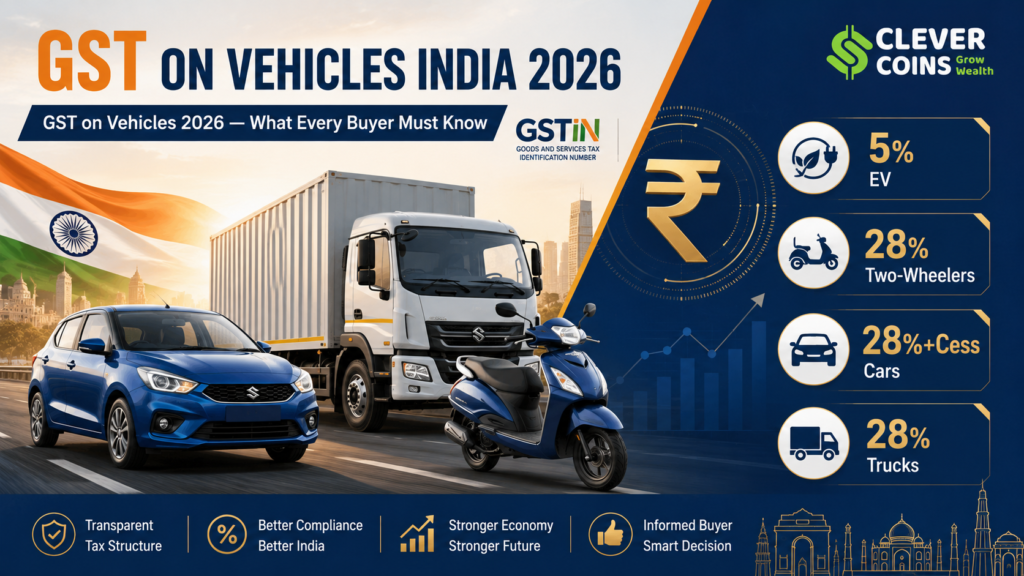
Electric vehicles enjoy the most favourable GST treatment in India’s vehicle tax framework. The GST rate on EVs — whether two-wheelers, three-wheelers, or four-wheelers — is just 5%, with zero Compensation Cess. This massive difference compared to 28–50% on ICE vehicles was a deliberate policy decision to accelerate EV adoption in India.
3.2 What Qualifies as an Electric Vehicle for GST Purposes?
As per CBIC notifications and clarifications, the following are treated as EVs for 5% GST:
- Battery Electric Vehicles (BEVs) — vehicles that run entirely on electric power with no internal combustion engine
- Electric two-wheelers and three-wheelers — Ola S1, Ather 450X, TVS iQube, Bajaj Chetak, etc.
- Electric four-wheelers — Tata Nexon EV, Tata Punch EV, MG ZS EV, Hyundai Ioniq 5, BYD Atto 3, Mahindra BE 6, etc.
- Electric buses and commercial vehicles used for public transport or goods
Note: Mild hybrids and strong hybrids (HEVs like Toyota Camry Hybrid, Maruti Grand Vitara Hybrid) do NOT qualify for the 5% EV GST rate — they attract 28% GST + 15% cess = 43%.
3.3 GST on EV Chargers and Charging Infrastructure
EV chargers attract 18% GST (HSN 8504), while charging stations as a service attract 5% GST. The CBIC has clarified that installation charges for EV chargers attract 18% GST when billed separately. This is an area the government is expected to review in upcoming GST Council meetings.
3.4 State EV Policies and Additional Incentives (2026)
Beyond GST, several Indian states offer additional EV incentives that further reduce the total on-road cost:
- Delhi: Road tax exemption + subsidy of up to ₹1,50,000 on EV two-wheelers and ₹3,50,000 on four-wheelers under the Delhi EV Policy 2.0
- Maharashtra: Road tax waiver on EVs and purchase subsidy of up to ₹1,00,000 on commercial EVs
- Gujarat: 50% road tax exemption on EVs registered in the state
- Tamil Nadu: FAME-III aligned subsidy for EV two-wheelers and commercial vehicles
🛵 Section 4: GST on Two-Wheelers — Motorcycles, Scooters & Mopeds
4.1 Standard GST Rate on Two-Wheelers
Two-wheelers (HSN 8711) attract GST at 28% across all engine capacities. However, the Compensation Cess structure varies based on engine size:
Two-Wheeler Category | GST | Cess | Total |
Engine capacity up to 350cc | 28% | Nil | 28% |
Engine capacity above 350cc | 28% | 3% | 31% |
Electric Two-Wheelers (BEV) | 5% | Nil | 5% |
4.2 Examples of Popular Two-Wheeler Models & Tax Impact
Let’s look at approximate base prices and their GST impact for popular 2026 models:
Model | Engine | Base Price | GST+Cess | Ex-Showroom* |
Honda Activa 6G | 110cc | ₹70,000 | 28% = ₹19,600 | ~₹89,600 |
Royal Enfield Classic 350 | 350cc | ₹1,80,000 | 28% = ₹50,400 | ~₹2,30,400 |
Royal Enfield Himalayan 450 | 452cc | ₹2,50,000 | 31% = ₹77,500 | ~₹3,27,500 |
KTM Duke 390 | 399cc | ₹2,90,000 | 31% = ₹89,900 | ~₹3,79,900 |
Ola S1 Pro (Electric) | EV | ₹1,30,000 | 5% = ₹6,500 | ~₹1,36,500 |
*Approximate figures for illustration. Actual ex-showroom prices include additional dealer charges. Road tax and registration are charged separately by state RTOs.
4.3 Two-Wheeler Accessories & Spare Parts GST
Beyond the vehicle, two-wheeler related items attract GST as follows:
- Helmets (ISI certified): 5% GST — a deliberate reduction from 18% to encourage safety compliance
- Motorcycle parts & accessories (handlebar grips, mirrors, etc.): 28% GST
- Tyres for two-wheelers: 28% GST
- Engine oil & lubricants: 18% GST
- Safety gear (jackets, gloves): 12% GST
🚛 Section 5: GST on Commercial Vehicles — Trucks, Tempos & Buses
5.1 GST on Goods Transport Vehicles (Trucks & Lorries)
Commercial vehicles used for transporting goods — covered under HSN 8704 — enjoy significantly lower GST rates compared to personal vehicles. This is a deliberate policy to reduce logistics costs in India and support the transportation sector.
Vehicle Type | GST Rate |
Trucks / Lorries (goods transport) | 28% |
Mini trucks / Light commercial vehicles (LCVs) | 28% |
Refrigerated vans / Specialised cargo vehicles | 28% |
Three-wheeler cargo (auto-rickshaw type) | 12% |
Electric commercial vehicles (goods) | 5% |
Note: While GST on trucks is 28%, there is NO Compensation Cess on commercial goods transport vehicles. This effectively makes their total GST burden lower (28% flat) compared to luxury passenger cars (28% + 22% cess = 50%).
5.2 GST on Buses & Passenger Transport Vehicles
Vehicle Type | GST Rate |
Buses with seating capacity >13 persons | 28% |
Electric buses (for public transport) | 5% |
School buses / Hospital ambulances | 28% (ITC eligible for operator) |
Ambulances | 12% |
5.3 GST on Three-Wheelers (Auto-Rickshaws)
Category | GST Rate |
Petrol/CNG Auto-Rickshaw (passenger) | 28% |
Diesel Three-Wheeler (goods) | 12% |
Electric Three-Wheeler (passenger/goods) | 5% |
5.4 GST on Tractors and Agricultural Vehicles
Tractors enjoy a concessional GST rate as they are essential to Indian agriculture:
- Tractors (with or without attachments): 12% GST
- Agricultural trailers & trolleys: 12% GST
- Combine harvesters: 12% GST
- Rotavators, soil-tilling machinery: 12% GST
🏎️ Section 6: GST on Special Categories of Vehicles
6.1 GST on Used / Second-Hand Vehicles
The GST treatment of used vehicles is completely different from new vehicles. For used vehicles, GST is levied on the MARGIN (difference between buying and selling price) for registered dealers, not on the total transaction value.
- If a registered used car dealer buys a car for ₹4,00,000 and sells it for ₹5,00,000 — GST applies only on the ₹1,00,000 margin
- GST on margin for small cars (petrol ≤1200cc, ≤4000mm): 12%
- GST on margin for mid-size and large cars: 18%
- GST on margin for SUVs and luxury vehicles: 18%
- If the dealer has sold the car at a LOSS (margin is negative), no GST is payable
For individuals selling their personal used vehicle (non-business sale), NO GST is applicable — as individuals are not registered businesses.
6.2 GST on Imported Vehicles
Imported vehicles attract both Customs Duty and GST. The layered tax structure makes importing premium vehicles extremely expensive in India:
- Basic Customs Duty (BCD): 60% to 100% depending on engine size and CIF value
- Social Welfare Surcharge: 10% on BCD
- IGST (Integrated GST): 28% + applicable cess on the CIF + Duties value
For a luxury SUV imported at CIF value of ₹60,00,000, total taxes (BCD + IGST + Cess) can push the landed cost to ₹1,20,00,000–₹1,50,00,000 — more than double the base price. This is why globally priced vehicles like Ferrari, Lamborghini, and Rolls Royce are dramatically more expensive in India.
6.3 GST on Ambulances
Ambulances attract 12% GST, reduced from 28% to support healthcare infrastructure. Hospitals and emergency service providers who are GST-registered can claim ITC on ambulance purchases used for providing taxable healthcare services.
6.4 GST on Vintage & Classic Cars
Vintage cars (typically over 25 years old) fall under HSN 9705 as collectibles/antiques in some interpretations, but CBIC has generally treated them under standard vehicle HSN codes. Their sale by collectors may attract GST depending on whether the seller is a registered taxable person. Advance ruling applications have yielded mixed results on this category.
📋 Section 7: Input Tax Credit (ITC) on Vehicle Purchases
7.1 The General Rule — ITC Blocked on Most Vehicles
This is perhaps the most important — and commonly misunderstood — aspect of GST on vehicles for businesses. Section 17(5) of the CGST Act, 2017 BLOCKS Input Tax Credit on motor vehicles in most circumstances. This means businesses CANNOT claim back the GST paid on vehicle purchases against their GST output liability.
7.2 When is ITC Allowed on Vehicles?
There are specific exceptions where ITC IS permitted on motor vehicle purchases:
- Vehicles used for SUPPLY of motor vehicles (car dealers, distributors) — ITC allowed on stock-in-trade
- Vehicles used for transportation of goods — trucks, lorries, delivery vans used in the course of business
- Vehicles used for transportation of passengers — if the business is licensed for this purpose (taxi companies, bus operators)
- Vehicles used for imparting training on driving, flying, navigating — driving schools
- Motor vehicles used for demonstration purposes by authorised dealers
For ALL other businesses — a construction company buying a fleet car for executives, an IT company providing car lease to employees, a manufacturer buying a car for the MD — ITC is BLOCKED. The GST paid on such purchases is a cost.
7.3 ITC on Rented/Leased Vehicles (Important 2026 Update)
A key area of dispute is GST ITC on vehicle leasing/renting. Post the 2023 GST Council clarifications and various AAR rulings:
- ITC on rented/leased cars for general business use — BLOCKED
- ITC on rented vehicles for transporting employees as a mandatory obligation (statutory requirement) — ALLOWED
- ITC for cab services used for employee transport where it’s a documented company policy — SUBJECT TO AAR RULINGS (varies by state)
7.4 ITC on Vehicle Repairs, Insurance & Maintenance
Even when ITC is blocked on the vehicle purchase itself, the treatment of related expenses is nuanced:
- Vehicle insurance: ITC BLOCKED if ITC on vehicle is blocked
- Fuel costs: ITC on petrol and diesel — ALWAYS BLOCKED under GST (petroleum products outside GST)
- Vehicle repairs & maintenance: ITC BLOCKED if the underlying vehicle ITC is blocked
- Tyres & spare parts used in vehicle manufacture or by authorised service centres — ITC ALLOWED
🏛️ Section 8: GST on Vehicle Services — Beyond the Purchase
8.1 GST on Vehicle Insurance
Service Type | GST Rate |
Motor Vehicle Insurance (Third Party/Comprehensive) | 18% |
Vehicle loan processing fees | 18% |
Vehicle EMI (principal portion) | Not applicable (exempt) |
8.2 GST on Vehicle Servicing & Repair
Service Type | GST Rate |
Authorised service centre charges (labour) | 18% |
Spare parts used in servicing | 18% / 28% (varies by part) |
Car washing / detailing services | 18% |
Body repair / painting | 18% |
Roadside assistance / breakdown service | 18% |
8.3 GST on Driving Services / Cab Aggregators
Service | GST Rate / Note |
Cab services via Ola/Uber (metered rides) | 5% GST (no ITC for driver) |
AC bus services by aggregators | 5% GST |
Rent-a-car (self-drive, non-AC) | 5% GST |
Rent-a-car (with driver, AC) | 12% GST |
Luxury cab / chauffeur services | 18% GST |
8.4 GST on Vehicle Leasing (Operating vs Financial Lease)
Vehicle leasing is a growing market in India with companies opting for fleet leasing instead of ownership. GST treatment differs between:
- Operating Lease (vehicle rented for use, ownership stays with lessor): 18% GST on monthly lease rentals
- Financial Lease (similar to hire-purchase, economic ownership transfers): 28% + cess GST on the vehicle value at the time of lease commencement
- EMI on car loans from NBFCs — the finance charge (interest) is exempt from GST; processing fee and other charges attract 18%
🔢 Section 9: Real-World GST Calculations — Worked Examples
Example 1: Buying a Maruti Baleno Petrol (Petrol, 1197cc, 3.99m length)
Category: Petrol car ≤1200cc, ≤4000mm → GST 28%, Cess 1%
- Manufacturer’s base price (ex-works): ₹7,00,000
- GST @ 28%: ₹1,96,000
- Cess @ 1%: ₹7,000
- Ex-showroom Price: ₹9,03,000
- Road Tax (Delhi, approx. 4%): ₹36,120
- Registration & Handling: ~₹15,000
- Insurance (first year, comprehensive): ~₹25,000
- On-Road Price (approx.): ₹9,79,120
Example 2: Buying a Hyundai Creta Petrol 1.5L Turbo (4300mm length)
Category: Petrol >1200cc, >4000mm → GST 28%, Cess 15%
- Base price: ₹18,00,000
- GST @ 28%: ₹5,04,000
- Cess @ 15%: ₹2,70,000
- Ex-showroom Price: ₹25,74,000
- Road Tax + Registration: ~₹1,80,000
- Insurance: ~₹60,000
- On-Road Price (approx.): ₹28,14,000
Example 3: Buying a Tata Nexon EV (Electric SUV)
Category: Electric Vehicle → GST 5%, Cess Nil
- Base price: ₹14,00,000
- GST @ 5%: ₹70,000
- Cess: ₹0
- Ex-showroom Price: ₹14,70,000
- Road Tax (many states waiver): ₹0 (Delhi/Maharashtra)
- Registration: ~₹10,000
- Insurance: ~₹40,000
- On-Road Price (approx.): ₹15,20,000
Comparison: The same ₹14,00,000 ICE mid-size car would pay ₹6,02,000 in GST+Cess (43%). The EV saves ₹5,32,000 in taxes alone — a compelling case for EV adoption.
Example 4: Truck Purchase for a Fleet Operator
Category: Goods Transport Vehicle → GST 28%, No Cess, ITC allowed
- Truck base price: ₹25,00,000
- GST @ 28%: ₹7,00,000
- Total payable: ₹32,00,000
- ITC claim (if truck used for taxable supply of transport service): ₹7,00,000
- Net effective cost after ITC: ₹25,00,000
This is why ITC availability is a critical factor for commercial vehicle buyers — it effectively means the GST cost is recovered through business operations.
⚖️ Section 10: Key GST Council Decisions on Vehicles — 2023 to 2026
53rd GST Council Meeting (June 2024) — Key Vehicle Decisions
- Clarification issued: Ground clearance of 170mm for SUV classification to be measured as ‘unladen ground clearance’ per ARAI/iCAT certification — not loaded vehicle clearance
- Ambulance GST maintained at 12% — proposal to reduce to 5% deferred for review
- Electric bus GST for state transport undertakings confirmed at 5%
54th GST Council Meeting (September 2024) — Updates
- Clarification on car seat classification: Detachable car seats sold separately attract 18% GST (not 28% as charged incorrectly by some manufacturers)
- Advance ruling on SUV cess for hybrid vehicles: Strong hybrids above 4000mm, above 1500cc engine, with ground clearance 170mm+ confirmed at 22% cess
- Review of EV charger GST (18%) referred to fitment committee
2025 Budget & GST Notifications
- GST compensation cess timeline: Extended through March 2026 to repay cess-backed IGST borrowings from COVID period
- FAME-III scheme (Faster Adoption and Manufacturing of EVs): Subsidies aligned with GST-paid input costs — EV manufacturers can claim production-linked benefits
- Import duty reduction on certain EV components (cells, chargers) to support domestic EV manufacturing
2026 Expectations & Pending Reviews
- The GST Council is reviewing whether strong hybrid vehicles (like Toyota Innova HyCross, Maruti Invicto, Camry Hybrid) should get concessional GST/cess treatment — currently at 43%, industry demands reduction to 12-18%
- Proposal to bring petrol and diesel under GST is being debated — currently outside GST — this would significantly change vehicle running cost calculations
- Review of cess on CNG vehicles is pending — currently treated same as petrol vehicles
📑 Section 11: GST Compliance for Vehicle Dealers & Businesses
11.1 GST Registration for Vehicle Dealers
Authorised vehicle dealers (for both 4-wheelers and 2-wheelers) are typically registered under GST. Key compliance requirements include:
- Monthly/Quarterly GSTR-1 filing for outward supplies
- GSTR-3B for net GST payment and ITC reconciliation
- HSN-wise reporting of vehicle sales mandatorily from FY 2024-25
- Annual GSTR-9 reconciliation
- E-invoicing mandatory for dealers with turnover above ₹5 crore (CBIC notification 2023)
11.2 E-Way Bill for Vehicle Transport
- E-Way Bill mandatory for transporting vehicles with value above ₹50,000
- For vehicles moved on their own wheels (own movement), special E-Way bill provisions apply — vehicle number can be updated after generation
- Transit time for vehicle transport E-Way bills is based on distance — 100km per day standard
- Violation of E-Way bill rules for vehicles attracts penalty of ₹10,000 or tax amount, whichever is higher
11.3 TCS on Vehicle Sale above ₹10 Lakh (Income Tax – not GST)
While not a GST provision, buyers and dealers should be aware that under Section 206C of the Income Tax Act, the seller must collect Tax Collected at Source (TCS) at 1% on sale of motor vehicles above ₹10,00,000. This is separate from GST and is an income tax compliance requirement. TCS is adjustable against the buyer’s income tax liability.
🔍 Section 12: State-Level Road Tax vs GST — Understanding Both
A common confusion among vehicle buyers is the relationship between GST and Road Tax / Vehicle Registration charges. It is important to understand:
- GST is levied by the Central Government (and shared with states) on the SALE/SUPPLY of the vehicle
- Road Tax is levied by the STATE GOVERNMENT on the REGISTRATION of the vehicle with the RTO (Regional Transport Office)
- Both are charged separately — paying GST does NOT exempt you from road tax
Road tax rates vary significantly by state:
State | Road Tax (Cars) | EV Road Tax |
Delhi | 4% to 12% (based on cost) | Nil (exempted) |
Maharashtra | 7% to 9% | Nil / 50% waiver |
Karnataka | 13% to 18% | Nil (up to 2026) |
Tamil Nadu | 10% to 15% | 50% waiver |
Gujarat | 6% | Nil |
Rajasthan | 6% to 10% | Nil |