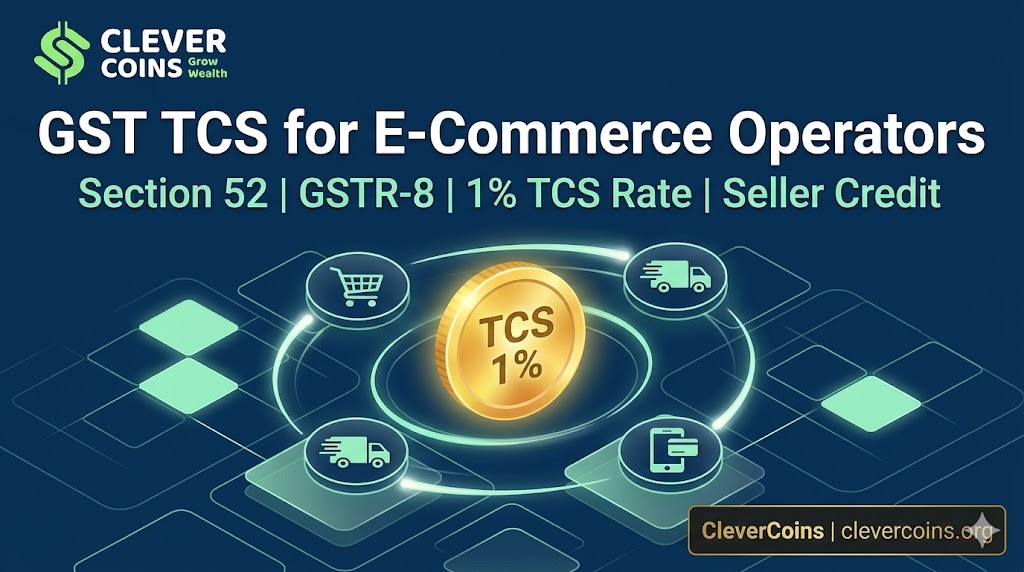
If you run an e-commerce marketplace in India — or if you sell products through one — the GST Tax Collected at Source (TCS) provisions under Section 52 of the CGST Act are something you absolutely cannot afford to ignore. This comprehensive guide breaks down every single aspect of GST TCS for e-commerce operators: what it is, who it applies to, the current rate, how to deposit and file it, and how sellers can claim credit for TCS deducted.
|
1. What Is GST TCS? — The Basic Concept
Tax Collected at Source (TCS) under GST is a mechanism introduced under Section 52 of the Central Goods and Services Tax (CGST) Act, 2017. Under this provision, every e-commerce operator that facilitates the supply of goods or services by other suppliers (sellers) through its digital platform is required to:
- Collect a specified percentage of the net value of taxable supplies made through its platform as TCS.
- Deposit the collected TCS amount with the government within the prescribed time.
- File a monthly statement of such TCS collections.
In simple terms: when a seller makes a sale of Rs 10,000 through an e-commerce platform like Amazon India, Flipkart, or Meesho, the platform deducts a small percentage (currently 1% of net taxable value) as TCS before paying out the sale proceeds to the seller. The platform then deposits this TCS amount to the government on the seller’s behalf.
Key Distinction — TCS vs TDS Under GST: TCS under Section 52 is for e-commerce operators. TDS under Section 51 is for government entities and certain notified persons. Do not confuse the two — they apply to completely different situations and have different rate structures, forms, and compliance requirements. |
2. Legal Basis — Section 52 of CGST Act, 2017
The legal foundation for GST TCS on e-commerce is contained in Section 52 of the CGST Act, 2017. Key sub-sections are:
Section 52(1): Every electronic commerce operator (not being an agent) shall collect an amount at the rate of one per cent (0.5% CGST + 0.5% SGST, or 1% IGST) of the net value of taxable supplies made through it by other suppliers where the consideration with respect to such supplies is to be collected by the operator.
Section 52(3): The amount so collected shall be paid to the Government by the operator within 10 days after the end of the month in which such collection was made.
Section 52(4): Every operator who collects the amount shall furnish a statement, electronically, containing the details of outward supplies of goods or services or both effected through it, including the supplies of goods or services or both returned through it, and the amount collected under this section, in Form GSTR-8. |
3. Who Is an E-Commerce Operator Under GST?
An ‘Electronic Commerce Operator’ (ECO) is defined under Section 2(45) of the CGST Act as any person who owns, operates, or manages a digital or electronic facility or platform for electronic commerce.
Examples of E-Commerce Operators in India
- Product Marketplaces: Amazon India, Flipkart, Meesho, Snapdeal, Myntra, Nykaa, Ajio.
- Food Delivery Platforms: Zomato, Swiggy (who collect consideration on behalf of restaurant partners).
- Travel Booking Platforms: MakeMyTrip, Cleartrip, Yatra, ixigo (collecting for hotels and service providers).
- Ride-Hailing and Mobility Platforms: Ola, Uber (collecting fares on behalf of driver-partners).
- Hotel Aggregators: OYO Rooms, Treebo (when they collect consideration on behalf of hotel partners).
- Freelancer and Services Marketplaces: Urban Company (collecting for service professionals).
- Hyperlocal Delivery Platforms: Blinkit, Zepto (when goods are supplied by third-party sellers).
Who Is NOT Covered as an ECO? A business that sells its OWN goods or services through its own website (e.g., a brand selling directly to consumers on its own platform) is NOT an ECO for the purposes of Section 52. TCS provisions apply only when the platform facilitates transactions of THIRD-PARTY sellers through it. |
4. Who Is a Supplier for E-Commerce TCS Purposes?
The ‘supplier’ in the context of GST TCS is any person or entity that sells goods or provides services through the e-commerce operator’s platform. Examples include:
- Individual sellers listing products on Amazon, Flipkart, or Meesho.
- Restaurants listed on Zomato or Swiggy.
- Hotels listed on MakeMyTrip, OYO, or Cleartrip.
- Cab drivers registered on Ola or Uber.
- Service professionals listed on Urban Company.
- Artisans, craftspeople, and small businesses selling on ONDC-connected platforms.
These suppliers must be GST-registered. If a supplier is not GST-registered, the e-commerce operator is required to collect TCS and the unregistered supplier is not entitled to any TCS credit.
5. Current GST TCS Rate Under Section 52
Nature of Supply | CGST TCS Rate | SGST/UTGST TCS Rate | IGST TCS Rate |
Intra-State Supply (Seller & Buyer in same state) | 0.5% | 0.5% | Not Applicable |
Inter-State Supply (Seller & Buyer in different states) | Not Applicable | Not Applicable | 1% |
Total Effective Rate | 0.5% CGST | 0.5% SGST | = 1% of Net Taxable Value |
Historical Note — Rate Reduction: The GST TCS rate was originally set at 1% (0.5% CGST + 0.5% SGST/IGST at 1%). The government temporarily reduced the rate to 0.5% (0.25% CGST + 0.25% SGST / 0.5% IGST) during 2020-21 as a COVID-19 relief measure. This was later restored to 1% effective 1 October 2023. Always verify the current rate with the latest GST council notifications. |
6. What Is ‘Net Value of Taxable Supplies’?
The GST TCS is not collected on the entire transaction value — it is collected on the ‘net value of taxable supplies’. This is defined in the Explanation to Section 52 as:
Net Value of Taxable Supplies = Aggregate value of taxable supplies of goods or services made during any month by all registered suppliers through the ECO MINUS Aggregate value of taxable supplies returned to the suppliers during the said month |
Key points about Net Value calculation:
- TCS is on the TAXABLE VALUE — i.e., the value BEFORE GST. GST itself is not included in the base for TCS calculation.
- Exempt supplies are NOT included in net taxable value.
- Returns of goods during the month REDUCE the net taxable value, thus reducing TCS liability.
- Cancelled orders where consideration is returned are also deducted from net taxable value.
Practical Example: Seller A makes sales of Rs 5,00,000 on Amazon India during June 2025. Returns during June are Rs 50,000. Net Taxable Value = Rs 4,50,000. TCS to be deducted by Amazon = 1% × Rs 4,50,000 = Rs 4,500. Amazon deposits Rs 4,500 to the government and credits it to Seller A’s Electronic Cash Ledger. |
7. GST Registration for E-Commerce Operators
Every e-commerce operator is mandatorily required to obtain GST registration under Section 24 of the CGST Act, 2017, regardless of their annual turnover. The threshold limit exemptions do NOT apply to e-commerce operators.
- An ECO must register in EVERY state where it facilitates supplies — it cannot operate on a single centralised registration for the entire country in most cases.
- The ECO must file a separate registration in each state under the state’s SGST / CGST Act.
- No threshold limit — even a startup ECO with zero revenue must register before commencing operations.
- Registration is required even if the ECO is not itself making any taxable supply — the mere act of facilitating third-party supplies triggers registration.
GST Registration for Suppliers on E-Commerce Platforms
- Suppliers making supplies THROUGH an e-commerce operator are also mandatorily required to obtain GST registration under Section 24(ix) — irrespective of turnover.
- This means even a small individual seller selling Rs 5 lakh worth of goods on Flipkart must be GST-registered.
- However, suppliers of notified services (e.g., transport of passengers by radio-taxi, housekeeping services) are exempt from this compulsory registration requirement under a specific government notification.
Critical Compliance Alert: Many small sellers on e-commerce platforms are unaware of the mandatory GST registration requirement. Selling on Flipkart, Amazon, or Meesho without GST registration is a violation of GST law, regardless of your turnover. This attracts penalties up to 100% of the tax amount or Rs 10,000, whichever is higher. Get registered before you start selling. |
8. TCS Deposit — Due Dates and Payment Process
The e-commerce operator must deposit the collected TCS amount with the government within a strict timeline:
Compliance | Due Date | Form / Mode |
Deposit TCS with Government | Within 10 days after the end of the month in which TCS was collected | PMT-06 / Electronic payment on GST portal |
File Monthly TCS Return | By 10th of the following month | GSTR-8 |
Annual Statement (if applicable) | December 31 of following financial year | Section 52(5) Annual Statement |
Matching with Supplier’s GSTR-1 | Auto-populated after GSTR-8 filing | System auto-reflects in GSTR-2A of supplier |
Example: TCS collected during June 2025 must be deposited by 10 July 2025 and GSTR-8 for June 2025 must be filed by 10 July 2025.
9. GSTR-8: The TCS Return for E-Commerce Operators
GSTR-8 is the monthly GST return that every e-commerce operator must file. It is different from GSTR-1, GSTR-3B, or any other return. Here is a detailed breakdown of GSTR-8:
Key Details to be Reported in GSTR-8
- Table 3: Details of all supplies made through the ECO by registered suppliers — including GSTIN of supplier, net taxable value, and TCS collected.
- Table 4: Details of all supplies made through the ECO by unregistered suppliers — gross value only, no TCS credit applicable to them.
- Table 5: Amendments to earlier filed GSTR-8 (corrections or modifications to previously reported data).
- Table 6: Interest, fees, and any other amount payable and paid.
Process to File GSTR-8
- Log in to www.gst.gov.in with ECO’s GSTIN credentials.
- Navigate to Returns > GSTR-8.
- Select the tax period (month and year).
- Enter supplier-wise details — GSTIN, taxable value of supplies, and TCS amount collected.
- Upload the statement if filing for a large number of suppliers (offline utility available).
- Preview the return and verify all figures.
- Pay the TCS liability through Electronic Cash Ledger.
- Submit using DSC (Digital Signature Certificate) or EVC.
Late Filing Penalty for GSTR-8: Late fee for delayed GSTR-8 filing is Rs 200 per day (Rs 100 CGST + Rs 100 SGST), subject to a maximum of Rs 5,000. Additionally, if TCS is not deposited by the due date, interest at 18% per annum is levied on the outstanding TCS amount from the due date until actual payment. Do not delay GSTR-8 filing under any circumstances. |
10. How TCS Affects Suppliers on E-Commerce Platforms
From the supplier’s perspective, GST TCS has a direct cash flow impact. Here is how the TCS mechanism works from the seller’s end:
A. Reflection in GSTR-2A / GSTR-2B
- After the ECO files GSTR-8, the TCS collected on each registered supplier’s behalf is auto-populated in the supplier’s GSTR-2A and GSTR-2B.
- Suppliers should verify that the TCS reflected in their GSTR-2A matches the TCS actually deducted by the platform.
- Discrepancies must be immediately reported to the e-commerce platform for correction through an amendment in the next GSTR-8.
B. Claiming TCS Credit in Electronic Cash Ledger
- The TCS amount reflected in the supplier’s GSTR-2A is credited to the supplier’s Electronic Cash Ledger (not Electronic Credit Ledger — it is CASH, not INPUT TAX CREDIT).
- The supplier can utilise this Electronic Cash Ledger balance to pay their GST tax liability in GSTR-3B.
- If the TCS amount is more than the tax liability for the month, the excess can be claimed as a GST refund.
Seller’s Practical Flow:
9. Seller makes sales of Rs 2,00,000 on Amazon in July 2025. 10. Amazon deducts TCS of Rs 2,000 (1%) and pays seller Rs 1,98,000 (after TCS). 11. Amazon files GSTR-8 by 10 August — Rs 2,000 deposited to government. 12. Rs 2,000 appears in seller’s Electronic Cash Ledger via GSTR-2A/2B. 13. Seller uses Rs 2,000 from ECL to offset their July 2025 GST liability in GSTR-3B. 14. If seller’s total GST payable for July is Rs 1,500, the remaining Rs 500 can be claimed as refund or carried forward. |
11. Reconciliation of TCS — Critical for Sellers
One of the most important monthly tasks for any seller on an e-commerce platform is TCS reconciliation. Here is a step-by-step reconciliation process:
- Download your monthly settlement statement from the e-commerce platform (Amazon Seller Central, Flipkart Seller Hub, etc.).
- Identify the TCS amount deducted as shown in the platform’s payout statement.
- Log in to the GST portal and check your GSTR-2A / GSTR-2B for the same month.
- Match the TCS reflected in GSTR-2A with the TCS deducted by the platform.
- If there is a mismatch — contact the platform’s seller support to raise a correction request.
- Ensure the TCS credit reflects in your Electronic Cash Ledger before filing your monthly GSTR-3B.
- Never file GSTR-3B before verifying TCS credit — it can lead to excess cash outflow.
Common Reconciliation Error — Do Not Ignore: If the ECO files GSTR-8 late, your TCS credit will NOT be reflected in your GSTR-2B on time. This means you may have to pay your GST liability from your own funds even though TCS has already been deducted. Follow up with your platform’s compliance team if GSTR-8 is not filed on time. |
12. TCS on Different Business Models — Sector-wise Analysis
A. Product E-Commerce (Amazon, Flipkart, Meesho)
- TCS is applicable on all taxable product sales by third-party sellers.
- TCS is collected on the net taxable value (excluding GST amount on the invoice).
- Returns during the month reduce TCS base.
- Platform’s own first-party sales (e.g., Amazon Retail selling its own inventory) are NOT subject to TCS — only third-party marketplace sales are covered.
B. Food Delivery Platforms (Zomato, Swiggy)
- Zomato and Swiggy are registered as ECOs and collect TCS on restaurant partner transactions.
- Restaurant supplies made through these platforms attract TCS at 1% on net taxable value.
- The platform deducts TCS and deposits it — restaurants can claim TCS credit in their GSTR-3B.
- Special provision: Restaurant services are treated as services provided BY the ECO from 1 January 2022 — ECO pays GST on restaurant services, not the restaurant. This is a sui generis provision under Section 9(5), different from the general TCS framework.
C. Ride-Hailing (Ola, Uber)
- Services provided by cab drivers through Ola and Uber platforms are specifically covered under Section 9(5) — GST is payable by the ECO (Ola/Uber), not by the driver.
- This is different from TCS — under Section 9(5), the ECO itself is the supplier for GST purposes.
- Driver-partners on these platforms are therefore not required to register under GST solely on account of such rides.
D. Hotel Aggregators (OYO, MakeMyTrip)
- Hotel bookings through OYO, MakeMyTrip etc. where the platform collects consideration from the customer — TCS at 1% is collected on the hotel partner’s net taxable value.
- Hotel must be GST-registered and reconcile TCS reflected in GSTR-2A with actual deductions.
13. Section 9(5) vs Section 52 — Key Difference
These two sections both deal with e-commerce taxation but are very different in nature. This is one of the most commonly confused areas in GST:
Parameter | Section 52 (TCS) | Section 9(5) (ECO as Supplier) |
Nature | ECO collects TCS on behalf of supplier; supplier pays GST | ECO itself is deemed supplier; ECO pays GST |
Who pays GST | Supplier (seller/service provider) | E-commerce operator |
Who collects TCS | ECO deducts TCS from seller payout | Not applicable — no TCS |
Applicable to | General e-commerce sales (products, services) | Specifically notified services (taxi, restaurant, hotel) |
Registration for Supplier | Mandatory for all suppliers | Supplier MAY not need GST registration |
Return to be filed | ECO files GSTR-8; Supplier files GSTR-1 & 3B | ECO files regular GST returns; supplier may file simplified returns |
14. Penalties and Consequences for Non-Compliance
Non-compliance with GST TCS provisions attracts serious penalties under GST law:
Violation | Penalty / Consequence | Legal Section |
Non-collection of TCS | Equal to TCS amount not collected + interest at 18% p.a. | Section 73/74 CGST Act |
Non-deposit of TCS | Interest at 18% per annum on amount not deposited | Section 50 CGST Act |
Late filing of GSTR-8 | Rs 200 per day (Rs 100 CGST + Rs 100 SGST), max Rs 5,000 | Section 47 CGST Act |
Non-filing of GSTR-8 | Show cause notice + penalty up to Rs 10,000 or 10% of tax, whichever higher | Section 125 CGST Act |
Supplier selling without GST registration | Penalty equal to tax amount, minimum Rs 10,000 | Section 122 CGST Act |
Furnishing incorrect TCS data | Penalty up to Rs 25,000 | Section 52(12) CGST Act |
15. TCS and ONDC — The Open Network for Digital Commerce
The Open Network for Digital Commerce (ONDC) is India’s government-backed open protocol that allows any buyer app to connect with any seller app, creating a decentralised alternative to traditional proprietary e-commerce platforms. GST TCS applicability on ONDC transactions is an evolving area:
- ONDC-enabled seller apps (Paytm, PhonePe, Snapdeal, Magicpin, etc.) that collect consideration on behalf of sellers qualify as ECOs and must collect TCS.
- The GSTIN of the network participant collecting consideration determines who has the TCS obligation.
- CBIC has issued circulars clarifying that the network participant (buyer app) that collects payment from the buyer is responsible for TCS compliance under Section 52.
- Sellers on ONDC must verify which network participant is collecting TCS on their behalf and reconcile accordingly in their GSTR-2A.
16. Practical Compliance Checklist
Monthly Compliance Checklist for E-Commerce Operators:
• Register under GST in every state where you facilitate supplies — no threshold applies. • Verify GSTIN of all registered suppliers before each transaction. • Calculate net taxable value of supplies made through platform — exclude exempt supplies and returns. • Collect TCS at 1% on net taxable value for each registered supplier. • Deposit TCS to government via PMT-06 on GST portal by 10th of next month. • File GSTR-8 by 10th of next month with supplier-wise breakup of TCS collected. • Ensure TCS data in GSTR-8 is matched and accurate — this flows to seller’s GSTR-2B. • Maintain records of all TCS calculations, settlement statements, and GSTR-8 filings for 6 years. • Check if any supply qualifies under Section 9(5) — treat separately from Section 52 TCS. • Monitor CBIC notifications for any TCS rate changes or exemptions. |
Monthly Compliance Checklist for Sellers on E-Commerce Platforms:
• Ensure your GST registration is active and GSTIN is correctly furnished to the platform. • Download the monthly settlement statement from your e-commerce platform. • Identify TCS deducted and match with GSTR-2A / GSTR-2B on the GST portal. • Raise reconciliation disputes with the platform immediately if TCS in GSTR-2A is lower than actual deduction. • File GSTR-1 — report all e-commerce sales correctly under the correct HSN/SAC codes. • File GSTR-3B — utilise TCS credit from Electronic Cash Ledger before paying cash tax. • If TCS credit exceeds tax liability, file refund claim under the appropriate refund category. • Do NOT begin selling on any platform without GST registration — mandatory under Section 24. |
Conclusion
GST TCS under Section 52 is a pivotal compliance requirement for the Indian e-commerce ecosystem. For e-commerce operators, it creates an obligation to register in every state, collect TCS at 1% from sellers, deposit it within 10 days, and file GSTR-8 by the 10th of every month. For sellers, it creates a cash flow timing difference that must be carefully managed through timely reconciliation and TCS credit utilisation.
The penalties for non-compliance are severe — from interest at 18% per annum to penalties of up to Rs 25,000 for incorrect TCS data. In the era of ONDC expansion and the rapid growth of India’s digital commerce, understanding and correctly implementing GST TCS is not optional — it is a business imperative.