IEC Code Registration Process Checklist for Small Businesses: The Complete Step-by-Step Guide
Expanding a small business beyond domestic borders is one of the highest-leverage growth strategies available to modern entrepreneurs. Whether you are a D2C brand shipping handcrafted goods to international buyers, a B2B manufacturer sourcing raw materials from overseas suppliers, or a boutique SaaS startup invoicing global clients in foreign currency, cross-border commerce opens doors to unprecedented revenue streams.
However, before a single shipment clears Indian customs or a single international wire transfer hits your commercial bank account for export proceeds, Indian foreign trade regulations require one foundational credential: the Importer-Exporter Code (IEC).
Issued by the Directorate General of Foreign Trade (DGFT) under the Ministry of Commerce and Industry, the IEC acts as the primary business identification number for international trade in India. While the Indian government has digitized the application workflow to make it remarkably fast, small business owners frequently encounter preventable delays, application rejections, and post-registration compliance pitfalls due to minor documentation mismatches or overlooked prerequisites.
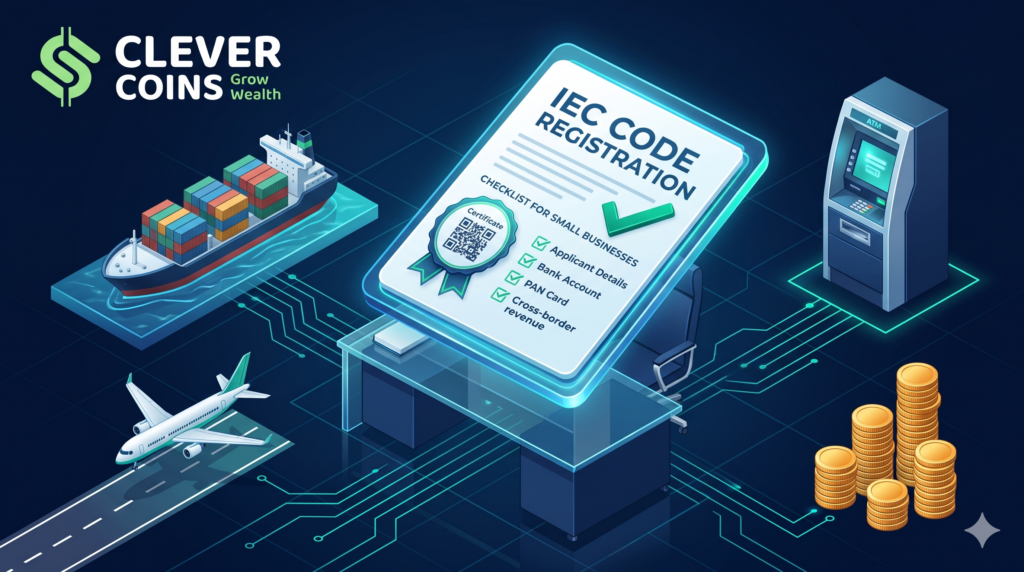
This exhaustive IEC Code Registration Process Checklist for Small Businesses walks you through every phase of the journey—from pre-application readiness and entity-specific documentation to the exact DGFT portal workflow, Bharatkosh fee payment, digital signing, and mandatory annual compliance.
Understanding the Importer-Exporter Code (IEC) and Why Small Businesses Need It
An Importer-Exporter Code (IEC) is a unique 10-digit alphanumeric identification number (which now mirrors your business’s 10-character Permanent Account Number, or PAN) issued by the DGFT. No person or business entity can legally import goods into India or export goods and services from India without obtaining an IEC, unless specifically exempted under the Foreign Trade Policy.
For small businesses, micro-enterprises, and startups, securing an IEC is not merely a statutory formality; it is an operational necessity across multiple touchpoints:
Customs Clearance for Goods: Whenever your imported raw materials, machinery, or finished inventory arrive at an Indian port or airport, customs authorities require your IEC to clear the consignment. Similarly, when shipping goods abroad, customs brokers and freight forwarders cannot generate a Shipping Bill without a valid IEC.
Cross-Border Banking and Foreign Remittances: Authorized Dealer (AD) Category-I banks require your IEC whenever you send foreign currency abroad to pay an international vendor or receive inward remittances from overseas customers. Without an IEC linked to your bank profile, inward export payments can be held up or rejected under Foreign Exchange Management Act (FEMA) guidelines.
Export Incentives and Government Schemes: Small businesses exporting from India can unlock substantial financial benefits—such as duty drawbacks, Remission of Duties and Taxes on Exported Products (RoDTEP), Export Promotion Capital Goods (EPCG) schemes, and zero-rated Goods and Services Tax (GST) refunds. None of these incentives can be claimed without an active IEC.
Global E-Commerce Marketplaces: If you plan to sell products on international marketplaces like Amazon Global Selling, eBay, Etsy, or Alibaba, onboarding requires submitting your valid IEC certificate alongside your GSTIN and bank details.
Service Exporters and SaaS Startups: A widespread misconception among small tech agencies, digital marketers, consultants, and SaaS founders is that IEC only applies to physical shipping crates. In reality, if you export services and wish to claim benefits under the Foreign Trade Policy or process zero-rated GST export invoices smoothly, you need an IEC covering service exports.
Key Highlights of the IEC System
Lifetime Validity: Unlike many trade licenses that require renewal fees every year or five years, an IEC is valid for the entire lifespan of your business entity.
Zero Post-Registration Filing Returns: Holding an IEC does not saddle your small business with monthly or quarterly tax returns. You only use the code when you execute an import or export transaction (aside from a simple annual online profile confirmation).
Flat Government Fee: The statutory application fee for a new IEC registration is a nominal ₹500, payable online via the Bharatkosh portal.
Eligibility Criteria: Can Your Small Business Apply for an IEC?
The DGFT maintains broad, inclusive eligibility criteria so that businesses of every scale—from solo home-based entrepreneurs to venture-backed corporations—can participate in global trade. Any of the following business structures registered in India can apply for an IEC:
Sole Proprietorship Firms (including individual freelancers and home-based sellers)
Partnership Firms (registered or unregistered)
Limited Liability Partnerships (LLPs)
Private Limited Companies (Pvt Ltd)
One Person Companies (OPCs)
Public Limited Companies
Hindu Undivided Families (HUFs)
Trusts, Societies, and NGOs engaged in eligible cross-border activities
Who is Exempt from IEC Registration?
While commercial trade strictly requires an IEC, specific exemptions exist:
Personal Use: Individuals importing or exporting goods strictly for personal use—and not connected with trade, manufacture, or agriculture—do not need an IEC.
Government Ministries and Departments: Central and state government ministries or notified charitable institutions importing/exporting goods for non-commercial purposes are exempt.
Micro-Scale Service Exports (Without Policy Benefits): Independent service providers or freelancers receiving small foreign remittances below RBI thresholds who do not intend to claim any Foreign Trade Policy export incentives may operate without an IEC, though obtaining one is strongly recommended as soon as invoicing scales.
Phase 1: Pre-Application Readiness Checklist
More than 70% of delays in IEC issuance stem from jumping onto the DGFT portal before aligning foundational business records. Before creating your DGFT login, work through this pre-application readiness checklist:
[ ] Active Permanent Account Number (PAN): Verify that your business entity holds a valid PAN card. For a Sole Proprietorship, the proprietor’s personal PAN is used. For Partnerships, LLPs, OPCs, and Private Limited Companies, the separate entity PAN is mandatory. Note that only one IEC can be issued against a single PAN.
[ ] Exact Name & Date Alignment with Income Tax Database: The DGFT portal validates your PAN in real time against the Income Tax Department database. Ensure that the exact legal name of the entity/proprietor and the Date of Incorporation (or Date of Birth for proprietors) match your PAN records character-for-character.
[ ] Active Current Bank Account in the Business Name: You must have an operational current bank account opened in the exact legal name of the firm. Savings accounts are generally not accepted for commercial business entities (though certain banks permit sole proprietors trading in their own personal name to use a personal account, a dedicated current account in the firm’s trade name is best practice).
[ ] GST Registration (If Applicable): While GST registration is not mandatory to apply for an IEC unless your turnover crosses statutory thresholds or you make interstate supplies, having your GSTIN handy allows you to link it seamlessly during the application.
[ ] Dedicated Mobile Number and Email ID: Secure an active mobile number and official email address accessible by the authorized signatory. Both will undergo instant One-Time Password (OTP) verification, and all future DGFT notifications and your e-IEC certificate will be dispatched to this email.
[ ] Aadhaar E-Sign or Digital Signature Certificate (DSC): Decide how you will authenticate and submit the final application.
For Sole Proprietorships: Aadhaar-based e-Sign works smoothly, provided the proprietor’s mobile number is linked to their Aadhaar card and the name/DOB on Aadhaar matches the PAN card.
For Companies, LLPs, and Partnerships: A valid Class 3 Digital Signature Certificate (DSC) token registered in the name of the authorized director, designated partner, or managing partner is strongly recommended and often required for portal validation.
[ ] Document Formatting & File Size Check: Every supporting document uploaded to the DGFT portal must be scanned clearly in PDF format only, with each individual file strictly under 5 MB. Blurry scans, cropped edges, or password-protected PDFs will trigger immediate rejection.
Phase 2: Master Document Checklist (By Business Structure)
Different business entities require distinct constitutional and address documents. Use the master checklist below to gather the exact paperwork required for your small business structure.
1. Universal Documents Required for All Applicants
Regardless of whether you run a solo proprietorship or a private limited company, you must prepare these core documents:
[ ] PAN Card Copy: Clear, self-attested scanned PDF of the firm’s PAN card (or proprietor’s PAN card for sole proprietorships).
[ ] Proof of Business Address (Principal Place of Business): Any one of the following valid documents showing the exact firm name and premises address:
Sale Deed / Property Tax Receipt (if the premises are owned by the business or proprietor)
Registered or Notarized Rent Agreement / Lease Deed (if the premises are rented)
Recent Utility Bill (Electricity bill, landline telephone bill, or post-paid mobile bill—ideally not older than 2–3 months)
Crucial Rule for Rented or Shared Premises: If the electricity bill or property tax receipt is in the landlord’s name (or a family member’s name for home-based businesses), you must attach a signed No Objection Certificate (NOC) from the property owner alongside the utility bill and rent agreement.
[ ] Bank Account Proof: Either of the following two documents:
Pre-Printed Cancelled Cheque: A scanned copy of a cancelled cheque from your business current account. The cheque must have the Legal Name of the Firm, Account Number, and IFSC Code pre-printed on it by the bank. Hand-written firm names or starter cheques without the company name printed on them will be rejected.
Bank Certificate: If you recently opened your current account and have not yet received a personalized cheque book with your firm’s name printed on it, obtain a formal Bank Certificate on the bank’s official letterhead, signed and stamped by the branch manager, confirming the account holder’s name, account number, IFSC code, and branch address.
[ ] Identity Proof of Authorized Signatory: Scanned copy of Aadhaar Card, Passport, or Voter ID of the proprietor, managing partner, or authorized director.
2. Entity-Specific Additional Documents
| Business Structure | Additional Required Documents | Key Verification Notes |
| Sole Proprietorship | • Proprietor’s Aadhaar Card, Passport, or Voter ID • Shop & Establishment License or Udyam Registration (optional, if trading under a distinct trade name) | If operating from home, ensure an NOC from the property owner (e.g., parents/spouse) is attached if the utility bill is not in the proprietor’s name. |
| Partnership Firm | • Scanned copy of the Partnership Deed • PAN Cards and Aadhaar/ID proofs of all partners • Letter of Authorization signed by all partners authorizing one partner to file the IEC | The firm’s name on the Partnership Deed must match the PAN card and current bank account name identically. |
| Limited Liability Partnership (LLP) | • Certificate of Incorporation issued by MCA • LLP Agreement • DPIN/DIN and ID proofs of all Designated Partners • Consent/Authorization Letter signed by Designated Partners | Entering the LLPIN on the DGFT portal auto-fetches core details from the MCA database. Ensure MCA records are updated. |
| Private Limited / OPC | • Certificate of Incorporation (COI) issued by MCA • Memorandum & Articles of Association (MOA/AOA) • Board Resolution authorizing a specific Director to apply for and manage the IEC • DIN and ID proofs of Directors | The Board Resolution must be printed on company letterhead, signed by directors, and explicitly name the authorized signatory. |
| Trust / Society / HUF | • Registration Certificate / Trust Deed / HUF Deed • Resolution from Managing Committee / Karta declaration • ID proofs of Karta or Managing Trustees | Ensure the PAN is registered in the name of the HUF, Trust, or Society. |
Phase 3: Step-by-Step DGFT Online Registration Checklist
The entire IEC registration process takes place digitally on the official DGFT portal (dgft.gov.in). Follow this sequential checklist to complete your application accurately without triggering portal errors.
Step 1: Create Your User Profile on the DGFT Portal
[ ] Open your web browser and visit the official DGFT website: https://www.dgft.gov.in.
[ ] Navigate to the top-right corner, click Login, and then select Register.
[ ] Under the “Register User As” dropdown menu, select Importer/Exporter.
[ ] Enter the mandatory registration details:
First Name and Last Name (of the proprietor or authorized signatory)
Valid Email ID (this will permanently serve as your DGFT portal username)
Active Mobile Number
Pin Code, District, State, and City
[ ] Enter the CAPTCHA code and click Send OTP.
[ ] Check both your email inbox and mobile SMS for two separate OTPs. Enter both OTPs within 15 minutes (before they expire) and click Validate.
[ ] Upon successful validation, you will receive an automated email containing a temporary password.
[ ] Return to the DGFT Login page, sign in using your email ID and temporary password, and immediately set a strong, permanent password.
Step 2: Initiate a Fresh IEC Application (Form ANF 2A)
[ ] Once logged into your DGFT dashboard, click on Services in the top navigation bar, select IEC Profile Management, and click Apply for IEC.
[ ] Click the Start Fresh Application button (if you previously saved a draft, you can choose Proceed with Existing Application).
Step 3: Fill in General Business Information
[ ] Nature of Concern / Firm: Select your exact legal structure (e.g., Proprietorship, Partnership, LLP, Private Limited Company, OPC).
[ ] Firm Name: Enter the exact legal name of your business as printed on your PAN card.
[ ] PAN Details: Enter your 10-character PAN number and Date of Incorporation / Date of Birth. Click Validate PAN—the system will cross-check your data with the Income Tax server in real time.
[ ] CIN / LLPIN (For Companies & LLPs): Enter your Corporate Identification Number or LLP Identification Number. The portal will query the Ministry of Corporate Affairs (MCA) database and auto-populate registered company details and director names.
[ ] GSTIN (Optional/If Registered): Enter your 15-digit Goods and Services Tax Identification Number if your business is GST-registered.
[ ] Category of Exporter/Importer: Select the nature of your operations—such as Merchant Exporter, Manufacturer Exporter, Service Provider, or Merchant cum Manufacturer. If you plan to export both goods and services, select the applicable combination.
[ ] Principal Place of Business Address: Enter the complete street address, landmark, city, district, state, and pin code matching your address proof document.
[ ] Upload Address Proof: Attach the scanned PDF (under 5 MB) of your electricity bill, rent agreement + NOC, or sale deed.
[ ] Click Save and Next.
Step 4: Add Branch Details (If Applicable)
[ ] If your small business operates warehouses, factories, or regional offices in addition to your registered head office, click Add Branch and input their addresses and GSTINs.
[ ] If you operate from a single location, leave this section blank and click Save and Next.
Step 5: Enter Proprietor, Partner, or Director Details
[ ] Fill in the personal details of the Proprietor, all Partners, Designated Partners, or Directors (as auto-fetched or manually entered):
Full Name and Father’s Name
PAN Number and DIN/DPIN (for company directors/LLP partners)
Residential Address, Mobile Number, and Email Address
If any director is a foreign national, check the designated box and provide passport details.
[ ] Click Save and Next.
Step 6: Link Business Bank Account Details
[ ] Enter your commercial bank details accurately:
Bank Account Number (double-check every digit)
Account Holder Name (must match the Firm Name on the application)
11-character IFSC Code
Bank Name and Branch Name
[ ] Upload Bank Proof: Upload the clear PDF scan of your pre-printed cancelled cheque or official Bank Certificate.
[ ] Click Save and Next.
Step 7: Select Preferred Sectors of Operation
[ ] Under the “Other Details” tab, select the primary industry sectors in which you intend to import or export (e.g., Textiles, Engineering Goods, IT & Software Services, Agricultural Products, Handicrafts, Chemicals). This helps DGFT categorize trade statistics and does not restrict you from trading other legal goods in the future.
[ ] Click Save and Next.
Step 8: Review Application Summary & Sign Digitally
[ ] Carefully review the complete application preview generated on screen. Verify spellings, PAN, bank account number, IFSC code, and uploaded attachments.
[ ] Accept the self-declaration checkbox confirming that all furnished particulars are true and correct.
[ ] Click Sign and authenticate the form using either:
Aadhaar e-Sign: Enter the Aadhaar number of the authorized signatory and verify via the OTP sent to the Aadhaar-linked mobile number.
Digital Signature Certificate (DSC): Plug in your USB DSC token, select your signing certificate from the prompt, and enter your token PIN.
Step 9: Pay the ₹500 Government Fee via Bharatkosh
[ ] Once digitally signed, click Payment for IEC.
[ ] You will be redirected securely to the Bharatkosh (Non-Tax Receipt Portal) payment gateway.
[ ] Verify the pre-filled amount of ₹500.
[ ] Complete the payment using Net Banking, Debit Card, Credit Card, or UPI.
[ ] Important: Wait until the payment gateway redirects you back to the DGFT portal automatically—do not close the browser tab or hit the back button mid-transaction. Download and save the Bharatkosh payment receipt for your accounting records.
Step 10: Download Your e-IEC Certificate
[ ] Once payment is confirmed, your application is submitted to the DGFT system.
[ ] In most straightforward cases where PAN, MCA, and bank records match cleanly, the e-IEC is auto-generated within 1 to 3 working days (and sometimes within hours).
[ ] You will receive an email confirmation with your e-IEC attached. You can also log into the DGFT portal anytime, go to Services > IEC Profile Management > Print IEC, and download your official QR-coded e-IEC Certificate.
Phase 4: Post-Registration Compliance Checklist for Small Businesses
Getting your e-IEC certificate is a major milestone, but several critical post-registration steps ensure your cross-border operations run smoothly without customs holds or deactivation penalties.
[ ] Register Your IEC with Your Authorized Dealer (AD) Bank: Submit a copy of your e-IEC certificate, PAN card, and GST certificate to your commercial bank branch. Your bank must map your IEC to their Foreign Exchange / Trade Finance portal so you can receive Electronic Bank Realization Certificates (e-BRC) for exports and remit foreign currency for imports.
[ ] Register on ICEGATE (Indian Customs Electronic Gateway): If you are importing or exporting physical goods, register your IEC and DSC on the ICEGATE portal (
icegate.gov.in). This links your IEC with Indian Customs ports nationwide and enables your Customs House Agent (CHA) to file Bills of Entry and Shipping Bills on your behalf.[ ] Obtain an AD Code Letter from Your Bank: Request an Authorized Dealer (AD) Code letter on your bank’s letterhead and register it at the specific seaport or airport customs station from which your goods will ship. Customs systems will not allow a Shipping Bill to be generated without an active AD Code registered at that port.
[ ] Apply for RCMC (Registration-Cum-Membership Certificate) if Claiming Export Benefits: Depending on your product category, register with the relevant Export Promotion Council (such as FIEO, APEDA, EEPC, or TEXPROCIL) to obtain an RCMC. You can link your RCMC directly inside your DGFT IEC profile.
[ ] Check Sector-Specific Regulatory Clearances: Verify whether your specific products require additional licenses before shipping—such as FSSAI import/export license for food products, BIS certification for electronics/steel, Drug Controller NOC for pharmaceuticals, or Plant Quarantine certificates for agricultural goods.
[ ] Mandatory Annual IEC Update (April to June Every Year): Under DGFT regulations, every IEC holder must log into the DGFT portal once every financial year between April 1 and June 30 to update or confirm their IEC profile details—even if there have been zero changes to your business. Failing to complete this free annual confirmation results in the automatic deactivation of your IEC, which will halt customs clearance until you update the profile.
[ ] Update IEC Promptly Upon Business Changes: Whenever your small business changes its registered office address, adds a new branch, changes bank accounts, or inducts/removes a partner or director, you must file an online IEC modification request on the DGFT portal immediately. Keep in mind that DGFT conducts physical post-issuance address verification via speed post for certain applications; ensure your business signage is visible at the registered address.