ITR-1 (Sahaj) Filing Guide 2026: Everything You Need to Know for AY 2026-27
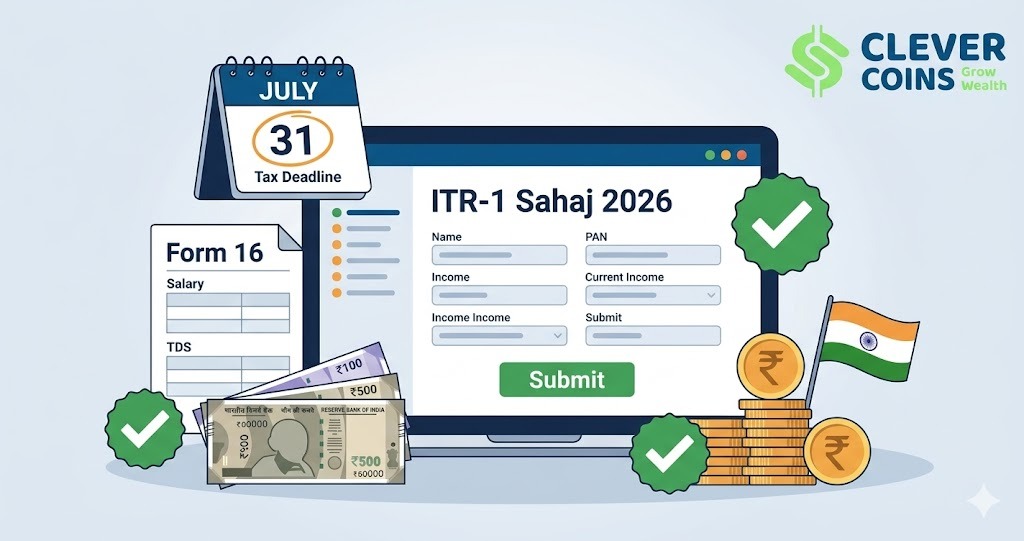
Every year, millions of salaried individuals across India sit down at their desks — or reach for their smartphones — to fulfil one of the most important civic responsibilities: filing their Income Tax Return (ITR). For a large majority of them, the right form is ITR-1, commonly known as Sahaj, which means ‘simple’ in Hindi. And simple it is — if you know the rules.
With the Assessment Year (AY) 2026-27 now underway, the Income Tax Department has rolled out updates to the Sahaj form. Whether you are a first-time filer or a seasoned taxpayer, this comprehensive guide walks you through every aspect of ITR-1 — from eligibility conditions and required documents to the step-by-step online filing process, deductions, and common mistakes to avoid.
What is ITR-1 (Sahaj)?
ITR-1 (Sahaj) is a simplified income tax return form prescribed by the Central Board of Direct Taxes (CBDT) for individual resident taxpayers with a straightforward income profile. The word ‘Sahaj’ reflects the government’s intention to make tax compliance easy and accessible for the common salaried citizen.
It is a one-page form (in paper format) that covers income from salary, one house property, and other sources such as interest income. It does not apply to businesses, professionals, or those with capital gains.
Who Can File ITR-1 in 2026? — Eligibility Criteria
You are eligible to file ITR-1 (Sahaj) for AY 2026-27 if ALL of the following conditions are met:
- You are a Resident Individual (not NRI, HUF, firm, or company).
- Your total income does not exceed ₹50 lakh during the financial year 2025-26.
- Your income sources include: Salary or Pension, Income from One House Property (excluding brought-forward losses), Income from Other Sources (interest from savings, FD, etc.).
- You have agricultural income up to ₹5,000.
- You have income from dividends within applicable limits.
Who CANNOT File ITR-1?
- Non-Resident Indians (NRIs) or Resident but Not Ordinarily Resident (RNOR).
- Individuals with total income exceeding ₹50 lakh.
- Those with income from business or profession.
- Individuals with capital gains from stocks, mutual funds, or property.
- Those who own more than one house property.
- Persons with foreign assets or foreign income.
- Directors of companies or those holding unlisted equity shares.
- Individuals who have deposited more than ₹1 crore in a bank account (subject to seventh proviso of Section 139(1)).
- Those with TDS deducted under Section 194N (cash withdrawals).
- Agricultural income exceeding ₹5,000.
Key Changes in ITR-1 for AY 2026-27
The CBDT has introduced several notable changes and updates for the 2026 filing season:
- New Tax Regime as Default: The New Tax Regime (Section 115BAC) continues to be the default regime. Taxpayers wishing to opt for the Old Tax Regime must explicitly declare it while filing.
- Revised Tax Slabs Under New Regime: Revised slabs effective from FY 2025-26 — ₹0–₹4L: Nil; ₹4L–₹8L: 5%; ₹8L–₹12L: 10%; ₹12L–₹16L: 15%; ₹16L–₹20L: 20%; ₹20L–₹24L: 25%; Above ₹24L: 30%.
- Enhanced Standard Deduction: Standard Deduction increased to ₹75,000 (from ₹50,000) under the New Tax Regime for salaried individuals.
- Rebate under Section 87A: Full tax rebate up to ₹60,000 for income up to ₹12 lakh under New Regime (effectively NIL tax for income ≤ ₹12L).
- Pre-filled Forms: The ITR portal now auto-populates data from Form 16, AIS (Annual Information Statement), and TIS (Taxpayer Information Summary).
- Updated Schedule for House Property: Improved bifurcation between self-occupied and let-out property details.
- Virtual Digital Assets (VDA): Disclosure requirements now embedded in ITR-1 for minor VDA income (subject to eligibility).
Documents Required to File ITR-1
- PAN Card — Your Permanent Account Number.
- Aadhaar Card — Mandatory for e-verification.
- Form 16 — Issued by your employer; shows salary and TDS details.
- Form 26AS — Tax Credit Statement (download from TRACES portal).
- Annual Information Statement (AIS) — Lists all financial transactions reported against your PAN.
- Bank Account Details — Account number and IFSC code for refund credit.
- Interest Certificates — From banks/post offices for FD and savings interest.
- Home Loan Interest Certificate — If claiming deduction under Section 24(b).
- Rent Receipts / Landlord’s PAN — For HRA exemption.
- Investment Proofs (if using Old Regime) — LIC, PPF, ELSS, NSC, school fee receipts, etc.
- Dividend Warrants / Statements — From mutual funds or companies.
Understanding the ITR-1 Form Structure
The ITR-1 form is divided into the following major parts:
▶ Part A – General Information: Personal details: Name, PAN, Aadhaar, DOB, address, email, phone, filing status, bank account details, and choice of tax regime.
▶ Part B – Gross Total Income: Income from salary/pension (as per Form 16), income from one house property, and income from other sources.
▶ Part C – Deductions & Taxable Total Income: Deductions under Chapter VI-A (80C, 80D, 80G, 80TTA, 80TTB, etc.) applicable under the Old Tax Regime.
▶ Part D – Computation of Tax Payable: Calculation of tax liability, rebate under Section 87A, surcharge, health & education cess, TDS/TCS credit, advance tax paid, and net tax payable/refund.
▶ Part E – Other Information: Bank account details, asset and liability details (if income > ₹50L), cash deposits, and other disclosures.
▶ Schedule IT – Advance Tax & Self-Assessment Tax: Details of advance tax and self-assessment tax payments made during the year.
▶ Schedule TDS1 & TDS2: TDS on salary and TDS on income other than salary respectively.
Step-by-Step Guide to File ITR-1 Online (2026)
Step 1: Log in to the Income Tax e-Filing Portal
Visit https://www.incometax.gov.in. Log in using your PAN as the User ID and your registered password. Complete OTP verification via your registered mobile/email.
Step 2: Navigate to ‘File Income Tax Return’
Go to: e-File → Income Tax Returns → File Income Tax Return. Select Assessment Year 2026-27 and choose the filing mode as ‘Online’.
Step 3: Select ITR-1 (Sahaj)
The portal may auto-suggest the right ITR form based on your AIS data. Confirm the selection of ITR-1. Click ‘Let’s Get Started’.
Step 4: Choose the Reason for Filing
Select the applicable reason: Income above basic exemption limit, or you wish to claim a refund, or any other applicable reason.
Step 5: Verify Pre-Filled Data
The form will auto-populate data from Form 26AS, AIS, and Form 16. Carefully review: Salary income, TDS details, interest income, dividend income, and other financial transactions.
Step 6: Select Your Tax Regime
Decide between: Old Tax Regime (allows deductions like 80C, HRA, etc.) or New Tax Regime (lower slab rates, fewer deductions). The portal’s built-in Tax Calculator can help you compare both.
Step 7: Enter Income Details
Provide salary breakdown: Basic pay, HRA, allowances, perquisites, and any other income as reflected in Form 16. For house property, enter details and compute Net Annual Value. Add interest income and any other income sources.
Step 8: Claim Deductions (Old Regime Only)
Enter your eligible deductions: Section 80C (up to ₹1.5L), 80D (health insurance), 80G (donations), 80TTA/80TTB (interest deductions), 80CCD(1B) (NPS contributions), and others.
Step 9: Review Tax Computation
The portal auto-calculates your: Gross Total Income, Total Deductions, Taxable Income, Tax Liability, Rebate (if applicable), TDS/TCS Credit, and Tax Payable/Refundable.
Step 10: Pay Tax (If Applicable)
If there is any outstanding tax, pay it online via Challan 280 before submitting. Self-assessment tax must be paid before filing.
Step 11: Submit the Return
Preview your filled ITR-1, verify all details, and click ‘Submit’.
Step 12: E-Verify Your Return
This is MANDATORY. Options: Aadhaar OTP (instant & recommended), Net Banking, Bank Account EVC, Demat Account EVC, or DSC. Unverified returns are treated as invalid.
Important Deductions Under the Old Tax Regime
Section | Limit | Description |
Section 80C | Up to ₹1,50,000 | PPF, EPF, LIC, ELSS, NSC, tuition fees, home loan principal, Sukanya Samriddhi, etc. |
Section 80CCD(1B) | Up to ₹50,000 | Additional NPS contribution (over and above 80C limit). |
Section 80D | Up to ₹25,000–₹1,00,000 | Health insurance premiums for self, spouse, children, and parents. |
Section 80G | 50% or 100% | Donations to eligible charitable organizations. |
Section 80TTA | Up to ₹10,000 | Interest on savings bank accounts (for individuals below 60 years). |
Section 80TTB | Up to ₹50,000 | Interest income from deposits for senior citizens (age ≥ 60). |
Section 24(b) | Up to ₹2,00,000 | Interest on home loan for self-occupied property. |
HRA Exemption | Actual HRA / 50%-40% of salary / Rent paid minus 10% salary — whichever is least | House Rent Allowance exemption for rented accommodation. |
Standard Deduction | ₹50,000 | Flat deduction from salary income (Old Regime). |
Important Due Dates for ITR-1 Filing 2026
📅 31st July 2026: Last date to file ITR-1 without penalty (non-audit cases).
📅 31st December 2026: Last date for Belated Return filing with penalty.
📅 31st March 2027: Deadline for Updated Return (ITR-U) under Section 139(8A).
📅 By 15th June 2026: First instalment of Advance Tax (if applicable).
Penalties for Late Filing
Filing after the due date attracts a late fee under Section 234F:
- ₹5,000 — if return is filed after 31st July 2026 but before 31st December 2026.
- ₹10,000 — if return is filed after 31st December 2026.
- ₹1,000 — if your total income does not exceed ₹5 lakh (maximum penalty capped).
- Interest under Section 234A — 1% per month on outstanding tax for every month of delay.
Common Mistakes to Avoid While Filing ITR-1
- Not reconciling Form 26AS with Form 16 — always cross-check TDS entries.
- Forgetting to report interest income from savings accounts, FDs, or post office schemes.
- Claiming HRA without proper documentation or landlord’s PAN (for rent > ₹1L/year).
- Selecting the wrong tax regime without comparing tax liability under both regimes.
- Not verifying the return — an unverified ITR is treated as not filed.
- Entering wrong bank account details, leading to failed refunds.
- Not disclosing all income sources, including freelance, rental, or foreign income.
- Missing the deadline and inviting penalty under Section 234F.
- Ignoring pre-filled AIS data discrepancies — always review and correct errors.
- Filing ITR-1 despite being ineligible (e.g., having capital gains).
Frequently Asked Questions (FAQs)
Q1. Is it mandatory to file ITR-1 even if my income is below ₹2.5 lakh?
A. Not mandatory if income is below the basic exemption limit, unless specific conditions apply (e.g., foreign travel expenses > ₹2L, electricity bill > ₹1L, deposited > ₹1Cr in bank).
Q2. Can I file ITR-1 if I have income from stock market?
A. No. Capital gains (short-term or long-term) from equity or mutual funds disqualify you from using ITR-1. You must file ITR-2 in such cases.
Q3. What if I made a mistake in my filed return?
A. You can file a Revised Return under Section 139(5) before 31st December of the Assessment Year.
Q4. How long does it take to get an income tax refund?
A. After e-verification, refunds are typically credited within 15–45 working days, directly to your pre-validated bank account.
Q5. Do I need to submit any documents physically?
A. No. ITR-1 is a paperless process. All documents are kept for your personal records. No physical submission is required to the IT Department.
Q6. Can a senior citizen file ITR-1?
A. Yes, if eligible. Senior citizens (≥ 60 years) with income only from salary, pension, and interest can use ITR-1. Additionally, super senior citizens (≥ 75 years) with only pension and interest income may be exempt from filing under Section 194P.
Q7. What is AIS and should I check it before filing?
A. Absolutely. The Annual Information Statement (AIS) gives a comprehensive view of all financial transactions linked to your PAN. Always review your AIS on the IT portal before filing to avoid mismatches.
Conclusion
Filing your ITR-1 for AY 2026-27 doesn’t have to be a stressful experience. With the right documents, a clear understanding of eligibility criteria, and the step-by-step guide above, you can complete the process in under 30 minutes — right from the comfort of your home.
Remember: Filing your return on time protects you from penalties, helps you claim refunds faster, builds your financial credibility for loans, and contributes to the nation’s tax base. Don’t delay — start your ITR-1 filing today!
💡 Pro Tip: Use the Income Tax Department’s official portal (incometax.gov.in) only. Beware of fraudulent websites and calls asking for your PAN or OTP.