Types of Bank Accounts in India Explained (2025 Complete Guide)
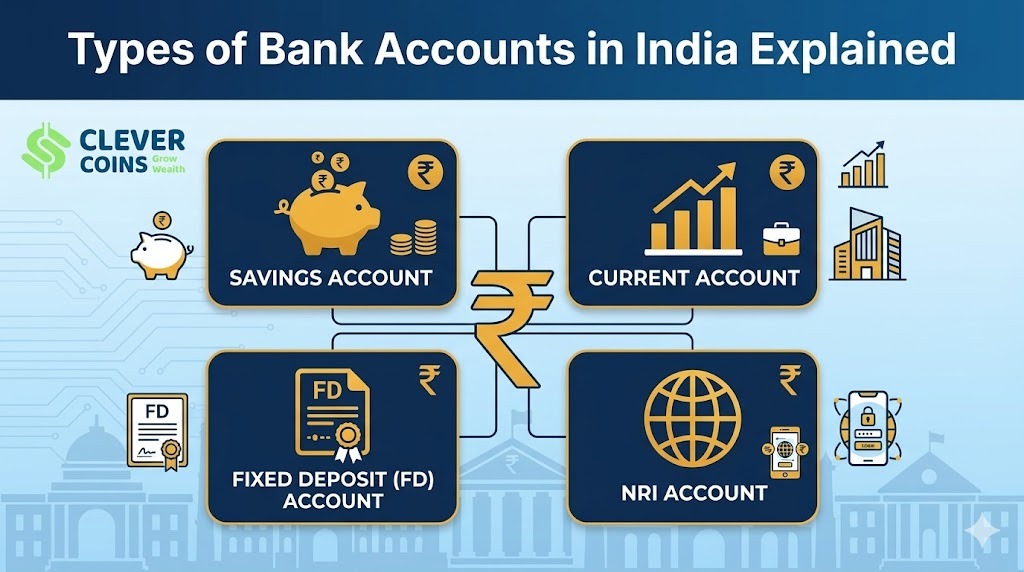
India’s banking system is one of the most diverse and well-regulated in the world, governed by the Reserve Bank of India (RBI). Whether you’re a student opening your first account, a business owner managing large volumes of cash, an NRI looking to invest back home, or a senior citizen seeking safe returns — there is a specific bank account designed exactly for your needs.
Understanding the types of bank accounts in India is the first step towards smarter financial management. In this comprehensive guide, we’ll walk you through every type of bank account available in India, their features, eligibility, benefits, limitations, and how to choose the right one for your financial goals.
Why Choosing the Right Bank Account Matters
Choosing the right bank account can:
- Maximise your savings with appropriate interest rates
- Reduce unnecessary banking charges and fees
- Ensure tax compliance as per Indian income tax laws
- Provide liquidity when you need funds urgently
- Help manage business cash flows efficiently
- Protect your money with RBI-backed deposit insurance (up to ₹5 lakh per bank)
Overview: Types of Bank Accounts in India
Here is a quick reference table of all major types of bank accounts in India:
Account Type | Best For | Interest Rate | Min. Balance |
Savings Account | Individuals, salaried | 2.5% – 7% p.a. | ₹0 – ₹10,000 |
Current Account | Businesses, traders | None | ₹5,000 – ₹25,000 |
Fixed Deposit (FD) | Long-term savings | 5.5% – 8.5% p.a. | ₹1,000+ |
Recurring Deposit (RD) | Monthly savings habit | 5.0% – 8.0% p.a. | ₹100/month |
NRI Account (NRE/NRO/FCNR) | Non-resident Indians | Varies | Varies |
BSBDA / Jan Dhan | Financially excluded | 2.5% – 4% | ₹0 (Zero balance) |
Salary Account | Salaried employees | 2.5% – 4% | ₹0 (Zero balance) |
Senior Citizen Account | Age 60+ individuals | 0.25% – 0.5% extra | Varies |
PPF Account | Long-term tax saving | 7.1% p.a. (2025) | ₹500/year |
Demat & Trading Account | Stock market investors | N/A | Varies |
1. Savings Account
What is a Savings Account?
A savings account is the most common and widely-used type of bank account in India. It is designed for individuals who want to deposit money, earn interest on their balance, and access funds easily. Almost every Indian with a bank account holds a savings account.
Key Features
- Interest rate: 2.5% to 7% per annum (varies by bank; small finance banks often offer higher rates)
- Minimum balance: Ranges from ₹0 (zero balance accounts) to ₹10,000 (private banks)
- Transaction limits: Some banks limit cash withdrawals to 3–5 times per month
- ATM/Debit card provided with the account
- Access to internet banking, mobile banking, and UPI
- Eligible for nomination facility
- Deposits up to ₹5 lakh insured by DICGC
Types of Savings Accounts
- Regular Savings Account – Standard account with minimum balance requirement
- Zero Balance Savings Account (BSBDA) – No minimum balance requirement
- Salary Account – Opened by employer, zero balance, converted if salary stops
- Student/Minor Savings Account – For students and minors (jointly operated with guardian)
- Women’s Savings Account – Special features and benefits for women
- Senior Citizen Savings Account – Higher interest and priority services for age 60+
Interest Tax Implication
Interest earned on savings accounts up to ₹10,000 per year is exempt from income tax under Section 80TTA of the Income Tax Act. For senior citizens, the exemption is up to ₹50,000 under Section 80TTB.
Best Banks for Savings Account in 2025
- SBI – Lowest minimum balance, widest branch network
- HDFC Bank – Premium digital features
- Kotak Mahindra Bank – High interest rates (up to 6%)
- AU Small Finance Bank – One of the highest rates (up to 7%)
- IDFC FIRST Bank – Zero fee banking with high interest
2. Current Account
What is a Current Account?
A current account is specifically designed for businesses, traders, freelancers, and companies that conduct a high volume of transactions daily. Unlike savings accounts, current accounts do not earn interest, but they offer unlimited transactions and various business-centric features.
Key Features
- No interest earned on deposits
- No limit on number of daily transactions
- Overdraft facility available (withdraw more than the balance)
- High minimum balance requirement: ₹5,000 to ₹25,000 (varies by bank)
- Chequebook facility with multiple cheques
- NEFT, RTGS, IMPS, and bulk payment options
- Suitable for GST-registered businesses
Who Should Open a Current Account?
- Sole proprietors and partnership firms
- Private limited companies and LLPs
- Traders, wholesalers, and retailers
- NGOs and trusts
- Freelancers and consultants with high transaction volumes
Current Account vs Savings Account
Feature | Current Account | Savings Account |
Interest | None | 2.5% – 7% p.a. |
Transaction Limit | Unlimited | Limited |
Overdraft | Available | Usually not |
Min Balance | ₹5,000 – ₹25,000 | ₹0 – ₹10,000 |
Best For | Businesses | Individuals |
3. Fixed Deposit (FD) Account
What is a Fixed Deposit?
A Fixed Deposit (FD) is a financial instrument where you deposit a lump sum amount with a bank for a fixed tenure at a pre-determined interest rate. FDs are one of the safest and most popular investment options in India.
Key Features
- Tenure: 7 days to 10 years
- Interest rates: 5.5% to 8.5% per annum (2025)
- Senior citizens receive an additional 0.25% to 0.50% interest
- Interest can be received monthly, quarterly, or at maturity
- Loan against FD available (up to 90% of FD value)
- Auto-renewal option available
- Premature withdrawal possible with a small penalty
- Tax-saving FD: 5-year lock-in, eligible for deduction under Section 80C (up to ₹1.5 lakh)
Tax Implications of FD
Interest earned on FDs is fully taxable as ‘Income from Other Sources’. If interest exceeds ₹40,000 per year (₹50,000 for senior citizens), TDS is deducted at 10%. You can submit Form 15G/15H to avoid TDS if income is below taxable limits.
Best FD Rates in India (2025)
Bank | General Rate | Senior Citizen Rate | Tenure (Highest) |
Unity Small Finance Bank | 9.00% | 9.50% | 1001 days |
Suryoday Small Finance Bank | 8.60% | 9.10% | 5 years |
IDFC FIRST Bank | 7.75% | 8.25% | 400 days |
SBI | 6.50% | 7.00% | 1–2 years |
HDFC Bank | 7.00% | 7.50% | 55 months |
4. Recurring Deposit (RD) Account
What is a Recurring Deposit?
A Recurring Deposit (RD) is a savings scheme where you deposit a fixed amount every month for a predetermined period and earn interest at a fixed rate. It is ideal for building a habit of regular saving with modest amounts.
Key Features
- Monthly deposit: Starting from ₹100 per month
- Tenure: 6 months to 10 years
- Interest rates: 5.0% to 8.0% per annum
- Interest compounded quarterly
- Premature closure allowed with penalty
- Loan against RD available (up to 80–90% of RD value)
- Both online and branch-based options
RD vs FD — Which is Better?
FD is better if you have a lump sum to invest. RD is better if you want to save systematically from your monthly income. Both earn similar interest rates but RD’s effective yield is slightly lower because each instalment earns interest only from its deposit date.
5. NRI Bank Accounts
What are NRI Accounts?
Non-Resident Indians (NRIs) and Persons of Indian Origin (PIOs) can open special types of bank accounts in India to manage their finances, invest, and repatriate funds. There are three main types:
5.1 NRE Account (Non-Resident External)
- Holds foreign earnings converted to Indian rupees
- Fully repatriable (can transfer funds abroad freely)
- Interest earned is tax-free in India
- Both principal and interest can be repatriated
- Available as savings, FD, or RD
5.2 NRO Account (Non-Resident Ordinary)
- Holds income earned in India (rent, dividends, pension)
- Partially repatriable (up to USD 1 million per financial year with documentation)
- Interest is taxable in India (TDS applies at 30%)
- Can be held jointly with a resident Indian
5.3 FCNR Account (Foreign Currency Non-Resident)
- Deposits held in foreign currency (USD, GBP, EUR, etc.)
- No exchange rate risk for the depositor
- Fully repatriable
- Interest is tax-free in India
- Only Fixed Deposit type — no savings or RD
Feature | NRE | NRO | FCNR |
Currency | INR | INR | Foreign Currency |
Repatriation | Full | Partial | Full |
Taxable | No | Yes (TDS 30%) | No |
FD Available | Yes | Yes | Yes (Only FD) |
Joint Account | NRI + NRI only | NRI + Resident | NRI + NRI only |
6. Basic Savings Bank Deposit Account (BSBDA) / Jan Dhan Account
What is BSBDA?
The Basic Savings Bank Deposit Account (BSBDA), popularised under the Pradhan Mantri Jan Dhan Yojana (PMJDY), is a no-frills zero-balance account aimed at providing banking services to the unbanked population of India.
Key Features
- Zero minimum balance required
- No charges for basic transactions
- RuPay Debit card provided
- Accidental insurance cover of ₹2 lakh (under Jan Dhan)
- Life cover of ₹30,000 (under Jan Dhan scheme)
- Overdraft facility of up to ₹10,000 (for eligible accounts)
- Access to government scheme direct benefit transfers (DBT)
- Can be converted to a regular savings account
As of 2025, over 53 crore Jan Dhan accounts have been opened in India, representing a massive step in financial inclusion.
7. Salary Account
What is a Salary Account?
A salary account is a type of savings account opened by an employer (company) for its employees to credit monthly salaries. These accounts are maintained as zero-balance accounts as long as the employee remains with the company.
Key Features
- Zero minimum balance requirement
- Auto-conversion to regular savings account if no salary credited for 3 months
- Free unlimited ATM withdrawals at bank’s own ATMs
- Pre-approved personal loans and credit card offers
- Higher transaction limits
- Special employee banking packages (insurance, locker discounts, etc.)
Popular Salary Account Banks
- HDFC Bank Corporate Salary Account
- ICICI Bank Corporate Salary Account
- Axis Bank Corporate Salary Account
- SBI Corporate Salary Account
8. Senior Citizen Savings Account
Banks in India offer specially tailored savings accounts for individuals aged 60 and above. These come with enhanced interest rates, priority banking, and additional benefits.
- Extra 0.25% to 0.50% interest on FDs and savings
- Dedicated senior citizen banking counters
- Free passbook and chequebook
- Doorstep banking services
- Special health insurance tie-ups
- Section 80TTB exemption on interest up to ₹50,000 per year
9. Public Provident Fund (PPF) Account
What is a PPF Account?
Though technically a government savings scheme, PPF accounts are operated through nationalised banks and post offices. It is one of the most popular long-term tax-saving investment options in India.
Key Features
- Interest rate: 7.1% per annum (Q1 2025, set by Government of India)
- Lock-in period: 15 years (extendable by 5 years)
- Maximum annual deposit: ₹1.5 lakh
- Minimum annual deposit: ₹500
- Tax-exempt: EEE status (Exempt on contribution, interest, and maturity)
- Partial withdrawal from year 7 onwards
- Loan against PPF from year 3 to year 6
- Cannot be attached by courts for debt recovery
10. Demat and Trading Account
While not a traditional ‘bank account,’ Demat and Trading accounts are often linked with bank accounts and are crucial for participating in the Indian stock market.
- Demat Account: Holds shares and securities in electronic form
- Trading Account: Used to buy and sell shares on BSE/NSE
- 3-in-1 Account: Bank + Demat + Trading (offered by ICICI, HDFC, Kotak, etc.)
- CDSL and NSDL are the two depositories in India
- Account opening charges: ₹0 to ₹750; annual maintenance charges vary
11. Minor Account
Banks in India allow parents or guardians to open accounts for children below 18 years of age.
- Two types: Jointly operated (with guardian) and self-operated (for minors above 10)
- Special products like SBI’s Pehli Udaan and HDFC Bank’s Kids Advantage Account
- Helps inculcate financial discipline from a young age
- Converts to a regular savings account upon attaining 18 years
How to Choose the Right Bank Account in India
Here’s a quick decision guide:
Your Situation | Recommended Account Type |
Individual saving money monthly | Savings Account |
Business with high transactions | Current Account |
Lump sum to invest safely | Fixed Deposit (FD) |
Saving small amounts monthly | Recurring Deposit (RD) |
NRI earning abroad | NRE Account |
NRI earning in India | NRO Account |
No income, financial inclusion | BSBDA / Jan Dhan Account |
Government employee / salaried | Salary Account |
Long-term tax saving | PPF Account |
Stock market investing | Demat + Trading Account |
Age 60+ | Senior Citizen Savings Account |
RBI Regulations You Should Know
- All bank deposits up to ₹5 lakh per bank are insured under DICGC (Deposit Insurance and Credit Guarantee Corporation)
- Banks are mandated to maintain Cash Reserve Ratio (CRR) and Statutory Liquidity Ratio (SLR) as directed by RBI
- Know Your Customer (KYC) norms are mandatory for opening any bank account
- Interest rates on savings accounts are deregulated — banks set their own rates
- Interest rates on FDs are also market-driven, not regulated by RBI
- All NRI accounts require specific documentation as per FEMA regulations
Frequently Asked Questions (FAQs)
Q1. Can I have multiple savings accounts in India?
Yes, there is no legal restriction on holding multiple savings accounts. However, each account has its own minimum balance requirement, and tax reporting obligations apply on all accounts.
Q2. Is FD interest taxable in India?
Yes, FD interest is fully taxable as per your income tax slab rate. TDS is deducted at 10% if interest exceeds ₹40,000 per year (₹50,000 for senior citizens).
Q3. What documents are required to open a bank account in India?
You typically need: Aadhaar card, PAN card, passport-size photographs, and a filled account opening form. Additional documents may be required for business accounts or NRI accounts.
Q4. What is a dormant account?
A savings or current account becomes ‘inoperative’ if there are no customer-induced transactions for 2 years. Banks are required to transfer unclaimed deposits to the RBI’s DEA Fund after 10 years.
Q5. Can NRIs open savings accounts in India?
Yes, but NRIs cannot open regular resident savings accounts. They must open NRE, NRO, or FCNR accounts depending on the nature of their income and repatriation needs.
Conclusion
India’s banking ecosystem caters to every segment of society — from the unbanked rural citizen to the sophisticated NRI investor. Understanding the types of bank accounts in India is not just about knowing where to park your money — it is about making smart, informed decisions that maximise your returns, minimise taxes, and serve your long-term financial goals.
Whether you’re choosing a savings account for everyday use, a fixed deposit for safe returns, or an NRE account for managing your overseas earnings, RBI’s robust regulatory framework ensures your money remains safe and accessible.
Open the right account today — because every smart financial journey starts with the right foundation.