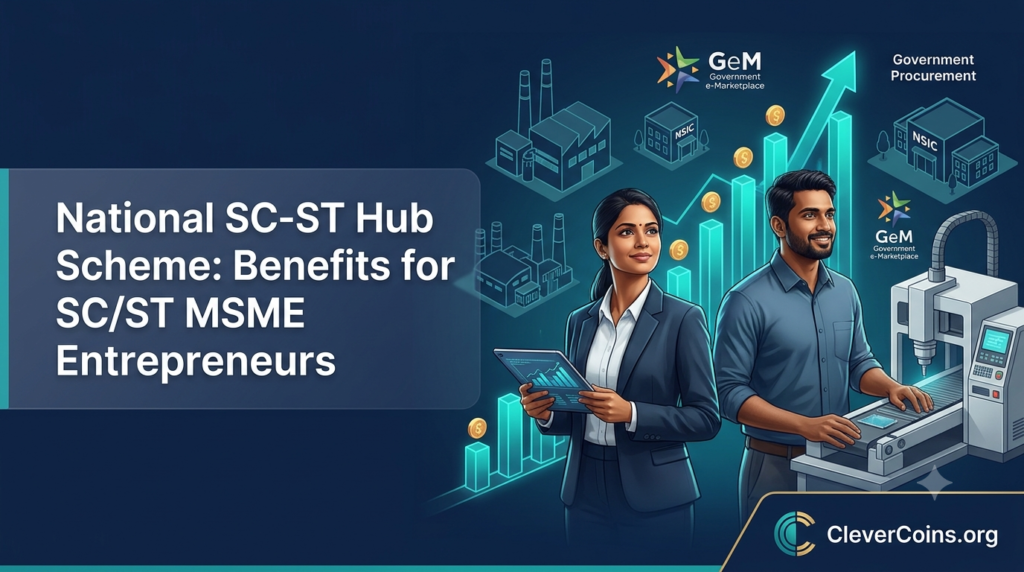
National SC-ST Hub Scheme: Benefits, Eligibility & Complete Guide for SC/ST MSME Entrepreneurs
Building a scalable, profitable enterprise in India requires far more than a strong business idea and relentless work ethic. For first-generation founders—particularly entrepreneurs belonging to Scheduled Caste (SC) and Scheduled Tribe (ST) communities—the path from launching a micro-enterprise to competing for multi-crore government and corporate contracts has historically been blocked by structural hurdles. Limited access to collateral-free institutional credit, high machinery upgrade costs, unfamiliarity with digital tender portals, and stringent vendor eligibility norms often keep promising businesses trapped in low-margin local markets.
To dismantle these exact barriers and weave marginalized communities directly into India’s industrial growth story, the Ministry of Micro, Small and Medium Enterprises (MSME) launched the National SC-ST Hub (NSSH) Scheme. Implemented by the National Small Industries Corporation (NSIC), the National SC-ST Hub acts as a comprehensive, single-window ecosystem offering capital subsidies, public procurement preferences, skill development, international marketing support, and substantial fee reimbursements.
Whether you are planning to launch your very first manufacturing unit, scaling a service-based startup, or looking to supply goods and services to Central Public Sector Enterprises (CPSEs) via the Government e-Marketplace (GeM), understanding every sub-component of the National SC-ST Hub Scheme can save your business tens of lakhs of rupees. In this exhaustive guide, we break down every financial benefit, eligibility rule, documentation requirement, and step-by-step application workflow you need to leverage NSSH for your enterprise.
1. What is the National SC-ST Hub (NSSH) Scheme?
Launched on October 18, 2016, by the Ministry of Micro, Small and Medium Enterprises, Government of India, the National SC-ST Hub (NSSH) is a flagship mission designed to foster inclusive entrepreneurship across the country. Rather than operating as a single standalone grant, NSSH functions as an integrated umbrella framework that coordinates financial, technical, managerial, and market-linkage interventions specifically for Micro and Small Enterprises (MSEs) owned and controlled by Scheduled Caste and Scheduled Tribe entrepreneurs.
At its core, the scheme addresses a critical economic mandate: under the Public Procurement Policy for Micro and Small Enterprises (MSEs) Order, 2012, every Central Ministry, Government Department, and Central Public Sector Enterprise (CPSE) is legally mandated to source at least 25% of its total annual procurement from MSEs. Within that 25% mandate, a dedicated sub-target of 4% of total annual procurement is exclusively earmarked for MSEs owned by SC and ST entrepreneurs.
Historically, public sector buyers struggled to meet this 4% quota due to a shortage of registered, tender-ready SC/ST vendors capable of meeting technical specifications, quality certifications, and scale requirements. The National SC-ST Hub was engineered to bridge this supply-demand gap by:
Building Capacity: Equipping SC/ST founders with modern management, technical, and digital bidding skills.
Subsidizing Technology: Providing upfront capital subsidies so micro and small units can purchase state-of-the-art plant and machinery.
Lowering Compliance & Bidding Costs: Waiving tender deposits and reimbursing 80% to 90% of costs related to bank loans, bank guarantees, product testing, and e-commerce onboarding.
Facilitating Direct Market Access: Organizing Special Vendor Development Programmes (SVDPs) and domestic/international trade exhibitions to put SC/ST entrepreneurs directly in front of institutional buyers.
Proven Impact and Growth Trajectory
Since its inception, the National SC-ST Hub has transformed the landscape of inclusive business in India. Official Ministry of MSME data underscores the massive scale of adoption and impact:
Nearly 39-Fold Surge in Public Procurement: Annual procurement from SC/ST-owned MSEs skyrocketed from just ₹99.37 crore in FY 2015–16 to ₹4,013.42 crore in FY 2025–26, spanning 12,524 active SC/ST enterprises.
Massive Beneficiary Reach: Over 1,90,414 aspiring and existing SC/ST entrepreneurs have received direct assistance under various NSSH interventions through mid-2026.
Nationwide Skill Development: More than 54,499 candidates have been trained since inception, including 10,717 trainees in FY 2025–26 alone across 47 partner institutions in 27 States (including 24 Aspirational Districts), with 55% of trainees being women entrepreneurs.
Pan-India Field Network: NSSH operates through 15 dedicated National SC-ST Hub Offices (NSSHOs) across major industrial hubs—including Mumbai, Pune, Surat, Hyderabad, Bengaluru, Chennai, Kolkata, Bhubaneswar, Ranchi, Patna, Lucknow, Agra, Ludhiana, Guwahati, and Shillong—ensuring grassroots handholding.
2. Complete Breakdown of Benefits Under the National SC-ST Hub Scheme
One of the biggest mistakes MSME founders make is assuming NSSH only offers tender assistance. In reality, the Hub operates 10 distinct financial, operational, and market-access sub-schemes. Depending on your business stage, you can combine multiple interventions simultaneously to dramatically reduce your capital expenditure (CapEx) and operating expenditure (OpEx).
A. Special Credit Linked Capital Subsidy Scheme (SCLCSS)
The Special Credit Linked Capital Subsidy Scheme (SCLCSS) is the crown jewel of NSSH’s financial support architecture. Upgrading machinery is the single most expensive hurdle for small manufacturers and service providers. SCLCSS directly subsidizes technology adoption.
Quantum of Subsidy: 25% capital subsidy on the purchase of eligible plant, machinery, and equipment.
Maximum Subsidy Cap: Up to ₹25 lakh per enterprise.
Sector Coverage: Covers both manufacturing and service sector MSEs with no product or sector-specific restrictions (unlike older general capital subsidy schemes that restricted benefits to specific sub-sectors).
Eligibility Nuances:
Open to both new (greenfield) and existing SC/ST-owned Micro and Small Enterprises.
Machinery must be purchased via an institutional term loan with a minimum repayment tenure of 3 years (including the moratorium period) from a Scheduled Commercial Bank, State Financial Corporation, or eligible lending institution.
Only brand-new plant, machinery, or equipment qualifies; second-hand, refurbished, or locally fabricated machinery without standard manufacturer billing is excluded.
Pure trading enterprises and industries classified under the Red Category (high pollution potential) by the Ministry of Environment, Forest and Climate Change are excluded.
Graduation Protection: If a Small Enterprise graduates to a Medium Enterprise due to growth, it remains eligible to claim SCLCSS for up to 3 years from the date of graduation.
Family Limit: Only one member of a family (self and spouse) can avail of the SCLCSS benefit.
Proven Track Record: Between 2016 and March 2026, 3,160 SC/ST MSEs across 233 districts received ₹356.10 crore in direct capital subsidies under SCLCSS.
B. Public Procurement Support & Single Point Registration Scheme (SPRS)
Winning government tenders is one of the fastest ways to build predictable, high-volume revenue. However, government procurement traditionally demands costly tender documents, hefty Earnest Money Deposits (EMDs), and prior experience thresholds. NSSH removes these barriers through NSIC’s Single Point Registration Scheme (SPRS).
100% Registration Fee Subsidy: SC/ST MSEs receive a 100% subsidy on the NSIC Single Point Registration fee, requiring only a nominal token payment of ₹100 + applicable GST.
Zero Earnest Money Deposit (EMD): Enterprises registered under SPRS are completely exempt from paying Earnest Money Deposit (EMD) when bidding on Central Government and CPSE tenders—freeing up critical working capital.
Free Tender Sets: Registered units receive tender documents free of cost.
4% Mandatory Procurement Earmarking: Access to the 4% annual procurement sub-quota across all Central Ministries, Departments, and CPSEs.
L1 + 15% Price Preference Rule: Under the Public Procurement Policy, if an SC/ST MSE quotes a price within L1 + 15% (up to 15% higher than the lowest non-MSE bidder), it is given the opportunity to match the L1 price and secure a significant portion of the tender volume.
358 Exclusively Reserved Items: Central buyers must procure 358 notified items exclusively from the MSE sector.
GeM & E-Tendering Handholding: NSSH field offices run dedicated onboarding clinics and e-tendering workshops (197 workshops conducted in FY 2025–26 alone) to help founders list products on the Government e-Marketplace (GeM) and respond to technical bids without errors.
C. Special Marketing Assistance Scheme (SMAS)
Even the highest-quality product fails without market visibility. The Special Marketing Assistance Scheme (SMAS) under NSSH enables SC/ST entrepreneurs to showcase their offerings at premier national and global trade fairs without bearing crippling travel and stall costs.
Annual Participation Limit: Eligible enterprises can receive financial assistance for up to 4 domestic exhibitions and 2 international trade fairs (including virtual exhibitions) in a single financial year.
International Exhibition Subsidy Caps:
Micro Enterprises: Up to ₹3.00 lakh per event.
Small Enterprises: Up to ₹2.50 lakh per event.
Medium Enterprises: Up to ₹1.50 lakh per event.
What Expenses Are Covered: Space/stall rental charges, airfare (economy class for eligible representatives), freight/shipment charges for display samples, and publicity material costs.
Special Vendor Development Programmes (SVDPs): NSSH regularly organizes buyer-seller meets with giants like NTPC, ONGC, Indian Oil, SAIL, Power Grid, and Indian Railways (247 SVDPs conducted in FY 2025–26), allowing SC/ST vendors to pitch directly to procurement officers.
D. Comprehensive Fee Reimbursements (80% to 90% Cost Recovery)
Beyond capital equipment and exhibitions, day-to-day banking, quality testing, export registrations, and executive education create recurring cash outflows. NSSH provides generous reimbursement schemes across six vital operational categories:
| Reimbursement Component | Subsidy Percentage | Maximum Annual Cap | Key Conditions & Eligible Institutions |
| 1. Bank Loan Processing Charges | 80% of processing fee | Up to ₹1,00,000 (excl. GST) | Business loans availed from Scheduled Commercial Banks, NBFCs, or State Finance Corporations. |
| 2. Performance Bank Guarantee (PBG) Charges | 80% of bank charges | Up to ₹1,00,000 per FY | Bank charges incurred on PBGs submitted for Central/State Govt. or CPSE tenders. |
| 3. Product Testing & BIS Certification Fees | 80% of eligible fees | Up to ₹1,00,000 per FY | Testing of raw materials/finished goods & BIS licensing via NABL/BIS-accredited, Govt., or PSU labs. |
| 4. Export Promotion Council (EPC) Membership | 80% of membership fee | Up to ₹20,000 per FY | Annual subscription/entry fees for recognized EPCs; requires valid IEC and RCMC. |
| 5. Govt. E-Commerce Portal Membership | 80% of subscription fee | Up to ₹25,000 per FY | Onboarding/subscription fees for GeM, e-Khadi, TRIFED, Tribes India, MSME Mart, etc. |
| 6. Top-50 NIRF Management Training | 90% of course fees | Up to ₹1,00,000 per FY | Short-term executive programs (1–30 days) at Top-50 NIRF-ranked institutes (up to 2 courses/year). |
E. Free Capacity Building, Skill Training & Business Accelerator Programme (BAP)
For aspiring entrepreneurs or founders looking to diversify into high-demand technical trades, NSSH sponsors 100% free residential and non-residential skill development programs conducted through premier central and state institutions (such as CIPET, NIELIT, NIESBUD, MSME Tool Rooms, and Apparel Training & Design Centres).
Zero Course Fee + Free Toolkits: Trainees pay nothing for instruction, and upon successful completion, participants receive industry-grade toolkits to jumpstart self-employment.
Market-Aligned Curriculum: Courses are specifically mapped to public procurement demand—covering CAD/CAM machining, precision welding, electrical/solar installation, commercial cafeteria & catering management, industrial packaging, fashion & garment manufacturing, and bamboo/agro-processing.
Business Accelerator Programme (BAP): Select high-potential SC/ST enterprises receive intensive one-on-one mentoring from industry experts to overhaul pricing models, lean manufacturing workflows, and tender bid positioning.
3. Who is Eligible for the National SC-ST Hub Scheme?
Before gathering paperwork, verify that your enterprise satisfies both the statutory MSME classification norms and the SC/ST ownership criteria laid down by the Ministry of MSME.
1. Community & Age Criteria
The applicant entrepreneur must belong to a Scheduled Caste (SC) or Scheduled Tribe (ST) community as notified under the Constitution of India.
Applicants must be at least 18 years of age.
No Income Ceiling: There is no upper family income limit to apply under NSSH, ensuring both grassroots micro-founders and established mid-sized promoters can participate.
Gender Inclusive: Open to all genders, with special encouragement and outreach for SC/ST women entrepreneurs.
2. Business Structure & Minimum Shareholding Rules
Per the Office of the Development Commissioner (DC-MSME) clarification memorandum, an enterprise qualifies as an “SC/ST-owned enterprise” based on its legal constitution:
Sole Proprietorship: The sole proprietor must belong to the SC or ST community (100% ownership).
Partnership Firm / LLP: SC and/or ST partners must hold at least 51% of the total capital/shares and exercise effective management control.
Private Limited / Public Limited Company: SC and/or ST promoters/directors must hold at least 51% of the paid-up equity share capital.
Co-operative Societies / Trusts: Registered societies or co-operatives where SC/ST members hold at least 51% controlling interest.
3. Enterprise Size & Registration Mandates
Micro or Small Enterprise (MSE) Status: The primary target group comprises Micro and Small Enterprises as defined under the MSMED Act (based on composite investment in plant & machinery/equipment and annual turnover). (Note: Medium enterprises are eligible for select components like SMAS international exhibition support and 3-year post-graduation SCLCSS window).
Mandatory Udyam Registration: The enterprise must hold a valid Udyam Registration Certificate reflecting its MSE status and social category.
MSME Data Bank Enrolment: Existing units applying for schemes like SCLCSS and SMAS must also register on the official MSME Data Bank.
4. Essential Documents Checklist for NSSH Applications
Having clean, consistent documentation prevents 80% of application rejections and query delays. Ensure your business name, promoter name, PAN, and address match across every single record before applying:
Identity & Social Category Proof:
Valid SC or ST Caste Certificate issued by a competent authority (Tehsildar / District Magistrate / SDM) for the proprietor or all SC/ST partners/directors.
Aadhaar Card and PAN Card of the proprietor/authorized signatory and the enterprise.
Business Registration & Constitution Proof:
Valid Udyam Registration Certificate (updated with latest turnover and investment details).
MSME Data Bank registration certificate/acknowledgment.
For Partnerships/LLPs: Registered Partnership Deed or LLP Agreement clearly specifying profit-sharing and capital ratio (≥51% SC/ST).
For Companies: Certificate of Incorporation (CoI), Memorandum & Articles of Association (MOA & AOA), and Form PAS-3 / MGT-7 / Shareholding Pattern certified by a Practicing Chartered Accountant (CA) or Company Secretary (CS) proving ≥51% SC/ST equity.
Banking & Financial Records:
Business Current Account details and a cancelled cheque.
For SCLCSS: Term loan sanction letter (minimum 3-year tenure), loan account statement, GST-compliant tax invoices for new machinery, and bank disbursement proof.
Scheme-Specific Expenditure Proofs (for Reimbursements):
Bank Loan / PBG Reimbursement: Bank debit advice/statement clearly showing processing fee or bank guarantee commission paid (excluding GST).
Testing Reimbursement: NABL/BIS lab test report, lab accreditation certificate, tax invoice, and payment receipt.
EPC / E-Commerce Reimbursement: Valid IEC (for exports), RCMC/membership certificate, subscription invoice, and payment proof.
NIRF Management Training: Course completion certificate from the Top-50 NIRF institute, fee receipt, and travel/attendance proof.
5. Step-by-Step Guide: How to Apply for the National SC-ST Hub Scheme
While general registrations, training enrollments, and fee reimbursements are processed directly through the central NSSH portal, SCLCSS capital subsidy applications follow a bank-routed workflow. Understanding both tracks ensures you never lose time applying through the wrong channel.
Track 1: Applying for Reimbursements, Training & Market Support (Direct Portal Route)
Step 1 — Complete Udyam & MSME Data Bank Registration: Ensure your Udyam Registration is active and your social category is accurately listed as SC or ST.
Step 2 — Register on the Official NSSH Portal: Visit the official National SC-ST Hub portal (
www.scsthub.in) and click on Enterprise Registration / Sign Up. Enter your Udyam Registration Number (URN), mobile number, email ID, and basic business details to create your dashboard.Step 3 — Select Your Specific Intervention: Log in to your enterprise profile and navigate to the relevant sub-scheme section (e.g., Bank Loan Processing Reimbursement, Testing Fee Reimbursement, SPRS Subsidy, SMAS Exhibition Support, or Capacity Building Training).
Step 4 — Fill Application & Upload Self-Certified Documents: Complete the online application form and upload clear PDF scans of your caste certificate, Udyam certificate, constitution/shareholding documents, invoices, and payment receipts.
Step 5 — Verification by Regional NSSHO: Your application is routed to your jurisdictional National SC-ST Hub Office (NSSHO). Officers review the documents and may raise an online query if any clarification is required.
Step 6 — Direct Benefit Transfer (DBT): Once approved by the competent authority, the reimbursement amount is credited directly into your registered enterprise bank account via DBT.
Track 2: Applying for the 25% Capital Subsidy Under SCLCSS (Bank-Routed Route)
You do not submit an SCLCSS claim directly on the portal yourself. Instead, follow this lending-institution workflow:
Step 1 — Secure a Term Loan from an Eligible Lending Institution: Approach a Scheduled Commercial Bank, SIDBI, NABARD, or State Financial Corporation for a term loan (minimum 3-year tenure) to buy new plant and machinery.
Step 2 — Submit SCLCSS Application to Your Lending Bank: Submit the prescribed SCLCSS subsidy claim form along with your Udyam certificate, caste certificate, shareholding proof, and machinery quotations/invoices directly to your lending bank branch.
Step 3 — Nodal Agency Portal Upload: Your lending bank verifies the loan disbursement and machinery installation, then uploads your claim onto the Ministry of MSME’s online portal through one of the 10 notified Nodal Banks/Agencies (such as SBI, Canara Bank, Union Bank of India, Bank of India, PNB, Bank of Baroda, Indian Bank, SIDBI, NABARD, or TIIC).
Step 4 — Subsidy Release & Lock-In Compliance: Upon Ministry approval, the 25% capital subsidy (up to ₹25 lakh) is released to your lending bank to be credited/adjusted against your term loan account. (Important: Do not foreclose or close your term loan before the sanctioned period or 3 years from the reference date, as premature closure triggers subsidy recall).
6. Real-World Success Stories: How NSSH Transforms Grassroots Businesses
Policy numbers only tell half the story. Across India, first-generation SC/ST entrepreneurs are using NSSH interventions to break into Tier-1 public sector supply chains:
Scaling Precision Manufacturing in Jharkhand: Shri Balwant Lal Suman, a mechanical engineer who founded Rigtech Infra in Hazaribagh, Jharkhand, utilized a ₹25 lakh capital subsidy under SCLCSS to install advanced industrial machinery. The resulting jump in production quality and capacity enabled his firm to win major infrastructure tenders from Rail Vikas Nigam Limited (RVNL) and expand his workforce.
Winning Heavy Engineering PSU Orders in Maharashtra: Sunil Popatrao Jagtap of Sawalaram Enterprises in Maharashtra leveraged NSSH’s Business Accelerator Programme (BAP) and tender mentoring to refine his cost estimation and bidding strategy—successfully securing a ₹5.10 lakh contract from Steel Authority of India Limited (SAIL) for precision hydraulic cylinders.
Breaking into Refinery Supply Chains in Rajasthan: Through NSSH machinery modernization support and quality certification handholding, woman entrepreneur Smt. Devi Gurjar upgraded her manufacturing unit to meet strict industrial safety norms, securing supply orders from HPCL Rajasthan Refinery Limited (HRRL).
7. Pro Tips to Maximize Your Approval Rate & Avoid Common Pitfalls
Having advised hundreds of MSME founders on government subsidies and compliance, our financial consultancy team recommends five critical best practices before you submit your NSSH application:
Align Your NIC Code Across Udyam, GST & Loan Documents: One of the most frequent reasons for SCLCSS rejection is a mismatch between the National Industrial Classification (NIC) activity code on your Udyam Certificate and the machinery being financed. Ensure your Udyam registration explicitly reflects manufacturing or eligible service activities prior to loan sanction.
Never Combine Two Capital Subsidies on the Same Machine: Under SCLCSS guidelines, while you can avail of other types of operational support (such as testing or marketing reimbursements), you cannot claim another Central or State capital/technology upgradation subsidy on the exact same plant and machinery.
Preserve Original GST Tax Invoices & Digital Payment Trails: Cash purchases of machinery, testing services, or exhibition fees are strictly ineligible. Every rupee claimed for reimbursement or capital subsidy must be backed by a valid GST invoice and an electronic bank transfer (NEFT/RTGS/UPI/Cheque) from your business current account.
Apply for Reimbursements Within the Stipulated Timeline: Most NSSH reimbursement components require claims to be filed within the same financial year or within a strict window (typically 3 to 6 months) from the date of invoice/payment. Set quarterly compliance reminders so valid bills never lapse.
Leverage SPRS + GeM Together for Compounding Advantage: Don’t stop at getting your NSIC Single Point Registration certificate. Immediately link your SPRS credentials on your GeM Seller Profile so your enterprise automatically displays the “SC/ST MSE” badge to CPSE procurement officers searching for vendors to fulfill their mandatory 4% quota.
8. Frequently Asked Questions (FAQs) About the National SC-ST Hub Scheme
Q1. Can a newly registered startup apply for the National SC-ST Hub Scheme?
Yes. Both newly incorporated startups (greenfield units) and existing operating businesses are eligible under NSSH, provided they are registered as a Micro or Small Enterprise on the Udyam portal and meet the ≥51% SC/ST ownership requirement.
Q2. Is a trading business eligible for the 25% SCLCSS machinery subsidy?
No. Pure trading enterprises are excluded from the Special Credit Linked Capital Subsidy Scheme (SCLCSS). SCLCSS is strictly meant for manufacturing and service sector MSEs investing in eligible plant, machinery, or service equipment. However, registered SC/ST micro and small traders can still benefit from public procurement support, GeM onboarding, and capacity-building workshops.
Q3. What happens if I have a non-SC/ST co-founder in my Private Limited Company or LLP?
You remain 100% eligible as long as the combined equity shareholding (or capital share in an LLP/Partnership) held by the SC and/or ST promoters is at least 51%. For example, a company where an SC founder holds 51% equity and a non-SC co-founder holds 49% equity fully qualifies for all NSSH benefits.
Q4. How much does it cost to register on the National SC-ST Hub portal?
Registration on the official National SC-ST Hub portal (www.scsthub.in) is completely free of cost. Even under NSIC’s Single Point Registration Scheme (SPRS), SC/ST MSEs receive a 100% registration fee subsidy and only pay a nominal token fee of ₹100 plus GST.
Q5. Can I apply for multiple NSSH benefits in the same financial year?
Yes. NSSH is designed as an integrated ecosystem. An eligible SC/ST MSE can simultaneously claim a 25% SCLCSS capital subsidy on new machinery, 80% reimbursement on bank loan processing fees, 80% reimbursement on NABL lab testing fees, NSIC SPRS tender fee waivers, and SMAS exhibition support within the same financial year, subject to each sub-scheme’s individual ceiling
Related posts:
GST Invoice Management System (IMS) from October 2024: New Rules for MSMEs to Accept or Reject ITC
RAMP Scheme Cluster Development: How Industrial Clusters Get Liveability Grants
GST on Corporate Guarantee to Subsidiary MSME: New Valuation Rule 2025 – Complete Guide to Rule 28(2...
NSIC Single Point Registration Scheme: How MSMEs Get Tender Benefits
Atal Innovation Mission (AIM): Complete Guide to Grants for Startups and MSMEs in 2026
GST on Personal Guarantee by Director to Bank: When is 18% GST Applicable?
National Logistics Policy Benefits for MSME Exporters: The Complete Cost Reduction Guide
Free Toolkit Scheme for SC-ST Women MSMEs Under NSIC 2025: Eligibility, Benefits, Training and How t...
PM Vishwakarma Yojana 2026: Benefits, Eligibility and Online Apply for MSMEs
ECLGS Extension 2025: Is Emergency Credit Line Still Available for MSMEs?
Related posts:
 Self Reliant India (SRI) Fund: Rs 50,000 Cr Equity Infusion for MSMEs Explained
 Credit Guarantee Scheme for Exporters (CGSE): New 2025 Scheme for MSME Exporters
 Agri Infra Fund for Food Processing MSMEs: Complete Guide to 3% Interest Subvention, Eligibility, Benefits and Application Process
 GST on Corporate Guarantee to Subsidiary MSME: New Valuation Rule 2025 – Complete Guide to Rule 28(2), 1% GST Valuation and ITC