Every Income Tax season, lakhs of Indian taxpayers wake up on 1st August (or 1st September for ITR-3 and ITR-4 filers) with a sinking feeling — the deadline has passed, and the question hanging over them is: ‘Ab kitna pay karna padega?’ The answer to that question lives in one specific provision of the Income Tax Act, 1961 — Section 234F.
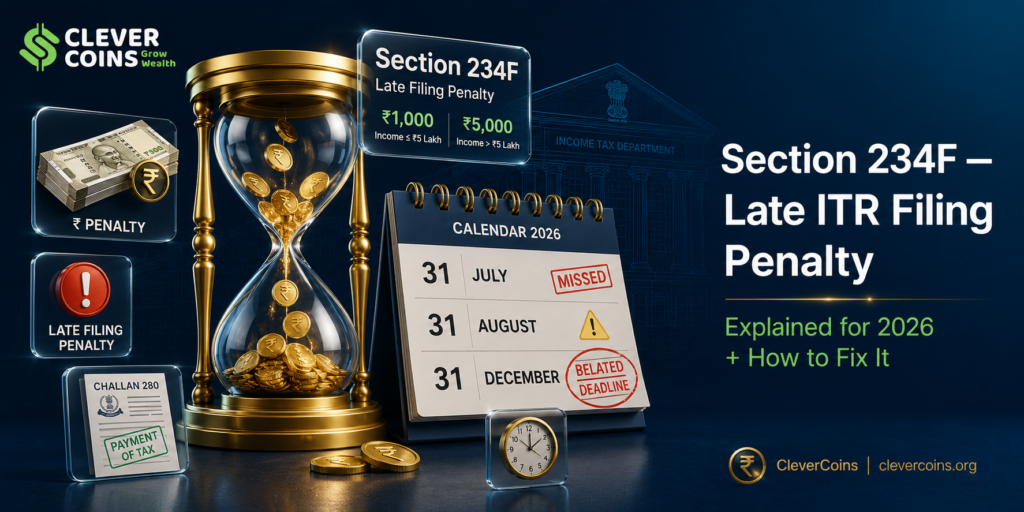
Section 234F is the late filing fee for any Income Tax Return filed after the due date prescribed under Section 139(1). It is NOT interest, NOT a penalty for tax evasion, and NOT a punishment in the legal sense. It is a statutory late fee — a flat, automatic, system-calculated charge that gets levied the moment your ITR is filed even one day after the deadline.
In 2026, with the Income Tax Act, 2025 coming into effect from 1 April 2026, Section 234F has been carried forward into the new law as Section 428 — with identical fee amounts. So whether you are filing your AY 2026-27 return under the old Act, or planning ahead for Tax Year 2026-27 under the new Act, the late fee rules are unchanged. This blog gives you the complete 2026 picture — slab structure, calculation examples in Indian Rupees, related interest charges, how to pay, how to file belated returns, and how to use ITR-U if all original deadlines have passed.
What is Section 234F? — The Legal Background
Section 234F was introduced by the Finance Act, 2017 and made applicable from Assessment Year 2018-19 onwards. Before this, the late filing penalty (under Section 271F) was discretionary and rarely levied. Section 234F changed that by making the late fee automatic and self-computed by the e-filing portal.
Key features of Section 234F
- Levied automatically when ITR is filed after the due date under Section 139(1).
- Fixed fee structure — not based on tax liability.
- Computed and added by the e-filing portal at the time of filing.
- Payable through Challan 280 under ‘Self-Assessment Tax’ before submitting the ITR.
- Cannot be waived by Assessing Officer in most cases — it is a statutory levy.
- Applies even if you have no tax liability or are eligible for a refund.
Who does Section 234F apply to?
Section 234F applies to ALL taxpayers who are required to file an ITR under Section 139(1) and miss the due date. This includes individuals, HUFs, firms, LLPs, companies, AOPs, BOIs, and any other person whose income exceeds the basic exemption limit.
Section 234F Late Fee Structure — The Complete 2026 Slab Table
This is the master table every Indian taxpayer should memorise. It is brutally simple — there are only three possible outcomes.
Total Income for FY 2025-26 | Late Fee under Section 234F |
Total income below basic exemption limit (₹3,00,000 under new regime / ₹2,50,000 old) | NIL — No late fee |
Total income up to ₹5,00,000 | ₹1,000 |
Total income above ₹5,00,000 | ₹5,000 |
Important clarifications
- ‘Total income’ for Section 234F means total income before allowing deductions under Chapter VI-A (i.e., gross total income after all exemptions but before 80C, 80D, etc.).
- The ₹5 lakh threshold has NOT changed since 2019 — it has been intentionally retained to provide relief to small taxpayers.
- The late fee maximum is capped at ₹5,000 — even if you file the return 11 months and 30 days late, the fee remains the same ₹5,000.
- The fee is per return, not per delay-day.
Section 234F vs Other Late Filing Charges — Don’t Confuse These
Many taxpayers receive a total figure of ₹8,000-₹15,000 in late filing demand and assume it’s all Section 234F. It isn’t. Multiple sections stack together. Here is the breakdown.
Section | Nature | Rate / Amount | When Triggered |
234F | Late filing fee (fixed) | ₹1,000 or ₹5,000 | ITR filed after due date |
234A | Interest on unpaid tax | 1% per month / part month | Tax liability not paid by due date |
234B | Interest on advance tax shortfall | 1% per month | Advance tax paid less than 90% of liability |
234C | Interest on instalment shortfall | 1% per month | Quarterly advance tax instalment missed |
270A | Penalty for under-reporting | 50% of tax | Under-reported income detected by Dept. |
The critical insight
Section 234F is just the headline charge. The real damage often comes from Section 234A — because if you have unpaid tax of, say, ₹50,000 and you file 6 months late, you pay ₹5,000 (234F) + ₹3,000 (234A interest) = ₹8,000. And that’s before 234B/234C kick in. Late filing is rarely ‘just ₹5,000’.
When is Section 234F NOT Applicable — The Exemptions
There are very specific situations where Section 234F does not apply. Understanding these can save you ₹1,000 or ₹5,000 legitimately.
Exemption 1 — Total income below basic exemption limit
If your total income is below the basic exemption limit, you are not required to file an ITR under Section 139(1) in the first place. Therefore, Section 234F does not apply even if you file a voluntary return after the due date. For FY 2025-26, the basic exemption limit is ₹3,00,000 under the new tax regime and ₹2,50,000 under the old regime (₹3,00,000 for senior citizens, ₹5,00,000 for super senior citizens under old regime).
Exemption 2 — Return not required under any provision
If you have no income source mandating an ITR (e.g., student with zero income, homemaker without independent income) and you file a voluntary return, Section 234F is not levied.
Exemption 3 — Belated return filed AFTER the basic exemption limit threshold but within belated deadline
This is a common confusion. If your gross income before exemption is below the basic exemption limit BUT after considering all transactions reported in AIS pushes it above (rare), the 234F still applies based on assessed income.
When you MUST file even if income is below exemption — and 234F still applies
- If you own foreign assets or have signing authority in foreign accounts.
- If your gross total income (before 80C, 80D etc.) exceeds the basic exemption limit.
- If you have deposited ₹1 crore+ in current account or ₹50 lakh+ in savings account during the year.
- If you have incurred ₹2 lakh+ expenditure on foreign travel or ₹1 lakh+ on electricity bills.
- If you have business turnover ₹60 lakh+ or professional receipts ₹10 lakh+.
- If TDS/TCS deducted on your behalf is ₹25,000+ (or ₹50,000+ for senior citizens).
In all these cases, even if your final tax liability is zero, you are MANDATORILY required to file the ITR — and missing the deadline triggers Section 234F.
Real-Life Section 234F Calculation Examples (in Indian Rupees)
Theory is fine, but numbers stick. Here are five real-life scenarios our CleverCoins clients face every year — each with the exact 234F + 234A computation.
Example 1 — Salaried employee, files 2 months late, refund pending
Mr. Aamir, a software engineer in Mumbai, has total income of ₹9,50,000 for FY 2025-26. TDS of ₹85,000 was deducted. His actual tax liability is ₹78,000 — meaning he is entitled to a ₹7,000 refund. He misses the 31 July 2026 deadline and files on 5 October 2026.
- Section 234F: ₹5,000 (income above ₹5 lakh).
- Section 234A: NIL (no unpaid tax).
- Refund: ₹7,000 − ₹5,000 (234F adjusted) = Net refund of ₹2,000.
- Net out-of-pocket cost of delay: ₹5,000 (refund eroded).
Example 2 — Freelancer with unpaid tax, files 4 months late
Ms. Khushboo, a freelance graphic designer in Thane, earns ₹7,00,000 in FY 2025-26. Her actual tax liability is ₹54,000. She paid only ₹30,000 advance tax. She files her ITR on 30 December 2026 (5 months past her 31 August deadline).
- Tax balance: ₹54,000 − ₹30,000 = ₹24,000 outstanding.
- Section 234F: ₹5,000.
- Section 234A: 1% × ₹24,000 × 5 months = ₹1,200.
- Section 234B/234C: Approx ₹2,500 (advance tax shortfall).
- Total cost of delay: ₹5,000 + ₹1,200 + ₹2,500 = ₹8,700 over and above the actual tax.
Example 3 — Small business owner with income just below ₹5 lakh
Mr. Pratik, a small kirana store owner in Mumbra, has total income of ₹4,80,000 for FY 2025-26 under presumptive taxation (Section 44AD). He files on 15 September 2026 (15 days past his 31 August deadline).
- Section 234F: ₹1,000 (income up to ₹5 lakh).
- Section 234A: Negligible if no unpaid tax.
Net cost of delay: ₹1,000.
Example 4 — Senior citizen with pension income just above exemption
Mrs. Sushila, a 65-year-old retired teacher, has pension income of ₹3,20,000 for FY 2025-26. Under the old regime, the basic exemption limit for senior citizens is ₹3,00,000. She files her ITR on 31 August 2026 (one month late).
- Total income (₹3,20,000) is above basic exemption limit (₹3,00,000).
- Section 234F: ₹1,000 (income up to ₹5 lakh).
- Net cost: ₹1,000 — could have been zero if she filed by 31 July.
Example 5 — Filing belated return on the LAST day
Mr. Yusuf, a salaried professional in Kalwa, has total income of ₹12,00,000 with all tax deducted via TDS — no unpaid tax. He completely forgets and finally files on 31 December 2026 (5 months late).
- Section 234F: ₹5,000 — same as if he filed in August.
- Section 234A: NIL (no unpaid tax).
- Key insight: The fee does NOT scale with delay. ₹5,000 is the ceiling. So if you have already missed the deadline, file ASAP — there’s no penalty for filing ‘too early’ within the belated window.
The Hidden Costs Beyond ₹5,000 — What Late Filing REALLY Costs
⚠️ Why ₹5,000 Late Fee Is Just the Tip of the Iceberg |
1. LOSS OF CARRY-FORWARD: Business losses, capital losses, and speculation losses CANNOT be carried forward in a belated return (except house property loss). For a ₹10 lakh business loss, this is potentially ₹2.5 lakh+ in lost tax savings over 8 years. 2. REFUND DELAYED: Belated refunds take longer to process; CPC often flags them for additional verification. 3. NO INTEREST ON REFUND for the delay period: Section 244A interest accrues only from the date of belated filing, not from April 1 of AY. 4. CANNOT REVISE EASILY: A belated return can be revised, but the revision window is tighter and many tax advisors avoid them due to scrutiny risk. 5. INCREASED NOTICE PROBABILITY: Belated returns have a statistically higher rate of receiving CPC adjustments and scrutiny. 6. NEW TAX REGIME LOCK-IN ISSUES: If you missed the deadline and want to opt for the old regime in some cases, you may be defaulted to new regime — losing your HRA, 80C, and other deductions. 7. PRACTICAL FALLOUT: Loan applications, visa processing, MSME tender eligibility — all get affected by visible late filings. |
How to Pay Section 234F Late Fee — Step-by-Step
Unlike interest charges that get auto-adjusted, the Section 234F fee must be paid BEFORE you submit your belated ITR. If you submit the return without paying, the ITR becomes ‘defective’ under Section 139(9).
Method: Pay via Challan 280 on the e-Filing Portal
- Step 1: Visit incometax.gov.in → e-Pay Tax (no login required for payment, but login is helpful for receipt).
- Step 2: Select ‘New Payment’ → choose ‘Income Tax’ (head 0021 for individuals other than companies).
- Step 3: Select Assessment Year 2026-27.
- Step 4: Select ‘Type of Payment’: (300) Self-Assessment Tax.
- Step 5: Under the breakup, enter your 234F amount in the ‘Fee under Section 234F’ field (₹1,000 or ₹5,000).
- Step 6: Also enter any unpaid tax + 234A/234B/234C interest if applicable.
- Step 7: Choose payment mode — Net Banking, Debit Card, UPI, RTGS/NEFT, or Pay at Bank Counter.
- Step 8: Complete payment. Download the Challan with BSR Code, Challan Number, and Date.
- Step 9: While filing your belated ITR, enter these challan details in the tax payment schedule. The portal will validate and clear your return.
Step-by-Step: Filing a Belated Return with Section 234F
Belated returns are filed under Section 139(4) of the Income Tax Act, 1961. For AY 2026-27, the belated return window closes on 31 December 2026. Here is the exact filing workflow.
- Step 1: Log in to incometax.gov.in with your PAN/Aadhaar.
- Step 2: Navigate to e-File → Income Tax Return → File Income Tax Return.
- Step 3: Select Assessment Year 2026-27.
- Step 4: Select Filing Type: 139(4) – Belated Return.
- Step 5: Choose the correct ITR form (ITR-1 to ITR-7 based on your category).
- Step 6: Pre-fill data will load. Review and add any missing income, deductions, and capital gains.
- Step 7: The portal auto-computes Section 234F based on total income — verify it matches the slab.
- Step 8: Pay the 234F + any unpaid tax + 234A/234B/234C interest via Challan 280 (see Section 7).
- Step 9: Enter Challan details in the tax payment schedule of the ITR.
- Step 10: Validate, preview, and submit the return.
- Step 11: E-verify within 30 days via Aadhaar OTP, net banking, or send signed ITR-V to CPC Bengaluru.
Can Section 234F Be Waived or Reduced?
This is the question every late filer asks: ‘Can I avoid this fee?’ Honest answer: in most cases, no. But there are narrow circumstances where waiver applications have succeeded.
Option 1 — Section 119(2)(b) Condonation of Delay
Under Section 119(2)(b), the CBDT or its delegated authorities can condone delay in filing returns where ‘genuine hardship’ is established. This is typically considered when:
- The taxpayer was seriously ill or hospitalised during the entire deadline window.
- Force majeure events — natural disasters, family bereavement.
- Refund cases where the taxpayer was entitled to refund and delay was not deliberate.
- Where the delay was caused by technical issues on the e-filing portal (documented).
The application is filed with the Pr. Chief Commissioner / Chief Commissioner of Income Tax depending on the refund amount involved. Condonation is at the discretion of the authority and is NOT a right. Most condonation requests succeed only when accompanied by medical records, death certificates, or other documented evidence of genuine hardship.
Option 2 — Where 234F is wrongly levied
If your total income is genuinely below the basic exemption limit and you filed a voluntary return after due date, but the portal still levied 234F — you can file a rectification request under Section 154 of the Income Tax Act, 1961. Provide supporting documents showing your income computation, and CPC typically processes such rectifications within 60-90 days.
Option 3 — When you are filing for the FIRST time after a long gap
If you have never filed an ITR before and are now filing voluntarily — even after the due date — and your income is below the basic exemption limit, Section 234F does NOT apply. The portal sometimes incorrectly levies it; in such cases, a polite grievance via the e-Nivaran portal resolves it.
ITR-U Updated Return — Your Lifeline if Belated Deadline is Also Missed
Miss the original deadline (31 July / 31 August / 31 October) AND the belated deadline (31 December)? You still have one final escape — the Updated Return under Section 139(8A), commonly called ITR-U. Post the Finance Act, 2025 amendment, the window is 48 months (4 years) from the end of the relevant Assessment Year.
ITR-U additional tax structure (in addition to Section 234F + 234A + 234B + 234C)
Time of Filing ITR-U (after end of AY) | Additional Tax Payable |
Within 12 months | 25% of (tax + interest) |
12 to 24 months | 50% of (tax + interest) |
24 to 36 months | 60% of (tax + interest) |
36 to 48 months | 70% of (tax + interest) |
Important limits on ITR-U:
- Can be used only to DECLARE additional income — not to reduce tax or claim refund.
- Cannot be filed if it results in a loss or reduces existing tax liability.
- Cannot be used if a search/survey is underway against the taxpayer.
- Section 234F still applies — ITR-U does NOT waive the late filing fee.
2026 Update: Section 428 of the Income Tax Act, 2025
The Income Tax Act, 2025 — which comes into force from 1 April 2026 — has restructured and modernised the entire Income Tax Act, 1961. Section 234F of the old Act has been carried forward as Section 428 in the new Act, with the same amounts and triggering conditions.
Key clarifications for 2026
- For AY 2026-27 (income earned in FY 2025-26) — Old Act applies. Section 234F continues with ₹1,000 / ₹5,000 slabs.
- For Tax Year 2026-27 (income earned in FY 2026-27, to be filed in 2027) — New Act applies. Section 428 with the same ₹1,000 / ₹5,000 slabs.
- Section 234F notices for AY 2026-27 and earlier years will continue to reference the old Act even after 1 April 2026.
- Procedures, fees, and exemptions remain unchanged — only the section number has updated for FY 2026-27 onwards.
What Budget 2026 changed — and didn’t
- CHANGED: Belated return deadline structure tied to staggered ITR deadlines (31 Aug for ITR-3/ITR-4).
- CHANGED: Revised return deadline extended from 31 December to 31 March of AY.
- CHANGED: ITR-U window confirmed at 48 months (from 24 months previously).
- UNCHANGED: Section 234F fee amounts and slabs.
- UNCHANGED: Section 234A interest rate of 1% per month on unpaid tax.
Top Mistakes That Inflate Your 234F + Late Filing Cost
⚠️ Avoid These Costly Errors |
1. Filing without paying 234F first — ITR becomes defective u/s 139(9), and you have to re-do everything. 2. Paying 234F under wrong head (e.g., Advance Tax instead of Self-Assessment Tax) — challan needs correction request. 3. Waiting until 31 December (last day) to file belated — portal crashes, errors increase, no time to fix mistakes. 4. Forgetting that 234A interest stacks ON TOP of 234F — many taxpayers budget only ₹5,000 and get hit with ₹10,000+. 5. Choosing the wrong filing type — selecting ‘Original u/s 139(1)’ instead of ‘Belated u/s 139(4)’ for late returns. 6. Ignoring loss carry-forward implications — preferring a belated return when an ITR-U for previous year might have been smarter. 7. Not e-verifying within 30 days — return becomes invalid, 234F has been paid, but tax department treats it as ‘not filed’. 8. Filing ITR-U thinking it waives 234F — it does not. Late fee still applies plus 25%-70% additional tax. 9. Trusting random pop-up sites for tax payment — ALWAYS pay via incometax.gov.in or authorised bank portals. 10. Not consulting a CA — a ₹2,000 fee can save you ₹15,000+ in interest, penalty, and refund loss. |
How CleverCoins Saves You Money on Late Filing
Missed the ITR deadline? Don’t panic. Don’t DIY. The cost of a wrong belated filing is far higher than the cost of professional help. Our CleverCoins team specialises in:
- Belated ITR filing under Section 139(4) — minimising total cost via correct regime selection and deduction claims.
- ITR-U Updated Return filing for older missed years — with proper additional tax computation.
- Section 119(2)(b) Condonation Application drafting — for genuine hardship cases.
- Rectification under Section 154 — for wrongly levied 234F.
- Response to Section 139(9) defective return notices.
- Strategic advice on whether to file belated, revised, or wait for ITR-U window.