GST on Construction & Works Contract in India — Complete 2026 Guide: Rates, ITC, Real Estate & Compliance
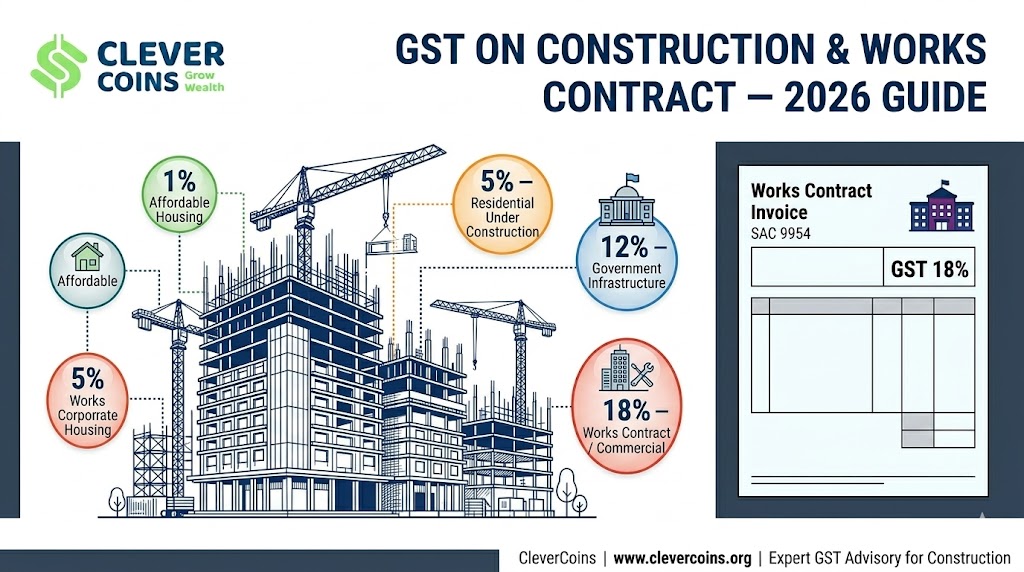
India’s construction sector is one of the most GST-intensive industries — and also one of the most complex. With a market size of over Rs. 17 lakh crore and contributions from government infrastructure, real estate development, industrial construction, and residential housing — construction businesses encounter the widest range of GST rates (1%, 5%, 12%, 18%), the most restrictive ITC blocking provisions, and some of the most litigated GST questions in India.
From a contractor building a national highway to a Mumbai developer selling affordable housing flats, from an interior designer fitting out a corporate office to a sub-contractor pouring concrete — each participant in the construction value chain faces a unique and precisely defined GST obligation.
This comprehensive 2026 guide by CleverCoins — India’s trusted tax consultancy firm — covers every dimension of GST on construction and works contract: legal definitions, complete rate tables (30 categories), works contract types, real estate developer GST, ITC blocked credit rules, time of supply, valuation, compliance obligations, and the latest 2024-2026 GST updates.
What is a Works Contract Under GST? — The Legal Definition
Under Section 2(119) of the CGST Act, 2017, a ‘works contract’ means a contract for building, construction, fabrication, completion, erection, installation, fitting out, improvement, modification, repair, maintenance, renovation, alteration, or commissioning of any immovable property wherein transfer of property in goods (whether as goods or in some other form) is involved in the execution of such contract.
In simpler terms: A works contract is any contract where BOTH services (labour, expertise) AND materials (cement, steel, tiles, wires) are combined together for the creation, modification, or improvement of an immovable property. It is a composite supply — but under GST, it is specifically classified as a SERVICE regardless of the value of materials involved.
📌 Pre-GST Position: Before GST, works contracts were treated partly as goods (VAT applicable on material value) and partly as services (service tax applicable on service portion). This created significant legal complexity. Under GST, the entire works contract is uniformly treated as a SERVICE — simplifying the classification but creating new ITC restriction challenges.
Types of Works Contracts — Classification and GST Rates
Not all works contracts attract the same GST rate. The rate depends on: (1) whether it is for the government or private sector, (2) whether it is original construction or repair/renovation, and (3) the nature of the structure being built.
Type of Works Contract | Description | GST Rate | ITC Available? |
Original Works | New construction from scratch — building, road, structure not previously existing | 18% (private) / 12% (govt infra) | YES |
Works Involving Repair / Renovation | Alteration, refurbishment, or improvement of an existing structure | 18% | YES |
Works Involving Completion / Finishing | Glazing, plastering, painting, tiling, flooring — finishing of a new structure | 18% | YES |
Pure Service Contract | Only labour / supervision provided — no materials supplied by contractor | 18% | YES |
Composite / Lump Sum Contract | Both materials and services provided together — deemed works contract | 18% (or 12% if govt infra) | YES (except residential under-construction sold to buyer) |
Sub-Contract | Works performed by a sub-contractor for a main contractor | Same as main (12% or 18%) | YES — sub-contractor charges, main contractor claims ITC |
EPC / Turnkey Contract | Engineering, Procurement, and Construction — complete project delivery | 12% (govt) / 18% (private) | YES |
⚠️ Critical Rule: Repair, renovation, and maintenance works ALWAYS attract 18% GST — regardless of whether the structure is a government building or private property. The concessional 12% rate applies only to ORIGINAL WORKS (new construction) for government infrastructure.
Master GST Rate Table — Construction & Works Contract (30 Categories)
The following comprehensive table covers GST rates for all major categories of construction and works contract services in India as of 2026:
Category / Type of Construction or Works Contract | GST Rate | ITC | SAC / Key Condition |
Affordable Housing Projects (carpet area ≤ 60 sqm in metro / ≤ 90 sqm non-metro; value ≤ Rs.45 lakh) | 1% (No ITC) | NO | SAC 9954 — CGST 0.5% + SGST 0.5% |
Residential apartments (non-affordable housing) — under construction | 5% (No ITC) | NO | SAC 9954 — CGST 2.5% + SGST 2.5% |
Commercial properties — under construction (shops, offices) | 12% (With ITC) | YES | SAC 9954 — if sold before completion certificate |
Completed / ready-to-move residential flat (with OC) | NIL (Exempt) | N/A | Not a supply of service — pure sale of immovable property |
Works contract for government — civil structures (railways, roads, bridges, dams) | 12% | YES | SAC 9954 — government infrastructure |
Works contract for government — other than above (plant, machinery) | 18% | YES | SAC 9954 |
Works contract — original works for private sector (new construction) | 18% | YES | SAC 9954 — no concessional rate for private |
Works contract — renovation / alteration / repair / maintenance | 18% | YES | SAC 9954 — repair is always 18% |
Sub-contracting of works contract (government infrastructure) | 12% | YES | Same rate as main contractor if for government works |
Sub-contracting of works contract (private sector) | 18% | YES | Standard rate applies to sub-contractor |
Construction of road, bridge, tunnel — for government | 12% | YES | Concessional rate for government infra |
Construction of dam, irrigation canal — for government | 12% | YES | SAC 9954 |
Construction of sewage treatment plant, pipeline — government | 12% | YES | Government water/sanitation infrastructure |
Construction of airport, port, railways — government | 12% | YES | Major infrastructure — concessional |
Pure labour contract — construction (no materials) | 18% | YES | SAC 9954 — labour-only contracts |
Turnkey / EPC contracts — government infrastructure | 12% | YES | Lump sum EPC — dominant nature test |
Turnkey / EPC contracts — private sector | 18% | YES | SAC 9954 — 18% on composite EPC |
Maintenance and operation contract (existing building) | 18% | YES | SAC 9997 or 9954 |
Affordable housing — sub-contractor to main contractor | 12% | YES | ITC available to sub-contractor |
Composite supply (materials + labour) — residential private | 18% | YES | If sold after OC — no GST on sale |
Construction of charitable trust hospitals / educational institutions (specified) | 12% | YES | SAC 9954 — only for notified entities |
Construction of Governmental Authority (not government entity) | 12% | YES | Notified 12% if it is a Governmental Authority |
Works contract — Excavation and site clearance only | 18% | YES | SAC 9954 — ancillary construction services |
Electrical installation in buildings (composite with construction) | 18% | YES | Part of works contract — 18% |
Interior decoration and design services | 18% | YES | SAC 9983 — professional design services |
Landscape, gardening services for construction projects | 18% | YES | SAC 9997 |
Structural steel fabrication and installation | 18% | YES | Composite works contract — 18% |
Solar panel installation (on buildings — composite) | 12% | YES | Composite supply — 12% for solar |
Real estate developer — joint development agreement (JDA) | 18% on developer’s share | YES (partial) | Complex — subject to specific valuation rules |
Affordable housing by promoter under JDA | 1% (No ITC) | NO | Follows affordable housing rate |
🏗️ CleverCoins Note: The single most important factor in determining the GST rate for a construction project is the NATURE of the recipient (government vs private) and the PURPOSE of the structure (infrastructure vs residential vs commercial). When in doubt — always seek a professional classification opinion before raising your first invoice.
GST on Real Estate — Builder / Developer Obligations
Real estate development is one of the most GST-sensitive areas. The March 2019 GST Council changes fundamentally restructured how developers account for GST — introducing the no-ITC model with lower effective rates.
Project Type | GST Rate | ITC | Key Conditions |
Affordable Housing — RERA-registered project | 1% (effective) | NO | Carpet area <= 60sqm metro / 90sqm non-metro AND value <= Rs.45 lakh |
Non-Affordable Residential — Under Construction | 5% (effective) | NO | Sold before Occupancy Certificate (OC) — if after OC = no GST (pure sale) |
Commercial Apartment / Office — Under Construction | 12% (effective) | NO | Sold before OC — 12% on consideration received |
Plotted Development (sale of land / plot) | NIL (Exempt) | N/A | Sale of land — not a supply of goods or services under GST |
Long-term lease of land (> 30 years) | 18% | YES | One-time premium — deemed supply of immovable property |
Development rights / FSI (Floor Space Index) transfer | 18% (RCM applicable) | Subject to use | Complex — valuation rules apply |
Composite construction + sale by developer (private clients) | 5% (No ITC) or 1% (affordable) | NO | Effective rate post-March 2019 revision |
Works contract by developer to construction company | 18% | YES | B2B construction contract — developer claims ITC |
Joint Development Agreement (JDA) — landowner’s share | 18% on value of flats given to landowner | Subject to facts | GST applies when possession transferred to landowner |
Transfer of development rights (TDR) — under RCM | 18% (RCM on developer) | YES (if for taxable output) | Developer pays GST under RCM on TDR value |
The Critical Pre-Completion vs Post-OC Distinction
The most important GST rule in real estate is: GST applies ONLY to under-construction properties sold before the Occupancy Certificate (OC) or Completion Certificate is granted. Once OC is obtained, the sale of the property becomes a pure sale of immovable property — which is not a supply of goods or services under GST — and therefore attracts zero GST (but stamp duty and registration fees apply).
✅ Example: A developer launches a project in January 2025. Buyer A books a flat in February 2025 and pays GST at 5% on his installments. Buyer B buys a flat in June 2026 after OC is granted in May 2026 — Buyer B pays ZERO GST (only stamp duty + registration). Both paid similar prices — but GST applies only to Buyer A’s purchase.
Affordable Housing — The 1% GST Rate
The government has provided a significant GST concession for affordable housing to promote homeownership among lower and middle-income groups. The effective GST rate is just 1% (CGST 0.5% + SGST 0.5%) — with no ITC — for projects meeting ALL of the following criteria:
- Project must be registered under RERA (Real Estate Regulatory Authority)
- Carpet area of the residential unit must be 60 square metres or less (in Metropolitan Cities: Delhi NCR, Bengaluru, Chennai, Hyderabad, Mumbai MMR, Kolkata)
- Carpet area must be 90 square metres or less (in non-metro / other cities)
- Total consideration (all-inclusive price) must not exceed Rs. 45 lakh
- The flat must be sold before OC/Completion Certificate is received
⚠️ ALL four conditions must be simultaneously satisfied for the 1% rate. If any one condition fails — the 5% rate (for residential) or 12% rate (for commercial) applies. Many buyers and developers are confused by this — get a professional verification from CleverCoins before claiming the 1% rate.
The No-ITC Trade-Off for Developers
Since March 2019, developers choosing the 1% or 5% rate must mandatorily forgo ITC on all inputs and input services used in construction. This means:
- GST paid on cement, steel, tiles, paint, electrical fittings, sanitary ware = COST (not credit)
- GST paid on architect fees, structural consultants, labour contractors = COST (not credit)
- GST paid on construction equipment hire, scaffolding, cranes = COST (not credit)
- The developer must procure at least 80% of inputs and input services from GST-registered vendors — failing which, the shortfall is taxed under RCM at 18%
📌 The 80% Procurement Rule: Under the GST notification for real estate, developers opting for the 1%/5% rate must ensure at least 80% of their total procurement value (inputs + input services) comes from registered suppliers. For the remaining 20% sourced from unregistered suppliers, the developer pays 18% GST under Reverse Charge Mechanism (RCM). CleverCoins helps developers track this monthly to avoid year-end RCM surprises.
GST on Government Construction Contracts — The 12% Rate Framework
The government is one of the largest buyers of construction and infrastructure services in India. Works contracts for government entities — particularly for infrastructure — attract a concessional 12% GST rate under Notification 11/2017-CT(R) as amended.
What Qualifies for 12% GST — Government Infrastructure
- Roads, highways, bridges, tunnels, and drainage systems
- Railways infrastructure — tracks, stations, signalling systems
- Airports — runways, terminals (for Airport Authority of India / government projects)
- Ports and inland waterways — government projects
- Dams, canals, irrigation works, barrages
- Sewage treatment plants, solid waste management infrastructure
- Water supply pipelines and treatment plants
- Power transmission lines and sub-stations (government utility companies)
- Government hospitals (original construction — not repair)
- Government schools and educational institutions (original construction)
- Any other civil structure for a government entity or governmental authority
What Does NOT Qualify for 12% — Remains at 18%
- Repair, renovation, or maintenance of government infrastructure — 18%
- Electrical, mechanical, and HVAC works in government buildings (plant and machinery) — 18%
- Works contract for PSUs / public sector undertakings — 18% (unless specifically notified)
- IT infrastructure, software, or technology works for government — 18%
- Works contract for charitable societies / trusts (unless specifically notified) — 18% or 12%
✅ Sub-contractors to government works contractors also charge 12% GST — as long as the sub-contracting is for the same type of infrastructure work. The concessional rate flows through the supply chain for original works on government infrastructure.
Government Entity vs Governmental Authority — Critical Distinction
The 12% concessional rate applies to works for a ‘Governmental Authority’ — defined as a body set up by an Act of Parliament or State Legislature or established by any government, with 90% or more participation by way of equity or control, to carry out a function entrusted to a municipality or a Panchayat under Article 243G or 243W of the Constitution.
A plain ‘Government Entity’ (central or state government department, ministry, or office) is different from a ‘Governmental Authority’. Both now attract 12% for original infrastructure works, but the distinction matters for certain specific services. Always verify the nature of the client entity before applying the 12% rate.
Input Tax Credit (ITC) in Construction — The Blocked Credit Regime
Section 17(5) of the CGST Act contains the most critical and far-reaching ITC restriction in the entire GST law — the blocked credit for construction of immovable property. Understanding this section is essential for every construction business, developer, and property owner.
Input / Expense | ITC Status | Legal Provision | Notes |
Works contract services for construction of own building | BLOCKED | Section 17(5)(c) CGST Act | ITC on WC services for immovable property blocked |
Materials (cement, steel) used in own construction | BLOCKED | Section 17(5)(d) CGST Act | Goods used for immovable property blocked |
Works contract received for further supply of WC (sub-contractor) | ALLOWED | Exception to 17(5)(c) | If recipient provides WC services to third party — ITC allowed |
Works contract for plant and machinery (not building) | ALLOWED | Section 17(5)(c) exception | Plant & machinery on foundation allowed if easily removable |
Construction of residential building being sold (developer) | BLOCKED | Section 17(5)(c) and GST notification | Developer gives up ITC to pay reduced 1%/5% rate |
Cement, steel purchased by contractor for client’s project (WC contract) | ALLOWED | Regular ITC rules | Contractor provides WC service — materials are inputs for taxable supply |
Commercial construction sold before OC (developer) | ALLOWED at 12% rate | Rule 36 | Developer claims ITC as they pay 12% GST and ITC is available |
Labour charges (pure service sub-contractor) | ALLOWED | Regular ITC rules | Input service for contractor’s taxable output |
Design / architecture fees for taxable project | ALLOWED | Regular ITC rules | Professional services — input for works contract |
Rental of machinery, equipment for construction site | ALLOWED | Regular ITC rules | Used for taxable supply — ITC eligible |
Insurance on construction equipment | ALLOWED | Regular ITC rules | Business insurance — eligible |
Motor vehicles used at construction site (goods vehicles) | ALLOWED | Section 17(5)(a) exception for goods transport | Goods transport vehicles — ITC allowed |
Motor vehicles for employee transport (cab/bus) | BLOCKED (generally) | Section 17(5)(a) | Passenger transport — blocked unless obligatory |
⚠️ The Most Misunderstood GST Rule in Construction: Many businesses assume that since they pay 18% GST to their contractor for building their factory, office, or warehouse — they can claim ITC of this GST. This is WRONG. Section 17(5)(c) and (d) specifically BLOCKS this ITC. The GST paid on construction of your own building — whether for use in your business or not — is a DEAD COST.
Exception 1: Plant and Machinery on Permanent Foundation
ITC is allowed on works contract services and goods used for construction of ‘plant and machinery’ even when it is permanently attached to earth — provided the machinery is not a building or civil structure. Examples:
- Manufacturing plant foundations and structures housing machinery
- Industrial chimneys, kilns, furnaces (permanent but removable in theory)
- Water tanks, effluent treatment plant structures
- Storage silos, grain storage structures
⚠️ The distinction between a ‘building’ and ‘plant/machinery on foundation’ is highly litigated under GST. Factories often argue that their production floors qualify as plant foundations — while GST authorities classify them as buildings (blocked ITC). CleverCoins can help you correctly determine your eligibility before claiming such ITC.
Exception 2: Works Contractor Claiming ITC on Sub-Contractor’s Invoice
A works contractor who provides works contract services to a client CAN claim ITC on the works contract services received from their sub-contractors — because the works contractor is using the sub-contractor’s service as an input for their own taxable output (the main works contract). The ITC restriction applies only to the END CLIENT who receives the final works contract service for construction of their own immovable property.
✅ Example: ABC Builders wins a Rs. 100 crore government road contract (12% GST). ABC sub-contracts the civil works to XYZ Civil (12% GST invoice). ABC can claim ITC on XYZ’s 12% GST invoice as an input for their taxable output supply (the 12% government road contract). The ITC blockage hits the government client — not the contractor in this case.
Time of Supply — When GST is Due on Works Contracts
‘Time of supply’ determines WHEN the GST liability arises — and consequently when GST must be paid to the government. For construction works contracts, this is particularly important because projects span months or years, payments come in stages, and advance amounts are received early.
Event | Applicable Rule | Time of Supply |
Invoice issued within prescribed time (30 days for services) | Section 13(2)(a) | Date of invoice — whichever is earlier |
Payment received before invoice | Section 13(2)(b) | Date of payment receipt |
Invoice not issued within 30 days of service completion | Section 13(2)(c) | Date of completion of service provision |
Progressive / milestone billing in WC contract | Section 13(2) | Each milestone invoice date — GST on each running bill |
Advance received from client (booking amount) | Section 13(2)(b) | Date of receipt of advance — GST due on advance |
Retention money released later | Section 13(2) | Date of release / date of invoice for retention |
Continuous supply of works contract services | Section 13(3) | Due date of each successive statement / payment |
🏗️ Running Bills in Construction: Most government and large private construction contracts use a ‘running account bill’ or ‘RA Bill’ system — where the contractor raises periodic invoices for work completed (measured by a quantity surveyor). Each RA bill is a separate invoice under GST. GST is due on the date of each RA bill — meaning contractors must pay GST on each RA bill submitted, even if payment is delayed by the client.
Advance Received from Home Buyer — GST Treatment
When a real estate developer receives a booking advance or instalments from a buyer for an under-construction property:
- GST is due on the date of receipt of each instalment/advance
- The developer issues a receipt voucher at the time of advance — and a tax invoice when the supply is completed or on the 30th day from advance, whichever is earlier
- If the project is cancelled and advance is refunded — GST is refundable/adjustable
- If OC is received before all installments are collected — subsequent installments after OC date attract zero GST
Valuation of Works Contract Supply — How to Compute GST
The value of supply for a works contract determines the taxable base on which GST is computed. Under GST, the value of supply is the transaction value — the price actually paid or payable for the supply.
For Works Contractors: Full Contract Value
The GST is charged on the TOTAL contract value — including both the material component and the labour/service component. There is no deduction for material value in a works contract under GST (unlike the pre-GST service tax system which allowed deduction of 60% or 70% for material value).
✅ This is a key change from pre-GST. Under service tax, a contractor could deduct the material value from the contract price and pay service tax only on the service portion. Under GST, the ENTIRE contract value — materials + labour + overhead + profit — is the taxable value.
For Real Estate Developers: Value of Under-Construction Flats
The GST notification for real estate (after March 2019) provides a specific valuation rule:
- For flats sold before OC: Taxable value = Total consideration (all amounts charged from buyer including preferential location charges, development charges, floor rise, parking — but EXCLUDING stamp duty and land value)
- Land deduction: A mandatory one-third deduction of total consideration is treated as the land value and excluded from GST — effectively, GST applies on two-thirds of the total consideration
- Example: Flat sold for Rs. 90 lakh (all-inclusive). Land value deduction = Rs. 30 lakh (one-third). Taxable value = Rs. 60 lakh. GST at 5% = Rs. 3 lakh.
⚠️ Builders often charge GST on the full consideration — including stamp duty, registration charges, car parking (in some cases), club membership, etc. — which may not be taxable under GST. Buyers should insist on a proper GST computation breakup from the developer.
E-Way Bill in Construction — When Required?
The E-Way Bill (EWB) system under GST requires generation of an EWB for movement of goods valued above Rs. 50,000. In the construction sector, this applies to:
- Movement of construction materials (cement, steel, sand, bricks) between states or within a state — when value exceeds Rs. 50,000
- Movement of construction equipment and machinery (cranes, excavators, concrete mixers) — when transported from one site to another
- Movement of prefabricated structures, modular units, or pre-engineered buildings
- Returns of goods from construction site to supplier (rejection, excess supply)
However, EWB is NOT required for:
- Movement by non-motorised conveyance (bullock cart, hand-cart)
- Certain goods specifically exempted under the EWB notification
- Movement for job work (under Rule 55A in some states)
✅ Construction companies managing multiple sites across cities or states must have a robust EWB management system. Missing an EWB on material movement can result in detention of goods and penalties under Section 129 of the CGST Act. CleverCoins can set up EWB compliance systems for large construction companies.
GST Compliance Obligations — Construction Companies & Developers
GST Registration Requirements
- Mandatory registration if aggregate turnover exceeds Rs. 40 lakh (goods) or Rs. 20 lakh (services) per year
- Inter-state supply of works contract services — mandatory registration regardless of turnover
- Government contractors — registration required to participate in tenders and issue compliant invoices
- Real estate developers — registration required if selling under-construction properties
- Sub-contractors — must register if turnover crosses threshold or if main contractor requires GST invoice
GST Returns for Construction Companies
- GSTR-1: Monthly (11th) or quarterly (13th) — all outward supply invoices, advance receipts, debit/credit notes
- GSTR-3B: Monthly (20th) — self-assessment of tax liability, ITC, and payment
- GSTR-2B: Auto-populated ITC statement — reconcile with purchase register monthly
- GSTR-9: Annual return — due 31st December of following year
- GSTR-9C: Reconciliation statement (if turnover > Rs. 5 crore) — due 31st December
Key Compliance Requirements Specific to Construction
- Maintain separate books for each construction project — site-wise GST tracking
- E-invoice generation: Mandatory for contractors with turnover > Rs. 5 crore (all B2B invoices)
- Advance receipt voucher: Issue for advances received before invoice date
- Debit/Credit notes: Issue for variations, claims, or price escalations in ongoing contracts
- 80% registered vendor rule: Developers must track monthly procurement from registered vs unregistered suppliers
- RCM payments: By 20th of following month for any RCM-eligible supplies
- RA Bill management: Number, date, and GST computation for every running account bill
TDS under GST on Construction Services — Section 51
Government entities (departments, local authorities, PSUs with certain annual turnover) are required to deduct Tax at Source (TDS) at 2% (1% CGST + 1% SGST, or 2% IGST) on payments made to contractors for works contract services above Rs. 2.5 lakh.
- TDS Deductor: Central government, state governments, local authorities, PSUs with annual turnover > Rs. 10 crore, and other notified entities
- TDS Rate: 1% CGST + 1% SGST (or 2% IGST for inter-state supply)
- Threshold: Per contract, per supplier — Rs. 2.5 lakh per single contract
- TDS Return: GSTR-7 — due by 10th of the following month
- Credit to Contractor: TDS reflected in contractor’s GSTR-2B — claimable as ITC or used to offset output tax liability
🏗️ Government contractors should carefully reconcile their GSTR-2B TDS entries with GSTR-7 filed by the deductor. Any discrepancy reduces their available credit. CleverCoins helps government contractors track and follow up on unmatched TDS entries with their government clients.
Special Issues in Construction GST — FAQs
Q1: Can a home buyer claim GST paid on a flat purchase?
No. Individual home buyers (end consumers) cannot claim ITC on GST paid to the developer. The GST is a cost to the buyer. Only if the flat is purchased for business purposes (by a company or firm) may ITC be claimable — and even then, Section 17(5) restrictions may apply.
Q2: My contractor is charging 18% GST on interior work — is this correct?
Yes. Renovation, interior decoration, and finishing works on an existing building attract 18% GST. The 1%, 5%, or 12% rates apply only to ORIGINAL construction (new build) under specific conditions — not to renovation or interior decoration of existing structures.
Q3: If I build my own factory, can I claim ITC on construction costs?
No. Section 17(5)(c) and (d) specifically block ITC on works contract services and goods used for construction of immovable property — even if the factory is for your taxable business. The only exception is if you are in the business of providing works contract services yourself (i.e., you are a contractor).
Q4: What is the GST on a labour-only contract (no materials)?
Pure labour contracts — where the contractor only provides manpower / labour and the client provides all materials — attract 18% GST on the labour charges. There is no concession for pure labour contracts in the private sector.
Q5: Does GST apply to the purchase of an agricultural land?
No. Sale of land (agricultural or otherwise) is not a supply of goods or services under GST. It does not attract GST. However, development services on land (site clearance, levelling, fencing) provided by a contractor would attract 18% GST.
Q6: What GST rate applies to a solar power plant construction contract?
Composite supply for solar power plant construction — including solar panels, inverters, and civil/structural works — was a matter of litigation. As per recent clarifications, the 12% GST rate applies to supply, installation, and commissioning of solar energy systems as a composite supply where the principal supply is the solar panel (goods) or as works contract for plant and machinery.
Q7: Our company received an advance from a government client for a works contract. When is GST due?
GST on advances received from government clients is due on the date of receipt of the advance. A receipt voucher must be issued. However, for government contracts where the invoice is issued first, GST is due on the invoice date.
Common GST Mistakes in Construction — and How to Avoid Them
- Charging 12% GST on repair/maintenance works for government clients — should be 18%
- Claiming ITC on construction of own office or factory building — blocked u/s 17(5)
- Not tracking the 80% registered vendor rule for real estate developers — RCM exposure
- Raising RA bills without proper GST computation — especially for multi-state projects (IGST vs CGST+SGST error)
- Not paying GST on advances received from home buyers — time of supply violation
- Missing E-Way Bills for material movement between sites — leading to vehicle detention
- Applying 1% affordable housing rate without verifying ALL four qualifying conditions
- Not filing GSTR-7 TDS return for government entities — late fee under Section 47
- Sub-contractor raising 18% invoice on government infrastructure work (should be 12%)
- Real estate developers not computing the one-third land deduction correctly — resulting in over/under GST payment
How CleverCoins Supports Construction Companies and Developers
- GST Registration & Classification: Correct registration and SAC code classification for every type of construction activity
- Rate Determination: Precise GST rate determination for works contracts — including mixed projects with government and private components
- ITC Analysis: Detailed Section 17(5) analysis for every project — identifying what ITC can be legitimately claimed vs what is blocked
- Real Estate Compliance: 1%/5%/12% rate eligibility verification, land deduction computation, 80% registered vendor tracking, RCM management
- Developer GST Setup: Monthly GST compliance for builders — GSTR-1 (advance receipts + invoices), GSTR-3B, reconciliation
- Government Contractor Support: GSTR-7 TDS reconciliation, 12% vs 18% determination, RA bill GST compliance
- E-Invoicing Implementation: Setup of e-invoicing for construction companies above Rs. 5 crore turnover
- EWB Compliance: E-Way Bill management for construction material movement across sites and states
- GST Audits: Defence in departmental audits and scrutiny for construction and real estate businesses
- JDA Structuring: GST advice on Joint Development Agreement structures to minimise tax exposure
Build Confidently — Let CleverCoins Handle Your Construction GST!
www.clevercoins.org | Instagram @clevercoins
Conclusion — Construction GST is Complex, But Manageable with Expert Help
GST on construction and works contracts is arguably the most complex area of Indian GST law — with five different rate levels (NIL, 1%, 5%, 12%, 18%), extensive ITC blocking provisions, special valuation rules for real estate, time of supply challenges in milestone-based billing, and the constantly evolving legal landscape of AAR rulings and GST council clarifications.
For contractors, developers, sub-contractors, government vendors, and homebuyers alike — getting GST right is not optional. The financial stakes are enormous — a wrong GST rate on a Rs. 100 crore project could mean a Rs. 6 crore GST demand; a missed ITC claim on a commercial project could cost lakhs; an incorrect affordable housing classification could mean penalty and interest.
At CleverCoins, our team of GST experts brings deep, sector-specific knowledge of construction and real estate taxation. We help you comply accurately, claim every rupee of legitimate ITC, and navigate the complexities of India’s construction GST framework — so you can focus on building great projects.