Portfolio Rebalancing: When & How to Master Your Investment Mix
Key Takeaways
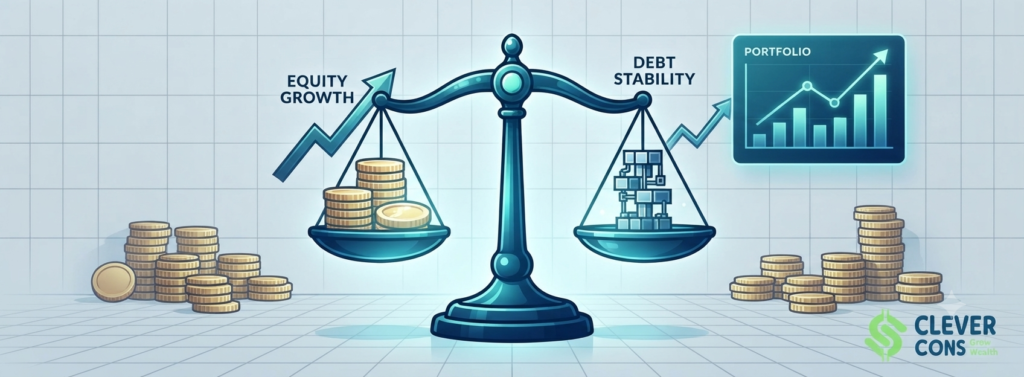
The Inevitable Drift: Over time, market movements cause your original asset allocation (e.g., 70% equity, 30% debt) to drift, silently exposing your portfolio to unintended risks.
Discipline Over Emotion: Rebalancing forces you to sell high-performing assets that have become overweight and buy undervalued, underperforming assets—enforcing the golden rule of investing.
Strategic Timing: Rather than timing the market daily, successful investors use either calendar-based rebalancing (e.g., annually) or threshold-based rebalancing (e.g., when an asset class drifts by $\pm 5\%$).
Tax Efficiency is Key: In India, selling equity units to rebalance can trigger Short-Term Capital Gains (STCG) or Long-Term Capital Gains (LTCG) tax; smart rebalancing utilizes fresh inflows or SIP adjustments to minimize tax friction.
Proactive Wealth Management: Partnering with an expert financial consultancy like CleverCoins ensures your asset mix aligns perfectly with your life goals, risk appetite, and 2026 tax regulations.
Introduction: The Silent Threat of Portfolio Drift
When you started your investment journey, you likely designed a carefully balanced portfolio tailored to your financial goals and risk tolerance. Perhaps you settled on a classic growth mix: 70% in dynamic equity mutual funds for aggressive wealth creation and 30% in stable debt instruments or fixed-income assets for downside protection.
However, the financial markets rarely stay still. Equity markets experience aggressive rallies, while debt instruments grow at a steady, predictable pace. Within a few quarters, your 70:30 portfolio might quietly drift into an 85:15 or 80:20 distribution. While seeing your equity values balloon feels exhilarating, this unmonitored growth introduces a dangerous hidden risk: your portfolio is now significantly riskier than you originally intended.
When a market correction hits, an overly equity-heavy portfolio takes a devastating hit, wiping out years of accumulated gains. This is where Portfolio Rebalancing becomes your ultimate financial superpower. It is the disciplined art and science of resetting your investment mix back to its target weights.
H2: What is Portfolio Rebalancing and Why Does It Matter?
Portfolio rebalancing is the process of realigning the weighting of a portfolio of asset classes. It involves periodically buying or selling assets in your portfolio to maintain an original or desired level of asset allocation.
Why Static Portfolios Fail
Many retail investors assume that once they set up a Systematic Investment Plan (SIP) or invest a lump sum, their job is done. They let their investments run on autopilot for a decade. This strategy ignores a fundamental law of finance: concentration risk.
When one asset class outperforms all others, it dominates your portfolio. If tech stocks or mid-cap funds surge by 40% in a year while government bonds remain flat, your portfolio’s risk profile shifts entirely toward equities. Rebalancing acts as a structural anchor, clipping the wings of overheated assets and reallocating capital into stable or discounted opportunities.
H2: The Hidden Dangers of Portfolio Drift (Case Study)
To understand how portfolio drift destroys risk-adjusted returns, let’s examine a real-world scenario.
Case Study: Rahul’s Unchecked Growth
Initial Setup (January 2023): Rahul invested ₹10,00,000 across a target allocation of 60% Equity (₹6,00,000) and 40% Debt (₹4,00,000).
The Bull Run (2023–2025): Driven by an aggressive economic expansion, Rahul’s equity allocation surged by 70%, reaching ₹10,20,000. Meanwhile, his debt allocation grew at a modest 8%, reaching ₹4,32,000.
The Total Portfolio Value: ₹14,52,000.
The Drift: Rahul’s actual asset allocation is now 70.2% Equity and 29.8% Debt.
While Rahul made more money on paper, his portfolio risk spiked beyond his personal risk tolerance. When a sudden global downturn occurred in early 2026, his heavy equity exposure resulted in a sharp 20% drawdown, erasing over ₹2,00,000 in days. Had Rahul practiced disciplined rebalancing at the end of 2024, he would have locked in equity profits, shifted capital into safer debt assets, and cushioned the blow.
H2: When Should You Rebalance Your Portfolio?
Knowing how to rebalance is important, but knowing when to do it separates amateur investors from institutional pros. There are two primary schools of thought regarding rebalancing frequency:
1. Calendar-Based Rebalancing
How it works: You review and adjust your portfolio at fixed calendar intervals—typically once a year (e.g., every financial year-end on March 31st or your birthday).
Pros: Simple, structured, and easy to remember. It removes emotional hesitation.
Cons: It may lead to unnecessary transactions if markets have barely moved, or it might miss extreme volatility windows occurring mid-year.
2. Threshold-Based Rebalancing (The Percentage Rule)
How it works: You establish a drift threshold (usually $\pm 5\%$ or $\pm 10\%$ from your target weight). If your target equity allocation is 70%, you only rebalance when equity drifts below 65% or above 75%.
Pros: Highly reactive to actual market movements. It ensures you only trade when market dislocations make it necessary.
Cons: Requires constant monitoring of your portfolio balances.
H2: Core Strategies for Effective Rebalancing
You do not always have to sell assets and trigger capital gains tax to rebalance. Experienced investors utilize three distinct methods:
Rebalancing Method | How It Works | Tax Efficiency | Best Suited For |
1. Cash-Flow Rebalancing | Directing all fresh SIP contributions or new savings into the underweight asset class until balance is restored. | Highest (Zero Tax) | Salaried investors with ongoing monthly SIPs. |
2. Asset Liquidation & Transfer | Selling units of the overweight asset class and reinvesting the proceeds into the underweight asset class. | Low to Moderate (Triggers Capital Gains) | Portfolios with massive drift where fresh cash inflow is insufficient. |
3. Dividend & Interest Reinvestment | Routing all dividend payouts, interest earnings, and maturity proceeds directly into lagging asset categories. | High | Income-generating or retired investors. |
H2: Tax Implications of Rebalancing in India (2026 Framework)
When executing a sell-and-buy rebalance in India, you must account for tax friction, as the tax man takes a cut of your realized gains:
Equity Mutual Funds / Stocks: Long-Term Capital Gains (LTCG) exceeding ₹1.25 Lakhs are taxed at 12.5%, while Short-Term Capital Gains (STCG) are taxed at a flat 20%.
Debt Mutual Funds: Capital gains from debt mutual funds are taxed as per your applicable income tax slab rates, regardless of the holding period.
Pro-Tip from CleverCoins: Always calculate the post-tax benefit of rebalancing. If your asset allocation has only drifted by 2%, the tax cost of selling equity units might outweigh the benefits of rebalancing. Utilize fresh monthly inflows (Cash-Flow Rebalancing) whenever possible to avoid unnecessary tax hits.
H2: Step-by-Step Guide to Master Your Investment Mix
Define Your Target Allocation: Base your asset mix on your age, financial goals, and time horizon (e.g., the 100-minus-age rule for equity exposure).
Audit Your Portfolio Quarterly: Review your consolidated account statement (CAS) across stocks, mutual funds, EPF, and fixed income.
Calculate the Drift: Compare your current portfolio weights against your target benchmarks.
Exhaust Fresh Inflows First: Direct your next bonuses, dividends, or SIP increments into the laggard asset class.
Execute Tactical Trims: If cash inflows aren’t enough, systematically trim your winning positions, keeping tax efficiency in mind.
H2: Common Pitfalls to Avoid During Market Volatility
Rebalancing Too Frequently: Over-trading racks up transaction costs, exit loads, and heavy capital gains taxes.
Chasing Past Performance: Mistaking a temporary market trend for a structural shift and overweighting a volatile sector.
Emotional Paralysis: Refusing to sell winning assets because they “feel” like they will keep going up forever.
H2: How CleverCoins Optimizes Your Wealth and Investment Strategy
Managing complex multi-asset portfolios, calculating capital gains tax implications, and monitoring asset drift can distract you from your core career and business pursuits. At CleverCoins, we transform financial complexity into a strategic advantage. Our expert advisors conduct comprehensive portfolio audits, design customized asset allocation models, and ensure your wealth compounds efficiently while minimizing unnecessary tax exposure.
H2: Frequently Asked Questions (20 Comprehensive FAQs)
Q: What is portfolio rebalancing in simple terms? A: It is the process of resetting your investments back to your original target percentages by buying or selling assets.
Q: Why is portfolio rebalancing necessary? A: It prevents your portfolio from becoming too risky when one asset class grows faster than the others.
Q: How often should I rebalance my portfolio? A: Most investors rebalance once a year or when an asset class drifts by more than 5% from its target.
Q: Does rebalancing guarantee higher returns? A: No, rebalancing is primarily a risk-management tool designed to control volatility rather than maximize speculative gains.
Q: Can I rebalance without selling my investments? A: Yes, by directing new savings or SIP contributions into underweight asset classes.
Q: Does rebalancing trigger capital gains tax in India? A: Yes, if you sell equity or debt units to rebalance, it may attract LTCG or STCG taxes.
Q: What is calendar rebalancing? A: Rebalancing your portfolio on a fixed date every year, regardless of market conditions.
Q: What is threshold rebalancing? A: Rebalancing only when an asset class crosses a predefined percentage boundary (e.g., $\pm 5\%$).
Q: How does equity market volatility affect my asset mix? A: Rapid equity growth inflates your equity weight, making your portfolio riskier than intended.
Q: Should retirees rebalance more frequently? A: Yes, retirees require stricter capital preservation, making regular rebalancing toward safe debt assets essential.
Q: What are the tax rates on equity mutual fund rebalancing? A: LTCG above ₹1.25 Lakhs is taxed at 12.5%, and STCG is taxed at 20%.
Q: Can I use tax-loss harvesting during rebalancing? A: Absolutely. Selling underperforming losing assets to offset capital gains is a great rebalancing strategy.
Q: Does rebalancing apply to EPF and PPF? A: Provident funds form part of your fixed-income allocation; you account for them when calculating your overall asset mix.
Q: What is the ideal equity-to-debt ratio for young investors? A: Many aggressive investors start with an 80:20 or 70:30 equity-to-debt ratio.
Q: How do exit loads impact rebalancing? A: Exiting mutual fund schemes before the specified lock-in or exit load period (usually 1 year) can incur penalty charges.
Q: Is rebalancing suitable for small-cap investors? A: Small-cap funds are highly volatile, making periodic rebalancing vital to lock in runaway gains.
Q: Can automated robo-advisors handle rebalancing? A: Yes, many digital wealth platforms offer automated threshold rebalancing features.
Q: What is concentration risk in a portfolio? A: Having too much money tied up in a single stock, sector, or asset class.
Q: How does CleverCoins assist with portfolio management? A: CleverCoins provides expert tax-optimized portfolio audits, asset allocation strategy, and year-round financial advisory.
Q: How do I get started with a professional portfolio review? A: You can reach out to CleverCoins directly at client@clevercoins.org or call +91 77389 59862.
Phone: +91 77389 59862
Email: client@clevercoins.org
Address: Ideal Market, Mumbra, Thane-400612
Website: https://clevercoins.org/
Days
Hours
Minutes
Seconds
Related posts:
GST Compliance Calendar for Start-ups (FY 2026-27)
GST
GST on Electricity: Is Your Power Bill Taxable or Exempt? The Ultimate Business Guide
GST
Taxation of Virtual Digital Assets in India: Complete Guide to Cryptocurrency and NFT Tax Rules 2025
GST
GST on Healthcare & Hospitals — 2026
GST
The Ultimate Guide to Securing a Money Transfer Agent License: Requirements, Costs, and Compliance
GST
GST Registration Cancellation: Process, Impact, and Comprehensive Business Guide
GST
Liquor License in India – State-Wise Process, Fees, and Complete Compliance Guide
GST
GST REGISTRATION CANCELLATION
GST
Essential Credit Card Dos and Don'ts: A Complete Guide for Smart Financial Management
GST
Joint Development Agreement & RERA: The Ultimate Legal, Financial, and Compliance Masterclass
GST