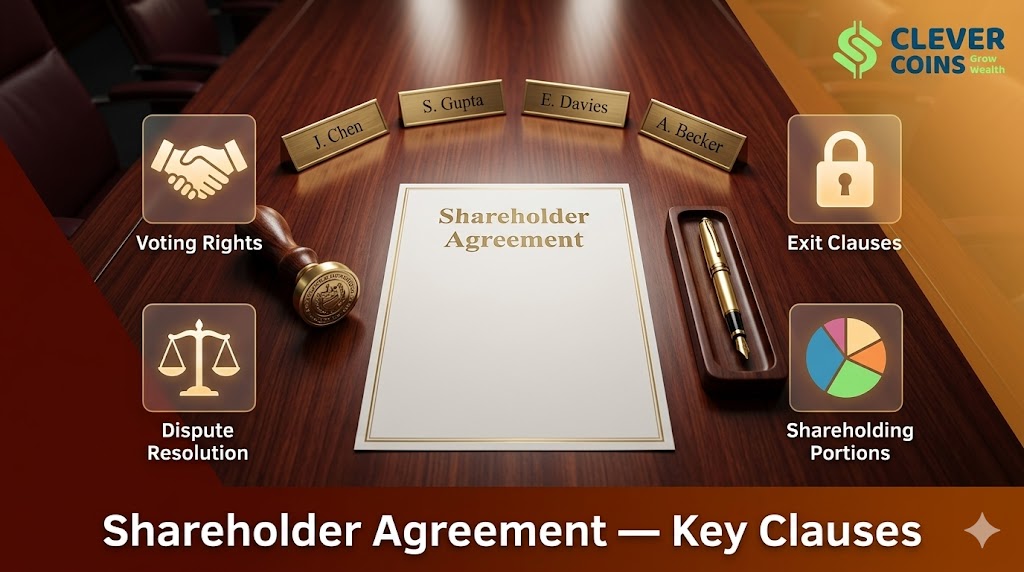
When two or more people come together to build a business, the excitement of shared vision can overshadow a critical legal necessity — a Shareholder Agreement. Whether you are co-founding a technology startup, launching a family business, or bringing in an investor for a growing enterprise, a well-drafted shareholder agreement is the single most important document that governs the relationship between the owners of a company.
Unlike the Articles of Association, which are publicly filed and provide a high-level framework for a company’s operations, a shareholder agreement is a private, legally binding contract between the shareholders themselves. It goes deeper — addressing rights, responsibilities, protections, decision-making powers, exit mechanisms, and dispute resolution in granular detail.
In this comprehensive guide, our legal and business experts break down every key clause you need to understand, negotiate, and include in a shareholder agreement to protect your interests, prevent disputes, and ensure the long-term health of your business.
What is a Shareholder Agreement?
A Shareholder Agreement (SHA) is a legally enforceable contract entered into by the shareholders of a company. It defines the rights and obligations of shareholders, outlines how the company will be governed, determines how shares can be transferred or sold, and provides mechanisms for resolving conflicts — both between shareholders and between shareholders and the company.
The SHA works alongside the company’s constitution (Articles of Association or equivalent), but because it is a private contract, it can include terms that are more flexible, confidential, and tailored to the specific needs of the shareholders involved.
Key characteristics of a shareholder agreement include:
- It is private and confidential — unlike Articles of Association, it is not a public document
- It is binding only on the parties who sign it — new shareholders must formally accede to it
- It can be amended only by unanimous consent of all parties (unless otherwise stated)
- It overrides the Articles of Association in most matters between shareholders
- It can be used in any jurisdiction and can govern multi-country shareholding structures
Why Every Business Needs a Shareholder Agreement
Many businesses — especially startups and family companies — postpone drafting a shareholder agreement, assuming goodwill and shared vision will suffice. This is one of the most costly mistakes a business can make. Here is why:
Preventing Shareholder Disputes
Disputes between shareholders are among the most common and destructive events in any business. A well-drafted SHA anticipates points of conflict and provides mechanisms to resolve them before they escalate to litigation or business paralysis.
Protecting Minority Shareholders
Without a SHA, minority shareholders can find themselves powerless — their shares diluted, their interests ignored, or their voices drowned out by majority decisions. The SHA provides specific protections to ensure minority shareholders are treated fairly.
Governing Share Transfers
Without agreed rules on share transfers, shareholders can sell their shares to anyone — including competitors or unknown third parties. The SHA controls who can become a shareholder and under what conditions.
Enabling Smooth Investor Relations
Institutional investors, angel investors, and venture capitalists almost always require a SHA before investing. Having one in place signals that your business is professionally governed and investor-ready.
Exit Planning
A SHA provides clear pathways for shareholders who wish to exit the business — whether due to retirement, disagreement, financial need, or death. Without these provisions, exits can become legally and financially complicated.
The Key Clauses of a Shareholder Agreement — Detailed Analysis
Below, we examine each major clause of a shareholder agreement in detail — explaining what it covers, why it matters, and what to watch for when negotiating.
Clause 1: Share Capital and Shareholding Structure
This foundational clause defines the total authorised share capital of the company, the classes of shares issued (ordinary, preference, etc.), the number of shares held by each shareholder, the par value of shares, and each shareholder’s percentage ownership.
Why It Matters
The shareholding structure directly determines voting power, dividend entitlements, and liquidation preferences. Getting this right from day one avoids ambiguity in every subsequent clause.
Key Considerations
- Define all classes of shares clearly — ordinary vs preference, and what rights each class carries
- Address fully diluted shareholding — including options, warrants, and convertible instruments
- Specify whether shares are transferable or restricted
- Include a capitalisation table (cap table) as a schedule to the agreement
Clause 2: Voting Rights
This clause governs how decisions are made within the company. It specifies which matters require a simple majority vote (50%+1), which require a special majority (typically 75%), and which require unanimous consent of all shareholders.
Matters Typically Requiring Unanimous Consent
- Amendments to the shareholder agreement itself
- Winding up or dissolution of the company
- Changes to the core business or fundamental change of business direction
- Issuance of new shares that would dilute existing shareholders
- Entry into related-party transactions
Matters Typically Requiring Special Majority (75%)
- Amendment of Articles of Association
- Major asset acquisitions or disposals
- Taking on significant debt or financial obligations
- Appointment or removal of auditors
Matters Requiring Simple Majority
- Routine operational decisions
- Approval of annual budgets (subject to reserve matters)
- Appointment of employees below board level
A critical sub-clause here is the concept of Reserved Matters — a list of decisions that, regardless of shareholding percentage, require the approval of specific shareholders (often minority investors). This is one of the most negotiated areas of any SHA.
Clause 3: Board Composition and Management Rights
This clause defines how the company’s board of directors is constituted, who has the right to appoint and remove directors, and how the board operates. It is one of the most practically important clauses in any SHA.
Key Provisions
- Number of directors on the board
- Which shareholders have the right to nominate directors (nomination rights, typically tied to shareholding thresholds)
- Quorum requirements for board meetings
- Frequency of board meetings
- Rights of shareholders who do not have board seats (observer rights, information rights)
- CEO/MD appointment and removal procedures
- Casting vote provisions
Investor Director Rights
Investors who hold significant minority stakes (typically 10-20%+) often negotiate the right to appoint at least one director to the board. This gives them visibility and influence over key decisions, even without a majority shareholding.
Clause 4: Pre-emption Rights (Right of First Refusal)
Pre-emption rights give existing shareholders the right to purchase new shares (or shares being sold by an existing shareholder) before they are offered to third parties — and at the same price and terms being offered externally.
Two Types of Pre-emption Rights
- Pre-emption on New Issue — If the company wants to issue new shares, existing shareholders have the right to subscribe for those new shares in proportion to their current holdings before they are offered to outsiders
- Pre-emption on Transfer — If a shareholder wants to sell their shares, they must first offer them to the other shareholders before selling to a third party
Why This Clause Is Critical
Without pre-emption rights, a shareholder could suddenly find themselves sharing ownership with an unknown third party — including a competitor. Pre-emption rights preserve the existing ownership dynamic and give shareholders control over who enters the cap table.
Pricing Mechanics
The clause should specify whether pre-emption is at the price offered to the third party, at fair market value, or at a formula-determined value. This is a key negotiation point.
Clause 5: Drag-Along Rights
A drag-along right gives majority shareholders the ability to force minority shareholders to join in the sale of the company when the majority has agreed to sell their shares to a third-party buyer. The minority shareholder is ‘dragged along’ on the same terms.
Why Majority Shareholders Need This
Without drag-along rights, a minority shareholder can block an acquisition by simply refusing to sell their shares. Most acquirers want 100% ownership. A minority holder who refuses to sell can effectively hold the entire deal hostage, preventing the majority from monetising their investment.
Protections for Minority Shareholders
The clause should include protections such as:
- A minimum price threshold — drag-along can only be triggered above a certain valuation
- Same price and terms for all shareholders — the minority cannot be forced to accept inferior terms
- Representations and warranties limited to title to shares — minority cannot be forced to give business-level warranties they are not responsible for
- Notice period — adequate time for the minority to evaluate and prepare
Clause 6: Tag-Along Rights
Tag-along rights (also called co-sale rights) are the mirror image of drag-along rights. They protect minority shareholders by giving them the right to join in any sale by the majority — on the same price and terms.
Why Minority Shareholders Need This
Without tag-along rights, a controlling shareholder could sell their stake to a buyer — potentially receiving a control premium — while the minority shareholders are left behind with a new majority owner they did not choose and potentially at a lower valuation.
How Tag-Along Works
If Shareholder A (majority) agrees to sell 60% of the company to a buyer at INR 100 per share, Shareholder B (minority, 20%) has the right to tag along and also sell their 20% at INR 100 per share to the same buyer — on identical terms.
Clause 7: Anti-Dilution Protection
Anti-dilution clauses protect existing shareholders — particularly investors — from having the value of their shares reduced when new shares are issued at a lower price than what they paid. This is most relevant in startup and venture capital contexts.
Types of Anti-Dilution Provisions
- Full Ratchet — The most investor-friendly provision. If new shares are issued at any lower price, the investor’s conversion price is adjusted to the lowest price ever paid
- Broad-Based Weighted Average — The most common and balanced approach. Adjusts the conversion price based on the weighted average of all shares outstanding
- Narrow-Based Weighted Average — Slightly more investor-friendly than broad-based, as it uses a smaller denominator
When Anti-Dilution Triggers
Anti-dilution provisions are triggered by ‘down rounds’ — when a company raises new funding at a lower valuation than a previous funding round. Without these protections, early investors can suffer significant economic dilution.
Clause 8: Dividend Policy
This clause establishes when and how dividends will be declared and distributed to shareholders. In closely held companies, dividend policy is often a source of significant disagreement — particularly between active shareholders (who may prefer reinvesting profits) and passive investors (who seek regular income).
Key Provisions
- Mandatory Dividend — Specifying a minimum percentage of distributable profits that must be paid as dividends (e.g., 30% of distributable profits after tax)
- Discretionary Dividend — Dividends are declared at the discretion of the board, subject to relevant legal requirements
- Preference Dividend — If there are preference shares, specifying when and how preference dividends are paid before ordinary dividends
- Dividend Priority — The order in which different classes of shareholders receive dividends
- Dividend Reinvestment — Whether shareholders can elect to have dividends reinvested in new shares
Clause 9: Lock-Up / Lock-In Period
A lock-up clause prevents shareholders from selling or transferring their shares for a specified period — typically ranging from one to five years. This is particularly common in investor-funded companies and post-IPO scenarios.
Purpose of Lock-Up Clauses
- Ensures founders remain committed to building the business after receiving investment
- Prevents early-stage investors from dumping shares immediately after an IPO, which could crash the share price
- Provides stability and confidence to new investors entering the cap table
Typical Lock-Up Scenarios
- Venture Capital: Founders typically locked up for 2-4 years from the first funding round
- Private Equity: Management shareholders often locked up for the duration of the PE hold period
- IPO: Both founders and pre-IPO investors typically locked up for 90-180 days post-IPO
Clause 10: Non-Compete and Non-Solicitation
These clauses restrict what shareholders (particularly founder-shareholders and key executives) can do when they leave the company. They are among the most heavily negotiated — and litigated — provisions in any SHA.
Non-Compete
Prevents a departing shareholder from setting up or joining a competing business within a specified geographic area and for a specified period after leaving. To be enforceable, the clause must be reasonable in scope, geography, and duration.
Non-Solicitation
Prevents a departing shareholder from poaching the company’s customers, clients, or employees after departure. Non-solicitation clauses are generally easier to enforce than non-compete clauses.
Key Drafting Points
- Define the scope of prohibited competition narrowly and specifically
- Limit geographic reach to where the company actually operates
- Keep duration reasonable — typically 12-24 months post-departure
- Link the clause to reasonable compensation if enforceability is uncertain
Clause 11: Good Leaver / Bad Leaver Provisions
These clauses determine what happens to a shareholder’s shares when they depart the company — and the terms depend on why they left.
Scenario | Typical Classification | Share Valuation Consequence |
Death or permanent disability | Good Leaver | Full market value or fair value |
Retirement at agreed age/terms | Good Leaver | Full market value or fair value |
Redundancy / company restructuring | Good Leaver | Full market value or fair value |
Resignation without cause | Often Bad Leaver | Lower of cost or market value |
Dismissal for cause (gross misconduct) | Bad Leaver | Cost price (often nominal) |
Breach of SHA / non-compete | Bad Leaver | Cost price or even forfeiture |
Voluntary resignation to join competitor | Bad Leaver | Cost price or discounted value |
The leaver provisions create powerful incentives for shareholders who are also employees to remain committed to the company and honour their obligations.
Clause 12: Deadlock Resolution
A deadlock occurs when shareholders (particularly in a 50/50 joint venture) cannot agree on a fundamental decision and neither side has the votes to break the tie. Without a deadlock resolution mechanism, the company can become paralysed.
Common Deadlock Resolution Mechanisms
- Escalation — The dispute is escalated to senior management, then to an independent expert or mediator
- Russian Roulette (Buy-Sell) — Either party can offer to buy the other’s shares at a stated price. The other party must either sell at that price OR buy the first party’s shares at the same price
- Texas Shoot-Out — Both parties simultaneously submit sealed bids. The highest bidder buys the other’s shares
- Tag-Along on Deadlock — If deadlock persists, any shareholder can trigger a sale of the entire company
- Casting Vote — The chairman or a specific director is granted a casting vote in case of a board-level deadlock
Clause 13: Information Rights
This clause specifies what financial and operational information shareholders are entitled to receive — and how frequently. Minority shareholders in particular rely on information rights to monitor their investment and hold management accountable.
Typical Information Rights
- Monthly management accounts — within 15-30 days of month-end
- Quarterly financial statements — within 45-60 days of quarter-end
- Annual audited financial statements — within 90-120 days of financial year-end
- Annual business plan and budget — prior to each financial year
- Board meeting minutes — within a specified number of days of each meeting
- Notification of material events — such as litigation, regulatory issues, major contracts
- Access to books and records — with reasonable notice during business hours
Clause 14: Liquidation Preference
Liquidation preference clauses determine the order and amount in which shareholders receive payment in the event of a company sale, merger, or winding up. They are most common in venture-backed companies but can appear in any shareholder agreement.
Types of Liquidation Preference
- Non-participating preference — The investor receives the greater of their preference amount OR their pro-rata share of remaining proceeds (but not both)
- Participating preference — The investor receives their preference amount AND then participates pro-rata in the remaining proceeds — the most investor-friendly structure
- Capped participation — The investor participates in remaining proceeds up to a cap (e.g., 2x or 3x their investment), then converts to ordinary participation
Preference Multiples
The preference multiple determines how much the investor receives before other shareholders. A 1x preference means the investor gets their investment back first. A 2x preference means they get twice their investment before others participate. Multiples above 1x are generally considered aggressive and can be highly dilutive to founders.
Clause 15: Intellectual Property Assignment
In businesses where intellectual property (IP) is a core asset — particularly technology startups — the SHA or an accompanying agreement must ensure that all IP created by shareholders in connection with the business is formally assigned to the company.
Key Provisions
- All IP created by founder-shareholders before and during the company’s operations must be assigned to the company
- Any pre-existing IP brought into the company must be licensed or transferred with appropriate documentation
- Moral rights waivers may be required in certain jurisdictions
- IP warranties — each shareholder warrants they have not infringed third-party IP
Without this clause, a founding shareholder who later departs could claim ownership of the company’s core technology or brand assets — potentially threatening the entire business.
Clause 16: Confidentiality
The confidentiality clause binds all shareholders to keep the contents of the SHA, and often broader commercial information about the company, strictly confidential. This is particularly important given that the SHA is a private document that may contain sensitive business strategy, financial projections, and personal arrangements.
Key Provisions
- Definition of Confidential Information — must be broad and clearly defined
- Permitted disclosures — to professional advisers, financiers, or as required by law
- Duration — typically survives termination of the SHA for 2-5 years
- Consequences of breach — specific performance and/or damages
Clause 17: Dispute Resolution
Even with the best-drafted SHA, disputes between shareholders can arise. The dispute resolution clause sets out the process for resolving them — balancing speed, cost, confidentiality, and enforceability.
Common Dispute Resolution Mechanisms
- Negotiation — First step: direct negotiation between senior representatives of the disputing parties
- Mediation — A neutral third party facilitates a negotiated settlement. Non-binding but often effective
- Expert Determination — An independent expert (e.g., an accountant for valuation disputes) makes a binding decision
- Arbitration — A private, binding process conducted under institutional rules (ICC, LCIA, SIAC, or domestic tribunals). Preferred for international disputes and where confidentiality is important
- Litigation — Court proceedings as a last resort
Governing Law and Jurisdiction
Clearly specify which country’s laws govern the SHA and which courts or arbitral tribunals have jurisdiction. For Indian companies, this is typically Indian law, with arbitration in India under the Arbitration and Conciliation Act, 1996 or institutional rules.
Clause 18: Representations and Warranties
Each shareholder provides representations and warranties — formal assurances about their status, capacity, and authority to enter into the SHA. These are particularly important when shares are being acquired or when new investment is being made.
Common Representations and Warranties
- Due incorporation and valid existence of the company
- Authority to execute the SHA — the shareholder is legally authorised to sign
- No existing encumbrances on the shares being sold or pledged
- No pending litigation that could materially affect the shareholder’s ability to perform
- Accuracy of financial statements provided to the other party
- No undisclosed liabilities or material adverse changes
Clause 19: Succession and Transmission of Shares
This clause addresses what happens to shares when a shareholder dies, becomes incapacitated, or is made bankrupt. Without clear provisions, shares can pass to heirs or trustees who may have no interest in or knowledge of the business.
Key Provisions
- Upon death — shares must be offered to the remaining shareholders at fair market value before passing to the estate
- Mental incapacity — similar provisions, with appropriate legal representation for the incapacitated shareholder
- Bankruptcy — shares typically trigger pre-emption rights for other shareholders
- Matrimonial disputes — the SHA can restrict the transfer of shares to a shareholder’s spouse in divorce proceedings
Many businesses also address succession through shareholder life insurance policies funded by the company or co-shareholders, ensuring that funds are available to buy out a deceased shareholder’s estate.
Clause 20: Amendment and Termination
The amendment clause specifies how the SHA can be modified and under what circumstances it terminates. Typically, SHA amendments require the unanimous written consent of all parties, although some provisions may allow for majority amendment on specific points.
Events That Typically Terminate the SHA
- Listing of the company on a public stock exchange (IPO) — many SHA provisions become inappropriate for a listed company
- Sale of 100% of the company’s shares to a third party
- Winding up or dissolution of the company
- Agreement of all parties to terminate
- A specific sunset date, if agreed
Shareholder Agreement vs Articles of Association — Key Differences
Aspect | Shareholder Agreement | Articles of Association |
Nature | Private contract between shareholders | Public constitutional document |
Visibility | Confidential — not filed publicly | Filed with the registrar, publicly accessible |
Flexibility | Highly flexible and customisable | Subject to statutory requirements |
Parties Bound | Only signatory shareholders | All current and future shareholders |
Amendment | Typically requires unanimous consent | Special resolution (75% majority) |
Enforcement | Contract law remedies | Company law remedies |
Scope | Unlimited — can cover any agreed matters | Restricted to matters permitted by statute |
Common Mistakes to Avoid in Shareholder Agreements
- Vague or ambiguous language — leads to disputes during enforcement. Every clause must be precise and unambiguous
- Failing to define ‘fair market value’ — leaving the valuation method for share buyouts open to dispute
- Not updating the SHA after major changes — new investors, new products, changed roles, or changed shareholdings must trigger an SHA review
- Ignoring minority shareholder protections — can expose the company to legal challenges and reputational damage
- Overly aggressive non-compete clauses — may be unenforceable and create bad blood with departing shareholders
- Not getting independent legal advice — each party should be separately represented to ensure the agreement is genuinely negotiated
- Treating the SHA as a one-time exercise — it should be reviewed annually and after every major corporate event
Getting the SHA Right — Practical Tips
- Engage specialist corporate lawyers with transaction experience — this is not a DIY exercise
- Draft the SHA during the honeymoon period — before any disagreements arise
- Negotiate in good faith — an SHA that one party feels was imposed on them will be resisted at every opportunity
- Use schedules and appendices — cap tables, business plans, and valuation mechanisms can be incorporated by reference
- Consider the future — build in provisions for scenarios that seem unlikely today (investor exit, founder departure, company sale)
- Register the SHA with your legal counsel for safekeeping — ensure all parties have certified copies
Conclusion
A Shareholder Agreement is not just a legal formality — it is the foundation of trust, clarity, and governance upon which every successful multi-owner business is built. By carefully negotiating and drafting each of the key clauses covered in this guide, shareholders can prevent the disputes, deadlocks, and costly litigation that destroy so many promising businesses.
Whether you are setting up a new company, bringing in an investor, or restructuring an existing business, investing in a professionally drafted shareholder agreement is one of the highest-return decisions you will ever make.
Do not wait for a problem to arise before you create the framework to solve it. Work with qualified legal and financial advisers, involve all shareholders transparently in the process, and create an agreement that protects everyone — and the business you are all working together to build.