What is Sukanya Samriddhi Yojana?
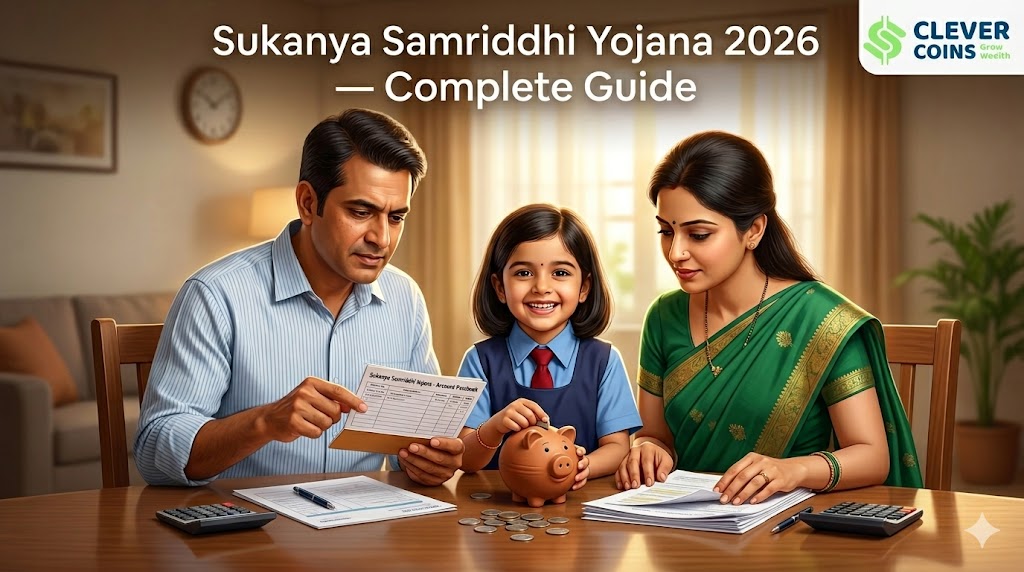
Sukanya Samriddhi Yojana (SSY) is a government-backed small savings scheme launched by the Government of India under the ‘Beti Bachao, Beti Padhao’ initiative. It was introduced on January 22, 2015, with one primary mission: to secure the financial future of the girl child in India. The scheme encourages parents and guardians to save for their daughters’ education and marriage expenses, offering one of the highest interest rates among government savings instruments.
As of 2026, SSY continues to be one of the most preferred investment choices for families with daughters aged below 10 years. With an attractive interest rate of 8.2% per annum (compounded annually), complete tax exemption under Section 80C, and sovereign guarantee, SSY stands tall as a triple-tax-exempt (EEE) investment.
This comprehensive guide covers everything you need to know about Sukanya Samriddhi Yojana in 2026 — from opening an account and eligibility rules, to interest calculation, withdrawal norms, and tax benefits.
2. Sukanya Samriddhi Yojana 2026 — Key Highlights at a Glance
Feature | Details |
Launched By | Government of India (Ministry of Finance) |
Launch Date | January 22, 2015 |
Scheme Type | Small Savings Scheme (Government Backed) |
Interest Rate (2026) | 8.2% per annum (compounded annually) |
Minimum Deposit | ₹250 per year |
Maximum Deposit | ₹1,50,000 per year |
Maturity Period | 21 years from account opening date |
Premature Closure | Allowed after 18 years of age of the girl |
Tax Benefit | Exempt under Section 80C (up to ₹1.5 lakh) |
Tax Status | EEE — Exempt-Exempt-Exempt |
Who Can Open | Parents/Guardians of a girl child below 10 years |
Max Accounts Per Family | Maximum 2 accounts (one per girl child) |
Partial Withdrawal | Up to 50% after girl turns 18 (for education) |
Penalty for Default | ₹50 per year if minimum deposit not made |
Available At | Post Offices & Authorized Banks across India |
3. Eligibility Criteria for Sukanya Samriddhi Yojana
3.1 Who Can Open an SSY Account?
- The account can be opened by a parent or legal guardian of a girl child.
- The girl child must be a resident of India.
- The girl child must be below 10 years of age at the time of account opening.
- A maximum of two SSY accounts can be opened per family — one for each girl child.
- In the case of twin or triplet girls born in the second birth, a third account is permissible with documentary proof.
3.2 Who Cannot Open an SSY Account?
- Non-Resident Indians (NRIs) cannot open a new SSY account.
- If an existing account holder becomes an NRI, the account must be closed immediately.
- Accounts cannot be opened for adopted daughters without valid legal adoption documents.
- HUF (Hindu Undivided Family) entities are not eligible.
3.3 Age Limit Details
The girl child must be below 10 years of age at the time of account opening. However, a one-year grace period was given during the launch phase (2015) for girls born between December 2, 2003, and December 1, 2004.
4. How to Open a Sukanya Samriddhi Yojana Account in 2026
4.1 Where to Open SSY Account
- Any Post Office branch across India.
- Authorized public sector banks: SBI, PNB, Bank of Baroda, Canara Bank, and many others.
- Authorized private sector banks: ICICI Bank, Axis Bank, HDFC Bank.
4.2 Step-by-Step Process to Open SSY Account
Step 1: Visit your nearest post office or authorized bank branch.
Step 2: Request the SSY account opening form (Form-1).
Step 3: Fill in the form with details of the guardian and girl child.
Step 4: Submit the required documents (see Section 4.3 below).
Step 5: Make the initial deposit (minimum ₹250, maximum ₹1,50,000).
Step 6: Collect the passbook issued by the bank/post office.
4.3 Documents Required
- Birth certificate of the girl child (mandatory).
- Identity proof of parent/guardian: Aadhaar Card, PAN Card, Passport, or Voter ID.
- Address proof: Aadhaar Card, Utility Bill, Driving License, or Passport.
- Photograph of the girl child and the guardian.
- Form-1 (Account Opening Form) duly filled and signed.
4.4 Online Account Opening — Is It Possible?
As of 2026, SSY accounts cannot be fully opened online from scratch. However, many banks offer the facility to submit forms and documents digitally after an in-person visit for biometric/KYC verification. Post offices and banks with internet banking may allow existing account holders to view their passbook and make deposits online through net banking.
5. Deposit Rules and Regulations
5.1 Minimum and Maximum Deposit
- Minimum deposit per year: ₹250
- Maximum deposit per year: ₹1,50,000
- Deposits can be made in lump sum or in multiple installments.
- There is no limit on the number of deposits per year — you can deposit any number of times.
5.2 Duration of Deposits
- Deposits must be made for a minimum of 15 years from the date of account opening.
- After 15 years, no further deposits are required, but interest continues to accumulate until the 21-year maturity period.
5.3 Default in Deposit
- If a minimum deposit of ₹250 is not made in a financial year, the account becomes irregular/defaulted.
- To revive the account, a penalty of ₹50 per defaulted year must be paid along with the minimum deposit of ₹250 per year.
5.4 Modes of Deposit
- Cash at the post office or bank counter.
- Cheque or Demand Draft.
- Online transfer through NEFT/RTGS/net banking (at authorized banks).
6. SSY Interest Rate 2026 — Everything You Need to Know
6.1 Current Interest Rate
The Sukanya Samriddhi Yojana interest rate for the financial year 2025-26 (Q1) is 8.2% per annum. The interest is compounded annually and credited to the account at the end of each financial year.
6.2 Historical Interest Rate Table
Financial Year | Interest Rate (% p.a.) |
2014-15 (Launch) | 9.1% |
2015-16 | 9.2% |
2016-17 | 8.6% |
2017-18 | 8.3% |
2018-19 | 8.5% |
2019-20 | 8.4% |
2020-21 | 7.6% |
2021-22 | 7.6% |
2022-23 | 7.6% |
2023-24 | 8.0% → 8.2% |
2024-25 | 8.2% |
2025-26 (Current) | 8.2% |
6.3 How Is Interest Calculated?
The interest is calculated on the lowest balance between the 5th and the end of the month. Therefore, it is advisable to deposit before the 5th of every month to earn maximum interest. The interest is compounded annually — meaning your interest earns interest too, creating a powerful wealth-building effect over 21 years.
Formula: A = P × (1 + r/n)^(nt)
Where: A = Maturity Amount | P = Principal deposited | r = Annual Interest Rate | n = Number of times interest compounded per year | t = Time in years
7. Sukanya Samriddhi Yojana Calculator — Maturity Amount Examples
The following table shows estimated maturity amounts assuming the 2026 interest rate of 8.2% per annum, with deposits made every year for 15 years, and interest accruing for 21 years total.
Annual Deposit (₹) | Total Invested (15 yrs) | Maturity Amount (21 yrs @ 8.2%) |
₹250 | ₹3,750 | ≈ ₹1,268 |
₹1,000 | ₹15,000 | ≈ ₹5,073 |
₹5,000 | ₹75,000 | ≈ ₹25,369 |
₹10,000 | ₹1,50,000 | ≈ ₹50,738 |
₹50,000 | ₹7,50,000 | ≈ ₹2,53,695 |
₹1,00,000 | ₹15,00,000 | ≈ ₹5,07,390 |
₹1,50,000 (Max) | ₹22,50,000 | ≈ ₹69,27,578 |
Note: Maturity amounts are approximate estimates assuming a constant rate of 8.2%. Actual amounts may vary depending on interest rate revisions by the Government of India.
8. Tax Benefits of Sukanya Samriddhi Yojana
8.1 Triple Tax Exemption (EEE Status)
SSY is classified under the EEE (Exempt-Exempt-Exempt) category — the best possible tax status for any investment in India:
- Exempt 1 — Contribution: Deposits up to ₹1,50,000 per year qualify for deduction under Section 80C of the Income Tax Act.
- Exempt 2 — Interest: The interest earned on the SSY account is fully tax-free.
- Exempt 3 — Maturity: The maturity amount is entirely tax-exempt in the hands of the depositor.
8.2 Section 80C Deduction
Under Section 80C, investments up to ₹1,50,000 per financial year in SSY are eligible for tax deduction. This reduces the taxable income of the depositor (parent/guardian) by up to ₹1.5 lakh annually, resulting in significant tax savings depending on your income tax bracket.
8.3 New Tax Regime Consideration
It is important to note that if you opt for the New Tax Regime (introduced under Section 115BAC), you will NOT be eligible for Section 80C deductions, including SSY. SSY tax deduction benefits are available only under the Old Tax Regime. Consult a financial advisor to determine which regime is more beneficial for your situation.
9. Withdrawal Rules and Premature Closure
9.1 Maturity Withdrawal
- The SSY account matures after 21 years from the date of account opening.
- The full maturity amount (principal + interest) is paid to the account holder (the girl child) at maturity.
- The girl must submit an application for closure along with proof of identity, residence, and citizenship.
9.2 Partial Withdrawal (For Education Purposes)
- A withdrawal of up to 50% of the account balance is permitted once the girl turns 18 years old.
- This withdrawal is specifically allowed for higher education expenses.
- Documentary proof of admission to a recognized educational institution must be submitted.
- The withdrawal can be made in a single lump sum or in up to 5 annual installments.
9.3 Premature Closure Before 21 Years
Premature closure is permitted only in the following circumstances:
- Death of the account holder (girl child): The account is closed immediately and the balance is paid to the guardian.
- Life-threatening illness of the account holder or death of the guardian: Premature closure is allowed with the appropriate documents.
- Marriage of the girl: The account can be closed one month before or three months after the girl’s marriage, provided she has attained 18 years of age.
- Change in residential status (NRI): If the girl becomes an NRI or non-citizen, the account must be closed.
9.4 Normal Closure After 5 Years
After completing 5 years from the account opening date, the account can be closed on grounds of extreme compassionate situations, financial hardship, or medical emergencies of the depositor. However, in this case, the interest applied will be at the Post Office Savings Account rate (approximately 4%), not the SSY rate.
10. Transferring Your SSY Account
The SSY account can be transferred freely from one post office to another or from one bank to another, anywhere in India. This makes it convenient for families who relocate. The process involves:
- Submitting a transfer request at the current branch.
- Providing the new address and new institution details.
- The balance and accumulated interest are transferred seamlessly.
- There is no fee for the transfer.
11. SSY vs Other Savings Schemes — 2026 Comparison
Feature | SSY | PPF | FD (Bank) | ELSS |
Interest Rate | 8.2% p.a. | 7.1% p.a. | 6–7.5% | Market Linked |
Investment Tenure | 21 years | 15 years | 1–10 years | 3 years (lock-in) |
Tax Benefit (80C) | Yes | Yes | Yes (5yr FD) | Yes |
Tax on Returns | Tax-Free | Tax-Free | Taxable | 10% LTCG |
Risk Level | Zero Risk | Zero Risk | Very Low | High (Market) |
Eligibility | Girl Child only | Any Indian | Any Individual | Any Individual |
Min. Deposit | ₹250/yr | ₹500/yr | ₹1,000 | ₹500/month |
Max. Deposit | ₹1.5L/yr | ₹1.5L/yr | No Limit | No Limit |
Guaranteed Returns | Yes | Yes | Yes | No |
12. Common Mistakes to Avoid with SSY
- Missing the annual minimum deposit of ₹250, which causes the account to become irregular.
- Depositing after April 5 (end of first week) — this reduces interest earned for that month.
- Opening more than two accounts thinking twins allow three — triplets/twins (second birth) is the only exception.
- Not keeping track of the maturity date and missing the claim window.
- Choosing the new tax regime without realizing you lose Section 80C benefits including SSY deductions.
- Not updating the nominee details after marriage or change in family circumstances.
- Failing to link Aadhaar with the SSY account (mandatory for continued benefits).
13. Smart Tips to Maximize Your SSY Returns in 2026
- Start as early as possible — even before the child turns 1 — to get the maximum compounding benefit over 21 years.
- Always deposit before April 5 every year to earn interest from the very first day of the financial year.
- Invest the maximum allowed amount (₹1,50,000 per year) to avail full Section 80C deduction and maximize maturity corpus.
- Use the SSY account for a specific goal — either higher education or marriage — and plan partial withdrawals accordingly.
- Keep the passbook updated regularly at your nearest bank/post office to track your growing balance.
- Link your Aadhaar card and mobile number to receive SMS alerts on deposits and interest credits.
14. Frequently Asked Questions (FAQs) — SSY 2026
Q1: Can I open an SSY account for my adopted daughter?
Yes. You can open an SSY account for an adopted daughter, provided you have valid legal adoption documents issued by a competent court. The age limit of below 10 years still applies.
Q2: Can a grandparent open an SSY account?
No. Only biological or legal parents and legal guardians are allowed to open and operate an SSY account. Grandparents cannot open the account unless they are the legal guardian of the child.
Q3: What happens to the SSY account when the girl gets married before 21 years?
The account can be prematurely closed one month before or three months after the marriage, provided the girl has attained 18 years of age. No penalty is levied in this case.
Q4: Is SSY available for NRIs?
No. NRIs are not eligible to open or maintain a Sukanya Samriddhi Yojana account. If an existing SSY account holder becomes an NRI during the tenure, the account must be closed.
Q5: Can I have both PPF and SSY for my daughter?
Yes. You can invest in both PPF and SSY simultaneously. However, the combined Section 80C deduction limit is ₹1.5 lakh per financial year across all eligible instruments.
Q6: Is there any online portal to check SSY balance?
Many banks (SBI, HDFC, ICICI, etc.) allow SSY balance checking through their internet banking or mobile banking apps. Post office SSY accounts can be checked through the India Post website or by visiting the post office.
Q7: What is the penalty for not depositing in SSY for a year?
If the minimum deposit of ₹250 is not made in a financial year, a penalty of ₹50 per defaulted year is levied. To revive the account, the depositor must pay the penalty along with the minimum deposit amount for each missed year.
Q8: Can the SSY account be closed after 21 years without the girl’s consent?
No. After maturity, the account closure requires the consent and signature of the girl child (account holder), not the parent/guardian.