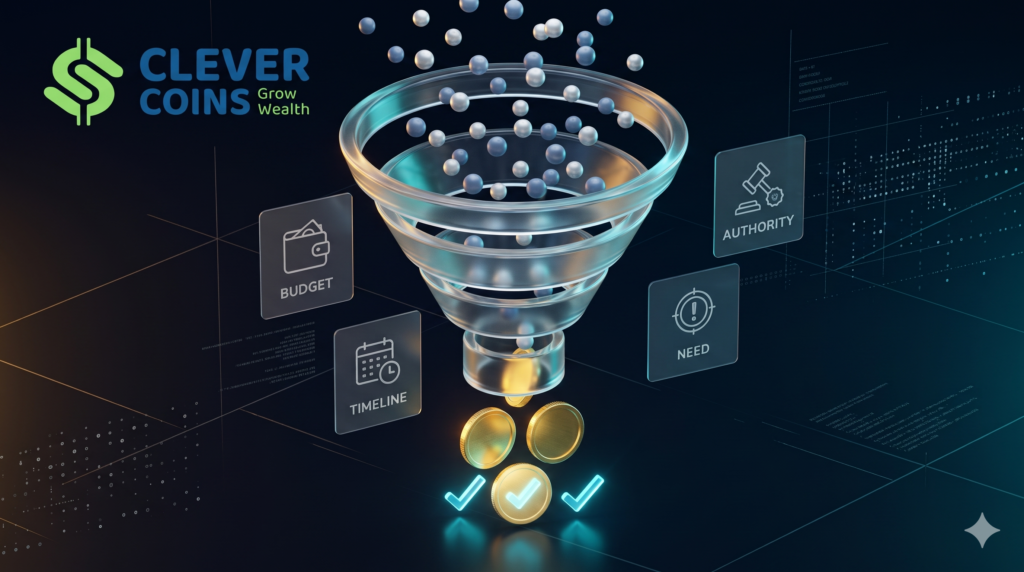
Step-by-Step Process for a Lead Qualification Framework: How to Turn Raw Leads into Predictable Revenue
Every high-growth organization eventually hits the exact same invisible wall. Marketing celebrates record-breaking top-of-funnel traffic, webinar registrations, eBook downloads, and demo requests. Meanwhile, the sales team complains that 70% of those leads have no budget, no decision-making power, no urgent pain point, or no intention of buying within the next twelve months. When marketing measures success by volume and sales measures success by closed-won revenue, the space between the two departments becomes a graveyard of wasted payroll, eroded morale, and missed quarterly targets.
The bridge across that divide is a rigorous, repeatable lead qualification framework.
Without a standardized qualification engine, sales representatives rely on gut instinct. They spend forty-five minutes on discovery calls with tiny businesses that cannot afford your minimum tier, while high-intent enterprise buyers sit uncontacted in a CRM queue for forty-eight hours until they sign with a faster competitor. A structured lead qualification process eliminates guesswork. It establishes an objective, shared language across Marketing, Sales Development Representatives (SDRs), Account Executives (AEs), and Customer Success, ensuring that human selling hours are invested exclusively in prospects who have a genuine problem you can solve and the organizational capacity to buy.
In this comprehensive guide, we will dismantle the guesswork and walk through an end-to-end, step-by-step process for building, implementing, automating, and optimizing a modern lead qualification framework from the ground up.
What Is a Lead Qualification Framework?
A lead qualification framework is a documented, systematic methodology used by revenue teams to evaluate whether a prospective buyer matches your company’s target customer profile, exhibits genuine purchase intent, and possesses the organizational criteria required to become a profitable, long-term customer.
Rather than treating every form fill or inbound inquiry as equal, a qualification framework filters prospects through progressive gates—moving them from raw Unqualified Leads to Marketing Qualified Leads (MQLs), Sales Accepted Leads (SALs), and finally Sales Qualified Opportunities (SQOs / SQLs).
Why Ad-Hoc Qualification Destroys Unit Economics
When businesses skip formal qualification, three hidden financial leaks quietly erode profit margins:
Bloated Customer Acquisition Cost (CAC): Paying expensive senior Account Executives to run full product demonstrations for unqualified prospects inflates your blended CAC and depresses sales productivity.
Distorted Pipeline Forecasting: A CRM filled with “maybe” deals creates false optimism. Leadership forecasts revenue based on inflated pipeline coverage, only to watch 80% of those deals stall in “No Decision” at the end of the quarter.
High Early-Stage Churn: Selling to a bad-fit customer just to hit a monthly quota creates downstream chaos. Bad-fit buyers overwhelm onboarding teams, demand custom features outside your roadmap, fail to see ROI, and churn within six months—destroying Lifetime Value (LTV).
A disciplined lead qualification framework protects both ends of the funnel: it accelerates high-fit buyers toward a fast close while gracefully disqualifying poor-fit prospects before they consume expensive resources.
Understanding the Core Qualification Methodologies (Before You Build)
Before designing your step-by-step workflow, your team must select the diagnostic lens SDRs and AEs will use during live conversations. Different deal sizes, buying committees, and sales cycles demand different frameworks.
| Framework | Core Criteria | Best Suited For | Primary Strength | Key Limitation |
| BANT | Budget, Authority, Need, Timeline | High-velocity SMB sales, transactional B2B, short sales cycles (<30 days) | Fast, simple to train, easy to score in CRM fields | Seller-centric; modern buyers rarely have fixed budgets before seeing value |
| CHAMP | Challenges, Authority, Money, Prioritization | Consultative mid-market sales, solution selling | Leads with buyer pain rather than interrogating about money upfront | Less rigorous around formal procurement and legal hurdles |
| ANUM | Authority, Need, Urgency, Money | Inbound-heavy SaaS and service agencies | Immediately verifies whether you are speaking to a real decision-maker | Can alienate influential champions who lack final sign-off power |
| GPCTBA/C&I | Goals, Plans, Challenges, Timeline, Budget, Authority / Consequences & Implications | Complex B2B SaaS, strategic consulting, multi-stakeholder deals | Ties product value directly to executive business goals and cost of inaction | Requires highly skilled, consultative reps to execute naturally |
| MEDDPICC | Metrics, Economic Buyer, Decision Criteria, Decision Process, Paper Process, Identify Pain, Champion, Competition | Enterprise B2B ($50k–$1M+ ACV), long cycles, complex procurement | Virtually eliminates late-stage deal surprises and “no-decision” losses | Overkill for low-ACV or rapid transactional deals |
Most modern revenue organizations adopt a hybrid two-tier model: they use lightweight automated enrichment plus CHAMP or ANUM at the top of the funnel (SDR stage) to verify fit and urgency, and transition to MEDDPICC at the middle of the funnel (AE stage) once an opportunity enters formal evaluation.
The 8-Step Process to Build and Execute Your Lead Qualification Framework
Building a qualification framework is not a one-hour brainstorming session—it is an operational architecture project. Follow these eight sequential steps to engineer a framework that aligns marketing, sales, and revenue operations.
Step 1: Define Your Ideal Customer Profile (ICP) and Anti-Personas
You cannot qualify a lead if you have not mathematically defined what “good” looks like. Many companies confuse an Ideal Customer Profile (ICP) with a Buyer Persona. They are distinct, complementary tools:
Ideal Customer Profile (ICP): Defines the organization (account-level attributes) that derives the highest value from your product and delivers the highest LTV to your business.
Buyer Persona: Defines the human individuals inside that organization (job titles, daily KPIs, frustrations, buying triggers) who champion, influence, or approve the purchase.
How to Build a Data-Backed ICP
Instead of guessing, audit your top 20% best current customers—the ones with the fastest sales cycles, highest retention, highest net revenue retention (NRR), and lowest support ticket volume. Extract common patterns across four dimensions:
Firmographics: Industry verticals, sub-sectors, annual revenue range, employee headcount, geographic markets, and corporate structure (e.g., private equity-backed, public, bootstrapped).
Technographics: Existing software stack (e.g., Salesforce vs. HubSpot, AWS vs. Azure, Shopify Plus), digital maturity, and API integration readiness.
Operational Triggers: Rapid hiring in a specific department, recent Series A/B funding, expansion into new tax or regulatory jurisdictions, mergers and acquisitions, or leadership changes (e.g., a new VP of Operations hired within the last 90 days).
Compliance & Structural Fit: Regulatory requirements, security certifications needed (SOC 2, GDPR, ISO), and minimum order or contract thresholds.
Define Your “Anti-Personas” (Explicit Disqualification Rules)
Equally important is documenting who you will not sell to. Create a clear exclusion list—for example: companies with fewer than 15 employees, businesses operating in unsupported regulatory regions, or buyers looking strictly for one-off freelance labor rather than ongoing strategic partnerships. Explicit disqualification criteria empower SDRs to say “no” early without guilt.
Step 2: Map the End-to-End Funnel Stages and Service Level Agreements (SLAs)
A qualification framework collapses if “MQL” means one thing to Marketing and something completely different to Sales. You must establish rigid, binary definitions for every stage of the lead lifecycle, backed by binding Service Level Agreements (SLAs).
Standard Lifecycle Stage Architecture
Lead / Raw Inquiry: A contact enters your database via content download, newsletter signup, event scan, or outbound prospecting list. No fit or intent verification has occurred yet.
Marketing Engaged Lead (MEL): The contact interacts with multiple brand touchpoints (e.g., visits pricing page, attends a webinar, opens three consecutive emails) but has not yet met full ICP + intent thresholds.
Marketing Qualified Lead (MQL): A contact who meets your minimum Firmographic Fit Score AND demonstrates explicit Behavioral Intent (either through high-intent hand-raising like requesting a consultation/demo, or crossing a cumulative engagement threshold).
Sales Accepted Lead (SAL): Within the agreed SLA window, an SDR reviews the MQL, confirms data accuracy, and formally accepts ownership to initiate outreach—or rejects it back to Marketing with a standardized reason code.
Sales Qualified Lead (SQL) / Opportunity: After initial discovery, the SDR confirms that the prospect meets core qualification criteria (verified pain, relevant authority, realistic timeline, and viable budget) and books a qualified discovery/demo meeting with an Account Executive, who accepts the opportunity into the active pipeline.
Disqualified / Nurture: Leads that fail qualification are segmented into either Permanent Disqualification (bad firmographic fit, competitor, student) or Long-Term Nurture (good fit, wrong timing—re-engaged automatically in 90 to 180 days).
Establishing Two-Way SLAs
Marketing SLA: Guarantees that 100% of routed MQLs meet documented ICP firmographics and carry enriched contact data (verified work email, company size, industry, and attribution source).
Sales SLA: Guarantees that high-intent inbound MQLs (demo/pricing requests) are contacted within 5 minutes during business hours, and behavioral MQLs are worked through a multi-channel sequence (phone, email, LinkedIn) within 4 business hours.
Step 3: Engineer a Two-Dimensional Lead Scoring Model
A common mistake in B2B marketing is using a single, flat lead score where downloading ten top-of-funnel PDFs gives a college student the exact same score as a VP of Finance visiting your pricing page. To prevent false positives, build a two-dimensional scoring matrix that separates Explicit Fit from Implicit Intent.
Dimension A: Explicit Fit Score (0 to 100 Points — Who They Are)
Measures how closely the lead matches your ICP and target Buyer Personas based on firmographic and demographic attributes:
Job Seniority: C-Suite / VP / Founder (+30 pts), Director / Department Head (+20 pts), Manager (+10 pts), Individual Contributor / Intern (-15 pts).
Company Size (Headcount / Revenue): Sweet-spot ICP tier (+30 pts), Secondary tier (+15 pts), Below minimum threshold (-40 pts).
Target Industry: Core high-converting vertical (+25 pts), Adjacent vertical (+10 pts), Excluded industry (-50 pts).
Corporate Email Domain: Verified business domain (+15 pts), Free webmail like Gmail/Yahoo (-10 pts).
Dimension B: Implicit Behavioral Intent Score (0 to 100 Points — What They Do)
Measures buying signals, recency, and depth of engagement across your digital ecosystem:
High-Intent Hand-Raises: Requests a demo, quote, or consultation (+60 pts); visits Pricing or Plans page twice within 7 days (+35 pts); uses an interactive ROI or tax/savings calculator (+30 pts).
Mid-Intent Evaluation: Downloads a technical comparison guide or buyer checklist (+20 pts); attends a live product webinar (+20 pts); views 3+ case studies (+15 pts).
Low-Intent Top-of-Funnel: Reads a single blog post (+3 pts); subscribes to newsletter (+5 pts); follows social media page (+2 pts).
Score Decay & Negative Signals: Subtract 10 points for every 30 days of complete inactivity so stale leads do not masquerade as active buyers. Subtract 25 points if a user visits your “Careers” page (indicating a job seeker, not a buyer).
The Fit × Intent Routing Matrix
Combine both scores into a four-quadrant operational grid:
High Fit + High Intent (A1 Leads): Immediate routing to top-performing SDR/AE + instant Slack/SMS alert + 5-minute speed-to-lead SLA.
High Fit + Low Intent (A2 Leads): Target accounts that are not yet actively shopping. Enroll in Account-Based Marketing (ABM) ads, executive invite campaigns, and outbound SDR prospecting.
Low Fit + High Intent (B1 Leads): Active shoppers outside your core ICP (e.g., smaller businesses). Route to automated self-serve checkout, low-touch group demos, or qualified partner referrals rather than senior AEs.
Low Fit + Low Intent (B2 Leads): Keep in automated educational email nurture; zero sales outreach.
Step 4: Automate Data Enrichment and Lead Routing
Speed-to-lead is one of the strongest predictors of conversion rate in modern sales. Industry benchmarks consistently show that contacting an inbound lead within five minutes dramatically increases qualification odds compared to waiting even thirty minutes. Manual lead assignment destroys that speed advantage.
Progressive Profiling & Waterfall Enrichment
Never put 14 mandatory fields on your website capture form—every unnecessary field slashes form conversion rates. Instead, capture minimal friction fields (Work Email, Name, Company) and use real-time waterfall enrichment tools (such as Clay, Clearbit/Breeze Intelligence, ZoomInfo, or Apollo) to automatically append company headcount, revenue, industry, tech stack, LinkedIn URL, and headquarters location in milliseconds before the lead ever hits your CRM.
Automated Routing Logic
Configure automated routing rules in your CRM or dedicated routing platform (such as Chili Piper, LeanData, or HubSpot Workflows) based on:
Account Ownership Check: If the lead belongs to an existing customer or an open opportunity owned by an AE, route directly to that owner to prevent internal channel conflict.
Territory & Segment Routing: Route Enterprise accounts to Enterprise SDRs, Mid-Market to Mid-Market teams, and regional inquiries to territory-aligned reps matching local time zones and languages.
Instant Calendar Booking: For high-fit leads who submit a “Book a Consultation” form, embed an instant round-robin calendar scheduler directly on the thank-you page so qualified buyers book directly onto an AE’s calendar while their buying intent is at its absolute peak.