Understanding Labor Law Compliance: Expert Tips for Modern Businesses
Managing a growing business means constantly balancing expansion with regulatory responsibility. Among all operational obligations, labor law compliance carries some of the highest financial, legal, and reputational stakes. A single misclassified contractor, an outdated wage structure, or a missed statutory filing can trigger steep penalties, back-pay liabilities, employee disputes, and regulatory audits that stall momentum.
In 2026, the compliance landscape has shifted dramatically. In India, the enforcement of the Four Labour Codes—alongside the notification of the Central Rules in May 2026—has consolidated 29 central labor statutes into a unified, digitized framework. Simultaneously, remote and hybrid work models have blurred geographic boundaries, forcing employers to track multi-state regulations regardless of where their headquarters sit.
Whether you are scaling an MSME, running a high-growth tech startup, or overseeing HR and finance for an established enterprise, proactive compliance is no longer optional—it is a competitive advantage. Below is an exhaustive, expert-backed guide to understanding labor law compliance, avoiding costly pitfalls, and building an audit-proof compliance engine.
What Is Labor Law Compliance and Why Does It Matter?
Labor law compliance refers to an organization’s adherence to all statutory laws, regulations, rules, and administrative guidelines governing the relationship between employers and workers. These rules span the entire employee lifecycle—from recruitment, onboarding, and wage structuring to workplace safety, social security contributions, leave entitlements, and full-and-final separation.
At its core, labor compliance protects two parties simultaneously:
Workers, by guaranteeing fair wages, safe working conditions, social security nets, non-discriminatory treatment, and formal documentation.
Businesses, by shielding founders, directors, and HR leaders from criminal prosecution, compounding fines, litigation, and operational shutdowns.
The True Cost of Non-Compliance
Many founders mistakenly treat HR and statutory compliance as an administrative afterthought until a labor inspector arrives or a disgruntled employee files a grievance. The consequences of non-compliance go far beyond nominal late fees:
Financial Penalties and Compounding Interest: Under India’s updated compliance framework and global labor standards, delayed Provident Fund (PF), Employees’ State Insurance (ESI), or minimum wage disbursements attract heavy statutory damages, penal interest, and per-day fines.
Back-Pay and Retroactive Liabilities: Misclassifying full-time staff as independent consultants or miscalculating the statutory “wage” base can force a company to pay years of unpaid overtime, gratuity, bonus, and social security contributions in a lump sum.
Director and Officer Liability: Severe violations—especially those involving workplace safety failures, non-deposit of deducted employee PF contributions, or failure to maintain mandatory sexual harassment redressal mechanisms—can expose company directors to personal legal liability.
Due Diligence Deal-Breakers: During venture capital fundraising, mergers, or acquisitions, investors conduct rigorous legal and secretarial due diligence. Unresolved labor notices or non-compliant payroll structures routinely lead to valuation haircuts, escrow holdbacks, or abandoned deals.
The 2026 Regulatory Shift: India’s Four Labour Codes Explained
For businesses operating in India, understanding labor law compliance requires mastering the Four Labour Codes, which came into effect on November 21, 2025, with final Central Rules notified in May 2026. By replacing 29 fragmented central laws, 1,228 sections, and 84 registers with 4 streamlined codes and 8 standardized registers, the government has emphasized digital transparency, uniform definitions, and universal worker protection.
1. The Code on Wages, 2019
This code governs minimum wages, timely payment of salaries, and statutory bonuses across all sectors—removing the old restriction that limited protections only to scheduled employments or employees earning below ₹24,000 per month.
Uniform Definition of “Wages”: Basic pay, Dearness Allowance (DA), and retaining allowance must constitute at least 50% of total remuneration. If excluded allowances (like HRA, conveyance, or special allowances) exceed 50% of the total CTC, the excess is automatically added back into “wages” for calculating PF, gratuity, and bonus.
Universal Minimum Wage & Floor Wage: Every employee—whether blue-collar or white-collar—is entitled to statutory minimum wages set by the respective state government, which cannot fall below the Central Government’s national floor wage.
Strict Settlement Timelines: Upon resignation, dismissal, retrenchment, or removal, full and final wage settlement must be completed within two working days.
2. The Code on Social Security, 2020
This code consolidates nine social security laws covering EPF, ESI, maternity benefits, gratuity, and employee compensation, while formally bringing gig workers, platform workers, and fixed-term employees into the social safety net.
One-Year Gratuity for Fixed-Term Employees: Fixed-term contract employees are now entitled to pro-rata gratuity after completing just one year of continuous service, compared to the five-year threshold for permanent staff.
Gig and Platform Worker Welfare: Aggregators must contribute 1% to 2% of their annual turnover (capped at 5% of payouts to gig/platform workers) toward a dedicated social security fund.
Expanded ESIC and EPFO Coverage: Establishments with 10 or more employees (and even single-employee hazardous units) fall under ESIC, with pan-India applicability and higher wage ceilings expanding worker coverage.
3. The Occupational Safety, Health and Working Conditions (OSH) Code, 2020
The OSH Code merges 13 laws governing factories, contract labor, interstate migrant workers, shops, and commercial establishments.
Single Registration and Electronic Returns: Businesses benefit from one registration, one license, and a single unified electronic return, slashing paperwork by nearly 90%.
Mandatory Formal Appointment Letters: Every employee must receive a formal, written appointment letter in a prescribed format detailing job role, wages, and social security entitlements.
Working Hours and Overtime: Standard working hours remain capped at 8 hours per day and 48 hours per week. Overtime requires worker consent, must be paid at twice the ordinary wage rate, and cannot exceed 144 hours per quarter.
Women in Night Shifts & Crèche Facilities: Women can work in any sector before 6:00 AM and after 7:00 PM provided they give written consent and the employer ensures adequate safety, transport, and welfare safeguards. Establishments with 50 or more employees must provide a crèche facility within 1 km or pay a statutory crèche allowance of at least ₹500 per child (for up to two children).
4. The Industrial Relations (IR) Code, 2020
The IR Code governs trade unions, standing orders, dispute resolution, layoffs, and retrenchment.
Higher Threshold for Standing Orders: Industrial establishments now require certified Standing Orders and prior government approval for layoffs, retrenchment, or closure only when employing 300 or more workers (raised from the earlier threshold of 100), giving mid-sized businesses greater operational agility.
Worker Re-Skilling Fund: For every retrenched worker, the employer must contribute an amount equivalent to 15 days’ last drawn wages into a government-administered Re-Skilling Fund within 10 days.
Core Pillars of Labor Law Compliance Every Business Must Master
Regardless of jurisdiction or headcount, robust labor law compliance rests on seven foundational pillars. Weakness in any single pillar creates audit exposure.
Pillar 1: Accurate Worker Classification
Misclassifying employees as independent contractors, freelancers, or interns is the single most common compliance failure worldwide. Regulators look past contract labels and apply the “economic reality” and “control” tests:
Do you dictate when, where, and how the individual works?
Are they integrated into your core business operations and using company equipment?
Do they work exclusively for your organization rather than serving multiple clients?
If the answer is yes, tax and labor authorities will reclassify the individual as an employee—triggering retroactive PF, ESI, tax withholding, overtime, and benefit liabilities.
Pillar 2: Wage Structuring and Payroll Accuracy
Compliance errors frequently hide inside Cost-to-Company (CTC) breakdowns. Many companies artificially depress Basic Salary to minimize PF and gratuity outflows by inflating “Special Allowances.” Under current rules, keeping Basic + DA below 50% of total remuneration triggers automatic statutory recalculations. Furthermore, payroll teams must monitor:
Off-the-Clock Work: Pre-shift setup, mandatory training, after-hours emails/messages for non-exempt staff, and travel between job sites all count as compensable working time.
Authorized Deductions Only: Employers cannot make arbitrary deductions from wages for damaged equipment, missed targets, or notice-period shortfalls unless strictly permitted by statute and backed by a documented show-cause notice process.
Pillar 3: Mandatory Statutory Registrations and Filings
Depending on headcount and business activity, employers must obtain and maintain active registrations across multiple authorities:
Shops and Establishments Act Registration: Mandatory for almost all commercial offices, retail outlets, and IT/service firms within 30 days of commencing operations.
EPFO (Provident Fund) & ESIC (State Insurance): Mandatory once employee thresholds (20 for EPF, 10 for ESI) are crossed, with monthly challans due by the 15th of every month.
Professional Tax (PT) & Labour Welfare Fund (LWF): State-specific levies deducted from employee salaries and remitted monthly, quarterly, or semi-annually.
Contract Labour (CLRA) Licenses: Principal employers engaging contract manpower through staffing agencies must verify that contractors hold valid licenses and deposit PF/ESI for deployed workers—otherwise, the principal employer becomes liable by default.
Pillar 4: Workplace Health, Safety, and Anti-Harassment (POSH)
Compliance extends to physical and psychological safety:
POSH Act Compliance: Every organization with 10 or more employees must constitute an Internal Committee (IC) with an external member, draft an anti-sexual harassment policy, conduct mandatory annual employee sensitization workshops, and file an annual POSH report with the District Officer.
Physical Safety & Annual Health Checks: Establishments must maintain clean, well-ventilated workspaces, separate washrooms for male, female, and transgender workers, first-aid kits, fire safety clearances, and free annual medical check-ups for eligible employees aged 40 and above.
Pillar 5: Leave, Holidays, and Statutory Benefits
Employers must harmonize internal HR leave policies with statutory minimums:
Earned / Privilege Leave: Typically accrued at 1 day for every 20 days worked, with rules governing annual carry-forward and encashment.
Maternity Benefit Compliance: Female employees who have worked at least 80 days in the preceding 12 months are entitled to 26 weeks of paid maternity leave (for the first two children), nursing breaks, and work-from-home options where feasible.
National and Festival Holidays: State laws mandate a minimum number of paid public holidays (including Republic Day, Independence Day, Gandhi Jayanti, and state-specific festival days), with double wages or compensatory off required if staff work on those days.
Pillar 6: Digital Record-Keeping and Statutory Registers
“If it isn’t documented, it didn’t happen.” During an inspection, the burden of proof lies entirely on the employer. Organizations must maintain up-to-date, tamper-proof digital or physical records for at least 5 years, including:
Register of Employees and Muster Roll (Attendance & Overtime)
Register of Wages, Deductions, and Fines
Signed Appointment Letters and Employee Nomination Forms (Form 2 for EPF, Form 1 for ESI, Form F for Gratuity)
Accident and Dangerous Occurrence Logs
Pillar 7: Mandatory Workplace Notices and Posters
Labor laws require employers to display statutory abstracts and notices conspicuously at the workplace—and digitally on company intranets for remote workers—covering minimum wage rates, working hours, POSH committee contact details, maternity benefits, and payment of bonus rules.
10 Expert Tips to Master Labor Law Compliance
Staying ahead of evolving regulations doesn’t require an army of lawyers; it requires structured systems, disciplined workflows, and proactive governance. Here are 10 actionable tips from seasoned compliance and finance professionals:
1. Re-Architect Your Salary Structures Around the 50% Wage Rule
Audit your existing CTC templates immediately. Ensure that Basic Pay plus Dearness Allowance equals at least 50% of total gross compensation. Adjust employer PF and gratuity provisioning in your financial forecasts now so that statutory recalculations don’t erode your operating margins mid-year.
2. Build a Multi-State Compliance Matrix for Remote and Hybrid Teams
Compliance obligations follow where the employee physically works, not where your company is registered. If you have a developer working remotely from Bengaluru, a marketer in Mumbai, and a sales lead in Delhi, you must track Professional Tax, Shops & Establishments rules, minimum wages, and state holiday calendars across all three states. Maintain a centralized state-by-state compliance matrix and distribute digital statutory posters via your HRMS portal.
3. Standardize Onboarding with Compliant Appointment Letters
Never let a new hire start work on a verbal offer or an informal email. Issue a legally vetted, prescribed-format appointment letter on Day 1 that explicitly defines probation terms, working hours, notice periods, intellectual property assignment, confidentiality, and itemized salary components. Collect signed statutory nomination forms during onboarding rather than chasing employees months later.
4. Conduct Quarterly Internal Compliance Self-Audits
Do not wait for a government notice or an investor audit to uncover gaps. Schedule internal compliance health checks every quarter focusing on high-risk areas:
Reconcile payroll registers against monthly EPF, ESI, and PT challans.
Verify contractor invoices against their statutory PF/ESI payment receipts.
Check attendance logs for unapproved overtime or missed weekly rest days.
Document every audit finding and remediation step to demonstrate “good-faith compliance” to regulators.
5. Automate Payroll, Time-Tracking, and Statutory Filings
Manual spreadsheets are compliance liabilities. Invest in cloud-based HRMS and payroll software that automatically updates state minimum wage slabs, calculates overtime at 2x rates, enforces quarterly overtime caps, generates statutory registers in prescribed formats, and creates electronic challan files (ECR) without human formula errors.
6. Audit Independent Contractor and Consultant Agreements Rigorously
If you engage freelancers, retainers, or consultants, ensure their contracts are deliverable-based rather than hours-based. Avoid issuing company email IDs with employee titles, enforce clear Statements of Work (SOWs), allow them to serve other clients, and pay against GST-compliant tax invoices rather than monthly payroll runs.
7. Audit Third-Party Staffing and Facility Vendors
Under the Contract Labour framework, if your housekeeping, security, or IT staffing vendor defaults on paying minimum wages or depositing EPF/ESI for staff deployed at your premises, the law holds you (the principal employer) financially liable. Make it a non-negotiable policy to hold vendor payments until they submit verified PF/ESI challans and ECR copies showing your deployed workers’ names.
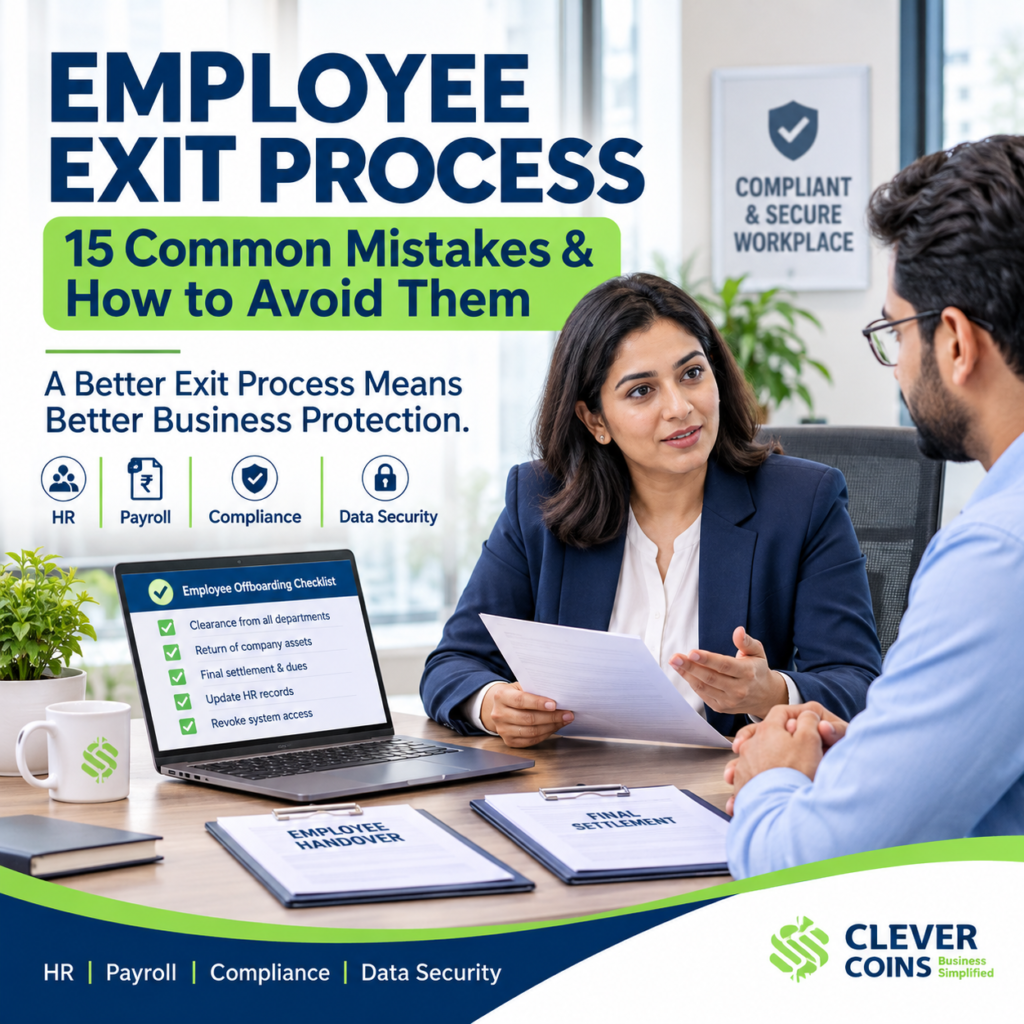
8. Establish a 48-Hour Full-and-Final (FnF) Offboarding Workflow
With the Code on Wages mandating wage settlement within two working days of an employee’s exit, traditional 30-to-45-day FnF cycles are no longer compliant. Build a rapid offboarding checklist where IT asset recovery, manager sign-off, leave encashment calculation, and payroll processing trigger automatically the moment an employee submits a resignation or receives a termination notice.
9. Train Frontline Managers—Not Just HR
Most labor disputes originate on the floor with team leads and department managers who unknowingly violate laws—such as denying a pregnant employee reasonable accommodations, asking non-exempt staff to work off the clock, mishandling a harassment complaint, or terminating an underperformer without documenting performance warnings. Conduct mandatory semi-annual training for all people managers on bias-free hiring, timekeeping, leave approvals, and anti-retaliation rules.
10. Subscribe to Regulatory Alerts and Retain External Compliance Counsel
Labor rules evolve continuously through state notifications, court rulings, and floor-wage revisions. Subscribe to official Ministry of Labour bulletins, configure alerts on your compliance calendar, and partner with specialized financial and legal compliance advisors (like CleverCoins) who can translate legislative changes into practical payroll and tax strategies before deadlines hit.
Comprehensive Labor Law Compliance Checklist for 2026
Use this quick-reference audit checklist to benchmark your organization’s compliance readiness across lifecycle stages:
| Compliance Area | Mandatory Action Item | Frequency |
| Registrations & Licenses | Maintain active Shops & Establishments, EPFO, ESIC, PT, LWF, and CLRA registrations/licenses. | One-time / On renewal |
| Onboarding | Issue prescribed formal appointment letters; collect EPF/ESI/Gratuity nominations. | Every new hire |
| Salary & Payroll | Verify Basic + DA ≥ 50% of total remuneration; pay wages on or before the 7th/10th of the month. | Monthly |
| Statutory Remittances | Deposit EPF, ESIC, TDS, and PT challans before statutory due dates without delay. | Monthly |
| Working Hours & Overtime | Enforce ≤ 8 hrs/day and ≤ 48 hrs/week; pay 2x overtime; cap overtime at 144 hrs/quarter. | Ongoing / Quarterly |
| POSH Compliance | Maintain active Internal Committee (10+ staff), run employee training, and file Annual POSH Report. | Annual |
| Workplace Notices | Display updated physical and digital labor law posters in English and local languages. | Semi-Annual |
| Registers & Returns | Maintain the 8 unified electronic registers and submit the single unified annual return. | Monthly / Annual |
| Offboarding (FnF) | Disburse final wages within 2 working days of separation; settle gratuity where applicable. | Per exit event |
Frequently Asked Questions (FAQs)
1. Does labor law compliance apply to small startups with fewer than 10 employees?
Yes. While thresholds for EPF (20 employees), ESIC (10 employees), and POSH Internal Committees (10 employees) apply once headcount grows, foundational laws—including the Code on Wages, Shops and Establishments Act registration, mandatory formal appointment letters, minimum wage rules, and 2-day full-and-final wage settlement—apply from your very first employee.
2. How does the 50% wage rule impact employee take-home pay?
If an employee’s current Basic Salary is below 50% of their total CTC, restructuring payroll to meet the 50% threshold increases the base on which EPF (12%) and Gratuity (4.81%) are calculated. While this boosts the employee’s long-term retirement corpus, it can slightly reduce monthly net take-home pay unless the employer absorbs the increased employer-side statutory contributions.
3. What are the rules for hiring remote employees across different Indian states?
Under labor law principles, the applicable minimum wage, Professional Tax, Labour Welfare Fund, and public holiday rules are determined by the state where the employee physically performs their work, not the state where your corporate headquarters is located. Employers must register for state-specific PT/LWF where required and provide digital access to state labor notices.
4. Can we hire employees on fixed-term contracts instead of permanent roles?
Yes. The Labour Codes explicitly recognize Fixed-Term Employment (FTE) across sectors. However, fixed-term employees must receive the exact same wages, working hours, and benefits as permanent employees doing similar work, and they become eligible for pro-rata gratuity after just one year of service.
5. How long must a business retain labor and payroll compliance records?
Under the updated Labour Code rules, employers must preserve statutory registers, wage slips, attendance logs, and inspection records (in physical or electronic form) for a minimum period of 5 years.