A holding company is one of the most powerful corporate structures used by large conglomerates and growing businesses in India. Whether you are an entrepreneur planning business expansion, an investor looking to diversify, or a corporate professional studying business law, understanding holding companies is essential in 2026.
In this comprehensive guide, we break down everything you need to know — from the legal definition under Indian law to tax benefits, compliance requirements, and real-world examples from the Indian market.
What is a Holding Company?
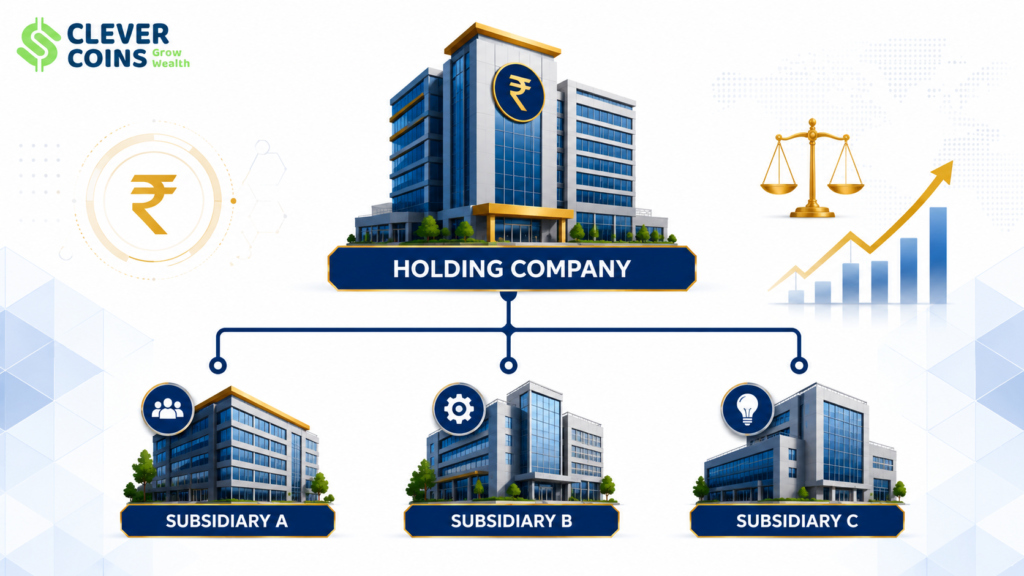
A Holding Company is a company that owns a controlling interest (more than 50% of the voting shares) in one or more other companies, known as Subsidiary Companies. The holding company does not typically engage in direct business operations itself; instead, it controls and manages its subsidiaries.
Under Section 2(46) of the Companies Act, 2013, a holding company is defined as:
“A company shall be deemed to be the holding company of another if that other is its subsidiary company.”
Simple Example
Imagine a company called ABC Holdings Pvt. Ltd. It owns 70% of the shares of XYZ Retail Pvt. Ltd. and 60% of PQR Tech Pvt. Ltd. In this case, ABC Holdings is the Holding Company, while XYZ Retail and PQR Tech are its Subsidiaries.
Legal Framework: Holding Companies Under Indian Law in 2026
Companies Act, 2013
The primary legislation governing holding companies in India is the Companies Act, 2013. Key sections include:
- Section 2(46): Definition of a Holding Company
- Section 2(87): Definition of a Subsidiary Company
- Section 129: Consolidated Financial Statements requirement
- Section 186: Loans and investments by companies
- Section 179 read with Section 180: Board resolutions for inter-company transactions
SEBI Regulations (2026)
For listed holding companies, SEBI (Securities and Exchange Board of India) has updated regulations that include:
- SEBI (Listing Obligations and Disclosure Requirements) Regulations, 2015 — amended up to 2026
- Mandatory disclosure of all subsidiary transactions in the annual report
- Material subsidiary policy: A subsidiary contributing 10% or more to consolidated revenue is considered ‘material’
- At least one independent director of the holding company must be on the board of a material listed subsidiary
RBI Guidelines for Holding Companies (2026)
The Reserve Bank of India (RBI) regulates Non-Banking Financial Companies (NBFCs) that act as holding companies. Key rules include:
- Core Investment Companies (CICs) must have assets of at least ₹100 crore to require RBI registration
- CICs must invest at least 90% of their net assets in group companies
- Not more than 30% of owned funds can be raised from public funds
Types of Holding Companies in India
Type | Description | Indian Example |
Pure Holding Company | Only holds shares; no direct operations | Tata Sons Pvt. Ltd. |
Mixed Holding Company | Holds shares AND conducts its own business | Reliance Industries Ltd. |
Intermediate Holding Company | Subsidiary of a parent but holds its own subsidiaries | Wipro Enterprises |
Financial Holding Company | Primarily holds financial/banking subsidiaries | Bajaj Finserv Ltd. |
Core Investment Company (CIC) | RBI-regulated; invests in group companies | Kotak Mahindra Investments |
Shell Holding Company | Minimal operations; mainly holds assets or IP | Various SPV Structures |
Holding Company vs Subsidiary Company vs Associate Company
Feature | Holding Company | Subsidiary Company | Associate Company |
Ownership | Owns >50% shares | Owned by holding co. | 20–50% ownership |
Control | Full control | Controlled | Significant influence |
Legal definition | Sec. 2(46) CA 2013 | Sec. 2(87) CA 2013 | Sec. 2(6) CA 2013 |
Financial statements | Consolidates all | Consolidated into parent | Equity method used |
Board autonomy | Sets board policy | Limited autonomy | Influenced, not controlled |
Indian example | Tata Sons | Tata Motors | Tata Teleservices |
Why Set Up a Holding Company in India? Key Benefits
1. Centralised Control and Strategic Planning
A holding company allows promoters to control multiple businesses from a single entity. Decision-making, capital allocation, and strategic direction are centralised, making it easier to manage diversified business empires like the Tata Group or Aditya Birla Group.
2. Limited Liability Protection
Each subsidiary is a separate legal entity. If one subsidiary incurs losses or faces litigation, the assets of other subsidiaries and the holding company itself are protected. This ring-fencing of risk is a major advantage.
3. Tax Efficiency — 2026 Indian Tax Rules
Under Indian tax law, there are several tax advantages for holding company structures:
- Dividend Income: Under Section 10(34) of the Income Tax Act, dividends received by an Indian holding company from domestic subsidiaries were previously exempt. Post the Finance Act 2020 amendments, dividends are now taxable in the hands of the holding company at applicable rates. However, inter-company dividends within a group can be managed through tax planning.
- Group Consolidation for MAT: Minimum Alternate Tax (MAT) applies at 15% of book profits for companies with a book profit exceeding ₹0 (updated rate as of 2026).
- Capital Gains Management: Transfer of shares between holding and wholly-owned subsidiary is exempt from capital gains tax under Section 47(iv) and (v) of the Income Tax Act.
- Intra-group Services: Transfer pricing regulations (Sections 92–92F) govern transactions between holding and subsidiary to prevent profit shifting.
4. Easier Capital Raising
Holding companies can raise funds at the parent level and channel capital to subsidiaries that need it most. They can also pledge shares of subsidiaries as collateral for loans. For example, Adani Enterprises has frequently used inter-company fund flows for capital allocation across its ports, energy, and infrastructure businesses.
5. Facilitates Mergers and Acquisitions
Acquisitions are simpler through a holding structure. The holding company can acquire a new business by purchasing its shares, integrating it as a subsidiary without disturbing existing subsidiary operations.
6. Intellectual Property (IP) Centralisation
Brands, patents, trademarks, and technology can be held by the holding company and licensed to subsidiaries. This protects IP assets and creates a royalty revenue stream within the group.
7. Succession Planning and Family Business Structuring
Holding companies are widely used by Indian family businesses (like the Birla or Ambani families) to facilitate smooth succession planning, prevent fragmentation of ownership, and maintain family control even as businesses grow.
How to Incorporate a Holding Company in India — Step-by-Step (2026)
Step 1: Choose the Right Business Structure
Most Indian holding companies are incorporated as:
- Private Limited Company (Pvt. Ltd.) — most common for closely held groups
- Public Limited Company (Ltd.) — if public listing is planned
- LLP — not recommended for holding structures due to investment restrictions
Step 2: Register with the Ministry of Corporate Affairs (MCA)
All companies must be registered under the Companies Act, 2013 through the MCA portal (mca.gov.in). Key requirements in 2026:
- Minimum 2 directors (Pvt. Ltd.) or 3 directors (Public Ltd.)
- Minimum 2 shareholders
- Minimum paid-up capital: No prescribed minimum under CA 2013 (abolished in 2015), though banks may require ₹1 lakh or more for account opening
- Digital Signature Certificate (DSC) and Director Identification Number (DIN) required
Step 3: File SPICe+ Form
The Simplified Proforma for Incorporating Company Electronically Plus (SPICe+) is the unified form for company incorporation. It covers name reservation, incorporation, DIN allotment, PAN, TAN, EPFO, ESIC registration, and GST registration in a single application.
Step 4: Draft Memorandum and Articles of Association (MoA & AoA)
The MoA should clearly specify that the company’s main object includes ‘holding investments in shares, securities, and subsidiaries.’ The AoA should detail provisions for inter-company transactions, dividend policies, and board composition.
Step 5: Obtain Relevant Licences
Depending on the nature of subsidiaries:
- If operating as a CIC: RBI Certificate of Registration required
- If holding listed subsidiaries: SEBI compliance framework required
- GST Registration if providing taxable services to subsidiaries
Step 6: Complete Post-Incorporation Compliances
- Annual ROC filings: Form AOC-4 (Financial Statements), Form MGT-7 (Annual Return)
- Board meetings: Minimum 4 per year
- Statutory audit by a Chartered Accountant
- Consolidated financial statements as per Ind AS
Financial Aspects of a Holding Company in India — 2026 Numbers
Cost of Setting Up a Holding Company (Indicative Costs in ₹)
Item | Approximate Cost (INR) |
Company Incorporation Fees (SPICe+) | ₹5,000 – ₹15,000 |
Professional/CA/Legal Fees | ₹20,000 – ₹75,000 |
Share acquisition costs (stamp duty) | 0.25% of transaction value (varies by state) |
Annual compliance (ROC, audit) | ₹30,000 – ₹1,50,000 per year |
RBI CIC registration (if applicable) | ₹25,000 (application fee) |
Transfer pricing study (if applicable) | ₹2,00,000 – ₹10,00,000 |
Dividend Income Taxation (2026 Framework)
As per the current Indian tax regime (Finance Act 2020 changes, applicable in 2026):
- Dividends received by holding companies from subsidiaries are taxable as ‘Income from Other Sources’ at applicable corporate tax rates
- Domestic companies: Taxed at 22% (base) + 10% surcharge + 4% cess = effective ~25.17%
- New manufacturing companies under Section 115BAB: 15% base rate
- However, Section 80M allows deduction for dividends redistributed to shareholders within a prescribed time, preventing cascading taxation
Compliance Requirements for Holding Companies in India (2026)
Annual Compliances Under Companies Act, 2013
- File Form AOC-4 (Standalone & Consolidated Financial Statements) within 60 days of AGM
- File Form MGT-7/7A (Annual Return) within 60 days of AGM
- Hold Annual General Meeting (AGM) within 6 months of financial year end (September 30 for March year-end companies)
- Maintain statutory registers at registered office
- Appoint Company Secretary if paid-up capital exceeds ₹5 crore or turnover exceeds ₹250 crore
SEBI Compliance (For Listed Holding Companies)
- Quarterly results filing within 45 days of quarter end
- Disclosure of related party transactions every 6 months
- Material subsidiary policy disclosure in Annual Report
- Minimum 50% independent directors on board
Income Tax Compliances
- File ITR-6 by October 31 (or November 30 if transfer pricing applicable)
- Transfer Pricing Report in Form 3CEB if international transactions exceed ₹1 crore or domestic specified transactions exceed ₹20 crore
- TDS compliance on all payments to subsidiaries for services
- Country-by-Country Reporting (CbCR) in Form 3CEAD if consolidated group revenue exceeds ₹5,500 crore
Landmark Indian Holding Company Structures — Case Studies
1. Tata Sons Private Limited
The ultimate holding company of the Tata Group, Tata Sons holds shares in over 100 companies including Tata Motors, TCS, Tata Steel, and Taj Hotels. The structure allows Sir Ratan Tata’s vision to be implemented across diverse sectors while each subsidiary operates with its own board and management team.
2. Reliance Industries Limited
Reliance operates as a mixed holding company — it directly conducts businesses in oil refining and chemicals while also holding significant stakes in Jio Platforms, Reliance Retail, and Reliance Jio Infocomm. This hybrid model allows cross-subsidisation and unified capital access.
3. Bajaj Finserv Limited
Bajaj Finserv is a financial holding company that holds stakes in Bajaj Finance, Bajaj Allianz Life Insurance, and Bajaj Allianz General Insurance. It is registered as a Non-Deposit Taking NBFC (ND-NBFC) and is RBI-regulated. Its structure allows it to tap the financial services sector through multiple licensed subsidiaries.
Challenges and Risks of Holding Company Structures
- Complex Compliance: Multiple subsidiaries mean multiple annual filings, audits, and board meetings — significantly increasing compliance costs.
- Transfer Pricing Scrutiny: The Income Tax Department closely monitors transactions between holding and subsidiary companies to prevent tax avoidance. Penalties under Section 271G can reach 2% of the transaction value.
- Minority Shareholder Disputes: Minority shareholders in subsidiaries may challenge decisions made by the holding company if they feel their interests are being harmed (Section 241-242, CA 2013).
- Cascading Taxes: Even with Section 80M relief, multi-layered dividend flows can still result in tax leakage across layers.
- Regulatory Overlap: Holding companies dealing with banking, insurance, or securities subsidiaries face multiple regulators (RBI, IRDAI, SEBI) — creating a complex compliance environment.
- Reputational Risk: A scandal in one subsidiary can affect the reputation and stock price of the listed holding company, even if legally ring-fenced.
Holding Company vs Direct Investment — Which is Better?
Criteria | Holding Company Structure | Direct Investment |
Liability Protection | High — ring-fencing per entity | Low — investor exposed directly |
Tax Planning | More options via inter-company structure | Limited |
Capital Raising | Easier via parent-level fundraising | Project-by-project basis |
Compliance Burden | High — multiple entities | Lower — single entity |
Succession Planning | Superior — shares can be transferred | Complex — direct assets |
Regulatory oversight | Higher scrutiny | Standard scrutiny |
Cost of Setup | Higher initial cost | Lower |
Best For | Multi-business conglomerates | Single-business owners |
Future of Holding Companies in India — 2026 and Beyond
The holding company model is evolving rapidly in India. Key trends to watch include:
- Digital-First Holding Structures: Technology conglomerates like Nykaa and Zomato are creating holding structures to house their fintech and logistics subsidiaries.
- ESG Compliance Integration: SEBI’s Business Responsibility and Sustainability Report (BRSR) mandate is pushing holding companies to implement group-wide ESG governance.
- Increased NCLT Jurisdiction: The National Company Law Tribunal (NCLT) is increasingly active in holding company disputes — especially on related party transactions and oppression/mismanagement matters.
- Budget 2026 Proposals: The Union Budget 2026 is expected to further rationalise dividend taxation and inter-company loan regulations based on the recommendations of the Taxation Simplification Committee.
- GIFT City Holding Structures: International holding companies are increasingly being set up in Gujarat International Finance Tec-City (GIFT City) to take advantage of the International Financial Services Centre (IFSC) tax regime, including 100% tax holiday for 10 years.
Frequently Asked Questions (FAQs)
Q1. Is a holding company a separate legal entity in India?
Yes. A holding company is a fully independent legal entity, incorporated under the Companies Act, 2013, with its own PAN, CIN, bank accounts, and statutory obligations.
Q2. Can a Private Limited Company be a holding company?
Yes. Both private and public limited companies can be holding companies under Indian law. Most family-held conglomerates prefer the private limited structure for their holding vehicle.
Q3. Does a holding company need GST registration?
If the holding company provides taxable services (e.g., management services, IP licensing, brand fees) to its subsidiaries, GST registration is mandatory. Threshold: ₹20 lakh aggregate turnover (₹10 lakh for special category states).
Q4. Can a holding company hold foreign subsidiaries?
Yes, subject to FEMA (Foreign Exchange Management Act) regulations. Indian companies can set up foreign subsidiaries under the Overseas Direct Investment (ODI) framework regulated by RBI. The Liberalised Remittance Scheme (LRS) for individuals and ODI Master Direction for companies apply.
Q5. What is the minimum ownership to be called a holding company?
Under Section 2(87) of the Companies Act, 2013, a company becomes a holding company if it owns more than 50% of the total voting power of the subsidiary, OR controls the composition of the subsidiary’s board of directors.
Q6. How is a holding company taxed in India in 2026?
A holding company is taxed as per the normal corporate tax rates: 22% for domestic companies (plus surcharge and cess = ~25.17% effective rate), unless it opts for the new regime at 15% (new manufacturing companies). Dividend income from subsidiaries is taxable and a deduction under Section 80M is available for dividends further paid out.