
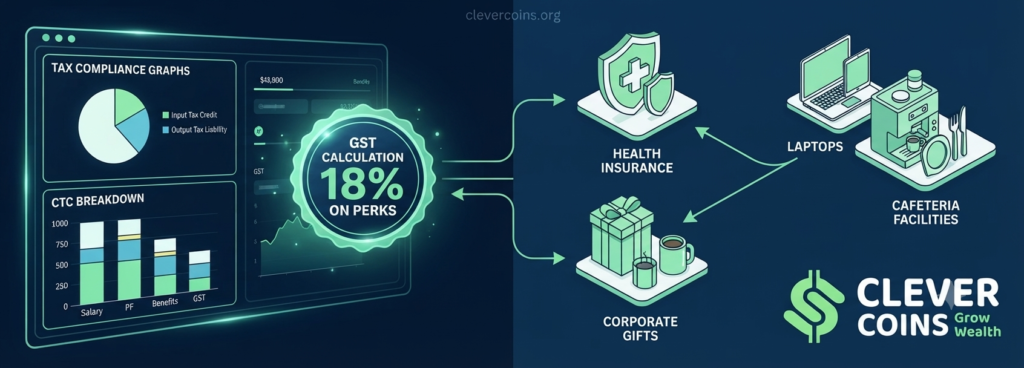
Demystifying GST on Employee Benefits & CTC Components: A Comprehensive Compliance Guide for Businesses
Introduction: The Intersection of HR Policies and Indirect Taxation
When the Goods and Services Tax (GST) regime was introduced in India, its primary objective was to subsume a multiplicity of indirect taxes into a unified framework. However, years into its implementation, corporate boardrooms, Human Resources (HR) departments, and finance professionals continue to navigate a complex grey area: GST on employee benefits and Cost-to-Company (CTC) components.
Traditionally, the relationship between an employer and an employee was governed strictly by labor laws, employment contracts, and Income Tax regulations (specifically regarding perquisites). With the advent of GST, transactions involving employers and employees have been thrown under the scanner of indirect tax authorities.
At CleverCoins, we regularly assist growing and enterprise-level businesses in decoding complex tax structures. Understanding how GST applies to salaries, allowances, workplace amenities, and perquisites is no longer optional—it is a critical necessity to avoid unexpected tax liabilities, penalties, and blocked Input Tax Credit (ITC).
Understanding the Statutory Framework: Employer-Employee Relations under GST
To comprehend how GST impacts employee benefits, we must first examine the legal provisions enshrined under the Central Goods and Services Tax (CGST) Act, 2017:
-
Section 7 (Scope of Supply): For any activity to attract GST, it must qualify as a “supply” of goods or services made for a consideration in the course or furtherance of business.
-
Schedule III (Activities or Transactions Treated Neither as Supply of Goods nor Supply of Services): Entry 1 of Schedule III explicitly states that services by an employee to the employer in the course of or in relation to his employment shall not be treated as a supply of goods or services. This means an employee’s service to their company for a salary is out of GST’s scope.
-
Schedule I (Activities to be Treated as Supply Even if Made Without Consideration): Entry 2 of Schedule I specifies that supplies of goods or services between related persons or distinct persons—when made in the course or furtherance of business—are deemed supplies, even if made without consideration.
-
The Explanation to Section 15: Employer and employee are deemed to be “related persons” under the tax statute.
Because of this “related party” clause, any free goods, services, or facilities provided by an employer to an employee outside or inside the contractual arrangement can potentially trigger tax implications, depending on how they are structured.
CTC Components and GST: What Falls In and What Falls Out?
Cost-to-Company (CTC) is the total expense an organization incurs on an employee. It typically comprises basic salary, house rent allowance (HRA), special allowances, provident fund contributions, medical insurance, and various perquisites.
1. Basic Salary, HRA, and Standard Allowances
Cash components like basic salary, dearness allowance, HRA, and performance bonuses form part of the regular employment contract. Because employees provide services in relation to employment (covered under Schedule III), pure salary and monetary allowances do not attract GST.
2. Statutory Benefits (PF, ESI, Gratuity)
Statutory contributions made by employers toward Provident Fund (PF), Employee State Insurance (ESI), and gratuity payments are welfare measures mandated by labor laws. These do not constitute a supply of goods or services and are completely outside the purview of GST.
Perquisites and Fringe Benefits: Taxable or Exempt?
Employers frequently provide non-cash benefits, perks, or amenities to boost morale, retain talent, and enhance productivity. Under GST, these are scrutinized closely to see if they constitute a “supply.”
1. Corporate Gifts to Employees
Employers routinely grant gifts during festivals (like Diwali), anniversaries, or milestones.
-
The Legal Position: According to the proviso to Entry 2 of Schedule I of the CGST Act, gifts up to an aggregate value of INR 50,000 per financial year per employee are not treated as a supply of goods or services.
-
The Catch: If a single gift or cumulative gifts exceed INR 50,000 in a financial year, the entire value (or the value exceeding the limit, subject to clarifications) can be treated as a taxable supply, and GST becomes applicable. Furthermore, HR teams must note that “gifts” refer to voluntary items given without consideration. Regular performance incentives or cash bonuses given on occasions are treated as ex-gratia or salary payments, not gifts.
2. Laptops and Mobile Phones Provided for Official and Personal Use
Providing laptops, mobile phones, and communication tools is standard practice.
-
If these assets are provided strictly for business use to execute job duties, they do not constitute a supply to the employee.
-
However, if company-owned assets are permanently transferred to employees upon exit or retirement without adequate consideration, or if they are treated as personal perks outside the employment contract, tax authorities may seek to levy GST based on the depreciated transaction value.
3. Company-Leased Vehicles and Car Perquisites
Providing a company-leased vehicle for official use is standard. However, if the car is used exclusively or partially for personal commuting by the employee:
-
It may be viewed as a perquisite.
-
If a nominal recovery is made from the employee’s salary for personal use, GST may apply on that recovered amount as a supply of service (leasing/renting of motor vehicles).
Workplace Amenities: CTC vs. Non-CTC Facilities
One of the most heavily debated aspects of indirect taxation is the provision of common workplace facilities. Tax applicability largely depends on whether these amenities form an inherent part of the employment contract or are provided additionally.
| Facility / Amenity | Contractual Status / Nature | GST Implication | Input Tax Credit (ITC) Availability |
| Canteen / Food Facilities | Subsidized or free food provided at office premises. | Taxable if treated as an independent supply; exempt if part of composite contractual terms and mandated under labor laws (e.g., Factories Act). | Generally blocked under Section 17(5) unless obligatory by law. |
| Health & Life Insurance | Group medical and term insurance coverage for staff. | No GST on employer-to-employee provision if part of CTC terms; tax applies on vendor billing. | Blocked under Section 17(5) of CGST Act, unless legally mandated for specific industries. |
| Cab / Transportation | Pick-up and drop-off transport services. | No GST if structured within employment terms as a facility; subject to scrutiny if separate charges apply. | Blocked under Section 17(5) unless specifically required for women employees working night shifts or statutory mandates. |
| Gym & Health Club | Corporate memberships provided to staff. | Can trigger tax if treated as a distinct service provided to related parties without cost recovery. | Blocked under Section 17(5). |
The Input Tax Credit (ITC) Conundrum
While calculating output tax liability on employee perks is critical, businesses face an even larger financial exposure regarding blocked Input Tax Credit (ITC) under Section 17(5) of the CGST Act.
Section 17(5) explicitly restricts ITC on several goods and services commonly associated with employee welfare:
-
Food and beverages, outdoor catering, beauty treatments, health services, and cosmetic and plastic surgery.
-
Membership of a club, health, and fitness center.
-
Rent-a-cab, life insurance, and health insurance.
The Statutory Exception: The restriction on ITC for health and life insurance, catering, or transport does not apply where the government makes it obligatory for an employer to provide such services to its employees under any contemporary law. For instance, if a factory law mandates running a canteen of a certain scale, the ITC on the inward supply from the canteen contractor may be claimable, subject to strict judicial interpretation and compliance.
Recoveries from Employees: When Salary Deductions Attract GST
In the corporate ecosystem, employers frequently make deductions from employee salaries for various reasons:
-
Notice Period Buyouts / Recoveries: When an employee leaves without serving a full notice period, the company recovers an amount equivalent to short-notice pay. Tax authorities have occasionally argued whether this recovery is a “tolerating an act” (taxable under GST). Judicial precedents and general consensus suggest that notice pay recovery is a shortfall adjustment of salary/employment contract terms and not a separate service supply, though litigation remains active.
-
Canteen Fee or Facility Part-Recoveries: If an employer deducts a nominal amount from employee salaries for food or transport, this recovery constitutes a “consideration” paid by the employee for a service. Consequently, GST becomes applicable on the recovered amount, and the employer is required to deposit this GST with the government.
Strategic Recommendations for HR and Finance Teams
To insulate your organization from unexpected tax demands, interest penalties, and audit friction, finance and HR leaders should implement the following best practices:
-
Audit Employment Contracts: Ensure that employment agreements and appointment letters broadly cover perks, welfare amenities, and working conditions as part of the overall compensation framework.
-
Monitor the INR 50,000 Threshold: Keep a strict track of corporate gifts, festive hampers, and high-value milestones given to individual employees to ensure they stay within the annual tax-free limit.
-
Evaluate Canteen and Transport Recoveries: Map out all internal deductions. If you recover costs for food, transport, or utilities from employees, ensure proper GST accounting and invoice matching.
-
Consult Tax Professionals: Indirect tax laws evolve continuously through circulars and rulings from the Authority for Advance Rulings (AAR). Partnering with specialist consultants like CleverCoins ensures your corporate tax strategy remains air-tight.
Conclusion
The intersection of GST, employee benefits, and CTC structures requires a delicate balance between HR strategy and tax compliance. While standard salaries are protected under the legal framework, perquisites, workplace amenities, asset transfers, and employee recoveries are heavily scrutinized by tax authorities.
By adopting proactive tax planning, structuring employment agreements prudently, and understanding the nuances of ITC blockages, businesses can optimize their tax positions while keeping employee morale high.
For customized tax structuring, GST compliance audits, and expert advisory tailored to your business model, reach out to the experts at CleverCoins today.
- Phone: +91 77389 59862
- Email: client@clevercoins.org
- Address: Ideal Market, Mumbra, Thane-400612





