
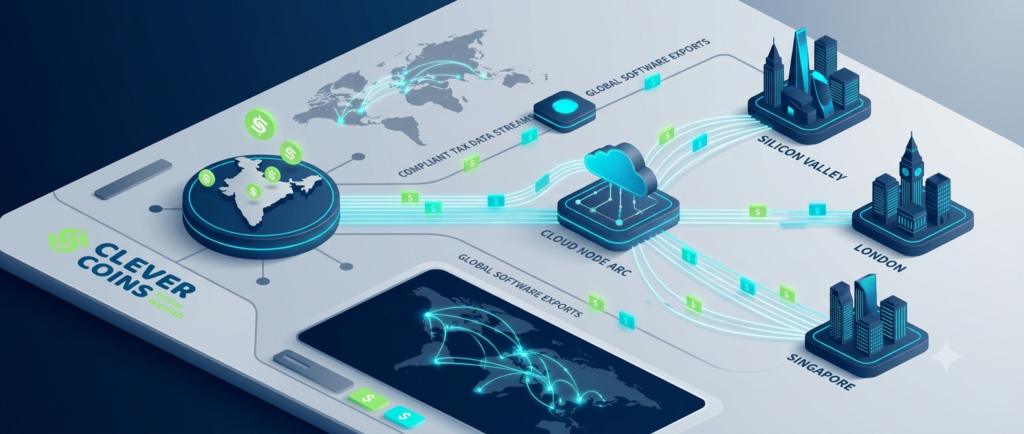
GST on IT, SaaS, and Software Development: Export Benefits and OIDAR Regulations
Introduction: The Digital Evolution and Tax Complexity
The rapid ascent of India’s Information Technology (IT), Software-as-a-Service (SaaS), and custom software development sectors has positioned the nation as a global powerhouse. From agile startups building cloud-native applications in Bengaluru to established tech giants exporting enterprise software worldwide, the digital economy operates across borderless horizons. However, this borderless trade brings complex tax landscapes.
Since its rollout, the Goods and Services Tax (GST) framework has fundamentally transformed how tech companies handle domestic supplies, cross-border exports, and digital service deliveries. For IT and SaaS executives, software developers, and compliance officers, mastering GST is no longer an optional administrative task—it is a core pillar of operational strategy and cash flow management.
This comprehensive guide dissects the intricate layers of GST compliance for the IT and SaaS ecosystem, exploring the nuances of zero-rated export benefits, the legal mechanics of Online Information and Database Access or Retrieval (OIDAR) regulations, place-of-supply rules, input tax credits (ITC), and practical steps to avoid costly tax audits.
Part 1: The Core Framework of GST in the IT and Software Sector
1. Classification of IT Services and Software Under GST
Under the GST regime, software and IT services are categorized based on their delivery mechanism and contractual structure:
-
Off-the-Shelf / Canned Software: Treated as “goods” if delivered on physical media (like CDs or hard drives) attracting standard goods rates, but predominantly treated as “services” when downloaded electronically.
-
Custom Software Development and IT Services (ITES): Classified under SAC 9983 (Other professional, technical, and business services) or SAC 9984 (Telecommunications, broadcasting, and information supply services).
-
Standard GST Rate: The baseline tax rate applicable to most IT services, software developments, cloud hosting, and SaaS platforms is 18% (9% CGST + 9% SGST for intra-state supplies, or 18% IGST for inter-state supplies).
2. Intra-State vs. Inter-State Supplies
Determining the exact geographic locus of a transaction dictates whether CGST/SGST or IGST applies:
-
Intra-State: When both the supplier and the location of the recipient (or place of supply) are within the same state, Central GST (CGST) and State GST (SGST) are levied.
-
Inter-State: When software services are supplied from one state to a client or business located in another state, Integrated GST (IGST) applies. Under Section 24 of the CGST Act, mandatory registration is triggered for inter-state taxable supplies, though certain threshold exemptions for service providers can apply.
Part 2: Export Benefits for IT, SaaS, and Software Development
India is a net exporter of software and digital solutions. To keep Indian tech globally competitive, the GST regime treats exports favorably through a Zero-Rated Supply mechanism.
1. What Qualifies as an Export of Services?
Under Section 2(6) of the Integrated Goods and Services Tax (IGST) Act, an export of services requires satisfying five cumulative conditions:
-
The supplier of service is located in India.
-
The recipient of service is located outside India.
-
The place of supply of service is outside India.
-
The payment for such service has been received by the supplier of service in convertible foreign exchange (or in Indian rupees wherever permitted by the RBI).
-
The supplier of service and the recipient of service are not merely establishments of a distinct person.
2. Mechanisms for Claiming Export Benefits
Exporters of IT and SaaS products have two primary legally approved routes to clear exports without bearing a tax burden:
Route A: Export Under Bond or Letter of Undertaking (LUT)
-
How it works: The tech company files an online LUT on the GST portal prior to effecting export shipments or service invoices. No IGST is paid at the time of export.
-
Advantage: Preserves working capital since capital is not blocked paying upfront taxes that are later refunded.
-
Compliance: Invoices must explicitly state: “SUPPLY MEANT FOR EXPORT ON PAYMENT OF IGST / SUPPLY MEANT FOR EXPORT UNDER BOND/LUT WITHOUT PAYMENT OF IGST.”
Route B: Export on Payment of IGST and Claiming Refund
-
How it works: The supplier raises an invoice charging IGST, pays the tax to the government, and subsequently claims a cash refund of the IGST paid on the export of services.
-
Advantage: Utilized typically when accumulated Input Tax Credit (ITC) cannot be fully realized via LUT paths under specific structural formulas.
-
Refund Processing: Filed electronically via Form RFD-01, backed by Foreign Inward Remittance Certificates (FIRC) or Bank Realization Certificates (BRC).
3. Unlocking Input Tax Credit (ITC) on Exports
Even though zero-rated supplies do not attract output tax, IT and SaaS companies incur substantial GST on domestic inputs—such as office rentals, hardware purchases, cloud infrastructure services (AWS, Azure, Google Cloud sourced locally), legal fees, and marketing agency contracts.
-
Under Section 16 of the IGST Act, exporters are fully entitled to claim Input Tax Credit (ITC) on these business-related inputs.
-
Unutilized ITC corresponding to export turnover can be claimed as a direct tax refund from the administration using standard statutory formulas.
Part 3: Deep Dive into OIDAR Regulations
As digital platforms scaled, traditional physical-nexus tax definitions broke down. To plug tax leakage from cross-border digital commerce, governments introduced OIDAR (Online Information and Database Access or Retrieval) regulations.
1. Defining OIDAR Under GST
OIDAR services refer to services whose delivery is mediated by information technology over the internet or an electronic network, characterized by the nature of such supply being automated involving minimal human intervention, making it impossible to ensure in the absence of information technology.
Key examples relevant to tech ecosystems include:
-
Software-as-a-Service (SaaS) platforms and automated application hosting.
-
Provision of digital data, downloadable software updates, and e-books.
-
Website hosting, cloud storage services, and automated database access.
-
Online advertising and digital gaming networks.
Note on 2023 Amendments: The Finance Act removed the restrictive phrase “essentially automated and involving minimal human intervention”, significantly widening the net to capture a broader spectrum of digitally delivered professional and technical services.
2. The B2B vs. B2C OIDAR Compliance Split
The compliance obligations for OIDAR vary drastically depending on whether the consumer is a registered business (B2B) or an individual consumer (B2C):
-
B2B Transactions (Business-to-Business):
-
When a foreign OIDAR/SaaS provider supplies services to an Indian business registered under GST, the Reverse Charge Mechanism (RCM) applies.
-
The foreign supplier does not need to register or collect GST in India. Instead, the Indian corporate recipient accounts for and pays 18% GST directly to the Indian government under RCM, while claiming corresponding ITC.
-
-
B2C Transactions (Business-to-Consumer):
-
When a foreign digital service provider supplies OIDAR services to unregistered individual consumers in India, the onus shifts entirely to the foreign supplier.
-
The overseas entity must take a Simplified GST Registration (using Form GST REG-10), charge 18% GST, and file periodic returns (such as GSTR-5A).
-
3. Obligations for Indian SaaS Companies Expanding Globally
If you are an Indian SaaS company selling subscriptions to individual users or unregistered entities overseas:
-
For users located in the European Union, the US, or other foreign jurisdictions, your supplies qualify as Exports of Services, provided payment is received in foreign currency and standard export criteria are satisfied.
-
Conversely, if you operate a multi-national platform serving foreign consumers, you must remain mindful of local digital tax counterparts to OIDAR (such as EU VAT rules or state-level SaaS sales taxes in the US).
Part 4: Place of Supply Rules for IT and Software
The entire architecture of GST relies on the Destination Principle—meaning taxes accrue where the service is consumed, not where it is produced.
1. General Rules for B2B vs. B2C Software Supply
-
For B2B Supplies: The place of supply is the location of the registered business recipient. If an IT firm in Noida develops custom enterprise software for a client headquartered in Chennai, the place of supply is Tamil Nadu, attracting IGST.
-
For B2C Supplies:
-
If the location of the recipient is available in the ordinary course of business, that location is deemed the place of supply.
-
For digital OIDAR software products sold to unverified individual users, specific proxy indicators establish location: IP addresses, billing addresses, bank account details, or the country code of the SIM card used.
-
2. Intermediary Services Confusion
A recurring trap for software development firms is the Intermediary classification. If an Indian software shop acts merely as a broker or agent connecting an overseas principal with an end client without taking principal responsibility for code delivery, the place of supply defaults to the location of the supplier (India) under Section 13(8) of the IGST Act, disqualifying the transaction from export-of-services benefits. Tech firms must structure contracts carefully to act as principals rather than intermediaries.
Part 5: Strategic Compliance Checklist for Tech CFOs and Founders
To insulate IT, SaaS, and software development businesses from aggressive tax audits, penalties, and working capital blockages, leadership teams should implement the following blueprint:
-
Rigorous Contract Architecture: Ensure every master service agreement (MSA) and statement of work (SOW) clearly delineates scope, delivery milestones, and principal-to-principal relationships to protect export statuses.
-
Automated Tax Engines: Integrate localized tax determination logic into billing systems (such as Stripe, Chargebee, or custom engines) to accurately capture customer locations, validate GSTINs for B2B transactions, and apply correct RCM or forward-charge treatments.
-
Flawless LUT Management: Always renew your Letter of Undertaking (LUT) on the GST portal at the start of every financial year to avoid inadvertent payment of IGST on export invoices.
-
Timely FIRC Reconciliation: Match your bank realization statements with outbound software invoices meticulously to satisfy RBI and GST audit trails for zero-rated export refunds.
-
Accurate SAC Code Usage: Consistently apply correct accounting codes (e.g., SAC 9983 for IT design and software development services) across all tax invoices to prevent misclassification queries during scrutiny.
Conclusion
The intersection of GST, cross-border IT exports, and OIDAR regulations represents a dynamic frontier for India’s digital economy. While the compliance burden can appear daunting, treating tax architecture as an integrated part of product development unlocks massive competitive advantages. By securing export benefits, automating OIDAR workflows, and ensuring meticulous documentation, tech enterprises can scale globally with absolute legal confidence and optimized cash flows.





