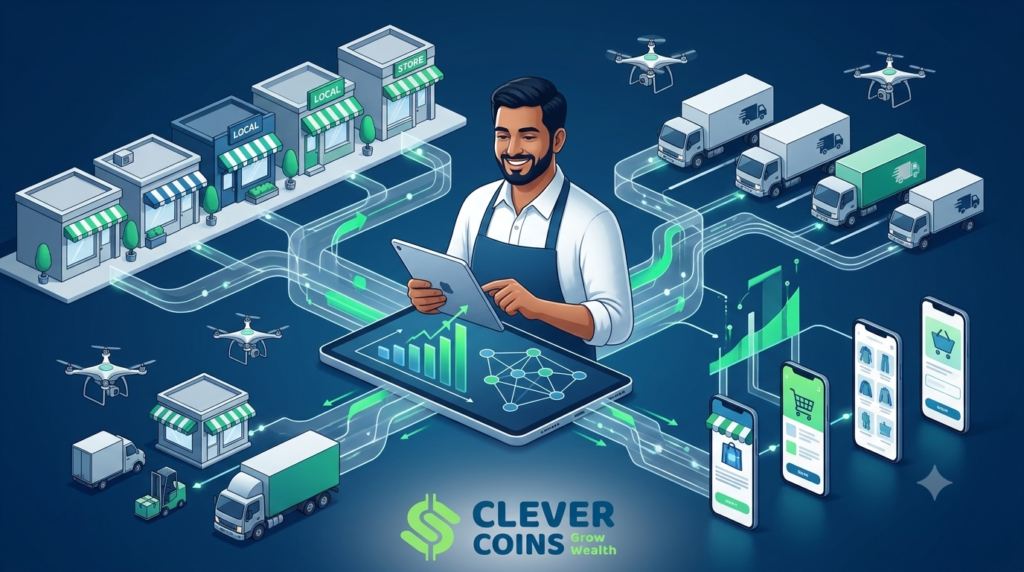
ONDC Benefits for MSME Sellers: Govt’s Free Alternative to Amazon & Flipkart
The Indian e-commerce landscape has undergone a monumental shift over the last decade. For millions of Micro, Small, and Medium Enterprises (MSMEs), local kirana store owners, direct-to-consumer (D2C) brands, and regional artisans, digital storefronts on private marketplace giants like Amazon and Flipkart became the default path to market. However, this growth came with a steep price tag. High commission fees ranging from 15% to 30%, opaque algorithm changes, delayed payouts, deep data isolation, and rigid platform-specific rules have consistently choked the profit margins of small businesses.
Enter the Open Network for Digital Commerce (ONDC)—a revolutionary, government-backed initiative designed to democratize digital retail in India. Conceptualized and spearheaded by the Department for Promotion of Industry and Internal Trade (DPIIT) under the Ministry of Commerce and Industry, ONDC is not a marketplace application or a single e-commerce company. Instead, it is a set of open, open-source network protocols built on open-network standards—functioning for e-commerce precisely what the Unified Payments Interface (UPI) did for digital payments.
If you are an MSME owner looking to scale your business online without losing your margins to corporate gatekeepers, understanding the profound ONDC benefits for MSME sellers is essential. This comprehensive guide explores how ONDC operates, why it serves as a powerful alternative to traditional monopolies, and how you can leverage it to grow your enterprise.
Understanding the Problem: The Walled Garden Dilemma of Private Marketplaces
To truly appreciate the value proposition of ONDC, we must examine the structural flaws of traditional e-commerce marketplaces. Giants like Amazon and Flipkart operate on a walled garden business model. In this ecosystem:
Platform Lock-In: To sell your products, you must register exclusively on their platform, agree to their terms of service, and conform to their UI/UX framework.
Exorbitant Commissions: Sellers frequently surrender a massive slice of their revenue—often between 15% to 30% per transaction—covering marketplace fees, mandatory advertising, fulfillment costs, and referral charges.
Data Isolation: The marketplace owns the customer relationship. Sellers do not get direct access to customer data, making repeat marketing and long-term brand loyalty exceptionally difficult to build.
Algorithmic Volatility: A sudden change in search ranking algorithms can wipe out a small seller’s visibility overnight unless they pay heavy sums for sponsored ads.
For MSMEs operating on razor-thin manufacturing or retail margins, these conditions make sustainable scaling nearly impossible. The system rewards deep-pocketed aggregators while stifling local innovation.
What is ONDC and How Does It Work?
ONDC changes the rules of the game by unbundling the e-commerce transaction chain. In a conventional marketplace, a single app handles everything: user discovery, cataloging, payments, logistics, and customer service.
Under the ONDC open-network framework, these functions are modularized across independent participants:
Buyer Network Participants (Buyer Apps): Consumer-facing apps (e.g., Paytm, Magicpin, Mystore, Pincode) where end-users search, browse, and place orders.
Seller Network Participants (Seller Apps): Platforms that onboard merchants, digitize their inventories, and help them list their products on the network.
Logistics Providers: Independent delivery and fulfillment partners (e.g., Dunzo, Shiprocket, Ekart Logistics) that handle physical product movement.
Gateway Providers: The connective tissue routing search queries and matching buyers with sellers seamlessly.
The Magic of Interoperability: Because ONDC uses open protocols, a seller registered on any authorized Seller App automatically becomes discoverable to buyers using any Buyer App on the network. You register once, and your inventory opens up to a vast ecosystem of buyers without paying separate tolls to individual walled gardens.
Core ONDC Benefits for MSME Sellers
1. Freedom from High Commissions and Platform Monopolies
The most immediate and profound advantage of ONDC is cost efficiency. Traditional marketplaces extract heavy commissions that eat into MSME profits. ONDC eliminates central middlemen by fostering open competition among service providers. Network transaction fees and seller app onboarding costs are a fraction of marketplace rake-offs, allowing small businesses to retain a much larger share of their hard-earned revenues.
2. Single Registration, Multi-Platform Visibility
Imagine having to list your products manually across five different private apps, maintaining separate dashboards, inventory syncs, and compliance logs. It is a logistical nightmare. With ONDC, you register your catalog once through an authorized Seller Network Participant (SNP), and your products instantly become visible across multiple buyer apps operating on the network. This multi-channel exposure maximizes reach with zero incremental administrative friction.
3. Direct Ownership of Customer Relationships
Unlike closed marketplaces that guard customer data fiercely, ONDC empowers MSMEs to build direct relationships with their buyers. Understanding who buys your product, where they reside, and what their preferences are enables targeted retention strategies, direct communication, and long-term brand equity creation.
4. Level Playing Field for Hyper-Local Businesses
Traditional e-commerce giants often prioritize large-scale sellers who can stock centralized warehouses. Local kirana stores, neighborhood artisans, and small-town manufacturers struggle to compete. ONDC thrives on a hyper-local model. It allows a local grocery store or a boutique apparel maker in Tier-2 or Tier-3 cities to instantly serve customers in their immediate geographical vicinity with lightning-fast delivery times, leveraging local logistics networks.
5. Access to Integrated Logistics and Digital Infrastructure
Scaling online operations often breaks down at fulfillment. ONDC integrates plug-and-play logistics and technology service providers (TSPs) directly into the network framework. Sellers do not need to build complex supply chain software or tie up with expensive proprietary courier fleets. They can plug into existing logistics aggregators available right on the network to handle shipping seamlessly.
6. Transparent Data and Fair Search Discoverability
On private marketplaces, search results are frequently influenced by sponsored listings and self-preferencing algorithms run by the platform. ONDC operates on neutral, protocol-driven discovery mechanisms. Visibility is earned through product quality, pricing, and fulfillment performance rather than advertising budgets, ensuring a fair fight for micro-entrepreneurs.
Government Support and Financial Incentives for MSMEs on ONDC
To accelerate adoption, the Ministry of MSME and various allied bodies have rolled out aggressive financial support structures under frameworks like the TEAM (Trade Enablement and Marketing) Initiative and digital empowerment schemes:
Free Onboarding & Cataloguing Support: Many government-backed and ecosystem-supported Seller Network Participants offer free or heavily subsidized onboarding assistance. Financial grants and support allowances (up to ₹2,500 per enterprise for digital catalogue creation and up to ₹5,000 for account management) are structured to absorb initial digital transition friction.
Udyam Registration Synergy: Enterprises holding a valid Udyam Registration can seamlessly integrate into the digital ecosystem. While GST registration is required for inter-state online sales, micro-enterprises with Udyam registration can leverage intra-state digital commerce opportunities efficiently.
Democratized Credit Access: Because ONDC transactions generate transparent, verifiable digital footprints, MSMEs can build verified financial health records. This makes it infinitely easier for banks, NBFCs, and fintech lenders on the network to extend working capital loans and credit lines without collateral hurdles.
Step-by-Step Guide: How MSMEs Can Register and Sell on ONDC
Transitioning your business to ONDC is straightforward. Because you do not register directly with a central ONDC portal (since ONDC is a network, not a company), you must register through an approved Seller Network Participant (SNP).
Step 1: Keep Your Documents Ready
Before starting your onboarding journey, ensure you have the following compliance documents handy:
PAN Card of the business or proprietor.
Udyam Registration Number (essential for MSME identity verification).
GSTIN Certificate (mandatory if you intend to execute inter-state sales; optional for intra-state micro-enterprises depending on turnover thresholds).
Bank Account Details linked with your business PAN for direct payment settlements.
Product Catalog Data: High-resolution product images, descriptions, pricing, SKUs, inventory counts, and HSN codes.
Step 2: Choose Your Seller Network Participant (SNP)
Select an authorized ONDC seller-side application that matches your business category. Popular SNP apps include:
Mystore (ideal for retail and D2C brands)
GoKwik / Plotch / Craftsvilla (specialized sector enablers)
Paytm for Business / Magicpin (great for hyper-local retail and food/beverage)
Step 3: Complete KYC and Digital Storefront Setup
Download the chosen Seller App or visit their merchant portal. Enter your Udyam and GST details to complete electronic KYC. Once verified, use the platform’s cataloging tools to upload your product listings, organize them into clean categories, and set your competitive pricing.
Step 4: Configure Logistics and Payment Gateways
Select your preferred fulfillment partners from the integrated logistics choices available on the network. Set up your payout gateway so that customer payments settle directly into your bank account securely upon order fulfillment.
Step 5: Go Live and Start Receiving Orders
Once your digital catalog is published, your store becomes live across all consumer-facing buyer apps connected to ONDC. Monitor your dashboard, pack your orders promptly, hand them over to the network logistics partner, and watch your digital footprint expand sustainably.
Overcoming Initial Challenges: What MSMEs Must Keep in Mind
While ONDC represents a watershed moment for Indian retail, business owners should navigate the transition with a practical mindset:
Adoption Curve: Since the network is decentralized, customer traffic is scaling rapidly but varies heavily by product category and geography. Do not abandon existing channels overnight; instead, adopt an omni-channel diversification strategy.
Fulfillment Discipline: Operating on an open network means maintaining strict adherence to dispatch timelines and inventory accuracy. Poor fulfillment ratings affect your standing across the entire network of buyer apps.
Customer Service Ownership: Because you own the transaction, customer grievance handling and returns management rest heavily on your operational readiness. Set up a clear return and support workflow.
Conclusion: The Future of Indian Digital Commerce is Open
The era of unchecked corporate digital feudalism is facing its greatest counterbalance. For years, MSMEs had to choose between high operating costs on dominant private platforms or complete invisibility in the offline world. ONDC bridges this gap by creating an equitable, transparent, and low-cost digital public infrastructure.
By cutting down predatory commissions, returning data ownership to merchants, and expanding customer reach across multiple applications, ONDC empowers small businesses to compete on merit, quality, and price. Whether you are a local manufacturer in Mumbra, a textile artisan, a regional D2C brand, or a neighborhood store owner, integrating with ONDC is no longer just an experiment—it is a strategic business imperative for sustainable growth.
Embrace the open network revolution today, protect your margins, and take absolute control of your digital destiny.
Related posts:
PMEGP Loan Scheme 2026: How to Get 35% Subsidy for New Business
The Complete Guide to the MeitY SAMRIDH Scheme: Fueling India's Startup Ecosystem
Udyam Registration Benefits: Top 10 Subsidies, Collateral-Free Loans, and Concessions
CGTMSE vs CGSS: The Ultimate Guide to Collateral-Free Business Loans in India
TReDS Platform: The Ultimate Government Solution to Solve MSME Delayed Payments in 45 Days
Section 43B(h) 45-Day MSME Payment Rule: Impact on Purchases, Deductions, and Working Capital
State Government MSME Schemes Compared: Maharashtra, Gujarat, TN, UP 2026
Atal Innovation Mission (AIM): Grants for Startups and MSMEs in 2026
Top 10 Central Govt Subsidies Every MSME Should Apply in 2026
Form AOC-4 and MGT-7 Filing Guide: Documents, Balance Sheet Attachments, and Penalties
Related posts:
 Udyam Registration Benefits: Top 10 Subsidies, Collateral-Free Loans, and Concessions
 The Ultimate Guide to MIDC Land Allotment and Industrial Incentives: Package Scheme of Incentives (PSI)
 CGTMSE vs CGSS: The Ultimate Guide to Collateral-Free Business Loans in India
 PLI Scheme 2026: Sector-Wise List and Benefits for MSME Vendors