
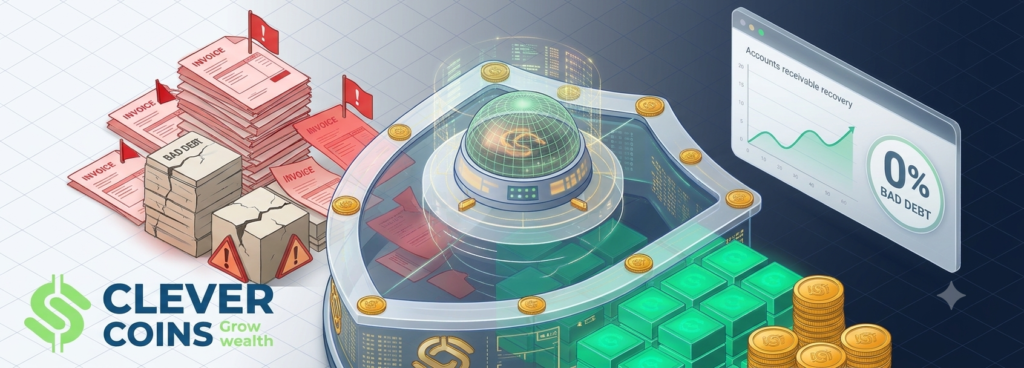
Complete Guide to Bad Debts Management: Protect Cash Flow, Minimize Write-Offs, and Master Receivables Recovery
In B2B commerce and credit-driven industries, a sale is not complete when the contract is signed or the goods are shipped. A sale is only complete when the cash clears your bank account. Yet thousands of profitable businesses face severe liquidity crunches—and even insolvency—every year because their revenue remains trapped in aging accounts receivable. When those unpaid invoices cross the threshold from “overdue” to “uncollectible,” they become bad debts.
Effective bad debts management is far more than chasing late payers with aggressive phone calls. It is an integrated financial discipline that spans customer onboarding, credit risk underwriting, contract structuring, automated invoicing, behavioral monitoring, accounting compliance, tax recovery, and structured collections.
This complete guide covers every dimension of bad debts management—from financial formulas and accounting journal entries to preventive credit policies, legal escalation frameworks, and modern automation strategies.
What Is Bad Debt? Understanding the True Cost of Uncollectible Receivables
Bad debt refers to accounts receivable—money owed to a business by customers for goods delivered or services rendered on credit—that the business determines will never be collected. Once an account is deemed uncollectible, it is recognized as a bad debt expense on the income statement and removed (written off) from the accounts receivable asset balance on the balance sheet.
Why Bad Debt Hurts Exponentially More Than Its Face Value
Many business owners mistakenly view a $10,000 unpaid invoice as a $10,000 loss. In reality, the financial damage is governed by your net profit margin. Because you have already incurred the cost of goods sold (COGS), labor, overhead, and fulfillment expenses for that transaction, recovering the lost cash requires generating massive top-line revenue.
Consider the replacement revenue required across different profit margins for a single $15,000 bad debt:
| Net Profit Margin | Bad Debt Loss | New Revenue Needed Just to Break Even |
| 5% | $15,000 | $300,000 |
| 10% | $15,000 | $150,000 |
| 15% | $15,000 | $100,000 |
| 25% | $15,000 | $60,000 |
Beyond direct profit erosion, unchecked bad debts trigger secondary operational damage:
Working Capital Paralysis: Cash tied up in delinquent receivables cannot fund inventory replenishment, R&D, payroll, or marketing expansion.
Increased Cost of Capital: Businesses with cash shortfalls often rely on high-interest overdrafts, lines of credit, or invoice factoring to bridge liquidity gaps.
Lower Business Valuation: Investors, lenders, and acquirers heavily discount companies with high Days Sales Outstanding (DSO) and bloated aging schedules during due diligence.
Administrative Burnout: Finance and sales teams waste dozens of hours every week manually tracking spreadsheets, sending reminders, and mediating disputes instead of driving growth.
Common Causes of Bad Debts in Modern Businesses
Understanding why invoices go unpaid is the prerequisite to preventing them. Bad debts rarely happen overnight; they typically stem from a combination of internal process gaps and external buyer distress.
1. Internal Operational Weaknesses
Absence of Formal Credit Vetting: Extending Net-30 or Net-60 payment terms to new B2B clients purely to close a deal—without checking credit bureaus, trade references, or financial statements.
Vague Contracts and Scope Creep: Missing purchase order (PO) numbers, ambiguous deliverable acceptance criteria, or undocumented scope changes give reluctant payers legal excuses to stall payment indefinitely.
Delayed or Inaccurate Invoicing: Sending invoices weeks after delivery, billing the wrong legal entity, omitting tax registration numbers (such as GSTIN or VAT IDs), or failing to attach required proof of delivery (POD).
Inconsistent Follow-Up Cadence: Allowing an invoice to sit untouched until it is 45 or 60 days past due. Collection probability drops precipitously after the first 30 days of delinquency.
2. External Customer Factors
Buyer Liquidity Crisis or Bankruptcy: Economic downturns, interest rate hikes, or the loss of the customer’s own major client can push an otherwise honest buyer into insolvency.
Invoice Disputes and Quality Dissatisfaction: Customers withholding 100% of an invoice balance over a minor 5% defect or shipping discrepancy.
Corporate Restructuring or M&A: Acquisitions, leadership turnovers, or accounts payable (AP) system migrations frequently orphan vendor invoices in approval queues.
Intentional Fraud (“Bust-Out” Schemes): Bad actors establishing small initial credit lines, paying on time twice to build trust, placing a massive order, and disappearing before payment is due.
The Preventive Pillar: Building an Airtight Credit Control Policy
The single highest-ROI strategy in bad debts management is preventing high-risk credit exposure before a contract is signed. A documented Credit Control Policy aligns your sales and finance teams around clear rules.
Step 1: Underwrite Buyers Using the 5 Cs of Credit
Before granting trade credit above a baseline threshold, evaluate prospective clients across five standard underwriting dimensions:
Character (Payment Reputation): Does the company have a track record of honoring financial commitments? Check commercial credit reports (Dun & Bradstreet, Experian, Equifax, CIBIL Commercial) and call at least two existing trade references.
Capacity (Cash Flow Strength): Does the buyer generate sufficient operating cash flow to pay short-term obligations? Review their current ratio ($\text{Current Assets} \div \text{Current Liabilities}$) and quick ratio. A current ratio below 1.2 signals tight liquidity.
Capital (Net Worth & Reserves): How much equity has the ownership team invested in the business? Companies heavily financed by short-term debt are far more likely to default during a slow quarter.
Collateral (Security & Guarantees): For high-value contracts or thin-file startups, can you secure a personal guarantee from directors, a bank letter of credit (LC), a security deposit, or a retention-of-title clause?
Conditions (Industry & Macro Context): Is the buyer operating in a sector facing regulatory headwinds, supply chain disruption, or seasonal cash troughs?
Step 2: Assign Tiered Credit Limits and Payment Terms
Never use a one-size-fits-all payment policy. Segment customers into risk tiers based on their credit assessment:
Tier A (Low Risk — Established Enterprise / Strong Credit Score): Net-45 or Net-60 terms; high credit limit reviewed annually.
Tier B (Moderate Risk — Growing SME / Average Credit History): Net-15 or Net-30 terms; moderate credit cap with automatic account hold if any invoice exceeds 15 days past due.
Tier C (High Risk — New Startup / Prior Late Payments / Distressed Sector): 50% upfront deposit + 50% upon delivery (COD), milestone-based billing, or Cash in Advance (CIA) with a small early-payment incentive.
Step 3: Lock In Bulletproof Commercial Terms
Your master service agreement (MSA), terms of sale, and invoices must explicitly state:
Exact payment due date (e.g., “Due within 30 calendar days of invoice date,” rather than vague phrasing).
Late payment interest penalties (e.g., 1.5% per month or the maximum rate permitted by local law).
Dispute notification window (e.g., “Any billing discrepancies must be reported in writing within 7 business days of invoice receipt; undisputed portions remain payable on the original due date”).
Fee-shifting clause stating that the buyer is liable for reasonable third-party collection agency fees, court costs, and legal expenses incurred to recover overdue balances.
Early Warning Signs: Detecting At-Risk Accounts Before Default
Distressed customers broadcast clear behavioral and financial warning signs months before they officially default. Training your accounts receivable and account management teams to spot these red flags allows you to tighten credit limits and collect while cash is still available.
Gradual Payment Stretching: A client who consistently paid on Day 28 begins paying on Day 37, then Day 49, then Day 62.
Switch from Electronic Transfers to Paper Checks: Delinquent payers often revert to physical checks to buy 5 to 10 days of mail and clearing float—or send unsigned/post-dated checks as stalling tactics.
Partial Payments Without Explanation: Paying round lump sums (e.g., $2,000 against a $7,450 invoice) indicates the buyer is triaging limited cash across multiple screaming vendors.
Sudden Spike in Order Volume: A struggling company that has been cut off by other suppliers may suddenly attempt to double its order size with you right before collapsing.
Sudden Nitpicking and Manufactured Disputes: Raising trivial complaints about packaging, formatting, or service delivery right on the invoice due date is a classic stalling maneuver.
Executive Turnover in Finance: Sudden departures of the CFO, Controller, or AP Manager often precede financial restatements or liquidity crises.
Unreturned Emails and “Gatekeeper” Deflection: Contacts who were responsive during the sales cycle suddenly become unreachable or repeatedly claim the check is “waiting on a signature.”
Accounting for Bad Debts: Methods, Formulas, and Journal Entries
Accurate accounting ensures that your financial statements reflect economic reality rather than inflated asset values. Under generally accepted accounting principles (GAAP) and International Financial Reporting Standards (IFRS 9), companies must account for expected credit losses properly.
1. The Direct Write-Off Method
Under the Direct Write-Off Method, a business waits until a specific invoice is definitively proven uncollectible before recording any expense.
Journal Entry When Invoice Is Deemed Uncollectible:
Debit: Bad Debt Expense (Income Statement)
Credit: Accounts Receivable — [Customer Name] (Balance Sheet)
Pros: Extremely simple to execute; often required for tax deduction purposes in many jurisdictions.
Cons: Violates the matching principle of accounting because the revenue may be recorded in Year 1 while the bad debt expense isn’t recorded until Year 2. It also overstates Accounts Receivable on the balance sheet. Therefore, GAAP prohibits this method for financial reporting except when bad debts are immaterial.
2. The Allowance Method (GAAP & IFRS Standard)
Under the Allowance Method, businesses estimate expected future bad debts at the end of each accounting period and record them proactively using a contra-asset account called Allowance for Doubtful Accounts (or Allowance for Credit Losses).
Step A — Recording the Estimated Provision (End of Period):
Debit: Bad Debt Expense
Credit: Allowance for Doubtful Accounts
Step B — Writing Off a Specific Uncollectible Account Later:
Debit: Allowance for Doubtful Accounts
Credit: Accounts Receivable — [Customer Name] (Notice that writing off a specific account under the allowance method does not hit Bad Debt Expense again, because the expense was already estimated and recognized in Step A.)
Step C — Recovering a Previously Written-Off Debt (Bad Debt Recovery): If a customer unexpectedly pays an invoice after you have already written it off, reverse the write-off first, then record the cash receipt:
Debit: Accounts Receivable | Credit: Allowance for Doubtful Accounts
Debit: Cash / Bank | Credit: Accounts Receivable
How to Calculate the Allowance for Doubtful Accounts
Finance teams rely on three primary estimation models:
A. Percentage of Credit Sales Method (Income Statement Approach)
Applies a historical bad debt percentage to total credit sales for the period.
B. Accounts Receivable Aging Method (Balance Sheet Approach)
Categorizes all open receivables by age brackets and applies progressively higher default probabilities to older buckets.
| Aging Bucket | Receivable Balance | Estimated Uncollectible % | Required Allowance |
| Current (0–30 Days) | $200,000 | 1% | $2,000 |
| 1–30 Days Past Due | $80,000 | 5% | $4,000 |
| 31–60 Days Past Due | $40,000 | 15% | $6,000 |
| 61–90 Days Past Due | $20,000 | 40% | $8,000 |
| 90+ Days Past Due | $10,000 | 75% | $7,500 |
| Total | $350,000 | — | $27,500 |
If your Allowance for Doubtful Accounts currently has a credit balance of $12,000, you record an adjusting journal entry for $15,500 ($27,500 target minus $12,000 existing balance) to bring the reserve to $27,500.
C. IFRS 9 Expected Credit Loss (ECL) Model
IFRS 9 requires forward-looking impairment modeling. Instead of relying purely on historical defaults, businesses incorporate macroeconomic indicators (such as GDP forecasts, sector default trends, and inflation) to calculate 12-month ECL for performing receivables and lifetime ECL for credit-impaired receivables.
Tax Implications of Bad Debts: Deductions and Indirect Tax (GST/VAT) Recovery
When a customer fails to pay, you should not suffer the double penalty of paying corporate income tax and indirect sales taxes on phantom revenue. However, tax authorities enforce strict evidentiary rules before allowing bad debt relief.
Corporate Income Tax Deductions
Accrual vs. Cash Basis Taxpayers: If you report taxes on a cash basis, you never reported the unpaid invoice as taxable income in the first place, so you cannot claim a bad debt tax deduction. Only accrual-basis taxpayers who previously included the invoiced amount in gross income can deduct bad debts.
Proof of Worthlessness: Tax authorities (such as the IRS under IRC Section 166 or corporate tax authorities globally) generally do not allow deductions for general accounting reserves. You must demonstrate that the specific debt became wholly or partially worthless during the tax year and that you took reasonable steps to collect it (demand letters, collection agency placement, or proof of debtor bankruptcy).
Reclaiming Indirect Taxes (GST / VAT) on Bad Debts
If you remitted Goods and Services Tax (GST) or Value Added Tax (VAT) to the government when issuing the invoice, check your local jurisdiction’s bad debt relief rules:
VAT Jurisdictions (UK, EU, UAE, etc.): Most VAT regimes allow businesses to reclaim output VAT paid on unpaid invoices once the debt is officially written off in the accounting records and remains unpaid for a statutory waiting period (commonly 6 months from the due date).
GST Jurisdictions (e.g., India, Australia, Singapore): Rules vary sharply by country. In Australia and Singapore, GST bad debt adjustments are permitted after 12 months or formal write-off. In India, under Section 34 of the CGST Act, a supplier cannot simply issue a credit note to reverse GST solely due to non-payment by a buyer unless there is a deficiency in goods/services or price renegotiation—making upfront milestone billing and advance tax planning critical for Indian B2B firms.
(Always consult a certified public accountant or chartered accountant in your jurisdiction to verify documentation requirements before claiming tax adjustments.)
The 90-Day Collections & Dunning Escalation Playbook
Speed, consistency, and professionalism determine whether you recover cash while preserving the customer relationship. Follow a structured, multi-channel escalation cadence:
Phase 1: Pre-Due Courtesy (7 Days Before Due Date)
Action: Automated email reminder with a PDF copy of the invoice, PO reference, and a one-click payment link (ACH, wire, or card).
Goal: Catch missing invoices or AP routing issues before the due date passes.
Phase 2: Gentle Nudge (1–7 Days Past Due)
Action: Friendly email assuming oversight: “Hi [Name], just a quick note that Invoice #1042 for $4,800 came due on [Date]. Please let us know if you need anything from our end to process payment this week.”
Goal: Prompt immediate payment from disorganized but solvent buyers.
Phase 3: Direct Phone Outreach & Account Hold (15–30 Days Past Due)
Action: Call the Accounts Payable contact directly—emails are too easy to ignore. Confirm receipt of the invoice, verify whether any dispute exists, and secure a specific Promise-to-Pay (PTP) date. Place new orders or ongoing services on soft credit hold.
Goal: Surface hidden disputes and get a firm payment commitment.
Phase 4: Executive Escalation & Structured Payment Plan (31–60 Days Past Due)
Action: Escalate from AP to the customer’s Controller, VP of Finance, or Founder. If the buyer admits to temporary cash-flow strain, offer a written Structured Payment Plan (e.g., 40% immediate down payment + 3 bi-weekly installments via auto-debit) paired with a personal guarantee or late-fee waiver contingent on on-time completion.
Goal: Lock in priority repayment ahead of less proactive vendors.
Phase 5: Formal Demand Letter (61–75 Days Past Due)
Action: Send a formal Final Demand Letter (on company or legal letterhead via certified mail and email) summarizing the principal balance, accrued contractual interest, prior reminders, and a strict 10-day deadline before external recovery begins.
Goal: Signal serious legal and credit-reporting consequences.
Phase 6: External Collection Agency, Legal Action, or Settlement (76–90+ Days Past Due)
At 90 days past due, internal collection efforts yield diminishing returns. Evaluate three final options based on balance size and debtor solvency:
Lump-Sum Settlement Discount: Accepting 60%–80% of the principal immediately in exchange for full release—often superior to spending months in litigation.
Third-Party Commercial Collection Agency: Agencies typically work on a contingency fee (15%–35% of recovered funds) and report defaults to commercial credit bureaus, creating strong leverage against active businesses.
Legal Action / Small Claims Court / Arbitration: Viable when the debt is substantial, undisputed, legally documented, and the debtor possesses attachable assets or active bank accounts.
Related posts:
GST on Commercial Rent: RCM Applicable for MSME Tenants in 2026
ZED Certification Scheme: How MSMEs Can Get Up to 80% Subsidy on Quality & Clean Tech
How to Respond to GST Notice DRC-01 for Input Tax Credit Mismatches: Step-by-Step Draft
Budget 2026 Key Highlights for Taxpayers: The Ultimate Blueprint for the New Income Tax Act
PF Return Filing: Step-by-Step ECR Generation, Monthly Payment, and Wage Ceiling Rules
Step-by-Step Guide to Using the Excel-Based GST IMS Offline Tool for High-Volume Invoices
Interest on Delayed GST Payment Payable Despite Voluntary Payment: Madras High Court Ruling Explaine...
How to Handle Rejected vs. Pending Invoices in GST IMS Without Blocking Working Capital
How to File a Trademark Application in India (Form TM-A): Step-by-Step Online Process
ITAT Bangalore Ruling: Capital Gains Deleted Under Section 2(47)(v) as Section 53A Conditions Not Sa...
Related posts:
 How to File a Trademark Application in India (Form TM-A): Step-by-Step Online Process
 Startup India Seed Fund Scheme (SISFS): Eligibility, Amount & How to Apply
 GST on Commercial Rent: RCM Applicable for MSME Tenants in 2026
 How to Cancel GST Registration and What Happens to ITC Balance? (2026 Complete Guide)

