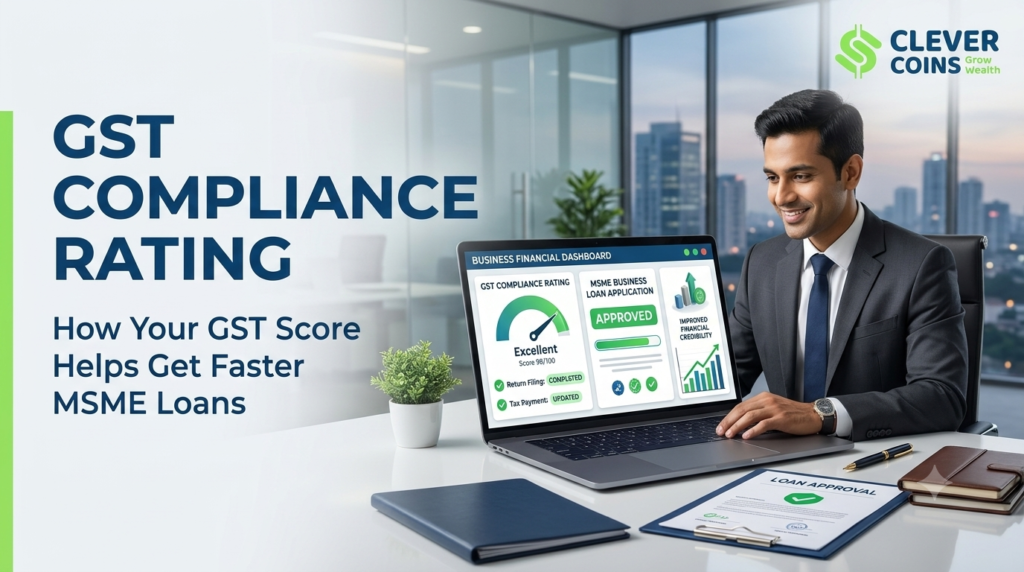
GST Compliance Rating: How Your GST Score Helps Get Faster MSME Loans
For every Micro, Small and Medium Enterprise (MSME), access to timely business finance can make the difference between business growth and missed opportunities. Whether you operate a manufacturing unit, trading company, wholesale business, retail outlet, distribution network, or service-based enterprise, sufficient working capital is essential for keeping daily operations running smoothly.
However, getting a business loan is not always easy.
Many MSME owners face challenges when approaching banks and Non-Banking Financial Companies (NBFCs). Lenders generally want to understand whether a business is financially stable, generates consistent revenue, maintains proper financial records, and has the ability to repay its loan obligations.
This is where GST compliance becomes particularly important.
Your Goods and Services Tax (GST) records can provide lenders with useful insights into your business operations. Regular GST return filing, timely tax payments, accurate reporting of sales and purchases, and consistency between GST returns and financial statements can help demonstrate that your business follows organised financial practices.
In other words, GST compliance can become an important part of your business’s financial credibility.
The concept of a GST Compliance Rating is particularly relevant here. It represents an approach to evaluating how consistently a business follows GST-related obligations. Depending on the lender or assessment system, GST-related information may contribute to a broader evaluation of business performance and loan eligibility.
But does a higher GST score actually help you get an MSME loan faster? Can your GST filing history influence the amount you can borrow? What happens if your GST returns are delayed? And how can you improve your GST compliance before applying for a business loan?
Let’s understand everything in detail.
What Is GST Compliance Rating?
GST Compliance Rating refers to an assessment of how effectively a registered business follows the rules and obligations prescribed under India’s Goods and Services Tax system.
These obligations generally include:
- Filing applicable GST returns within the prescribed deadlines.
- Paying GST liabilities on time.
- Reporting sales and purchases accurately.
- Maintaining proper tax invoices.
- Reconciling purchase records with available supplier information.
- Avoiding unnecessary discrepancies in GST reporting.
- Responding to GST notices and complying with applicable requirements.
- Maintaining accurate registration and business information.
A business that regularly fulfils its GST obligations demonstrates better financial discipline than one that repeatedly delays returns, reports inconsistent information, or accumulates unpaid tax liabilities.
Is GST Compliance Rating an official government score?
There is an important distinction worth understanding.
GST portal documentation has historically described a taxpayer compliance rating on a scale of 0 to 10, based on parameters such as return filing, tax payments and penalties. However, businesses should not assume that this historical description represents a currently available, universally applicable, live government rating for every GSTIN.
The term GST Compliance Rating can also be used more broadly to describe a lender’s internal assessment of a business’s GST compliance.
Therefore, when discussing GST scores in the context of business financing, it is important to distinguish between:
- Historical or portal-documented taxpayer compliance ratings.
- Internal GST-based assessments used by lenders or financial institutions.
- A broader business creditworthiness assessment that considers GST information along with other financial indicators.
A GST compliance assessment should not be confused with a CIBIL score, commercial credit rating, or an official guarantee of loan approval.
The central idea is simple: Better GST compliance can help a business establish stronger financial credibility.
Why Is GST Compliance Important for MSME Businesses?
GST is not just a tax-related requirement. For registered businesses, it also creates a structured record of commercial transactions.
Every time a business reports its taxable outward supplies, purchases, applicable tax liabilities and other relevant information through GST returns, it contributes to a documented picture of business activity.
This information can become useful when a lender evaluates an MSME loan application.
Consider two businesses operating in the same industry.
Business A files its GST returns regularly, maintains consistent sales records, pays applicable taxes on time and keeps its financial statements updated.
Business B frequently delays GST returns, has inconsistent turnover figures and struggles to explain differences between its bank statements and tax records.
Even if both businesses generate similar revenue, Business A may be easier for a lender to evaluate because its financial information is better organised and more transparent.
This is why GST compliance matters beyond taxation.
1. It demonstrates business transparency
Financial institutions need reliable information before extending credit.
GST returns provide a structured view of reported business transactions. They can help lenders understand the scale and consistency of a company’s reported taxable activity.
Transparent reporting can reduce uncertainty during the loan assessment process.
2. It supports verification of business turnover
Turnover is one of the important factors considered during MSME loan assessments.
GST returns can provide supporting evidence of reported sales, subject to the nature of the business, applicable exemptions, return types and accounting treatment.
A lender may compare GST-reported turnover with bank statements, income-tax returns and financial statements to understand whether the business’s financial information is consistent.
3. It reflects financial discipline
Filing returns and paying taxes within prescribed timelines indicates that a business is managing its statutory responsibilities.
While timely GST filing does not automatically prove repayment capacity, it can contribute positively to an overall assessment of business discipline.
4. It helps create a documented business history
Businesses with consistent records are generally easier to evaluate than those with incomplete documentation.
A regular history of GST filings can help demonstrate that a business has been actively reporting its operations over time.
5. It may simplify digital loan assessments
Some lenders and lending platforms use technology to process financial information and assess applications.
Where appropriate borrower consent and applicable regulatory requirements are met, GST information may be considered alongside banking and other financial data.
This can help reduce dependence on manual document collection and support more structured underwriting.
How Does Your GST Score Help You Get Faster MSME Loans?
The relationship between GST compliance and faster business loans is becoming increasingly relevant as financial institutions adopt technology-driven lending processes.
Traditional business loan assessments often require borrowers to submit multiple documents, including bank statements, financial statements, income-tax returns, GST returns, registration certificates and other supporting records.
When these records are complete, consistent and readily available, lenders may find it easier to evaluate an application.
Here are the major ways GST compliance can support the MSME lending process.
1. Faster business verification
Before approving a business loan, lenders generally need to establish that the applicant is operating a genuine business.
GST registration details and return history can help support business verification.
For example, a registered trader applying for a working capital loan may be asked to provide GST returns covering the previous financial periods.
These returns can help the lender understand:
- Whether the business has an established filing history.
- Whether reported turnover is consistent.
- Whether the business has regular taxable transactions.
- Whether its GST registration details match the application.
- Whether any compliance-related issues require further examination.
When relevant information is already organised, verification may become more efficient.
2. Better understanding of business turnover
A business’s reported turnover is often relevant when evaluating its financing requirements and repayment capacity.
GST returns can help lenders understand reported sales trends over different months or quarters.
For example, consider a business with the following illustrative monthly GST-reported taxable sales:
| Month | Reported taxable sales |
|---|---|
| April | ₹4,50,000 |
| May | ₹5,20,000 |
| June | ₹5,80,000 |
| July | ₹6,10,000 |
| August | ₹5,90,000 |
| September | ₹6,50,000 |
This pattern suggests relatively consistent commercial activity with an upward trend.
A lender may use this information as one input when assessing the business.
However, GST turnover should not automatically be treated as profit, free cash flow or the amount available for loan repayment.
3. Stronger confidence in financial documentation
One of the common challenges in MSME lending is the inconsistency between different financial records.
For example:
- GST returns report one level of sales.
- Bank statements show a different pattern of receipts.
- Income-tax returns report another financial position.
- Financial statements contain figures that require reconciliation.
Such differences are not necessarily evidence of wrongdoing. They may arise because of timing differences, exempt supplies, advances, credit notes, accounting adjustments, exports or other legitimate reasons.
However, unexplained discrepancies may lead lenders to request additional documents.
Maintaining accurate GST records and reconciling them with other financial documents can reduce avoidable clarification requests.
4. Better visibility into business performance
GST data can help demonstrate whether a business has regular commercial activity.
A lender may examine:
- Monthly sales patterns.
- Seasonal variations.
- Changes in taxable turnover.
- Consistency of business activity.
- Industry-related revenue fluctuations.
- Available supporting financial records.
For example, a seasonal garment manufacturer may report higher turnover during festive periods and lower turnover during other months.
Understanding this pattern can help a lender evaluate the business more accurately than looking at a single month’s sales figure.
5. Support for digital and data-driven underwriting
Technology is changing how business loans are evaluated.
Depending on the lender’s systems and the borrower’s consent, financial information may be collected and analysed digitally.
GST records can form part of this assessment, alongside:
- Bank transaction history.
- Credit bureau information.
- Income-tax records.
- Financial statements.
- Existing loan repayment history.
- Business registration details.
Digital underwriting can help standardise information collection and reduce certain manual steps.
However, digital processing does not mean that every GST-compliant business will receive instant approval. Credit assessment, lender verification, eligibility checks and applicable regulatory requirements still apply.
6. Potentially fewer compliance-related queries
Imagine submitting an MSME loan application with complete GST returns, accurate turnover information, updated registration details and reconciled financial statements.
The lender has fewer reasons to request basic GST-related clarifications.
By contrast, missing returns, inconsistent turnover or unresolved tax liabilities may result in additional questions.
A clean documentation trail can therefore support a smoother application process.
7. Stronger overall creditworthiness
A GST compliance record is only one part of business creditworthiness.
However, when combined with good banking behaviour, manageable liabilities, consistent revenue, healthy cash flow and responsible repayment history, it can strengthen the overall financial profile of an MSME.
The key is to understand that lenders evaluate the entire business rather than relying on a single GST score.
What Factors Influence GST Compliance?
A business’s GST compliance depends on several activities carried out throughout the financial year.
Understanding these factors can help MSME owners identify areas that need improvement.
1. Timely GST return filing
Timely filing is one of the most important compliance practices.
Registered taxpayers must file applicable GST returns according to the filing frequency and statutory deadlines relevant to them.
Common GST returns include:
- GSTR-1: Details of outward supplies.
- GSTR-3B: Summary return and payment of applicable tax liabilities.
- GSTR-9: Annual return, where applicable.
- GSTR-9C: Reconciliation statement, where applicable under the prevailing rules.
Not every business is required to file every return. Applicability depends on registration category, turnover, scheme selection and current GST provisions.
Consistent filing helps maintain an organised compliance history.
2. Timely payment of GST liabilities
Filing a return and paying the tax liability are separate compliance considerations.
A business should ensure that applicable GST liabilities are discharged within the prescribed timelines.
Unpaid liabilities may attract interest, late fees or other consequences depending on the circumstances and applicable law.
A pattern of delayed payments can also raise questions during a lender’s assessment.
3. Accurate reporting of sales
Businesses should ensure that their outward supply information is accurate.
Common reporting problems include:
- Incorrect invoice values.
- Missing sales invoices.
- Wrong GSTIN details.
- Incorrect tax rates.
- Incorrect place-of-supply information.
- Errors in reporting credit notes or debit notes.
- Differences between books of accounts and GST returns.
Accurate reporting makes financial reconciliation easier.
4. Proper reconciliation of purchase records
Businesses claiming input tax credit should regularly reconcile their purchase records with relevant GST information, including GSTR-2B, subject to applicable eligibility and legal requirements.
Common problems include:
- Missing supplier invoices.
- Incorrect GSTINs.
- Supplier non-compliance.
- Duplicate entries.
- Ineligible input tax credit claims.
- Differences between purchase registers and GST records.
Proper reconciliation helps businesses identify issues before they become larger compliance problems.
5. Responding to GST notices
Ignoring a GST notice can create avoidable complications.
Businesses should regularly monitor their GST portal communications and respond within the prescribed timelines.
If a notice requires clarification, supporting documents should be maintained and submitted appropriately.
6. Maintaining accurate registration information
Business details such as legal name, principal place of business, additional places of business and authorised signatory information should remain updated wherever changes require GST registration amendments.
Incorrect or outdated registration information can create verification difficulties.
7. Maintaining proper tax invoices
Tax invoices are important commercial and tax records.
They should contain the particulars prescribed under applicable GST rules.
Businesses should maintain organised invoice records and ensure that their accounting systems capture the correct tax information.
GST Compliance Rating vs CIBIL Score: What Is the Difference?
Many MSME owners confuse GST compliance ratings with CIBIL scores.
Although both may be relevant during business loan evaluation, they measure different aspects of financial behaviour.
| Parameter | GST Compliance Rating | CIBIL/Credit Score |
|---|---|---|
| Main purpose | Evaluates GST compliance-related behaviour | Evaluates credit history and creditworthiness |
| Information | GST filing, tax reporting and related compliance information | Credit accounts and repayment information |
| Focus | Tax and statutory compliance | Borrowing and repayment behaviour |
| Used for | Supporting business verification and lender assessment | Assessing credit risk |
| Directly reflects loan repayment history? | No | Yes, through reported credit history |
| Determines loan approval alone? | No | No |
Why should MSMEs maintain both?
A business may have excellent GST compliance but a weak credit history because of delayed loan repayments.
Similarly, a business may have a good credit score but poor GST filing practices.
Therefore, maintaining both tax compliance and responsible credit behaviour is important.
For an MSME seeking financing, the strongest position is to have:
- Consistent GST returns.
- Accurate financial statements.
- Healthy banking activity.
- A manageable debt burden.
- Responsible loan repayment history.
- Complete business documentation.
How Do Banks and NBFCs Use GST Data During MSME Loan Assessment?
Banks and NBFCs generally evaluate multiple factors before sanctioning a business loan.
The exact process differs between lenders, loan products and borrower categories.
GST-related information can support several stages of the assessment.
Step 1: Business identity verification
The lender may examine GST registration information and compare it with the applicant’s business documents.
This helps establish whether the information provided in the loan application is consistent.
Step 2: Turnover assessment
GST returns may be reviewed to understand reported sales and business activity.
The lender may compare turnover figures with bank credits, financial statements and income-tax returns.
Step 3: Financial consistency checks
The lender may examine whether the reported business activity is supported by other financial records.
For example, a company reporting significant sales should be able to explain its corresponding banking and accounting transactions.
Step 4: Cash flow evaluation
Turnover alone does not establish repayment capacity.
Lenders may examine operating expenses, receivables, payables, debt obligations and available cash flow.
GST records may provide context for understanding business activity.
Step 5: Credit history evaluation
The lender may check the applicant’s credit profile and existing borrowing obligations, subject to applicable rules and consent.
Step 6: Final credit appraisal
The lender combines the available information with its internal lending policy, risk appetite, product eligibility requirements and regulatory obligations.
The application may then be approved, declined or referred for additional information.
A stronger GST compliance record can support the process, but it does not replace the lender’s complete credit assessment.
Which MSME Loans Can Benefit From Good GST Compliance?
GST information can be relevant across different business financing products.
1. MSME Term Loans
Term loans are generally used for longer-term business requirements.
Examples include:
- Purchasing machinery.
- Expanding production facilities.
- Setting up a new business unit.
- Purchasing business equipment.
- Renovating commercial premises.
- Expanding operational capacity.
A lender may examine GST records to understand the business’s revenue history and operating activity.
2. Working Capital Loans
Working capital finance helps businesses manage their day-to-day operational requirements.
Common uses include:
- Purchasing raw materials.
- Managing supplier payments.
- Paying employee salaries.
- Managing inventory.
- Handling seasonal demand.
- Meeting short-term operational expenses.
GST records may help lenders understand sales activity and business cycles.
3. Cash Credit Facilities
Cash credit is generally designed to support ongoing working capital requirements.
Lenders may consider business turnover, stock, receivables, financial statements, banking activity and other relevant information.
GST returns can support the evaluation of reported sales.
4. Overdraft Facilities
An overdraft allows an eligible borrower to withdraw funds up to an approved limit, subject to the terms of the facility.
A consistent compliance history may support the broader assessment, but eligibility depends on the lender’s product criteria.
5. Invoice Financing
Invoice financing allows businesses to obtain funding against eligible unpaid invoices.
GST-verified invoice information can be relevant in certain financing arrangements.
For example, Trade Receivables Discounting System (TReDS) platforms facilitate the financing of eligible MSME trade receivables through participating financiers.
6. Equipment and Machinery Finance
Manufacturers and other eligible enterprises may require finance for purchasing productive assets.
A lender may examine the enterprise’s financial performance, existing obligations, repayment capacity and GST records as part of the assessment.
How to Improve Your GST Compliance Before Applying for an MSME Loan
If you plan to apply for a business loan, improving your GST compliance should be part of your financial preparation.
Here are practical steps that MSME owners can follow.
1. Review your GST filing history
Check whether all applicable GST returns have been filed.
Review the previous financial periods and identify pending returns, filing errors or outstanding compliance requirements.
Do not wait until the loan application stage to identify missing filings.
2. Clear outstanding tax liabilities
Review your electronic liability register and other relevant GST portal records.
Identify pending tax, interest, late fees and other liabilities.
Pay outstanding amounts or address disputed liabilities through the appropriate legal process.
Do not assume that every outstanding amount can simply be ignored because a loan application is pending.
3. Reconcile GSTR-1 and GSTR-3B
Review the information reported in your outward supply details and summary returns.
Investigate unexplained differences in taxable turnover and tax liability.
Where corrections are required, follow the applicable GST provisions and timelines.
4. Reconcile purchase records and GSTR-2B
Review supplier invoices and eligible input tax credit.
Identify mismatches, duplicate entries and ineligible claims.
Maintain proper supporting documentation for the input tax credit claimed.
5. Match GST turnover with financial statements
Your GST turnover and financial statement revenue may differ for legitimate reasons.
For example, differences may arise because of exempt supplies, non-GST supplies, exports, advances, credit notes and accounting treatment.
Prepare a reconciliation that clearly explains material differences.
This can be particularly useful when a lender asks for clarification.
6. Maintain consistent bank transactions
Use a dedicated business bank account wherever appropriate.
Avoid unnecessary mixing of personal and business transactions.
Ensure that important business receipts and payments can be identified and supported by invoices and accounting records.
7. Maintain accurate invoices
Make sure your invoices contain the applicable GST particulars.
Maintain systematic records of sales invoices, purchase invoices, credit notes and debit notes.
Digital accounting tools can help reduce manual errors.
8. Monitor GST notices regularly
Check your GST portal notifications and communications.
Respond to notices within the prescribed time.
Keep copies of replies, acknowledgements and supporting documents.
9. Keep GST registration details updated
Verify that your business name, address, bank details and other relevant registration information are correct.
Update registration particulars whenever required under the applicable rules.
10. Work with a qualified tax professional
If your business has complicated transactions, multiple GST registrations, input tax credit issues or unresolved notices, consider professional assistance.
A qualified Chartered Accountant or GST practitioner can help review your records and identify compliance gaps.
Documents Required for an MSME Business Loan
A well-prepared loan application can reduce unnecessary back-and-forth between the borrower and lender.
Although documentation varies by financial institution and loan product, the following documents are commonly requested.
Business registration documents
- Udyam Registration Certificate, where applicable.
- GST Registration Certificate, where applicable.
- Partnership deed, LLP agreement or company incorporation documents, as relevant.
- Business address proof.
- PAN of the business, where applicable.
Identity and KYC documents
- PAN card of the applicant or authorised persons.
- Aadhaar or other accepted identity documents.
- Address proof.
- Photographs, where required.
- Authorisation documents for the person applying on behalf of the business.
Financial documents
- Recent bank statements.
- Income-tax returns, where applicable.
- Audited or provisional financial statements, as required.
- Profit and loss account.
- Balance sheet.
- Cash flow statements, where available.
- Existing loan details.
GST-related documents
- GST registration certificate.
- Applicable GSTR-1 returns.
- Applicable GSTR-3B returns.
- Annual returns, where applicable.
- GST payment records.
- Reconciliation statements, where necessary.
- Supporting invoices or other records requested by the lender.
Loan-specific documents
For certain loans, lenders may request:
- Project report.
- Machinery quotations.
- Working capital calculations.
- Stock statements.
- Debtor and creditor details.
- Purchase orders.
- Sales contracts.
- Details of existing business assets.
Important: This is a general document checklist, not a universal statutory requirement. The final list depends on the lender, loan amount, business structure and product.
Does a High GST Compliance Score Guarantee an MSME Loan?
No.
This is one of the most important points every business owner should understand.
Even if your business maintains excellent GST compliance, a lender may decline your application for other reasons.
For example:
- Poor credit history.
- Existing loan defaults.
- High debt obligations.
- Insufficient repayment capacity.
- Unstable cash flow.
- Inadequate business vintage.
- Weak profitability.
- Incomplete documentation.
- Industry-specific risk.
- Failure to meet the lender’s eligibility criteria.
GST compliance supports financial transparency, but it is not a substitute for repayment capacity.
A business with regular GST filings but consistently negative operating cash flow may still face difficulties obtaining credit.
Similarly, a newly established enterprise may have limited GST history but could still qualify for certain financing products depending on its business profile, promoter credentials, collateral, scheme eligibility and lender policy.
The correct approach is to treat GST compliance as one important component of overall business financial health.
Common GST Compliance Mistakes That Can Affect MSME Loan Applications
Many businesses face unnecessary documentation issues because they overlook basic GST-related practices.
Here are some mistakes worth avoiding.
1. Filing returns at the last minute
Last-minute filing increases the possibility of errors, missed deadlines and payment delays.
Create a compliance calendar and review obligations regularly.
2. Reporting inconsistent turnover
Differences between GST returns, accounting records and financial statements should be investigated and explained.
Do not simply assume that all differences are immaterial.
3. Ignoring supplier-related mismatches
Input tax credit should be reviewed carefully.
Unresolved mismatches can create tax and documentation issues.
4. Not maintaining supporting invoices
Every important business transaction should have appropriate supporting documentation.
Poor invoice management can make financial verification difficult.
5. Ignoring GST notices
Notices should be reviewed promptly and answered within the applicable timelines.
6. Mixing business and personal finances
Unclear banking transactions may make it harder for lenders to understand business cash flow.
7. Providing incorrect information in loan applications
GST turnover, annual revenue and business income should be reported accurately.
Never inflate revenue figures to obtain a higher loan amount.
8. Applying to multiple lenders without preparation
Submitting incomplete applications to several lenders can create avoidable administrative work and, depending on the lender and enquiry process, multiple credit enquiries.
Understand your requirements and compare suitable products before applying.
How GST Compliance Supports the Digital Lending Ecosystem
India’s lending ecosystem is gradually adopting technology to make financial information more accessible and loan processing more efficient.
MSMEs often face difficulties because traditional lending assessments rely heavily on paper-based documents and historical financial statements.
Digital lending models can help address some of these challenges.
Data-driven credit assessment
With appropriate legal permissions and borrower consent, lenders may use digital financial information to understand business activity.
This can include relevant GST information, banking data and other financial records.
Reduced manual documentation
Digital access to eligible information may reduce repetitive document collection.
However, borrowers should always verify what information is being collected and why.
More structured risk evaluation
Digital systems can help lenders analyse revenue patterns, transaction histories and other available indicators.
This may support more consistent credit evaluation.
Better borrower transparency
The RBI’s Digital Lending Directions, 2025 establish important requirements relating to digital lending, borrower disclosures, data collection and the responsibilities of regulated entities and their lending service providers.
Borrowers should understand who the actual lender is, review the applicable loan terms and verify that the digital lending arrangement is legitimate.
Digital convenience should never come at the cost of financial safety.
GST Compliance and Government Support for MSME Financing
Apart from conventional bank and NBFC loans, eligible MSMEs may explore government-supported credit facilitation mechanisms.
One important example is the Credit Guarantee Fund Trust for Micro and Small Enterprises (CGTMSE).
What is CGTMSE?
CGTMSE is a credit guarantee mechanism designed to encourage lending to eligible micro and small enterprises.
It provides guarantee coverage to eligible lending institutions against qualifying credit facilities, subject to the scheme’s conditions.
This helps address one of the common challenges faced by smaller businesses: limited access to collateral.
Does CGTMSE provide loans directly?
No.
CGTMSE does not directly lend money to business owners.
An eligible business must approach a participating Member Lending Institution, which evaluates and sanctions the credit facility according to its lending policies.
The lender then follows the applicable guarantee coverage process.
Can GST compliance help in CGTMSE-backed loans?
GST compliance may support the lender’s assessment of the business’s financial position and operating history.
However, guarantee eligibility is governed by the scheme’s rules, and the lender still carries out its credit appraisal.
A strong GST compliance record does not automatically qualify a business for CGTMSE coverage.
MSMEs should also explore other applicable government initiatives and lender-specific products depending on their business activity and eligibility.
Practical Example: How Better GST Compliance Can Support a Business Loan
Consider an illustrative manufacturing MSME named ABC Components.
The company manufactures industrial components and supplies them to distributors and other businesses.
It wants a working capital loan of ₹15 lakh to purchase raw materials and meet increasing customer demand.
Initially, the company has several documentation issues:
- GST returns are not consistently filed on time.
- Sales figures differ between GST returns and financial statements.
- Some supplier invoices have not been reconciled.
- Business banking transactions are not properly categorised.
- The company has difficulty producing complete financial records.
These issues may lead to additional lender queries.
The business decides to improve its financial documentation before applying again.
It takes the following steps:
- Reviews all applicable GST returns.
- Files pending returns and addresses compliance issues.
- Reconciles GSTR-1 and GSTR-3B.
- Reviews eligible input tax credit against relevant records.
- Reconciles GST turnover with its financial statements.
- Organises bank statements and business invoices.
- Prepares updated financial statements.
- Compiles the required loan application documents.
Now, when the company approaches a lender, its financial records are easier to understand and verify.
The lender can review the company’s reported business activity and assess its repayment capacity using more complete information.
This does not guarantee approval or instant disbursal. However, it may help reduce avoidable documentation-related delays.
The lesson: Good GST compliance is not simply about improving a score. It is about building a reliable financial record that supports better business financing opportunities.
GST Compliance Checklist for MSMEs Before Applying for a Loan
Before submitting your next business loan application, review this practical checklist.
- All applicable GST returns are filed.
- Outstanding tax liabilities have been reviewed.
- GST payment records are available.
- Sales invoices are properly maintained.
- Purchase records are organised.
- Eligible input tax credit has been reconciled.
- GSTR-1 and GSTR-3B differences have been reviewed.
- GST turnover has been reconciled with financial statements.
- Business bank statements are available.
- Income-tax records are updated, where applicable.
- Existing loan obligations have been reviewed.
- Credit history has been checked.
- Business registration details are accurate.
- All relevant GST notices have been addressed.
- Required loan documents are ready.
Following this checklist can help you approach lenders with greater confidence and reduce avoidable documentation issues.
How to Choose the Right MSME Loan After Improving GST Compliance
Once your financial and GST records are organised, the next step is to select a financing product that suits your actual business requirements.
Do not choose a loan simply because it offers the highest approved amount.
Consider the following factors.
1. Understand the purpose of borrowing
Are you looking to purchase inventory, pay suppliers, expand production, buy machinery or manage temporary cash flow requirements?
The loan product should match your business objective.
2. Compare interest rates
Compare interest rates across different banks and NBFCs.
Understand whether the rate is fixed or floating and how it may change during the loan tenure.
3. Check the total borrowing cost
Do not focus only on the advertised interest rate.
Review:
- Processing fees.
- Documentation charges.
- Applicable insurance costs.
- Penal charges.
- Prepayment or foreclosure charges, where applicable.
- Other disclosed fees.
4. Evaluate repayment tenure
Choose a repayment schedule that is consistent with your business cash flow.
A shorter tenure may increase monthly instalments, while a longer tenure may increase the total interest cost.
5. Understand collateral requirements
Some business loans are secured, while others may be available without traditional collateral, subject to eligibility and lender policy.
Explore eligible credit guarantee options where relevant.
6. Verify the lender
Always identify the actual bank or RBI-regulated NBFC providing the loan.
If a digital platform or lending service provider facilitates the application, verify its relationship with the regulated lender.
Review the loan agreement, Key Facts Statement and other required disclosures before accepting an offer.
Frequently Asked Questions About GST Compliance Rating and MSME Loans
1. What is GST Compliance Rating?
GST Compliance Rating refers to an assessment of how consistently a taxpayer follows GST-related obligations such as filing applicable returns, paying taxes and maintaining accurate records. The exact rating methodology depends on the assessment system being used.
2. Is GST Compliance Rating an official government score?
GST portal documentation has historically referred to a taxpayer compliance rating on a 0–10 scale. However, businesses should verify the current availability and applicability of any such facility rather than assume that every GSTIN has a live, universally issued government score.
3. Does GST compliance help in getting an MSME loan?
Yes, good GST compliance can support an MSME loan application by providing lenders with useful information about reported business activity, turnover and tax-related discipline. However, loan approval depends on the lender’s complete credit assessment.
4. Can a high GST score help get faster business loans?
A consistent GST filing and payment history may help reduce compliance-related verification issues. Where lenders use GST data in digital assessments, organised information may support a smoother process. It does not guarantee faster approval or disbursal.
5. Is GST score the same as CIBIL score?
No. GST compliance relates to tax reporting and statutory compliance, whereas a CIBIL score relates to credit history and repayment behaviour. Both can be relevant to a lender’s assessment.
6. What is a good GST Compliance Rating?
There is no single universal GST compliance score that guarantees loan eligibility across all lenders. Businesses should focus on filing applicable returns on time, paying liabilities, maintaining accurate records and resolving compliance issues.
7. Can I get an MSME loan if I have delayed GST returns?
Possibly. The impact depends on the extent of delay, the nature of the business, applicable tax requirements and the lender’s policy. You should review and address pending returns before applying.
8. Do banks check GST returns before approving business loans?
Many lenders may request GST returns as part of their documentation and verification process, particularly for GST-registered businesses. The exact requirements vary by lender and loan product.
9. How many months of GST returns are required for an MSME loan?
There is no universal requirement. Some lenders may request six months, twelve months or more of GST returns, depending on the applicant’s business profile and product eligibility.
10. Can a new business get an MSME loan without a long GST history?
Yes, depending on the lender and loan scheme. New businesses may be assessed using promoter credentials, business plans, projected cash flows, available capital, collateral or applicable government-supported schemes.
11. Does GST turnover determine the maximum loan amount?
Not by itself. Lenders may consider GST turnover alongside profitability, operating cash flow, banking activity, existing liabilities, credit history and repayment capacity.
12. What happens if GST turnover and bank turnover do not match?
The lender may request clarification. Differences can arise because of timing, cash transactions, exempt supplies, credit notes, advances or other accounting factors. Businesses should maintain a proper reconciliation.
13. Can an MSME get a loan without collateral?
Eligible micro and small enterprises may explore collateral-free credit facilities, including loans covered under applicable CGTMSE arrangements. Approval depends on the lender’s assessment and scheme conditions.
14. Does GST compliance affect working capital loans?
It can support the assessment by helping lenders understand reported sales, business activity and documentation consistency. Other financial factors remain important.
15. Can GST data be used for digital lending?
GST-related information may be considered in lending assessments where the lender has an appropriate legal basis and complies with applicable consent, privacy and regulatory requirements.
16. How can I improve my GST compliance before applying for a loan?
File applicable returns on time, pay tax liabilities, reconcile sales and purchase records, review input tax credit, maintain invoices, resolve outstanding notices and keep your financial statements updated.
17. Is GST registration mandatory for every MSME loan?
No. GST registration requirements depend on applicable GST law and business circumstances. Some lenders may have their own documentation requirements. Not every business is legally required to register under GST.
18. Does CGTMSE directly provide business loans?
No. CGTMSE provides credit guarantee support to eligible lending institutions. Businesses apply through participating lenders.
19. Will excellent GST compliance reduce my business loan interest rate?
Not automatically. Interest rates depend on the lender’s risk assessment, product pricing, credit history, loan structure, collateral and other factors. Good GST compliance may support a stronger overall application but does not guarantee a lower rate.
20. How can I prepare for a faster MSME loan approval?
Prepare accurate GST returns, bank statements, income-tax records, financial statements, Udyam details, KYC documents and loan-purpose information. Ensure that important differences between financial records are properly explained.
Final Thoughts: Make GST Compliance a Business Growth Advantage
For MSMEs, GST compliance should not be viewed only as a statutory responsibility.
It can also become an important part of building business credibility.
Regular GST filing, timely tax payments, accurate invoices, reconciled financial records and transparent business transactions help create a more reliable picture of your enterprise.
When lenders evaluate business loan applications, this information can support their understanding of your business operations and financial performance.
A strong GST compliance record, combined with healthy cash flow, responsible borrowing behaviour and complete financial documentation, can help put your MSME in a better position when seeking finance.
Remember that a GST score alone cannot guarantee a business loan. The ultimate decision depends on the lender’s credit appraisal and applicable eligibility requirements.
However, one thing is clear: A financially organised business is better prepared to access business finance.
Start improving your GST compliance today, maintain accurate business records and make your enterprise more financially ready for its next stage of growth.
Looking for better financial opportunities for your MSME? Explore the business finance resources and guidance available through CleverCoins.org and take a more informed approach to your business financing journey.