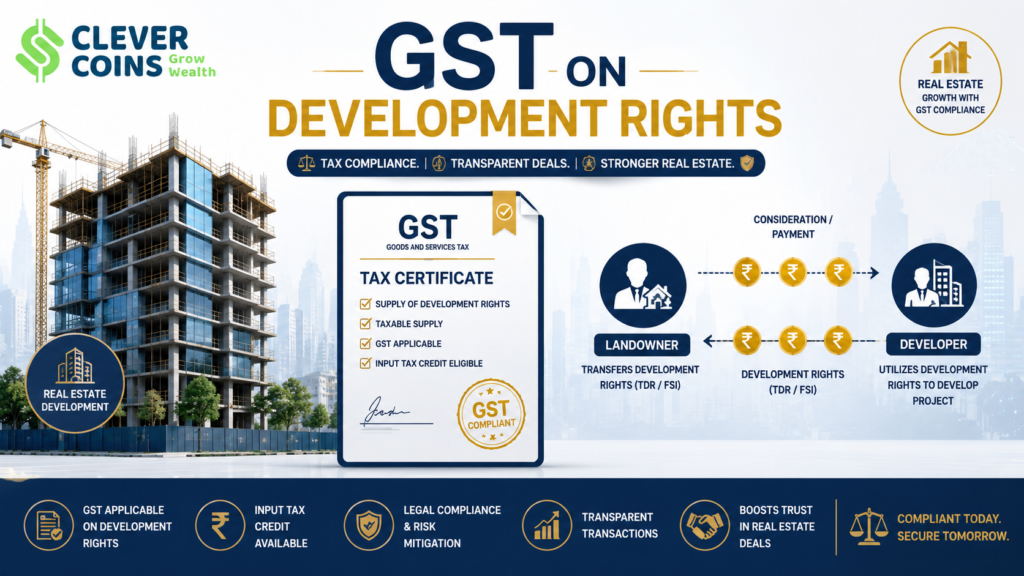
India’s real estate sector is one of the most dynamic and complex segments of the economy, and the Goods and Services Tax (GST) framework has brought in sweeping changes to how transactions involving land and development are taxed. Among the most nuanced provisions under GST is the taxation on Development Rights — a topic that directly affects landowners, builders, developers, and investors across the country. Whether you are a landowner entering into a Joint Development Agreement (JDA), a builder constructing apartments on transferred land, or a tax professional advising clients, understanding GST on Development Rights is absolutely essential in 2026.
This comprehensive guide covers every aspect of GST on Development Rights — from the legal background and applicable GST rates to Input Tax Credit (ITC) eligibility, recent amendments, landmark rulings, and compliance obligations. We have incorporated all updates as per Indian GST law applicable in 2026.
1. Understanding Development Rights: The Legal and Taxation Framework
1.1 What Are Development Rights?
Development Rights refer to the rights transferred by a landowner to a developer or builder, authorising them to construct a building or project on the landowner’s plot of land. These rights are typically transferred through a Joint Development Agreement (JDA) or a Development Agreement (DA), which is a contractual arrangement between the landowner and the developer.
In Indian real estate practice, Development Rights are categorised under two broad mechanisms:
- Transfer of Development Rights (TDR): A regulatory tool used in urban planning, especially in cities like Mumbai, where development potential from one plot is transferred to another.
- Joint Development Agreement (JDA) Rights: Rights granted by a landowner to a developer to develop the land in exchange for a revenue share or a certain number of constructed units.
1.2 Legal Provisions Governing Development Rights Under GST
Under GST, development rights are treated as a ‘supply of service.’ The statutory provisions governing GST on development rights are primarily embedded in:
- Notification No. 4/2018-Central Tax (Rate) dated 25.01.2018
- Notification No. 3/2019-Central Tax (Rate) dated 29.03.2019
- Notification No. 6/2019-Central Tax (Rate) dated 29.03.2019
- Section 7 of the CGST Act, 2017 (defining ‘supply’)
- Schedule II of the CGST Act, 2017 (activities treated as supply of services)
- Para 5(b) of Schedule II: Construction of a complex, building, etc., for sale is treated as a supply of service where the consideration is received before the issuance of the completion certificate.
2. GST Applicability on Joint Development Agreements (JDA)
2.1 Nature of Supply in JDA
A Joint Development Agreement creates a unique transaction where:
- The Landowner transfers Development Rights to the Developer.
- The Developer in exchange provides constructed units (flats, apartments, commercial spaces) or a portion of the sale proceeds to the Landowner.
From a GST perspective, both legs of this transaction — the transfer of development rights by the landowner AND the construction service provided by the developer — qualify as separate taxable supplies.
2.2 GST on Transfer of Development Rights by Landowner
When a landowner transfers development rights to a developer, it constitutes a supply of service under GST. The key parameters are:
|
Parameter |
Details |
Remarks |
|
Nature of Supply |
Service (Transfer of Immovable Property Rights) |
Para 5(b) Schedule II CGST Act |
|
GST Rate |
18% (as applicable on date of transfer) |
Effective from 01.04.2019 |
|
Time of Supply |
Date of Transfer of Development Rights |
Per Section 13 CGST Act |
|
Taxable Person |
Landowner (supplier) |
Subject to registration threshold |
|
Reverse Charge Mechanism |
Applicable (Developer pays GST) |
Notification 4/2018-CT(Rate) |
Importantly, the Reverse Charge Mechanism (RCM) applies in most cases, meaning the developer (recipient) is liable to pay GST on the transfer of development rights — not the landowner. This is especially relevant where the landowner is an individual and may not be registered under GST.
2.3 GST on Construction Services by Developer to Landowner
When the developer agrees to provide constructed units to the landowner as consideration for the development rights, the developer is essentially rendering a construction service. This triggers a separate GST liability for the developer.
|
Scenario |
GST Rate |
Note |
|
Affordable Housing Units to Landowner |
1% (without ITC) |
Units priced up to Rs. 45 Lakh |
|
Non-Affordable Housing Units to Landowner |
5% (without ITC) |
All other residential projects |
|
Commercial Units to Landowner |
12% (with ITC) |
As per GST rate schedule |
3. GST Rates Applicable on Development Rights — 2026 Updated Schedule
3.1 Consolidated GST Rate Table for Real Estate and Development Rights
|
Transaction Type |
GST Rate |
ITC Availability |
|
Transfer of Development Rights (TDR/JDA) — Under RCM |
18% |
Developer can avail ITC |
|
Construction of Affordable Housing (for sale) |
1% |
No ITC |
|
Construction of Non-Affordable Residential Housing (for sale) |
5% |
No ITC |
|
Commercial Real Estate (for sale before completion) |
12% |
ITC Available |
|
Works Contract Services (for construction) |
18% |
ITC Available (for further taxable supply) |
|
Long-term Lease (over 30 years) |
18% |
On 1/3rd value after land deduction |
|
Rental of Commercial Property |
18% |
ITC Available |
|
Transfer of FSI / Additional FSI |
18% (under RCM) |
As per notification |
3.2 Affordable vs. Non-Affordable Housing: Definition as per 2026
The distinction between affordable and non-affordable housing is critical for determining the correct GST rate. As per the current provisions in 2026:
|
City Category |
Carpet Area Limit |
Value Cap |
|
Metropolitan Cities (Delhi-NCR, Mumbai, Bengaluru, Hyderabad, Chennai, Kolkata) |
Up to 60 sq. metres |
Up to Rs. 45 Lakh |
|
Other Cities and Towns |
Up to 90 sq. metres |
Up to Rs. 45 Lakh |
Both conditions — carpet area AND value — must be satisfied simultaneously for a project to qualify as affordable housing for the purpose of the 1% GST rate.
4. Reverse Charge Mechanism (RCM) on Development Rights
4.1 How RCM Works in Development Rights Transactions
The Reverse Charge Mechanism is a pivotal feature of GST on development rights. Under RCM, the developer (recipient of the development rights service) becomes liable to pay GST instead of the landowner (supplier). This provision was introduced to ensure GST compliance even in cases where landowners are unregistered individuals.
4.2 Key Conditions for RCM to Apply
- The supplier (landowner) must be any person (registered or unregistered).
- The recipient (developer) must be a registered taxable person.
- The supply must involve development rights, Floor Space Index (FSI), or long-term lease of land.
- The development must be for the purpose of construction of a project (residential or commercial).
4.3 RCM on FSI (Floor Space Index)
Transfer of additional FSI (also known as TDR — Transferable Development Rights) also attracts GST under the Reverse Charge Mechanism at 18%. This has significant implications in cities like Mumbai, Pune, and Bengaluru where TDR is commonly transacted in the real estate market.
|
Important Note on RCM Filing Developers who pay GST under RCM must mandatorily issue a Self-Invoice as per Section 31(3)(f) of the CGST Act, 2017. This self-invoice serves as the document for availing Input Tax Credit on RCM payments. The RCM amount must be reported in GSTR-3B under Table 3.1(d) and in GSTR-1 as applicable. |
5. Input Tax Credit (ITC) on Development Rights: Rules and Restrictions
5.1 ITC Eligibility for Developers
Input Tax Credit is one of the most important aspects for developers when calculating overall project costs and profitability. However, the ITC rules for the real estate sector are complex and restrictive.
5.2 ITC Restrictions Under the New Real Estate GST Regime (Post April 2019)
Post the significant GST amendment for real estate effective 01.04.2019, developers opting for the lower GST rates (1% for affordable housing and 5% for non-affordable residential housing) are NOT allowed to avail Input Tax Credit. Here is a detailed breakdown:
|
Project Type |
GST Rate |
ITC Allowed? |
|
Affordable Residential (New Scheme) |
1% |
No |
|
Non-Affordable Residential (New Scheme) |
5% |
No |
|
Commercial Projects (Ongoing/New) |
12% |
Yes |
|
Works Contract (B2B) |
18% |
Restricted (only for further supply) |
|
Residential Projects Under Old Scheme (pre-April 2019) |
8% or 12% |
Yes (where opted) |
5.3 ITC on RCM Paid by Developer
Developers who pay GST under RCM on development rights, FSI, and long-term lease can avail Input Tax Credit of such RCM-paid GST, subject to the condition that the credit is used for the purpose of making taxable supplies. However, for residential projects under the new regime (1% or 5%), ITC is blocked even on RCM amounts.
5.4 Pro-Rata ITC Calculation for Mixed Projects
Where a developer undertakes a mixed project (involving both commercial and residential units), ITC must be calculated on a proportionate basis. The formula for calculating eligible ITC is:
|
ITC Formula for Mixed-Use Projects: Eligible ITC = Total ITC x (Carpet Area of Commercial Portion / Total Carpet Area of the Project) |
6. Time of Supply for Development Rights Under GST
6.1 When Does GST Liability Arise?
Determining the correct time of supply is crucial for compliance and avoiding late payment interest. Under GST, the time of supply for development rights is governed by Section 13 of the CGST Act, 2017, read with the relevant notifications.
6.2 Time of Supply Rules — Simplified
|
Supply Type |
Time of Supply |
Applicable Section |
|
Transfer of Development Rights (Landowner to Developer) |
Date of Transfer / JDA Registration or Completion Certificate whichever is earlier |
Section 13(2) CGST Act |
|
Construction Services by Developer (under JDA) |
Date of completion certificate or first occupation, whichever is earlier |
Notification 6/2019-CT(Rate) |
|
RCM on Development Rights |
Date of entry in developer’s books, or 60 days from date of document, whichever is earlier |
Section 13(3) CGST Act |
|
Long-term Lease Premium |
Date of payment or date of invoice, whichever is earlier |
Section 13 CGST Act |
6.3 Deferment of GST Liability for Landowners
A critical relief provided to landowners under Notification 4/2018 is the deferment of GST liability. The landowner’s GST liability on transfer of development rights arises only at the time the developer receives the Completion Certificate or when the developer sells the units — whichever is earlier. This means landowners do not need to pay GST at the time of signing the JDA, which was a significant concern before the notification.
7. Valuation of Development Rights for GST Purposes
7.1 The Challenge of Valuing Development Rights
One of the most complex aspects of GST on development rights is determining the taxable value (consideration) upon which GST is to be calculated. Since development rights involve non-monetary or in-kind consideration (typically the developer gives back constructed units to the landowner), conventional valuation methods may not apply.
7.2 Valuation as Per GST Rules
Rule 27 of the CGST Rules, 2017 deals with the value of supply where the consideration is not wholly in money. The taxable value of development rights is determined as follows:
- The value of the construction service provided by the developer to the landowner shall be equal to the value of similar units sold by the developer to independent third-party buyers at or near the time of development.
- If similar units are not available, the value shall be determined based on cost of construction plus a reasonable profit margin.
- Circular No. 177/09/2022-GST clarified that the value of supply of development rights by the landowner to the developer shall be the GST-inclusive market value of the units allotted to the landowner.
7.3 Practical Valuation Example
|
Particulars |
Amount (Rs.) |
Remarks |
|
Market Value of 2 BHK Unit allotted to Landowner |
Rs. 75,00,000 |
Based on similar unit sales |
|
Less: Land Value Deduction (1/3rd) |
Rs. 25,00,000 |
As per GST valuation rules |
|
Taxable Value of Construction Service |
Rs. 50,00,000 |
Base for GST calculation |
|
GST @ 5% (Non-Affordable Housing) |
Rs. 2,50,000 |
Developer’s liability |
|
Value of Development Rights for RCM |
Rs. 75,00,000 |
RCM on full market value of units |
|
GST @ 18% under RCM |
Rs. 13,50,000 |
Paid by Developer on behalf of Landowner |
8. GST Registration Requirements for Landowners and Developers
8.1 When Must a Landowner Register Under GST?
A landowner who transfers development rights is required to obtain GST registration when the aggregate turnover from all taxable supplies exceeds Rs. 20 Lakhs per financial year (Rs. 10 Lakhs for Special Category States). However, since RCM applies on development rights, even unregistered landowners are generally protected from direct GST liability — as the developer pays GST on their behalf.
8.2 Mandatory Registration for Developers
All developers engaged in construction activities for sale (before the issuance of completion certificate) are mandatorily required to register under GST, irrespective of their turnover, because:
- Construction activity involves taxable supply of services.
- Developers are required to pay GST under RCM on development rights, FSI, and long-term leases.
- GST registration is needed for ITC availing on commercial projects.
8.3 Composition Scheme Availability
Developers are NOT eligible to opt for the Composition Scheme under Section 10 of the CGST Act, 2017, as construction services involving development rights fall outside the scope of activities permitted under the Composition Scheme.
9. Exemptions from GST on Development Rights
9.1 Key Exemptions Available in 2026
While development rights broadly attract GST, certain transactions and activities are exempt from GST. Here is a comprehensive list of relevant exemptions:
|
Exemption Category |
Details |
|
Pure Land Sale |
Sale of land (without construction) is exempt from GST as land is neither goods nor services. |
|
Sale of Completed Units |
Sale of a building/flat AFTER the issuance of completion certificate is exempt from GST as it is treated as sale of immovable property. |
|
Affordable Rental Housing |
Affordable Rental Housing Complexes (ARHC) notified under government schemes are exempt from GST. |
|
Low-Cost Houses under Government Schemes |
Construction of houses under schemes like PMAY (Pradhan Mantri Awas Yojana) where the entire cost is funded by government is exempt. |
|
Services by Government Bodies |
Development rights transferred by Government/Local Authority to government-specified entities are generally exempt. |
10. Compliance Requirements: Returns, Invoices, and Documentation
10.1 GST Returns Applicable for Real Estate Developers
Developers involved in development rights transactions must comply with the following GST return filing requirements:
|
Return Type |
Frequency |
Purpose |
|
GSTR-1 |
Monthly / Quarterly |
Outward supply details including construction services |
|
GSTR-3B |
Monthly |
Summary of tax liability and ITC claimed, including RCM |
|
GSTR-9 |
Annual |
Annual return consolidating entire year’s transactions |
|
GSTR-9C |
Annual (if turnover > Rs. 5 Cr) |
Reconciliation statement and audit report |
10.2 Invoice and Documentation Requirements
Proper documentation is essential for GST compliance in development rights transactions. The required documents include:
- Joint Development Agreement (JDA) — stamped and registered
- Development Rights Transfer Deed / Deed of Assignment
- Self-Invoice issued by Developer under RCM
- Tax Invoices for construction services provided to landowner
- Completion Certificate from the relevant authority
- ITC reversal documents (for residential projects)
10.3 Anti-Profiteering Compliance
Under Section 171 of the CGST Act, developers must ensure that the benefit of ITC or reduction in GST rates is passed on to buyers. The National Anti-Profiteering Authority (NAA) has been succeeded by the Competition Commission of India (CCI) for this function, and developers must maintain proper records of cost reduction and price adjustments passed to consumers.
11. Landmark GST Rulings and AAR Decisions on Development Rights (2019–2026)
11.1 Key Advance Authority for Ruling (AAR) Decisions
Over the past several years, numerous Advance Rulings by State Authorities and the National AAR have clarified ambiguities in GST on development rights. Some landmark rulings include:
- In Re: Sri Vinayaga Agencies (Tamil Nadu AAR) — Held that development rights constitute a supply of service and attract GST. Landowner and developer are separate taxable entities.
- In Re: Prahitha Construction Pvt. Ltd. (Telangana AAR) — Clarified that the value of development rights should be calculated based on the market value of units allotted to the landowner.
- In Re: Maarq Spaces Pvt. Ltd. (Karnataka AAR) — Ruled that GST is applicable on the development rights transferred through JDA even if no monetary consideration is involved — in-kind consideration is sufficient.
- Godrej Properties vs. Union of India — Challenged the retrospective application of the 2019 GST amendments to ongoing JDAs. Courts provided interim relief noting that new rates should not apply to contracts executed before 01.04.2019 without transition provisions.
- CBIC Circular No. 177/09/2022-GST — Clarified the valuation of services supplied by developer to landowner in cases involving development rights, removing several ambiguities.
12. GST on TDR (Transferable Development Rights) — Special Considerations
12.1 TDR in Urban Real Estate Development
Transferable Development Rights (TDR) are instruments used by urban local bodies to incentivise landowners whose land is required for public purposes (roads, parks, civic amenities). In exchange for surrendering land, the government issues TDR certificates which can be used by the owner or sold to other developers.
12.2 GST Treatment of TDR
The GST treatment of TDR has been a subject of significant debate. The current position as of 2026 is:
- Purchase of TDR by a Developer: Subject to GST @ 18% under the Reverse Charge Mechanism.
- Sale of TDR by an Original Landowner: Treated as transfer of development rights, attracting GST under RCM on the buyer/developer.
- Sale of TDR by a TDR Trader (who purchased TDR for resale): Subject to 18% GST, payable by the trader (forward charge).
12.3 TDR Transactions in Mumbai: Specific Considerations
Mumbai’s real estate market has a highly evolved TDR ecosystem. The city-specific Development Control and Promotion Regulations (DCPR) 2034 govern TDR usage. For GST purposes, TDR transactions in Mumbai follow the same national GST framework, and developers must account for:
- GST under RCM on TDR purchase value.
- ITC eligibility based on the nature of the project (commercial vs. residential).
- Proper documentation of TDR purchase agreements and stamp duty paid receipts for audit trails.
13. Recent GST Amendments and Notifications Affecting Development Rights (2024–2026)
13.1 Key Amendments in 2024 and 2025
The GST Council has been actively reviewing the real estate sector, and several amendments have been introduced that impact development rights transactions:
- GST Council 52nd Meeting (October 2023): Confirmed continuation of the 1%/5% rates for residential projects, with renewed focus on anti-evasion measures in real estate.
- CBIC Circular 2024: Issued clarifications on the treatment of undivided share (UDS) of land in development agreements, reaffirming that UDS transfer does not trigger separate GST if it is part and parcel of the JDA.
- Finance Act 2025: Introduced changes to CGST Act Section 17(5) dealing with blocked credits for real estate, reaffirming restrictions on ITC for residential construction.
- Notification updates in 2025-26: GST Council has been deliberating on rationalising the complex valuation rules for development rights to bring greater clarity and reduce disputes.
13.2 Expected GST Council Agenda for 2026
The real estate sector is on the agenda of the GST Council for further rationalisation in 2026, including:
- Possible revision of the affordable housing threshold to account for inflation in property prices.
- Simplification of ITC reversal rules for mixed-use projects.
- Standardisation of TDR GST treatment across all states.
- Potential introduction of a flat GST structure for development rights to eliminate valuation disputes.
14. Practical Implications for Stakeholders
14.1 For Landowners Entering Into JDA
Landowners must be fully aware of the GST implications before entering into a Joint Development Agreement:
- Even though RCM means the developer pays GST on their behalf, the transaction is a taxable event — keep all documents ready.
- If the landowner receives cash in addition to constructed units, the cash consideration may be separately taxable.
- Engage a GST consultant before signing the JDA to understand your tax obligations.
- Ensure the JDA clearly specifies the nature of consideration, completion timeline, and the units being received.
14.2 For Real Estate Developers
- Maintain separate project-wise accounting for GST compliance.
- Properly account for RCM payments on development rights, FSI, and long-term leases.
- Carefully evaluate whether to opt for the 1%/5% rate (without ITC) versus the higher rate (with ITC) based on project economics.
- File GSTR-1, GSTR-3B, and GSTR-9 accurately and on time to avoid interest and penalties.
- Ensure ITC reversal is done correctly for residential units on the date of completion certificate.
14.3 For CA/Tax Professionals
- Stay updated with CBIC circulars and AAR rulings on development rights.
- Help clients structure JDA agreements to optimise GST outflows legally.
- Assist in valuation exercises for development rights to avoid disputes.
- Conduct GST audits of real estate clients with special focus on ITC eligibility and RCM compliance.
15. Penalties and Consequences of Non-Compliance
15.1 GST Penalties for Non-Compliance in Development Rights
|
Violation |
Penalty |
Provision |
|
Non-payment of GST under RCM |
10% of tax due, minimum Rs. 10,000 |
Section 73 CGST Act |
|
Fraudulent non-payment |
100% of tax due |
Section 74 CGST Act |
|
Wrongful ITC claim |
Equal to ITC wrongly claimed + 18% interest |
Section 73/74 CGST Act |
|
Failure to file return |
Rs. 50 per day (Rs. 20 per day for Nil return) |
Section 47 CGST Act |
|
Fraudulent avoidance of GST |
Imprisonment up to 5 years + fine |
Section 132 CGST Act |
Conclusion: Navigating GST on Development Rights in 2026
GST on Development Rights is undoubtedly one of the most intricate areas of Indian taxation, requiring a thorough understanding of multiple provisions, rates, exemptions, and compliance obligations. Whether you are a landowner, developer, or tax professional, the key to navigating this landscape lies in:
- Understanding the nature of supply — whether it is a transfer of development rights, construction service, or both.
- Applying the correct GST rate based on the type of project (affordable, non-affordable, commercial).
- Complying with the Reverse Charge Mechanism obligations for RCM on development rights and FSI.
- Maintaining meticulous documentation — JDAs, invoices, self-invoices, and completion certificates.
- Staying current with CBIC notifications, circulars, and AAR rulings.
With the real estate sector contributing significantly to India’s GDP and employment, the government has been working towards rationalising GST provisions. Staying compliant not only avoids penalties but also strengthens the foundation of your real estate business. Always consult a qualified GST practitioner for specific transaction-based advice.