GST on Education Services in India: Exemptions, Rates, EdTech, Coaching & Complete Compliance Guide
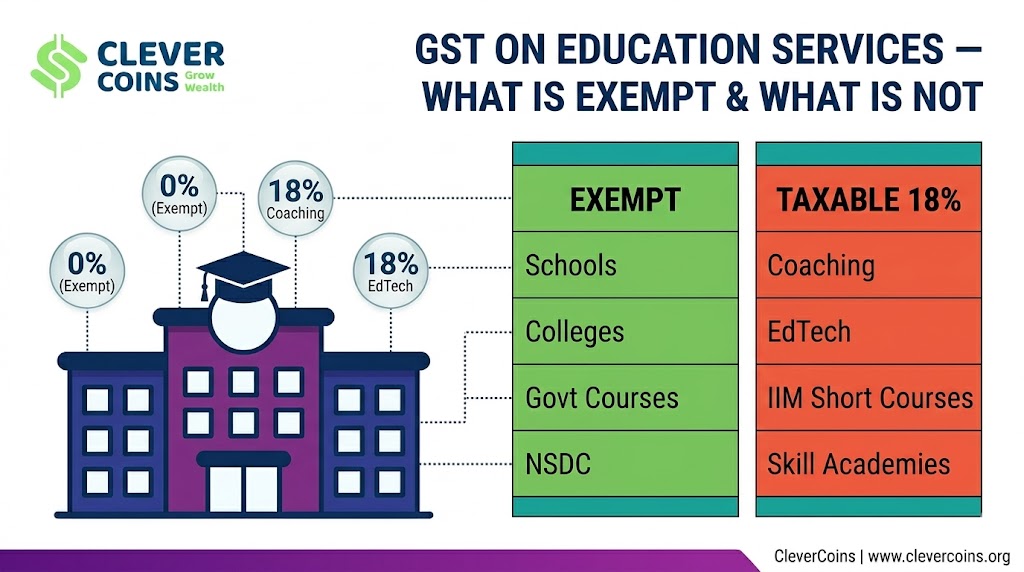
Education is one of India’s most vital and complex sectors under the Goods and Services Tax (GST) framework. With a population of over 1.4 billion, a rapidly growing EdTech industry, thousands of coaching institutes, and a dense network of schools, colleges, and universities — the GST treatment of education services directly impacts millions of students, parents, educational institutions, and businesses.
The fundamental principle under GST is that education — as a public good — deserves a special status. Accordingly, the government has exempted most formal education services from GST. However, the exemption is not blanket. Coaching institutes, EdTech platforms, skill academies, aviation training, and many ancillary services are fully taxable at 18%.
This comprehensive guide by CleverCoins — India’s trusted tax consultancy firm — covers every dimension of GST on education: legal definitions, exempt and taxable services, a 30-row master rate table, ITC rules, EdTech platform taxation, GST for coaching institutes, compliance obligations, and the latest 2024-2026 updates.
Legal Framework — GST and Education
The GST exemption for education services is governed by Entry 66 of Notification No. 12/2017-Central Tax (Rate), dated 28th June 2017. This notification grants a nil GST rate on specified education services. The exemption is conditional — it does not apply to all education-related services automatically.
Key Definitions Under GST Law
- Educational Institution
Under GST law, ‘educational institution’ is defined as an institution providing services by way of:
- Pre-school education and education up to higher secondary school or equivalent
- Education as a part of a curriculum for obtaining a qualification recognised by any law for the time being in force
- Education as a part of an approved vocational education course
⚠️ Critical Point: Coaching institutes, private tuition centres, hobby classes, and EdTech platforms do NOT qualify as ‘educational institutions’ under GST law — because their courses are NOT part of a curriculum leading to a government-recognised qualification.
- Approved Vocational Education Course
This means a course run by an industrial training institute (ITI) or industrial training centre (ITC) affiliated to the National Council for Vocational Training (NCVT), or a Modular Employable Skill course approved under the National Skill Development Framework (NSDF) by the Sector Skill Council under NSDC.
- Services ‘By’ vs. Services ‘To’ an Educational Institution
This is one of the most important distinctions in education GST:
- Services PROVIDED BY an educational institution to its own students, faculty, and staff: Exempt
- Services PROVIDED TO an educational institution by third-party vendors: Exempt only for specific services — housekeeping, security, catering, transport, admission-related services
- All other services provided TO educational institutions by third parties: Taxable at applicable rates
✅ Example: A cleaning company providing housekeeping services to a school is exempt from GST. But the same cleaning company providing services to a coaching institute is taxable at 18%, because the coaching institute is not an ‘educational institution’ under GST law.
Master GST Rate Table — Education Services (30 Categories)
The following comprehensive table covers GST rates for all major categories of education-related services and supplies in India:
Category / Service | GST Rate | SAC Code | Key Condition / Notes |
Services by educational institution to students, faculty & staff | NIL (Exempt) | 9992 | Core academic services fully exempt |
Services to educational institution by another entity (transport, housekeeping, security, catering) | NIL (Exempt) | Various | Exempt only if provided TO the institution |
Services by IIMs for executive development programmes (long duration) | NIL (Exempt) | 9992 | Only long-duration diploma/PG programmes |
Services by IIMs — short-term executive/management courses | 18% | 9992 | Changed post-2021: short courses taxable |
Approved vocational education courses under National Skill Development Corporation (NSDC) | NIL (Exempt) | 9992 | Must be approved NSDC/Sector Skill Council course |
Coaching institutes / private tuition centres | 18% | 9992 | Not ‘educational institutions’ under GST law |
Online coaching classes / e-learning platforms | 18% | 9992 | Taxable — not covered under education exemption |
Distance education by universities / UGC-approved institutions | NIL (Exempt) | 9992 | Must be a recognised university/institution |
Entrance exam preparation coaching (e.g., IIT-JEE, NEET, CAT) | 18% | 9992 | Pure coaching — not educational institution |
Professional courses: CA, CS, ICWA institute (ICAI, ICSI, ICMAI) | NIL (Exempt) | 9992 | Statutory institutes — exempt |
Training by government / recognised bodies for skill development | NIL (Exempt) | 9992 | Must be under approved government scheme |
Yoga / dance / art / recreational classes (non-curriculum) | 18% | 9993/9996 | Not academic — taxable |
Self-defence, martial arts classes | 18% | 9996 | Recreational/sports — taxable |
Commercial pilot training | 18% | 9992 | Treated as vocational — AAR rulings: taxable |
Supply of food / canteen in educational institutions (part of academic fee) | NIL (Exempt) | 9963 | If composite with exempt service — exempt |
Supply of food by external caterer to institution | 5% (if turnover > 20L) | 9963 | Standalone catering — taxable at 5% |
Printing of textbooks / question papers by institution | NIL (Exempt) | 9989 | Part of academic service — exempt |
Supply of printed books (external publisher) | NIL | 4901 | Books are NIL rated — separate from service |
Stationery, pens, bags sold by institution | 12% or 18% | Various | Goods supply — standard rates apply |
Renting of premises by institution to commercial entity | 18% | 9972 | Commercial rental always taxable |
Renting of premises among educational institutions | NIL (Exempt) | 9972 | Exempt if both are educational institutions |
Hostel accommodation — by educational institution to students | NIL (Exempt) | 9963 | Below Rs. 20/day threshold — always exempt for students |
Hostel accommodation — by private hostel providers (non-institution) | 12% (if > Rs. 1000/day) | 9963 | Updated post-47th GST Council |
Transport provided by institution to students/staff | NIL (Exempt) | 9964 | When provided by institution — exempt |
School bus operated by 3rd party contractor | NIL (Exempt) | 9964 | Transport of students — specifically exempt |
Supply of uniforms to students by institution | 5% / 12% | Various | Goods — standard textile/garment rates |
Fees for board exams (CBSE, State Boards) | NIL (Exempt) | 9992 | Government / statutory exam body |
Registration / application fees for entrance tests by institutions | NIL (Exempt) | 9992 | If collected by the educational institution itself |
Software / e-content subscription (Byju’s, Unacademy, etc.) | 18% | 9984/9992 | EdTech platforms — not exempt educational institutions |
Foreign university branch campus in India (if approved by UGC) | NIL (Exempt) | 9992 | If registered and recognised under Indian law |
📌 CleverCoins Note: The GST exemption for education is strictly tied to the legal definition of ‘educational institution’. When in doubt about whether your institution or service qualifies, seek an Advance Ruling from the GST Authority for Advance Rulings (AAR) — CleverCoins can help you prepare and file the application.
Exempt vs Taxable Education Services — Quick Reference
The following side-by-side table provides an at-a-glance comparison of which education services are exempt and which are taxable:
EXEMPT (NIL GST) | TAXABLE (18% unless noted) |
Government schools, colleges, universities (UGC-recognised) | Private coaching institutes (IIT-JEE, NEET, CAT, UPSC) |
CBSE / ICSE / State Board affiliated schools | EdTech platforms (Byju’s, Unacademy, Vedantu, etc.) |
IIMs — long-duration PG diploma programmes | IIMs — short-duration executive programmes |
NSDC / Sector Skill Council approved vocational courses | Non-approved skill / hobby courses |
CA / CS / CMA institute programs (ICAI, ICSI, ICMAI) | Yoga, dance, art, music, self-defence classes |
Transport to students by institution | Self-defence / martial arts (non-curriculum) |
Hostel for students by institution | Private hostel operators (12% if above Rs.1000/day) |
Canteen food (composite with academic service) | Food by external caterer (standalone — 5%) |
Government skill development training | Commercial pilot training, aviation courses |
Exam fees by CBSE / State Boards | Subscription-based online courses / apps |
⚠️ The most common misconception: Many coaching institutes and private tutorial centres believe they are exempt from GST. They are NOT. The GST exemption applies only to recognised educational institutions. Coaching institutes must charge 18% GST on fees if they are registered (or liable to register) under GST.
GST on Schools — Pre-School, Primary, Secondary & Higher Secondary
What is Exempt for Schools?
- Tuition fees, examination fees, admission fees charged by the school to students
- Sports fees, activity fees, computer lab fees — when charged as part of the school package
- Annual day, cultural events organised by the school for students
- School transport operated by the school itself
- Hostel accommodation provided by the school to students
- Food / mid-day meal provided by the school as part of education
- School-level competitions — interschool events organised by recognised bodies
What is Taxable for Schools?
- Sale of uniforms, school bags, stationery — these are goods, not services, and attract applicable GST rates
- Renting of school premises for commercial purposes (conferences, events) — 18% GST
- Selling books at a profit (if the school acts as a commercial trader of books — though books themselves are nil rated)
- Fees for hobby classes, music classes, art classes outside the regular curriculum — 18%
- Advertisement on school premises or school notice boards — 18%
GST on Universities, Colleges & Higher Education
Fully Exempt Services
- Tuition fees, semester fees, registration fees for recognised degree/diploma programmes
- Examination fees for university-level examinations
- Library fees, laboratory fees as part of course curriculum
- Research programmes and PhD course fees
- Services provided by deemed universities and autonomous colleges under UGC Act
- Distance education programmes by UGC-approved institutions
- Hostel accommodation provided by the institution to students — exempt
Taxable Services by Universities
- Short-duration executive programmes and professional development programmes not leading to a recognised degree
- Renting of auditorium / conference halls to external parties — 18%
- Canteen / food services operated as a commercial franchise — 5%
- Placement services provided to companies for campus recruitment — may be taxable
- Publication and sale of books, journals for commercial purposes
📌 UGC-recognised institutions providing degree / diploma courses that are part of the formal educational curriculum are fully exempt. However, the same institution offering a short non-degree professional certificate programme may attract 18% GST.
GST on IIMs — Special Case
Indian Institutes of Management (IIMs) are premier management institutions established under the IIM Act, 2017. The GST treatment for IIM programmes has evolved significantly:
IIM Services — Pre-2021 Regime
Before the Finance Act, 2021, ALL IIM programmes were exempt from GST, including executive programmes, as IIMs were considered part of the educational institution framework.
IIM Services — Post-2021 Regime (Current)
- Long-duration management programmes (2+ years) leading to a Post Graduate Diploma in Management (PGDM) recognised by AICTE: EXEMPT
- Fellowship Programme (equivalent to PhD): EXEMPT
- 5-year integrated programmes: EXEMPT
- Short-duration Executive Development Programmes (EDPs), Management Development Programmes (MDPs), and Certificate Programmes: TAXABLE at 18%
⚠️ The 2021 change was controversial. Many IIM alumni associations and business schools argued that this makes executive education more expensive. As of 2026, the 18% rate on short IIM courses continues to apply.
GST on Coaching Institutes — The Full Picture
Coaching institutes represent one of India’s largest education businesses — with market leaders like FIITJEE, Aakash, Allen, Career Launcher, TIME, and thousands of local coaching centres. Despite being in the education space, coaching institutes are NOT covered under the GST education exemption.
Why Are Coaching Institutes Taxable?
Coaching institutes do NOT qualify as ‘educational institutions’ under GST because:
- They do not provide education leading to a recognised qualification under any law
- They are supplementary services — preparing students for exams, not awarding degrees or diplomas
- Their courses are not part of any government-recognised curriculum
GST Rates for Coaching Institutes
- Coaching fees: 18% GST
- Study material / printed notes sold separately: 18% GST (not a book, treated as printed matter)
- Online study modules / video lectures (digital): 18% GST
- Hostel accommodation for coaching students: 12% (if above Rs. 1,000/day)
- Food and mess services: 5% GST
GST Registration Threshold for Coaching Institutes
A coaching institute must register for GST if its aggregate annual turnover exceeds Rs. 20 lakh (Rs. 10 lakh for special category states). Since coaching fees attract 18% GST, even medium-sized institutes can quickly cross the registration threshold.
✅ Important: Many small coaching institutes below Rs. 20 lakh turnover are not required to register for GST. However, if they receive advances that push them over the threshold, or if they provide inter-state coaching services, registration becomes mandatory.
ITC for Coaching Institutes
Since coaching institutes provide taxable services (18% GST), they ARE eligible to claim Input Tax Credit (ITC) on their business inputs, subject to standard ITC eligibility rules:
- ITC on study material printing, stationery: YES
- ITC on IT infrastructure (computers, projectors, software): YES
- ITC on rent paid for coaching premises: YES
- ITC on advertising and marketing expenses: YES
- ITC on construction of building: NO (blocked u/s 17(5)(c)/(d))
- ITC on canteen food for staff: NO (blocked u/s 17(5)(b))
GST on EdTech Platforms — The Booming Sector
India’s EdTech sector has exploded post-COVID, with platforms like Byju’s, Unacademy, Vedantu, Simplilearn, UpGrad, Coursera India, and thousands of smaller online learning providers. This sector has unique and important GST implications:
EdTech Platform / Service Type | GST Rate | Reason |
Online subscription courses (Byju’s, Unacademy, Vedantu) | 18% | Not a recognised educational institution under GST |
LIVE online tuition / coaching classes | 18% | Coaching service — not exempt |
Recorded video courses / MOOCs (non-institution) | 18% | Digital content service — taxable |
E-books / digital study material (downloaded) | 18% | Electronic publication — taxable (unlike printed books) |
Printed books / textbooks (physical) | NIL | Books are zero-rated — HSN 4901 |
SaaS-based LMS platform subscription for institution | 18% | B2B tech service — taxable |
Online certification programme by IIT / IIM / UGC institution | NIL (Exempt) | Offered by exempt institution — exempt |
Freelance online tutoring (individual tutor) | 18% (if registered) | Service provider — taxable if turnover > threshold |
YouTube / social media educational content (subscription) | 18% | OTT/digital service — taxable |
Government SWAYAM / NPTEL courses | NIL | Government-run — exempt public service |
⚠️ Key Issue for EdTech Platforms: Unlike physical schools and colleges, EdTech platforms are treated as technology/service companies — NOT educational institutions under GST law. All their subscription fees, course fees, and digital content revenues attract 18% GST. This is a significant cost passed on to learners and must be disclosed clearly in their pricing.
EdTech and Place of Supply Rules
For EdTech platforms providing online education to students across India and internationally:
- B2C (student in India): IGST or CGST+SGST applies based on place of supply rules
- B2B (educational institution buying LMS software): GST at 18%, ITC available to the institution for taxable outputs
- Foreign students accessing Indian EdTech platform: Export of service — 0% GST (IGST refund or LUT)
- Indian student accessing foreign EdTech platform: Import of service — Reverse Charge Mechanism (RCM) applies if B2B; B2C exempted
GST on Skill Development & Vocational Training
Skill development is a priority sector for the Indian government under schemes like Skill India, PMKVY (Pradhan Mantri Kaushal Vikas Yojana), and NSDC. The GST treatment depends on whether the course is ‘approved’ under the prescribed framework:
Exempt Vocational / Skill Development Training
- Courses run by ITIs / ITCs affiliated to NCVT
- Modular Employable Skill (MES) courses approved under NSDF by NSDC Sector Skill Councils
- Courses funded and run under government schemes (PMKVY, DDU-GKY, STAR scheme)
- Training by Pradhan Mantri Kaushal Kendras (PMKK)
Taxable Vocational / Skill Training
- Private skill academies NOT affiliated to NCVT or NSDC Sector Skill Councils
- Corporate training programmes by private trainers — 18% GST
- Language learning centres (spoken English, French, German classes) — 18% GST
- Personality development, public speaking, leadership workshops — 18% GST
- Beautician / hair styling courses (unless NSDC-approved) — 18% GST
- Computer training centres (DTP, Tally, etc.) unless NSDC-affiliated — 18% GST
💡 CleverCoins Tip: If you operate a skill training centre, getting affiliated with an NSDC Sector Skill Council can save your students 18% GST — making your courses significantly more affordable and competitive.
GST on Hostel Accommodation — Educational Institutions vs Private
Hostel accommodation is a significant cost for students in India. The GST treatment depends on who provides the hostel and at what price:
- Hostel by an educational institution to own students: EXEMPT — always, regardless of amount charged (part of educational service)
- Hostel by a separate private hostel operator near college/school: 12% GST if charge exceeds Rs. 1,000 per day per person (per 47th GST Council change effective 18 July 2022)
- Hostel by PG / paying guest accommodation provider: 12% GST if above Rs. 1,000/day
- Hostel by charitable trust / NGO operating residential schools: NIL — if registered under relevant acts and running for charitable purposes
⚠️ The 47th GST Council (July 2022) removed the Rs. 1,000/day exemption for private hostels. Any private hostel charging above Rs. 1,000 per person per day now pays 12% GST. This has impacted the cost of student accommodation in cities like Pune, Bengaluru, and Delhi.
GST on Study Material — Books vs Digital Content
There is a fundamental GST difference between physical books and digital/electronic content:
- Printed books, textbooks, children’s books (HSN 4901): NIL GST — completely zero-rated
- Printed brochures, leaflets, pamphlets (HSN 4901–4911): 5% GST
- Printed study material sold by coaching institutes (not books): 18% GST (treated as printed matter, not books)
- E-books / digital books downloaded (HSN 9984): 18% GST — key difference from physical books
- Online access to digital study platform / LMS: 18% GST
- Subscription to digital library / journal (Elsevier, JSTOR): 18% GST
✅ Smart Strategy: Coaching institutes that sell physical printed study material can potentially argue NIL GST if the material qualifies as a ‘book’. However, AAR rulings in several states have held that study material / workbooks sold by coaching institutes are taxable at 18% as they are not ‘books’ in the traditional sense. Seek professional advice before adopting any GST position.
GST on Foreign Education Services & International Schools
- Foreign university offering courses in India via physical campus (approved by UGC): EXEMPT if recognised
- Foreign university offering online courses to Indian students (no physical presence): Import of service — 18% GST under Reverse Charge Mechanism for B2B; exempt for B2C (individual students)
- International schools (IB, IGCSE curriculum): Generally treated as educational institutions — NIL GST on school fees if affiliated to recognised international boards
- Study abroad consultants / overseas education agents: 18% GST on service fees
- IELTS / TOEFL / GRE exam fees: 18% GST (these are testing services, not education services)
GST Compliance for Educational Institutions — Registration & Returns
Is GST Registration Required for Schools/Colleges?
Educational institutions providing only exempt services are generally not required to register under GST, since their output is nil-rated/exempt and there is no tax liability. However, registration becomes necessary if:
- The institution has both exempt AND taxable services (e.g., renting out auditorium, running a taxable executive programme)
- The institution makes inter-state supply of taxable services
- The institution is required to deduct TDS under GST (if it is a government entity making specified payments)
- Voluntary registration is sought to claim ITC on taxable inputs
GST Returns for Educational Institutions (If Registered)
- GSTR-1: Outward supply details — monthly (turnover > Rs. 5 crore) or quarterly
- GSTR-3B: Monthly self-assessment return — tax liability computation
- GSTR-9: Annual return — by 31st December of following year
- GSTR-9C: Reconciliation statement — if turnover > Rs. 5 crore
GST Compliance for Coaching Institutes
- Mandatory GST registration once aggregate turnover exceeds Rs. 20 lakh
- Collect 18% GST on all fees — tuition, study material, mock tests
- Issue tax invoices with GSTIN, HSN/SAC code, and GST breakup
- File GSTR-1 and GSTR-3B monthly or quarterly as applicable
- E-invoicing mandatory if turnover exceeds Rs. 5 crore
- Claim ITC on eligible business inputs
- Maintain proper books — student-wise fee register, supply registers, ITC ledger
Input Tax Credit — Education Sector ITC Rules
Expense / Input | ITC Eligible? | Reason |
Books, stationery for exempt academic services | NO | Used for exempt output — blocked u/s 17(2) |
Computers / tablets for student lab (exempt courses) | NO | Attributable to exempt supply |
Construction of school building / college campus | NO | Immovable property — blocked u/s 17(5)(c)/(d) |
School bus (transport vehicle) | NO | Motor vehicle — blocked u/s 17(5)(a) |
Staff uniforms / canteen food for employees | NO | Personal consumption — blocked u/s 17(5)(b) |
IT infrastructure for coaching institute (taxable) | YES | Used for taxable supply — eligible |
Marketing / advertising for taxable courses | YES | Business expense for taxable output |
Furniture / equipment for taxable executive programme | YES (partial) | If mixed use — proportionate ITC |
Office supplies used for admin (both exempt + taxable) | PARTIAL | Rule 42 proportionate reversal applies |
Online platform / LMS software for taxable e-learning | YES | Used exclusively for taxable supply |
Printing services for taxable course material | YES | Input for taxable output — eligible |
📌 CleverCoins ITC Strategy for Mixed-Use Institutions: If an institution provides both exempt (school/college) and taxable (executive programmes, auditorium rental) services, it must compute proportionate ITC under Rule 42 and Rule 43 every month. Our team can set up a compliant ITC tracking system tailored to your institution’s specific revenue mix.
Recent GST Updates Affecting Education — 2024 to 2026
- 54th GST Council (September 2024): Broad slab rationalisation discussed — education sector was examined for possible inclusion of coaching in a lower 12% slab (no final decision announced as of early 2026)
- E-invoicing: Coaching institutes and EdTech platforms with turnover above Rs. 5 crore must now generate e-invoices for all B2B transactions
- GST on online education exports: Clarification issued that online education services to foreign students qualify as ‘export of service’ — LUT filing enables 0% GST
- NSDC Sector Skill Councils: New approved courses added in 2024–25 in drone technology, green energy, and AI — reducing GST burden for these training providers
- GST Amnesty Scheme 2024: Many coaching institutes with legacy non-compliance have been using GST amnesty provisions to regularise past returns
- EdTech ITC Audits: GST authorities have been scrutinising ITC claims by large EdTech platforms — particularly around credits on marketing expenses and software licences
💡 Stay Updated: GST regulations for education are evolving. The government is actively reviewing whether EdTech platforms should be given a lower GST rate (12%) to promote digital education access. CleverCoins monitors all GST council meetings and CBDT/CBIC circulars so your institution stays fully compliant and avoids surprises.
Frequently Asked Questions — GST and Education
Q1: Does a playschool or preschool need to pay GST?
No. Preschool education and education up to higher secondary level (Class 12) provided by an educational institution is exempt from GST. Playschools registered as educational institutions under any applicable state law also qualify for the exemption.
Q2: Is GST charged on medical / engineering college fees?
No. Fees charged by medical colleges, engineering colleges, law colleges, and any college affiliated to a recognised university for providing education as part of a curriculum leading to a government-recognised qualification are fully exempt from GST.
Q3: Are NEET / IIT-JEE coaching fees subject to GST?
Yes. Coaching institutes that prepare students for competitive entrance examinations like NEET, IIT-JEE, UPSC, and other competitive tests are NOT recognised educational institutions under GST. They must charge 18% GST on coaching fees.
Q4: Is the National Pension System (NPS) or EPF deduction from coaching teacher’s salary affected by GST?
GST is a transaction tax on supply of goods and services. Salary deductions like NPS, EPF, or TDS are income-related and not subject to GST. There is no GST on employment salary.
Q5: Is GST applicable on donation received by an educational trust?
Pure donations (without any quid pro quo — i.e., no goods or services given in return) are not a supply under GST and are therefore not taxable. However, if a ‘donation’ is in reality a payment for naming rights, advertising, or a seat in the institution, it becomes a taxable supply.
Q6: What is the GST treatment for a school that rents its playground to a cricket academy?
Renting of school premises to an external commercial entity is a taxable supply at 18% GST. The school would need to be registered under GST and charge GST on the rental income — even though its core education services are exempt.
Q7: Is the EdTech platform Byju’s / Unacademy liable to collect GST?
Yes. All major EdTech platforms — Byju’s, Unacademy, Vedantu, Simplilearn, UpGrad — are required to collect 18% GST on all fees charged for their online courses, subscriptions, and content access. Their services are not covered by the education exemption.
How CleverCoins Helps Educational Institutions & Coaching Institutes
- GST Classification Advisory: We correctly classify your services as exempt or taxable — preventing misclassification and notices
- GST Registration: Complete registration support for coaching institutes, skill academies, and EdTech startups
- ITC Optimisation: We set up Rule 42/43 ITC computation for institutions with mixed exempt and taxable outputs
- Return Filing: Timely GSTR-1, GSTR-3B, GSTR-9, and GSTR-9C preparation and filing
- Advance Ruling Applications: For complex GST classification questions — we prepare and file AAR applications
- EdTech GST Compliance: End-to-end GST compliance for EdTech startups — from registration to monthly returns to export of service LUT filing
- Coaching Institute Setup: GST registration, invoicing system setup, ITC eligibility analysis for new coaching centres
- Notice & Audit Defence: We represent institutions and coaching centres before GST officers during scrutiny and audits
Need GST Clarity for Your Educational Institution? Call CleverCoins!
www.clevercoins.org | Instagram @clevercoins
Conclusion — Know the Line Between Exempt and Taxable
GST on education services in India is not a simple black-and-white picture. A government school and a coaching institute — both in the ‘education’ space — have completely different GST obligations. An IIM’s 2-year PGDM is exempt, but its 3-day executive workshop is taxable at 18%. An NSDC-affiliated skill centre pays no GST, but a private beautician academy does.
Understanding where your institution or education business falls — on the exempt side or the taxable side — is critical for legal compliance, financial planning, and pricing strategy.
At CleverCoins, our tax experts have deep experience in education sector GST compliance. Whether you are a school principal confused about hostel GST, a coaching centre owner unsure about ITC, an EdTech founder building a compliant tax stack, or a university CFO navigating mixed supplies — we are here to guide you with precision, clarity, and complete legal backing.