GST on IT & Software Services in India: Rates, SaaS, Export, OIDAR, ITC & Complete 2026 Guide
India’s Information Technology (IT) and software sector is the backbone of its export economy — contributing over $245 billion in annual revenues and employing more than 5 million professionals. From Bengaluru’s startup ecosystem to Mumbai’s SaaS companies, from Chennai’s ERP consultancies to Hyderabad’s cybersecurity firms — every IT business must navigate GST compliance with precision.
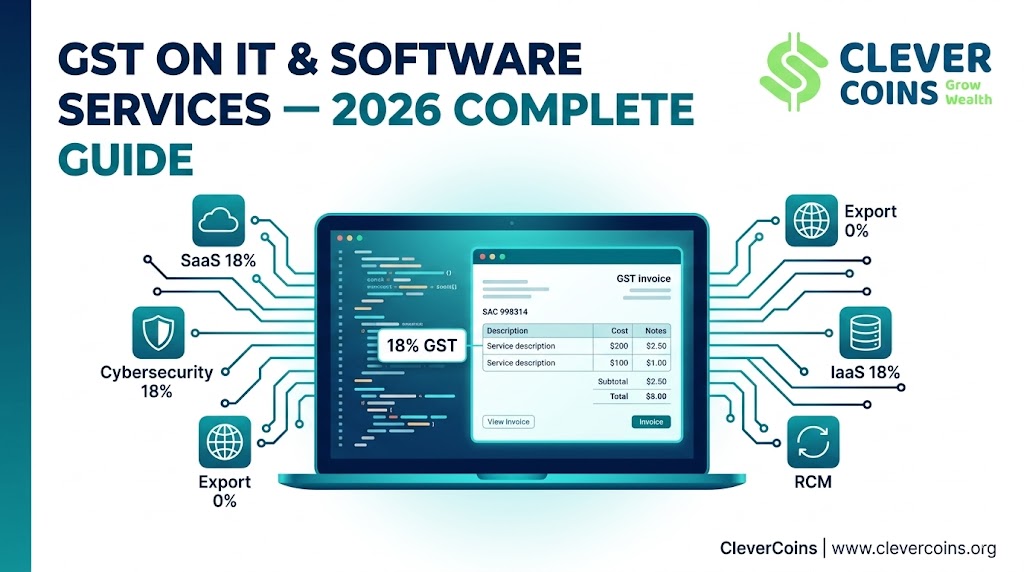
GST on IT and software services operates at a flat 18% rate for most categories — but the complexity lies in the details: whether software is a good or service, how SaaS is taxed, what constitutes an ‘export of service’, when OIDAR (Online Information and Database Access or Retrieval) rules apply, what Reverse Charge Mechanism (RCM) obligations arise from importing foreign software, and how to maximise Input Tax Credit (ITC).
This comprehensive 2026 guide by CleverCoins — India’s trusted tax consultancy — covers every dimension of GST on IT and software services: rate tables, place of supply rules, export provisions, OIDAR regulations, SaaS-specific GST analysis, ITC optimisation strategies, compliance obligations, and the latest updates.
Why GST on IT Services is Complex
Unlike physical goods where GST rates are straightforward, IT and software services involve unique complexities:
- The goods vs. service distinction for software affects HSN/SAC classification and rate applicability
- OIDAR (Online Information and Database Access) rules create special obligations for cross-border digital service providers
- Export of service provisions, LUT (Letter of Undertaking) requirements, and zero-rated supply rules govern IT exporters
- Reverse Charge Mechanism (RCM) applies when Indian businesses import software or cloud services from foreign providers
- Place of supply rules for IT services differ between B2B and B2C, domestic and cross-border transactions
- SaaS, PaaS, and IaaS — each cloud delivery model may have distinct GST implications under different scenarios
- IT companies with global clients must manage GST refunds, foreign exchange remittance compliance, and FIRC documentation
- Freelance IT professionals and gig economy tech workers have their own registration thresholds and compliance requirements
⚠️ The single most common GST mistake by IT companies: Misclassifying an export of service as a domestic supply — or vice versa. This results in either unnecessary 18% GST being charged to foreign clients, or failure to comply with LUT/IGST refund procedures, resulting in demand notices.
GST Registration for IT and Software Companies
When is GST Registration Mandatory?
- Annual aggregate turnover exceeds Rs. 20 lakh (general) or Rs. 10 lakh (special category states)
- ANY inter-state supply of services — even a single invoice to a client in another state — requires registration regardless of turnover
- Export of IT services (even with zero GST payable) — exporters must register to claim LUT/IGST refund
- OIDAR service providers outside India serving Indian consumers — must register under Section 14 of the IGST Act
- E-commerce operators and IT aggregator platforms — mandatory registration regardless of turnover
- IT companies making reverse charge mechanism supplies — must register
Threshold Exemption for Freelancers and Solo Developers
Individual freelance IT professionals and solo software developers with annual turnover below Rs. 20 lakh are not required to register for GST. However, there are critical exceptions:
- If any single project or annual revenue from inter-state clients exceeds threshold — registration required
- Freelancers exporting services to foreign clients: Even if below Rs. 20 lakh, voluntary registration is advisable to claim IGST refund or file LUT for zero-rated supply
- Freelancers receiving advance payments from foreign clients through international wire transfer need to manage foreign exchange compliance alongside GST
✅ Pro Tip by CleverCoins: Even if you are below the Rs. 20 lakh threshold, if you service even ONE foreign client — voluntary GST registration enables you to file a LUT and issue zero-rated invoices professionally. This builds credibility with international clients and allows you to recover any IGST on your input costs.
GST Rate Structure for IT and Software Services — Master Table (35 Categories)
The following comprehensive table covers the GST rates applicable to all major IT and software service categories in India as of 2026:
|
IT / Software Service / Supply |
GST Rate |
SAC / HSN |
Key Notes |
|
Custom software development (IT services — domestic) |
18% |
998314 |
Standard IT services rate |
|
Custom software development — EXPORT (LUT / IGST refund) |
0% / 18% (refundable) |
998314 |
Export of service — ZRP with LUT or IGST refund |
|
Software as a Service (SaaS) — domestic B2B |
18% |
998314 |
Online information supply — OIDAR if cross-border |
|
SaaS — subscription to Indian business (B2B domestic) |
18% |
998314 |
Full ITC available to recipient |
|
SaaS — export to foreign business (B2B export) |
0% (with LUT) |
998314 |
Export of service — zero rated |
|
SaaS — subscription by Indian individual (B2C domestic) |
18% |
998314 |
Consumer pays GST inclusive price |
|
Platform as a Service (PaaS) — domestic |
18% |
998314 |
Cloud infrastructure service |
|
Infrastructure as a Service (IaaS) — domestic |
18% |
998313 |
Data centre / hosting service |
|
Website development and maintenance |
18% |
998314 |
IT services |
|
Mobile application development |
18% |
998314 |
IT services — development |
|
IT consulting / advisory services |
18% |
998313 |
Professional IT advisory |
|
IT support, helpdesk, and maintenance services |
18% |
998315 |
Post-supply support |
|
BPO / KPO / data processing services (domestic) |
18% |
998313 |
Business support services |
|
BPO / KPO — EXPORT to foreign client |
0% (with LUT) |
998313 |
Export of service — ZRP |
|
Packaged / off-the-shelf software (boxed — physical media) |
18% |
4907 / 8523 |
Treated as goods — HSN 8523 |
|
Packaged software downloaded electronically (no physical media) |
18% |
998314 |
Treated as service (OIDAR if cross-border) |
|
Software licence (one-time purchase, perpetual) |
18% |
998314 |
Service — supply of software right |
|
Annual software maintenance / AMC contract |
18% |
998315 |
Service contract — maintenance |
|
Cloud storage / backup services |
18% |
998313 |
Data storage services |
|
Cybersecurity services / ethical hacking |
18% |
998314 |
IT professional services |
|
Artificial Intelligence / ML model development |
18% |
998314 |
IT development services |
|
Data analytics and business intelligence services |
18% |
998313 |
Information technology services |
|
Blockchain development services |
18% |
998314 |
IT development — emerging tech |
|
ERP implementation services (SAP, Oracle, Tally) |
18% |
998314 |
IT consulting and implementation |
|
UI/UX design services for digital products |
18% |
998314 |
Design — part of IT services |
|
Digital marketing services / SEO / SEM / SMM |
18% |
998361 |
Online marketing services |
|
Domain name registration services |
18% |
998314 |
IT support services |
|
Web hosting services — domestic provider |
18% |
998313 |
Infrastructure services |
|
OIDAR services — foreign to Indian consumer (B2C) |
18% (RCM on recipient / supplier) |
9983 |
OIDAR — special place of supply rules |
|
OIDAR services — Indian business to foreign consumer |
0% (with LUT — export) |
9983 |
Export of OIDAR service |
|
Resale of cloud services (AWS, Azure, GCP reseller) |
18% |
998313 |
Reseller margin — full chain taxable |
|
IT staffing / contract staffing services |
18% |
998512 |
Manpower supply — taxable |
|
Software testing services |
18% |
998314 |
QA — part of IT services |
|
Game development services |
18% |
998314 |
Digital content development |
|
Embedded software development (IoT devices) |
18% |
998314 |
Software embedded in hardware |
📌 CleverCoins Note: All IT and software services — whether development, consulting, SaaS, cloud, BPO, or digital marketing — attract 18% GST in India. There are no lower-rated or exempt IT services in the domestic market. The critical differentiation is between DOMESTIC supply (18% CGST+SGST or IGST) and EXPORT of service (0% GST with LUT or 18% IGST refundable).
Software: Goods or Service? — The Critical GST Classification
One of the most fundamental — and frequently confused — questions in IT sector GST is whether software is classified as ‘goods’ or ‘services’. The answer determines which HSN or SAC code applies and affects the invoice format, place of supply rules, and compliance requirements.
|
Supply Type |
Classification |
GST Treatment |
Practical Example |
|
Boxed / physical packaged software with CD/DVD |
Goods |
18% as goods (HSN 8523) |
Tally ERP CD box sold in store |
|
Downloaded software — off-the-shelf (electronic) |
Service |
18% as service (SAC 998314) |
Downloading MS Office from Microsoft India |
|
Custom-built software (developed to order) |
Service |
18% as service (SAC 998314) |
Freelancer builds custom CRM for a client |
|
Perpetual software licence (right to use) |
Service |
18% as service (SAC 998314) |
Adobe Acrobat perpetual licence purchase |
|
Annual software subscription / SaaS |
Service |
18% as service (SAC 998314) |
Zoho CRM monthly plan |
|
Pre-written software on a USB drive (physical) |
Goods |
18% as goods (HSN 8523) |
Antivirus software on physical USB |
|
Software update delivered electronically |
Service |
18% as service |
Patch/upgrade download for existing software |
|
Hardware + bundled software (composite) |
Composite supply |
Rate of principal (hardware — 18%) |
Laptop sold with pre-installed OS |
⚠️ Key Ruling: The Supreme Court of India in TCS vs. State of Andhra Pradesh (2004) held that software can be treated as goods. However, under GST, the government has taken a nuanced position: ELECTRONICALLY DELIVERED software is treated as a SERVICE, while software on PHYSICAL MEDIA is treated as GOODS. Most modern software transactions are electronic, making them services under GST.
SaaS Under GST — A Deep Dive
Software as a Service (SaaS) is the dominant delivery model for modern business software. From Zoho CRM to Salesforce, from Slack to Jira, from Tally Prime on cloud to QuickBooks Online — SaaS companies need to understand their GST obligations precisely.
SaaS — Domestic B2B (Indian Company Selling to Indian Business)
This is the most straightforward scenario:
- GST Rate: 18% (CGST + SGST for same-state transactions; IGST for different-state)
- SAC Code: 998314 — Information Technology Software Services
- Invoice: Full tax invoice with GSTIN of both parties
- ITC: Recipient can claim full ITC — making SaaS cost-neutral for registered businesses
- E-invoicing: Mandatory if supplier’s turnover > Rs. 5 crore
SaaS — Domestic B2C (Indian Company Selling to Individual Consumers)
- GST Rate: 18% — included in the subscription price
- Invoice: Bill of Supply or simplified tax invoice for B2C
- No ITC available to the consumer (individuals are end users)
- The SaaS company collects and deposits the 18% GST with the government
SaaS — Export (Indian Company Selling to Foreign Business)
This is where the most significant GST advantage lies for Indian SaaS companies:
- Classified as ‘Export of Service’ under Section 2(6) of IGST Act — if conditions are met
- Zero-rated supply — 0% GST chargeable to the foreign client
- Condition 1: Supplier is in India
- Condition 2: Recipient is outside India
- Condition 3: Place of supply is outside India
- Condition 4: Payment received in convertible foreign exchange (or Indian Rupees permitted by RBI)
- Condition 5: Supplier and recipient are not merely establishments of a distinct person (i.e., not related party transactions)
✅ MECHANISM: The Indian SaaS company files a Letter of Undertaking (LUT) on the GST portal at the beginning of each financial year. This allows them to issue invoices to foreign clients WITHOUT charging IGST. If LUT is not filed, they must charge 18% IGST and then claim a refund — which takes 60-90 days through the portal.
SaaS — Import (Indian Business Subscribing to Foreign SaaS)
When an Indian business subscribes to a foreign SaaS platform (e.g., Salesforce US, AWS, Microsoft Azure, Google Workspace from abroad):
- This is an ‘import of service’ — taxable under GST
- Reverse Charge Mechanism (RCM) applies under Section 5(3) of the IGST Act
- The Indian RECIPIENT (not the foreign supplier) pays IGST at 18% on the import value
- The ITC of the RCM GST paid can be claimed in the same month — making it cost-neutral for GST-registered businesses
- The foreign supplier does NOT need to register under Indian GST for B2B OIDAR services (the Indian recipient handles RCM)
⚠️ Common Compliance Gap: Many Indian businesses subscribe to foreign SaaS tools (AWS, Slack, Notion, Figma, Canva Pro, Zoom, GitHub) without paying RCM-based IGST. This is a GST compliance failure — the Indian business is liable for 18% IGST + interest + penalty on each such payment.
OIDAR Services — Online Information and Database Access or Retrieval
OIDAR is a special category under GST that covers digital services delivered over the internet or an electronic network, where the nature of the supply is essentially automated and involves minimal human intervention. This is one of the most important — and most misunderstood — concepts for the IT sector.
What Qualifies as OIDAR Services?
- Advertising on digital platforms (Google Ads, Facebook Ads charged from abroad)
- Cloud services — storage, software access, platform access
- Online gaming, e-learning, distance learning (electronically delivered)
- Online subscription services — music streaming, video streaming (Netflix, Spotify)
- E-books, digital content downloads
- Online database access or retrieval services
- Software delivery electronically (downloads, app installations)
- Digital marketplace commissions charged by foreign platforms
GST on OIDAR — Foreign Supplier to Indian Consumer (B2C Import)
When a foreign company provides OIDAR services to Indian consumers (individuals who are not GST-registered), the foreign SUPPLIER is responsible for collecting and depositing GST in India:
- The foreign OIDAR supplier must register under Section 14 of the IGST Act
- GST Rate: 18% IGST on the service value
- The foreign company files simplified GST returns through the GST portal
- Examples: Netflix charging Indian subscribers, Spotify India subscriptions, Google Drive storage plans for individuals
📌 Simplified Registration for Foreign OIDAR Providers: Foreign companies providing OIDAR to Indian consumers can register through a simplified process on the GSTN portal without needing a physical establishment or tax representative. They file a quarterly return (GSTR-5A).
GST on OIDAR — Indian Company to Foreign Consumer (B2C Export)
When an Indian IT company provides OIDAR / digital services to foreign individual consumers:
- This qualifies as ‘export of service’ — zero-rated under GST
- File LUT and issue invoices without IGST
- Conditions for export must be satisfied: foreign payment in foreign exchange, recipient outside India
GST on OIDAR — Indian B2B (Indian Business Receiving Foreign OIDAR)
- RCM applies — the Indian registered business pays 18% IGST on the import
- Foreign supplier need NOT register in India for B2B OIDAR (recipient handles RCM)
- ITC of RCM IGST available to the Indian business
Place of Supply Rules for IT Services — Critical for GST Compliance
The ‘place of supply’ determines which type of GST (CGST+SGST or IGST) applies and whether a transaction is domestic or an export. IT companies must get this right for every invoice.
|
Transaction Type |
Supplier |
Recipient |
Place of Supply |
GST Type Charged |
|
IT services — B2B |
Indian company |
Indian company (diff. state) |
Recipient’s state |
IGST |
|
IT services — B2B |
Indian company |
Indian company (same state) |
State of supply |
CGST + SGST |
|
IT services — Export (B2B) |
Indian company |
Foreign company |
Location of recipient (outside India) |
0% (ZRP with LUT) |
|
OIDAR — B2C Import |
Foreign company |
Indian individual |
Location of recipient (India) |
IGST — supplier or representative pays |
|
OIDAR — B2C Export |
Indian company |
Foreign individual |
Location of recipient (outside India) |
0% (Export of service) |
|
SaaS — B2B Import |
Foreign company |
Indian registered business |
India (RCM applicable) |
IGST under RCM |
|
IT services — B2B Domestic (unregistered recipient) |
Indian company |
Unregistered person in India |
Supplier’s location |
CGST + SGST |
⚠️ The Most Common Error in IT Company GST: Charging CGST+SGST to a client in another state (instead of IGST). This is a wrong levy — and both parties can face demand notices. Always check the GSTIN and billing address of the client before deciding the tax type.
Export of IT Services — LUT, IGST Refund & Conditions
What Qualifies as Export of Service Under GST?
Section 2(6) of the IGST Act defines ‘export of services’ as a supply of service where:
- The supplier of service is located in India
- The recipient of service is located outside India
- The place of supply of the service is outside India
- The payment for such service has been received by the supplier of service in convertible foreign exchange or Indian rupees (wherever permitted by RBI)
- The supplier of service and recipient of service are not merely establishments of a distinct person as defined in Explanation 1 to Section 8
Option 1: LUT (Letter of Undertaking) — Recommended
Filing a LUT on the GST portal (Form RFD-11) at the beginning of each financial year allows the IT exporter to:
- Issue invoices to foreign clients WITHOUT charging IGST
- No cash outflow on GST for export invoices
- Claim ITC refund on inputs used for export services
- LUT is valid for the entire financial year — one-time annual filing
- No bond or security required (unless the exporter has a confirmed export obligation)
✅ LUT is the PREFERRED mechanism for IT exporters. It eliminates working capital blockage and simplifies compliance. Every Indian IT company exporting services should file LUT on 1st April of each financial year.
Option 2: Pay IGST and Claim Refund
If LUT is not filed, the exporter must charge 18% IGST on export invoices and then claim a refund:
- File refund application in Form RFD-01 on the GST portal
- Refund processed within 60 days (in theory) — often takes 90-120 days in practice
- Requires FIRC (Foreign Inward Remittance Certificate) / FIRA from bank as proof of foreign receipt
- Blocking 18% of invoice value as working capital until refund — significant cash flow impact
⚠️ Most IT exporters prefer LUT over IGST refund route to avoid the cash flow burden and the administrative complexity of managing refund applications, tracking acknowledgements, and following up with GST officers.
Reverse Charge Mechanism (RCM) for IT Companies — Imported Services
Indian IT companies that subscribe to foreign software, cloud services, SaaS platforms, or receive consulting from foreign entities must pay GST under the Reverse Charge Mechanism (RCM). This is Section 5(3) of the IGST Act read with IGST Notification No. 10/2017-IT(Rate).
Common RCM Triggers for IT Companies
- AWS, Microsoft Azure, Google Cloud Platform — subscriptions from foreign entities
- GitHub Enterprise, GitLab, Jira, Confluence — if billed from foreign entities
- Figma, Adobe Creative Cloud, Zoom Pro — if billed from foreign entities (B2C exempted; B2B — RCM)
- Foreign IT consultants / contractors providing services to Indian company
- Foreign software licences — perpetual or subscription
- International certification exam fees (if treated as import of service)
RCM Calculation and Payment
For RCM on imported services:
- Identify all foreign vendor payments in the month
- Calculate 18% IGST on the invoice value (converted to INR at RBI rate on invoice date)
- Pay the RCM IGST in cash (not from ITC ledger) via Challan PMT-06 by the 20th of the following month
- Declare RCM supply in GSTR-3B (Table 3.1(d) and Table 4 for ITC claim)
- Declare in GSTR-1 as well (though no tax is collected from the supplier)
- Claim ITC of RCM IGST paid in the same tax period — effectively cost-neutral for registered businesses
💡 RCM ITC Tip: The ITC of RCM-paid IGST is available in the same tax period — meaning you pay the GST and immediately get it back as credit. For most IT companies with domestic taxable clients, this is cost-neutral. The cash must be available for the payment date though.
Input Tax Credit (ITC) for IT and Software Companies
IT companies are primarily in the business of providing taxable services (18%). This means they are in the best position to claim maximum ITC on almost all their business inputs — subject to standard restrictions.
|
Input / Expense |
ITC Eligible? |
Reason / Condition |
|
Software / SaaS subscriptions (Jira, Slack, AWS used for business) |
YES |
Used for taxable output — fully eligible |
|
Laptops, computers, servers — for software development |
YES |
Capital goods for taxable supply |
|
Office rent (GST-registered landlord) |
YES |
Business premises — ITC eligible |
|
Marketing & advertising expenses (domestic) |
YES |
Business expense — eligible |
|
GST on employee meal / canteen (provided in office) |
NO |
Blocked u/s 17(5)(b) — personal consumption |
|
Company car / cab service for employees |
NO/PARTIAL |
Motor vehicle — generally blocked u/s 17(5)(a) |
|
Construction of office building |
NO |
Immovable property — blocked u/s 17(5)(c)/(d) |
|
Health insurance premium for employees (group policy) |
YES |
Mandatory obligation — exception to 17(5)(b) |
|
Training / upskilling of employees (taxable course) |
YES |
Business related — eligible |
|
Travel expenses (flights, hotels — for business) |
YES |
Business travel — eligible if invoiced to company |
|
Office furniture, equipment — for business use |
YES |
Capital / business goods — eligible |
|
IGST paid on import of software services (RCM) |
YES |
RCM credit available if used for taxable supply |
|
Professional services — CA, lawyer fees (GST-registered) |
YES |
Business services — eligible |
|
Internet / broadband charges |
YES |
Directly used for IT business — eligible |
|
Mobile phones — dual use (personal + business) |
PARTIAL |
Business proportion only — needs documentation |
📌 IT companies generally have very high ITC eligibility since their output is taxable at 18%. The blocked credits (motor vehicles, construction, canteen food, personal use) are the same as for any other business. The key advantage for IT exporters: excess ITC accumulated from export invoices (where no output tax is charged) can be claimed as a GST REFUND — freeing up working capital.
GST on Freelance IT Professionals and Independent Contractors
India has millions of freelance developers, designers, data scientists, and IT consultants who provide services both domestically and internationally. Their GST obligations are as follows:
Domestic Freelancers (Below Rs. 20 Lakh Threshold)
- Not required to register for GST
- Cannot charge GST on invoices — cannot issue tax invoices
- Clients cannot claim ITC from them — may create friction with GST-registered corporate clients
- No GST filing obligations
Domestic Freelancers (Above Rs. 20 Lakh or Providing Inter-State Services)
- Must register under GST
- Charge 18% GST on all domestic service invoices
- File GSTR-1, GSTR-3B, and GSTR-9 as applicable
- Claim ITC on eligible business expenses (laptop, software, internet, coworking space)
Freelancers Exporting IT Services to Foreign Clients
- Strong recommendation: Register voluntarily even if below Rs. 20 lakh threshold
- File LUT to issue zero-rated invoices to foreign clients
- Claim ITC refund on inputs if accumulated credit exists
- Maintain FIRC / FIRA from bank for each foreign payment received
- Reconcile foreign client payments with FIRC and GST returns
⚠️ Important: Many freelancers exporting IT services believe they don’t need GST registration because their services are zero-rated. This is INCORRECT. You must register (voluntarily if below threshold) and file LUT to correctly classify your exports. Without registration, you cannot legally issue zero-rated export invoices.
GST on IT Companies in SEZ — Special Economic Zones
IT companies operating from Special Economic Zones (SEZs) enjoy a unique GST treatment:
- Supplies MADE BY an SEZ unit to a non-SEZ entity are treated as inter-state supplies — IGST applicable
- Supplies MADE TO an SEZ unit by a non-SEZ entity are treated as zero-rated supplies — supplier can issue LUT or charge IGST and claim refund
- Supplies within the same SEZ between two SEZ units: Treated as non-supplies — no GST
- Imported goods into SEZ: Exempt from BCD and IGST under special SEZ provisions
- SEZ units export IT services: Treated as export of service — zero-rated
✅ SEZ IT companies receive significant GST advantages — both on procurement (zero-rated inputs from non-SEZ) and exports (zero-rated outputs to foreign clients). This makes SEZs highly attractive for large IT service exporters.
GST Compliance Obligations for IT Companies — The Complete Checklist
Monthly / Quarterly Returns
- GSTR-1: Outward supply details — due 11th (monthly) or 13th (quarterly QRMP) of following month
- GSTR-3B: Summary return with tax payment — due 20th of following month
- GSTR-2B: Auto-populated ITC statement — review and reconcile before GSTR-3B
- GSTR-5A: For foreign OIDAR providers — quarterly return due 20th of following month
Annual Compliance
- GSTR-9: Annual return — due 31st December of following financial year
- GSTR-9C: Reconciliation statement (if turnover > Rs. 5 crore) — due 31st December
- LUT renewal: File fresh LUT (Form RFD-11) at the start of each financial year for continued export benefits
- ITC annual reconciliation: Reconcile GSTR-2B vs books of account — reverse any ineligible ITC
Transaction-Level Compliance
- E-invoicing: Mandatory if turnover > Rs. 5 crore — all B2B invoices must be generated via IRP and carry IRN + QR code
- E-way bill: Mandatory for movement of goods above Rs. 50,000 — relevant for physical software media or hardware supply
- FIRC maintenance: For every foreign payment received — obtain FIRC or FIRA from bank and maintain for GST audit
- RCM tracking: Maintain a monthly register of all foreign vendor payments subject to RCM
- HSN/SAC declaration: Correct SAC code on all invoices (998314 for most IT services)
GST on Digital Marketing Services — A Sub-Sector Analysis
Digital marketing is one of the fastest-growing IT sub-sectors in India. Whether you are an SEO agency, a performance marketing firm, a social media management company, or a content marketing startup — your GST obligations are as follows:
- All digital marketing services: 18% GST (SAC 998361)
- Google Ads spend — Indian business paying Google India: 18% GST on invoice from Google India
- Facebook / Meta Ads — if billed from Meta Ireland: 18% RCM IGST on the Indian business importing the advertising service
- Influencer marketing fees paid to registered influencers: 18% GST on the influencer’s invoice
- Affiliate marketing commissions: 18% GST
- Content writing, copywriting services: 18% GST
⚠️ Google Ads and Meta Ads Billed from India vs Abroad: If Google India Pvt. Ltd. bills you — you pay 18% GST on the invoice (and claim ITC). If Google Ireland or Meta Ireland bills you directly — you must pay 18% RCM IGST yourself. Many businesses miss this RCM obligation on foreign ad spends.
Recent GST Updates for IT Sector — 2024 to 2026
- E-invoicing threshold lowered: IT companies above Rs. 5 crore turnover must mandatorily use e-invoicing for all B2B transactions — including export invoices (though export invoices are zero-rated)
- OIDAR clarifications: CBIC issued clarifications in 2024 on the scope of OIDAR services — particularly for hybrid services that combine human interaction with digital delivery
- GST on virtual digital assets (crypto): Separate debate on whether certain blockchain development and NFT-related services need special classification — ongoing
- GST refund processing for exporters: Digital processing of refund claims improved — average processing time reduced from 60 to 30 days for compliant exporters
- Pilot for quarterly LUT: Government exploring making LUT multi-year to reduce compliance burden on IT exporters
- 54th GST Council: Discussed rationalisation of the 18% rate on IT services — no change announced as of 2026, but industry bodies continue to lobby for a lower 12% rate on domestic IT services
- GST on outsourced IT employees (contract staffing): Clarity issued that IT staffing companies must charge 18% GST on manpower supply — and recipient can claim ITC
💡 CleverCoins watches every GST Council meeting, CBIC circular, and AAR ruling that affects the IT sector. Subscribe to our newsletter at clevercoins.org to stay updated on all changes that impact your IT business’s GST position.
GST for IT Startups — The Essentials
India’s startup ecosystem has over 100,000 recognised startups — many in the IT and SaaS space. Here is what every IT startup needs to know about GST from Day 1:
Day 1: Register for GST
Even if you are below the Rs. 20 lakh threshold, register voluntarily if:
- You plan to invoice foreign clients — needed for LUT filing
- Your corporate clients require a GSTIN on invoices
- You want to claim ITC on office expenses, software subscriptions, and equipment
From Day 1: Get Your SAC Code Right
Most IT startups use SAC 998314 (IT Software Services). Get this right from your first invoice — misclassification can lead to demand notices.
Export-First Startups: File LUT Immediately
If your first client is a foreign company — file LUT before issuing the first invoice. This ensures all export invoices are legally zero-rated from day one.
Handle RCM from Month 1
If you are subscribing to AWS, Slack, GitHub, Figma, or any other foreign SaaS tool — calculate and pay 18% RCM IGST every month. Claim it back as ITC. Never leave RCM compliance gaps.
How CleverCoins Supports IT Companies in GST Compliance
- GST Registration & SAC Classification: Correct registration and classification from day one — avoiding misclassification penalties
- LUT Filing & Export Compliance: Annual LUT filing, export invoice review, FIRC reconciliation, and refund applications
- RCM Management: Monthly RCM register maintenance, IGST payment, and ITC claim management for all foreign software subscriptions
- ITC Optimisation: Maximum eligible ITC computation — recovering every rupee of credit from business inputs
- E-Invoicing Setup: Implementation of e-invoicing for IT companies crossing the threshold — API-integrated or portal-based
- GSTR Return Filing: Timely GSTR-1, GSTR-3B, GSTR-9, GSTR-9C, and GSTR-5A filing
- Export Refund Claims: RFD-01 filing, deficiency memo responses, and refund follow-up with GST authorities
- Freelancer Compliance: Complete GST setup for freelance IT professionals — registration, LUT, FIRC management, and annual return filing
- GST Audit Representation: Defence in GST departmental audits, scrutiny proceedings, and adjudication
Is Your IT Company 100% GST Compliant? Get a Free Review from CleverCoins!
www.clevercoins.org | Instagram @clevercoins
Conclusion — GST Compliance is a Competitive Advantage for IT Companies
In a sector as competitive and globally integrated as IT and software, GST compliance is not just a legal obligation — it is a business imperative. Foreign clients increasingly require GST-compliant invoices. Incorrect GST treatment on exports can result in lost working capital tied up in IGST refunds. Missed RCM payments on foreign software subscriptions can trigger audits and demand notices.
Whether you are a 2-person SaaS startup or a 200-person IT services company, getting GST right from the start saves you money, builds credibility, and avoids the exponential cost of non-compliance.
At CleverCoins, we understand the IT sector deeply — from startup-stage freelancers to growth-stage SaaS companies. Our team manages your entire GST lifecycle so you can focus on building great software and serving great clients.