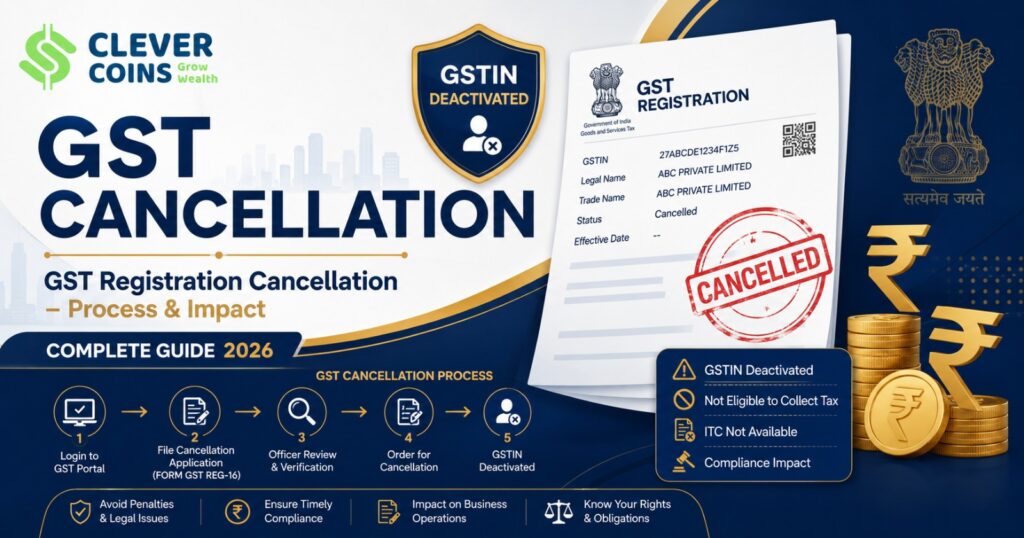
What is GST Registration Cancellation?
GST Registration Cancellation refers to the process through which a registered taxpayer’s GSTIN is deactivated either voluntarily or by the GST authority. Once cancelled, the taxpayer is relieved from the obligations of GST compliance — including filing returns, paying taxes, and maintaining GST records — going forward. However, all pending liabilities and returns up to the date of cancellation must be settled before the cancellation becomes effective.
Under the Goods and Services Tax (GST) framework governed by the CGST Act, 2017, the concept of cancellation is well-defined under Section 29 and the detailed procedural framework is laid out in Rule 20 to Rule 22 of the CGST Rules, 2017. As of 2026, the GST Council has introduced further digital automation and stricter compliance norms around this process.
1.1 Legal Basis
- Section 29 of CGST Act, 2017 – Cancellation or Suspension of Registration
- Rule 20 – Application for Cancellation
- Rule 22 – Cancellation of Registration by Proper Officer
- CGST (Amendment) Act, 2023 & relevant circulars up to 2026
1.2 Types of Cancellation
Type | Initiated By | Reason |
Voluntary Cancellation | Registered Taxpayer | Business closure, turnover below threshold, switching to composition scheme |
Suo Motu / Compulsory | GST Officer | Non-compliance, fake invoices, fraud, non-filing of returns |
Deemed Cancellation | System / Authority | Provisional registration not converted, death of proprietor (in some cases) |
Who Can Apply for GST Cancellation?
Not every registered taxpayer can apply for voluntary cancellation at will. The law specifies eligibility criteria based on business circumstances:
2.1 Eligible Applicants
- Businesses that have been discontinued, transferred, amalgamated, demerged, or otherwise disposed of
- Businesses where the annual aggregate turnover has fallen below the GST registration threshold (₹20 Lakhs for most states; ₹10 Lakhs for special category states as of 2026)
- Businesses that have changed their constitution — e.g., sole proprietorship converting to a company
- Persons who were registered voluntarily but no longer require registration
- Businesses switching from regular GST to Composition Scheme (requires fresh registration under composition)
- Non-Resident Taxable Persons (NRTP) at the end of their registered operations
2.2 Who Cannot Apply
- Persons registered under the Composition Scheme must apply via a different form (GST REG-16 is not applicable for them)
- Taxpayers with pending show-cause notices from GST authorities cannot voluntarily cancel until the notice is resolved
- Businesses with unpaid taxes, interest, or penalties — cancellation will be held until dues are cleared
Step-by-Step Process for Voluntary GST Cancellation (2026)
The voluntary cancellation process is entirely online through the GST Portal (www.gst.gov.in). The process involves multiple stages as described below:
Step 1 – Login to GST Portal
Visit www.gst.gov.in and log in using your GSTIN, username, and password. Navigate to: Services → Registration → Application for Cancellation of Registration
Step 2 – Fill Form GST REG-16
GST REG-16 is the application form for voluntary cancellation. You must provide the following details:
- Reason for cancellation (from the dropdown list)
- Date from which cancellation is sought
- Details of closing stock (including capital goods) held on the date of cancellation
- Amount of tax payable on closing stock (Input Tax Credit reversal)
- Particulars of payments made towards tax, interest, penalty, fee, or other dues
- Details of pending returns, if any
Step 3 – Reverse Input Tax Credit (ITC)
This is one of the most critical steps. As per Section 29(5) read with Section 18(4) of the CGST Act, a person whose registration is cancelled must pay an amount equivalent to the ITC held in respect of:
- Inputs held in stock and inputs contained in semi-finished or finished goods
- Capital goods or plant and machinery
The amount to be reversed is the higher of:
- ITC availed on the stock/capital goods, OR
- Output tax payable on such goods at transaction value as per Section 15
This reversal must be declared in Form GSTR-10 (Final Return).
Step 4 – File Pending GST Returns
Before cancellation is processed, all pending GST returns must be filed. As of 2026, the applicable returns are:
Return | Frequency | Purpose |
GSTR-1 | Monthly / Quarterly | Outward Supplies |
GSTR-3B | Monthly / Quarterly | Summary of Inward & Outward + Tax Payment |
GSTR-9 | Annual | Annual Return |
GSTR-10 | Within 3 months of cancellation | Final Return after Cancellation |
Step 5 – Submission & ARN Generation
After filling the form and ensuring all returns are filed, submit REG-16 using Digital Signature Certificate (DSC) for companies/LLPs, or EVC (Electronic Verification Code) for proprietorships and partnerships. An Application Reference Number (ARN) is generated upon successful submission.
Step 6 – Verification by GST Officer (Rule 22)
The GST officer has 30 days from the date of application to review and process the cancellation. If the officer finds the application in order, they issue Form GST REG-19 (Cancellation Order). If there are discrepancies or objections, the officer issues a Show Cause Notice (SCN) via GST REG-17, to which the taxpayer must respond within 7 working days using GST REG-18.
Step 7 – Cancellation Order (GST REG-19)
If satisfied, the proper officer passes the cancellation order in Form GST REG-19 specifying the effective date of cancellation. The GSTIN is then deactivated from the GST system, and the taxpayer receives a notification.
Documents Required for GST Cancellation
The following documents and information are typically required while filing Form GST REG-16:
- GSTIN and login credentials
- Details of all pending GST returns and payment challans
- Stock register / closing stock statement as on the date of cancellation
- ITC Reversal calculations (including inputs, WIP, finished goods, capital goods)
- Bank account details for any refund due
- DSC or EVC for authentication
- In case of business transfer/amalgamation: Copy of merger order, sale deed, or dissolution document
- In case of death of proprietor: Death certificate + Legal heir details
- Proof of cessation of business activity (if applicable)
Suo Motu / Compulsory Cancellation by GST Officers
Apart from voluntary cancellation, the GST authority has the power to cancel registration suo motu — i.e., on its own motion — under Section 29(2) of the CGST Act. This is initiated when the officer has reason to believe that:
5.1 Grounds for Compulsory Cancellation
- The registered person has not conducted any business from the declared place of business
- The taxpayer has issued invoices or bills without actual supply of goods or services — commonly known as ‘fake invoicing’
- The person has violated anti-profiteering provisions
- A composition taxpayer has not filed returns for 3 consecutive tax periods
- A regular taxpayer has not filed returns for a continuous period of 6 months
- The registration was obtained by fraud, willful misstatement, or suppression of facts
- The taxpayer fails to commence business within 6 months from the date of voluntary registration
5.2 Procedure for Suo Motu Cancellation
- GST officer issues Show Cause Notice in Form GST REG-17
- Taxpayer must reply in Form GST REG-18 within 7 working days
- Officer conducts personal hearing if requested or required
- If reply is unsatisfactory, officer passes cancellation order in GST REG-19
- If reply is satisfactory, officer drops proceedings via GST REG-20
5.3 Suspension of GSTIN
Effective from 2020 and strengthened through 2025 amendments, Section 29(2A) empowers the GST authority to SUSPEND a taxpayer’s GSTIN during the pendency of cancellation proceedings. During suspension:
- Taxpayer cannot issue valid tax invoices
- No ITC can be claimed by buyers from a suspended supplier
- The GSTIN shows as ‘Suspended’ on the GST portal — publicly visible to all buyers
- Suspended taxpayer can still file returns but cannot conduct fresh business transactions under GST
Final Return – GSTR-10
GSTR-10 is the final return to be filed by a taxpayer whose GST registration has been cancelled or surrendered. It is mandatory for all taxpayers whose registration is cancelled (except those registered under Input Service Distributors and persons paying tax under Section 51 or 52).
6.1 Key Details of GSTR-10
Particulars | Details |
Who Files | All taxpayers (except ISD & TDS/TCS deductors) whose GSTIN is cancelled |
Due Date | Within 3 months from date of cancellation order or date of cancellation, whichever is later |
Late Fee (2026) | ₹200 per day (₹100 CGST + ₹100 SGST) – Maximum ₹10,000 per return |
Contents | Details of closing stock, ITC reversal, tax payable on stock |
Mode of Filing | Online via GST Portal using DSC / EVC |
Form | GSTR-10 |
6.2 Calculation of Tax Payable in GSTR-10
The tax on closing stock is to be calculated as follows:
Tax Payable = ITC originally claimed on stock OR Output Tax computed at transaction value under Section 15 — whichever is HIGHER
Example Calculation (2026):
Item | Amount (₹) |
Closing Stock (inputs) at cost | ₹5,00,000 |
ITC claimed on such inputs | ₹90,000 |
GST applicable at 18% on ₹5,00,000 | ₹90,000 |
ITC to be reversed (Higher of both) | ₹90,000 |
Net Tax Payable in GSTR-10 | ₹90,000 |
Revocation of Cancellation
If a taxpayer’s registration has been cancelled suo motu by the GST officer (not through voluntary cancellation), the taxpayer has the right to apply for revocation of cancellation. This is governed by Section 30 of the CGST Act.
7.1 Application for Revocation
- Application must be filed in Form GST REG-21 within 90 days from the date of service of the cancellation order
- The GSIT Council has, through multiple amnesty schemes (the latest in 2024-25), extended time limits for revocation to encourage compliance
- The taxpayer must file all pending returns and pay all outstanding taxes, interest, and penalties before applying for revocation
7.2 Process
- File GST REG-21 on the portal with reasons for revocation and proof of compliance
- GST officer reviews within 30 days
- If satisfied, officer passes revocation order in GST REG-22
- If not satisfied, officer issues SCN — taxpayer must reply within 7 days
- On rejection, taxpayer can appeal before the Appellate Authority
7.3 Important Note (2026 Update)
⚠️ As per the Finance Act 2024 and related GST amendments effective in 2025-26, taxpayers who fail to apply for revocation within the
prescribed time limit AND whose GSTIN has remained cancelled for more than 1 year may face permanent deactivation of GSTIN with
no revocation option. Such cases require fresh GST registration.
Impact of GST Registration Cancellation on Business
GST cancellation — whether voluntary or compulsory — has far-reaching consequences for a business and its stakeholders. Understanding these impacts is critical for business owners, finance teams, and legal advisors:
8.1 Operational Impact
- Cannot collect GST from customers — no valid tax invoice can be issued after GSTIN deactivation
- All buyers (recipients) who claimed ITC based on your invoices post-cancellation will face ITC reversal and interest liability
- Cannot claim ITC on any purchases made after the date of cancellation
- Business may lose GST-registered supplier/buyer relationships — many B2B companies only deal with GST-registered entities
- Cannot participate in government tenders or corporate procurement that mandates GST registration
8.2 Financial & Tax Impact
- Immediate reversal of accumulated ITC — potentially a significant cash outflow
- Tax liability on closing stock as computed in GSTR-10
- Penalties and interest if GSTR-10 is not filed within the prescribed 3-month window
- Outstanding tax dues must be cleared — failure leads to recovery proceedings, including attachment of bank accounts and property
- Pending demand notices and assessments remain active even after cancellation — GST officers retain jurisdiction for 5 years from the cancellation date
8.3 Legal & Compliance Impact
- Even after cancellation, the taxpayer is liable to appear before GST authorities for audit, inquiry, or investigation for past periods
- Records must be maintained for 72 months (6 years) from the due date of the annual return for the relevant year
- If cancellation was compulsory due to fraud, the taxpayer may face criminal prosecution under Section 132 of the CGST Act
- Directors, partners, and proprietors may be held personally liable for unpaid GST dues in certain circumstances
8.4 Reputational Impact
- A cancelled or suspended GSTIN is publicly visible on the GST portal — damaging business reputation
- Buyers who discover mid-transaction that the GSTIN is cancelled face ITC disallowance — leading to loss of business relationships
- Banks and financial institutions may downgrade credit facilities based on cancelled GST status
- E-commerce operators (Amazon, Flipkart, etc.) suspend seller accounts linked to cancelled GSTINs
8.5 Impact on Input Tax Credit (ITC) of Recipients
One of the most critical downstream effects of cancellation is on the Input Tax Credit of buyers/recipients:
Scenario | Impact on Buyer’s ITC |
Supplier’s GSTIN cancelled BEFORE invoice date | ITC is invalid — full reversal required with 18% interest |
Supplier’s GSTIN cancelled AFTER invoice date but not uploaded in GSTR-1 | ITC can be reversed — risk of demand from GST department |
Invoice uploaded in GSTR-1 before cancellation | ITC is generally safe but subject to scrutiny |
Supplier’s GSTIN suspended (not cancelled) | ITC available but risky — advisory to verify supplier status |
Penalties & Consequences for Non-Compliance
Failure to adhere to the GST cancellation process — including non-filing of GSTR-10, non-payment of tax dues, or operating after cancellation — attracts significant penalties:
Violation | Penalty / Consequence |
Not filing GSTR-10 (Final Return) | Late fee: ₹200/day (₹100 CGST + ₹100 SGST), max ₹10,000 |
Collecting GST after cancellation | Penalty equal to 100% of GST collected + recovery with interest |
Issuing fake/fraudulent invoices | Penalty up to ₹1 Crore OR amount of tax evaded (whichever is higher) + imprisonment |
Non-payment of tax on closing stock | Tax + 18% interest per annum + up to 100% penalty |
Failure to maintain records post-cancellation | Penalty up to ₹25,000 |
Obstruction of GST officer | Penalty up to ₹25,000 + possible arrest |
GST Cancellation vs. Suspension vs. Revocation – Key Differences
Parameter | Cancellation | Suspension | Revocation |
Meaning | GSTIN deactivated permanently | GSTIN temporarily deactivated | Reversal of cancellation order |
Initiated by | Taxpayer (voluntary) or Officer (suo motu) | Officer (during proceedings) | Taxpayer (after compulsory cancellation) |
Can Issue Tax Invoice? | No | No | Yes (after revocation order) |
Can Claim ITC? | No | No | Yes (after revocation) |
Filing of Returns | File pending + GSTR-10 | Yes, required | File all pending returns first |
Form Used | REG-16 / REG-19 | Automatic / Officer action | REG-21 / REG-22 |
Time Limit | N/A | Until proceedings conclude | Within 90 days of cancellation |
Special Scenarios & Practical Considerations
11.1 Death of Proprietor
In case of death of a sole proprietor, the legal heirs must apply for cancellation by submitting the death certificate and succession documents. The legal heir may also choose to transfer the business and apply for GST registration in their own name, avoiding the need for cancellation.
11.2 Business Transferred as Going Concern
If a business is sold or transferred as a going concern (all assets and liabilities including GST registration), the transferee can apply for a fresh GST registration. The transferor must cancel their GSTIN and settle all dues up to the date of transfer.
11.3 Merger & Amalgamation
In cases of corporate mergers/amalgamations, the merged entity’s GSTIN must be cancelled after the NCLT or High Court order is passed. The successor company must register all branches under their GSTIN and claim transitional ITC credits if applicable.
11.4 E-Commerce Sellers
E-commerce sellers (selling on Amazon, Flipkart, Meesho, etc.) who opt to cancel GST registration must inform the e-commerce operator. Their seller accounts will typically be suspended. Re-registration will be required to resume selling. Operators like Amazon require active GSTIN for all sellers as a platform policy.
11.5 Export Businesses
Businesses primarily engaged in exports should carefully evaluate GST cancellation. Export-oriented businesses benefit from IGST refunds and LUT (Letter of Undertaking) benefits. Cancellation would permanently disable these benefits for all future transactions.
2025–2026 Updates Related to GST Cancellation
The GST Council and CBIC have introduced several updates relevant to cancellation that are effective in 2025-26:
- Automated GSTIN Suspension: GST systems now automatically suspend GSTINs where return filing lapses beyond 6 months (regular taxpayers) — effective from January 2025
- Aadhaar-Based OTP for Revocation: Aadhaar OTP authentication is now mandatory for filing GST REG-21 (revocation application)
- E-Invoice Mandate: Businesses under e-invoice mandate must ensure all invoices are cancelled on the IRP (Invoice Registration Portal) before initiating GST cancellation
- Enhanced Data Analytics: GST authorities now use AI-based risk scoring to identify mismatches in ITC claims post-cancellation — triggering automatic notices
- Amnesty Scheme 2024-25: Taxpayers with long-pending cancellation orders were given a one-time window to file pending GSTR-10 with waived/reduced late fees — a significant relief measure
- Stricter Fake Invoice Detection: The GSTN portal now cross-checks e-invoice data with GSTR-1 and GSTR-3B in real-time — fake invoice-based cancellation attempts are flagged immediately
Checklist Before Applying for GST Cancellation
✅ COMPLETE PRE-CANCELLATION CHECKLIST (2026)
□ File all pending GSTR-1 returns up to cancellation date
□ File all pending GSTR-3B returns up to cancellation date
□ File GSTR-9 (Annual Return) for all pending financial years
□ Pay all outstanding tax, interest, penalty, and fee
□ Prepare closing stock statement (inputs + WIP + finished goods + capital goods)
□ Calculate ITC to be reversed on closing stock
□ Collect all purchase invoices for capital goods (for ITC reversal computation)
□ Cancel all pending e-invoices on the IRP
□ Inform all regular buyers about GSTIN cancellation (to avoid their ITC issues)
□ Retain all GST records, invoices, and books of accounts for 72 months
□ Close all pending refund applications before cancellation
□ Check for any pending Show Cause Notices or audit proceedings
□ Update bank, vendors, and buyers about change in tax status
□ File GSTR-10 within 3 months of cancellation
FAQs – GST Registration Cancellation
Q1. Can I cancel GST registration if I have pending returns?
No. All pending returns must be filed before the application for cancellation can be processed by the GST officer. However, you can file REG-16 even if returns are pending — the officer will not pass the cancellation order until all returns are filed and dues are paid.
Q2. How long does GST cancellation take in 2026?
The prescribed time limit for the GST officer to process the cancellation application is 30 days from the date of application. However, if a Show Cause Notice is issued, the timelines extend. Practically, voluntary cancellations with clean compliance records are processed within 15–30 working days.
Q3. Can a cancelled GST registration be reactivated?
Only if the cancellation was compulsory (suo motu) can it be revoked by applying in GST REG-21 within 90 days. Voluntary cancellation cannot be revoked — a fresh registration application must be filed.
Q4. What happens to my Input Tax Credit balance at the time of cancellation?
The ITC balance in your Electronic Credit Ledger as on the date of cancellation must be reversed. You cannot take a refund of the ITC balance at the time of cancellation unless it relates to exports or inverted duty structure (which must be claimed before cancellation).
Q5. Is GSTR-10 compulsory even for voluntary cancellation?
Yes. GSTR-10 (Final Return) is mandatory for all taxpayers whose GST registration is cancelled or surrendered, regardless of whether it was voluntary or compulsory. The only exceptions are Input Service Distributors and persons paying tax under Section 51/52 (TDS/TCS).
Q6. What is the late fee for GSTR-10 in 2026?
The late fee for delayed filing of GSTR-10 is ₹200 per day (₹100 under CGST + ₹100 under respective SGST/UTGST), subject to a maximum of ₹10,000 per return. Interest at 18% per annum also applies on any unpaid tax.
Q7. Can I apply for new GST registration after cancellation?
Yes. After the cancellation of a GSTIN, a taxpayer can apply for fresh GST registration whenever their business activity or turnover crosses the threshold limit again. There is no bar on fresh registration after voluntary cancellation. However, in compulsory cancellations involving fraud or serious offences, fresh registration may be restricted.
Conclusion
GST Registration Cancellation is a significant legal and financial event for any business. Whether voluntary or compulsory, the process demands careful attention to compliance — from clearing all pending returns and paying taxes to filing the final GSTR-10 and reversing Input Tax Credit on closing stock. Failure to comply correctly can result in heavy penalties, legal proceedings, and lasting damage to business relationships and credit standing.
For businesses considering cancellation, it is highly advisable to consult a qualified GST practitioner or Chartered Accountant to ensure complete compliance with the process. The 2025-26 updates, including automated suspension, AI-based compliance monitoring, and stricter penalties for fake invoicing, make it more important than ever to approach GST cancellation methodically and transparently.
As India’s GST system matures and digital enforcement becomes more sophisticated, staying informed and compliant — even in the process of exiting the GST ecosystem — is not just a legal obligation but a business imperative.