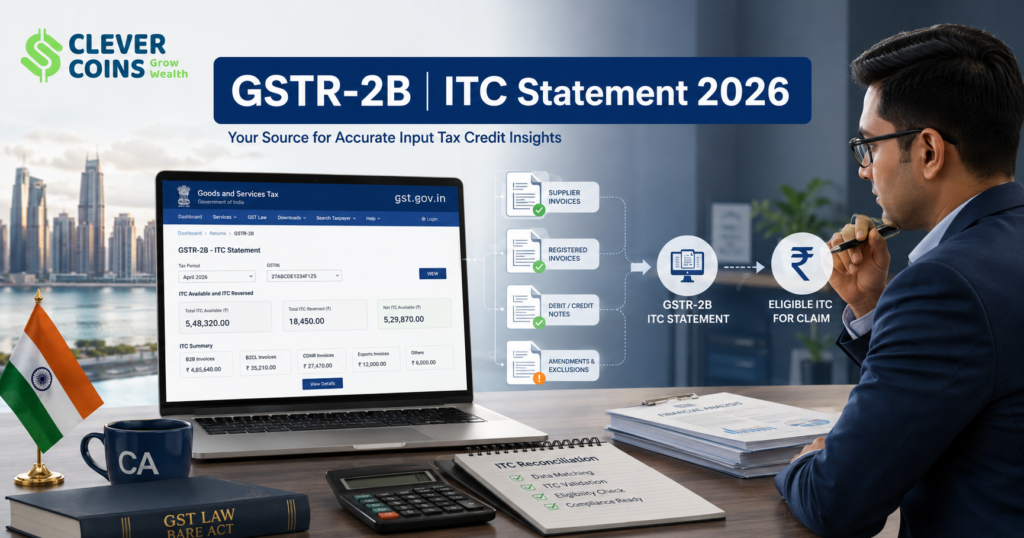
GSTR-2B
In the Indian Goods and Services Tax (GST) framework, accurate claiming of Input Tax Credit (ITC) is the backbone of compliant tax management. GSTR-2B is a static, auto-drafted ITC statement generated by the GST portal for every registered taxpayer on a monthly basis. Unlike GSTR-2A, which is dynamic and updates in real-time, GSTR-2B provides a fixed, date-specific snapshot of all eligible ITC available to a taxpayer based on the filings made by their suppliers.
Introduced by the CBIC (Central Board of Indirect Taxes and Customs) to bring greater accuracy and ease to the reconciliation process, GSTR-2B has now become the primary reference document for claiming ITC under Rule 36(4) of the CGST Rules, 2017. As of 2026, all GST-registered taxpayers in India are required to reconcile their ITC claims with GSTR-2B before filing GSTR-3B.
What is GSTR-2B? – Meaning and Definition
GSTR-2B is an auto-drafted, static Input Tax Credit (ITC) statement available to every GST-registered taxpayer on the GST common portal (www.gst.gov.in). It is generated on the 14th of each month for the previous tax period and reflects details of ITC available to the recipient based on:
- GSTR-1 / IFF (Invoice Furnishing Facility) filed by the supplier
- GSTR-5 filed by non-resident taxable persons
- GSTR-6 filed by Input Service Distributors (ISDs)
- Import of goods data from ICEGATE (Customs portal)
- GSTR-7 filed by persons liable to deduct TDS under GST
- GSTR-8 filed by e-commerce operators liable for TCS under GST
The term ‘static’ means that once generated, the data in GSTR-2B for a particular month does not change. It gives taxpayers a clear and reliable figure to base their ITC claims upon.
Key Features of GSTR-2B
1. Static and Immutable Nature
Unlike GSTR-2A (which keeps updating), GSTR-2B is generated once on the 14th of each month and remains unchanged for that return period. This gives taxpayers certainty and clarity.
2. Covers All ITC Sources
GSTR-2B consolidates ITC data from B2B invoices, import of goods, credit notes, debit notes, ISD credits, TDS credits (CGST/SGST/IGST), and TCS credits from e-commerce operators.
3. Segregation of ITC
The statement clearly classifies ITC into:
- ITC Available: Tax for which the supplier has filed and the recipient can claim
- ITC Not Available: Tax that is blocked under Section 17(5) or ineligible due to reverse charge mismatches
4. Document-Level Details
GSTR-2B provides detailed, document-level information including GSTIN of the supplier, invoice number, invoice date, taxable value, IGST/CGST/SGST/CESS amounts, and the place of supply.
5. Advisory to Taxpayers
The form includes specific advisories noting whether ITC is eligible or not, and the reason for ineligibility, helping taxpayers take informed decisions.
6. Download in JSON/Excel Format
Taxpayers can download GSTR-2B data in both Excel and JSON format for offline reconciliation with their books of accounts and ERP systems.
GSTR-2B vs GSTR-2A – Key Differences
Understanding the difference between GSTR-2B and GSTR-2A is essential for every GST taxpayer:
|
Parameter |
GSTR-2A |
GSTR-2B |
|
Nature |
Dynamic (auto-updated) |
Static (fixed on generation date) |
|
Generation |
Real-time / continuously |
14th of every month |
|
Used for ITC Claim |
Not the basis (post-2021) |
Primary basis under Rule 36(4) |
|
Data Sources |
GSTR-1, IFF, GSTR-5, GSTR-6, GSTR-7, GSTR-8, ICEGATE |
Same sources (at cut-off date) |
|
Amendments Reflected |
As and when filed |
Fixed for the period |
|
Purpose |
Tracking supplier activity |
ITC reconciliation & GSTR-3B filing |
|
Legal Basis |
Rule 60(1) of CGST Rules |
Rule 60(7) of CGST Rules |
When is GSTR-2B Generated? – Due Dates 2026
GSTR-2B is auto-generated by the GSTN (GST Network) system on the 14th of the following month for the previous tax period. Here is the generation and availability schedule for 2026:
|
Tax Period |
GSTR-2B Generation Date |
GSTR-3B Due Date (Monthly) |
GSTR-3B Due Date (Quarterly) |
|
January 2026 |
14th February 2026 |
20th February 2026 |
22nd / 24th February 2026 |
|
February 2026 |
14th March 2026 |
20th March 2026 |
22nd / 24th March 2026 |
|
March 2026 |
14th April 2026 |
20th April 2026 |
22nd / 24th April 2026 |
|
April 2026 |
14th May 2026 |
20th May 2026 |
22nd / 24th May 2026 |
|
May 2026 |
14th June 2026 |
20th June 2026 |
22nd / 24th June 2026 |
|
June 2026 |
14th July 2026 |
20th July 2026 |
22nd / 24th July 2026 |
Note: For taxpayers under the QRMP (Quarterly Return Monthly Payment) scheme, GSTR-2B is generated quarterly – covering B2B invoices filed in IFF for M1 and M2 months and GSTR-1 for the final month of the quarter.
How to Access GSTR-2B on the GST Portal
Accessing GSTR-2B is straightforward via the GST portal. Follow these steps:
- Go to www.gst.gov.in and log in with your credentials
- Click on ‘Services’ > ‘Returns’ > ‘Returns Dashboard’
- Select the applicable Financial Year and Return Filing Period
- Click on ‘GSTR-2B’ tile
- The system displays a summary of ITC available
- Click ‘View’ to see detailed document-level information
- Use ‘Download’ to get the data in Excel or JSON format
The portal also provides a ‘Matching Tool’ within GSTR-2B to compare auto-drafted data with the Purchase Register maintained by the taxpayer.
Structure and Components of GSTR-2B
GSTR-2B is divided into multiple parts, each covering specific ITC sources:
Part A – ITC Available (Where Action is Required)
- 3A – B2B Invoices (Other than reverse charge) – Inward supplies received from registered suppliers
- 3B – B2B Invoices (Reverse Charge) – Supplies attracting reverse charge mechanism
- 3C & 3D – Import of Goods (From SEZ units/developers and others)
- 3E & 3F – ISD Credits (Input Service Distributor distributions)
- 3G – TDS Credits – Tax Deducted at Source under GST (Section 51)
- 3H – TCS Credits – Tax Collected at Source by e-commerce operators (Section 52)
Part B – ITC Not Available (For Information Only)
- 4A – B2B Invoices – Ineligible ITC (blocked under Section 17(5))
- 4B – Imports – Ineligible due to specific exclusions
Summary Section
Provides a consolidated view of total available ITC breakup between IGST, CGST, SGST, and CESS for easy GSTR-3B filling reference.
ITC Eligibility Rules Under GSTR-2B (2026 Update)
As per the CGST Act, 2017 and the latest amendments effective in 2026, the following conditions must be met to claim ITC reflected in GSTR-2B:
Conditions for Claiming ITC
- The taxpayer must be registered under GST
- The goods/services must be used for business purposes
- The supplier must have filed their GSTR-1 / IFF
- The invoice must be received by the taxpayer
- The invoice value and tax paid must match GSTR-2B figures
- ITC must not be blocked under Section 17(5) of the CGST Act
- The taxpayer must not be claiming ITC in excess of the amount in GSTR-2B (subject to Rule 36(4) restrictions)
Blocked Credits Under Section 17(5) – Updated 2026
The following categories of ITC remain ineligible and are reflected in Part B (not available) of GSTR-2B:
- Motor vehicles (with certain exceptions for transport businesses)
- Food and beverages, outdoor catering
- Beauty treatment, health services, cosmetic/plastic surgery
- Membership of clubs, health/fitness centres
- Rent-a-cab, life insurance, health insurance (unless mandated by law)
- Works contract services for construction of immovable property
- Goods or services for personal consumption
- Goods lost, stolen, destroyed or given as gifts/free samples
Rule 36(4) and Its Linkage with GSTR-2B
Rule 36(4) of the CGST Rules, 2017 is the cornerstone regulation governing ITC claims in GSTR-3B. As per the 2022 amendment (effective till date in 2026):
A taxpayer can claim ITC in GSTR-3B only to the extent it reflects in GSTR-2B. The earlier 5% provisional ITC cushion has been completely removed since January 2022.
Practical Impact
- If a supplier has NOT filed GSTR-1 for a particular month, the invoice will NOT appear in GSTR-2B
- The recipient cannot claim ITC for that invoice until the supplier files
- This makes timely supplier compliance critical for the recipient’s cash flow
- Businesses must proactively follow up with suppliers who haven’t filed
This change significantly increased the importance of GSTR-2B as the definitive ITC reference document.
GSTR-2B Reconciliation Process – Step by Step
Reconciliation between GSTR-2B and the Purchase Register (Books of Accounts) is a mandatory exercise before filing GSTR-3B. Here is the detailed process:
Step 1: Download GSTR-2B Data
Download the GSTR-2B in Excel format from the GST portal for the applicable tax period.
Step 2: Extract Purchase Register
Extract your inward supplies register (purchase register) from your accounting software (Tally, SAP, Zoho Books, etc.) for the same period.
Step 3: Match Invoices
Compare each invoice in GSTR-2B against your purchase register on the following parameters:
- GSTIN of Supplier
- Invoice Number
- Invoice Date
- Taxable Value
- IGST / CGST / SGST / CESS Amount
Step 4: Identify Mismatches
Classify mismatches into:
- Invoices in GSTR-2B but NOT in your books (recipient missed recording)
- Invoices in your books but NOT in GSTR-2B (supplier not filed)
- Amount mismatches (supplier filed different amounts)
Step 5: Resolve Mismatches
For supplier-not-filed cases: Follow up with the supplier to file GSTR-1. For amount mismatches: Request supplier to amend via GSTR-1 amendment.
Step 6: Claim Eligible ITC in GSTR-3B
Claim only the ITC that appears in GSTR-2B and is verified in your books. Do not claim ITC for missing/mismatched invoices until resolved.
GSTR-2B for QRMP Scheme Taxpayers
Taxpayers under the Quarterly Return Monthly Payment (QRMP) scheme have special provisions for GSTR-2B:
- GSTR-2B is generated quarterly (not monthly) for QRMP taxpayers
- Data from IFF filed by suppliers for Month 1 (M1) and Month 2 (M2) of the quarter is included
- GSTR-1 data of suppliers for the complete quarter is also included
- The GSTR-2B is available after the 14th of the month following the end of the quarter
- For monthly PMT-06 payments (advance tax), taxpayers should refer to GSTR-2A for interim ITC estimation
Common Issues and Challenges with GSTR-2B
1. Supplier Non-Compliance
The most prevalent issue is suppliers failing to file GSTR-1 on time, resulting in ITC not reflecting in GSTR-2B. This directly impacts the recipient’s working capital as they must pay GST from pocket without ITC offset.
2. Amendment Entries Confusion
When a supplier amends an invoice in a subsequent period, the amendment appears in the GSTR-2B of that subsequent month, not the original month. Taxpayers must track such amendments carefully.
3. Large Data Volume
For large businesses with thousands of purchase invoices monthly, manual reconciliation is impractical. Advanced reconciliation tools and ERP integrations are essential.
4. Duplicate Entries
Occasionally, data from ICEGATE or other government portals may show duplicate import entries. Taxpayers must verify with actual customs documents.
5. Credit Notes Not Matching
Credit notes from suppliers may reduce available ITC. If a supplier issues a credit note after filing GSTR-2B generation date, it appears in the next month’s GSTR-2B, creating temporary overstated ITC.
Penalties for Wrong ITC Claims – 2026 Provisions
The GST law in India prescribes stringent penalties for incorrect or fraudulent ITC claims:
|
Nature of Default |
Penalty Provision |
Penalty Amount |
|
Claiming ITC in excess of GSTR-2B |
Section 50(3) – Interest |
18% per annum on excess ITC |
|
Fraudulent ITC claim |
Section 74 of CGST Act |
100% of tax due + equal penalty |
|
Wrong ITC due to negligence |
Section 73 of CGST Act |
10% of tax due (min ₹10,000) |
|
Not reversing ITC on blocked supplies |
Rule 37 & Section 17(5) |
ITC reversal + 18% interest |
|
ITC reversal on non-payment to supplier (180 days) |
Rule 37A |
ITC reversed + interest from date of claim |
As per Rule 37A (effective from 2022, enforced strictly in 2026), if a taxpayer claims ITC and the supplier does not pay the GST to the government, the taxpayer must reverse the ITC with 18% interest from the date of claiming.
Auto-Population of GSTR-3B from GSTR-2B
One of the significant ease-of-compliance measures introduced by CBIC is the auto-population of GSTR-3B Table 4 using GSTR-2B data. This is how it works:
- Table 4(A) of GSTR-3B is auto-populated with ITC Available from GSTR-2B
- Table 4(D)(1) is auto-populated with ITC declared as ineligible (Section 17(5))
- The auto-populated values are editable – taxpayers can modify before submission
- The system shows side-by-side comparison of auto-populated vs actual values
- CBIC advisory recommends NOT claiming ITC beyond auto-populated GSTR-2B figures
ITC Reversal Rules Linked to GSTR-2B (2026)
Rule 42 & 43 – Proportionate Reversal
Where inputs or capital goods are used for both taxable and exempt supplies, ITC must be reversed proportionately. GSTR-2B data is used as the base for calculating such reversals. The reversal must be effected in GSTR-3B through Table 4(B)(1) and 4(B)(2).
Rule 37 – Non-Payment to Supplier
If a registered person fails to pay the supplier within 180 days from the invoice date, ITC claimed on that invoice must be reversed. Once payment is made, the ITC can be re-claimed. Businesses must track payment dates against GSTR-2B invoice dates.
Section 17(5) – Blocked Credits
As reflected in Part B of GSTR-2B, blocked credits must NEVER be claimed. If inadvertently claimed, they must be reversed in the same return period to avoid interest liability.
Annual GSTR-2B Reconciliation for GSTR-9 Filing
GSTR-9 (Annual Return) requires taxpayers to disclose the total ITC claimed during the year and reconcile it with:
- Total ITC reflected in all 12 months of GSTR-2B
- ITC actually claimed in GSTR-3B filings
- ITC reversed during the year
- Balance ITC carried forward
Any excess ITC claimed over GSTR-2B figures must be reversed with interest before the due date of GSTR-9 (31st December 2026 for FY 2025-26). The GSTR-9C (Reconciliation Statement) filed by taxpayers with turnover above ₹5 Crore requires a certified reconciliation of GSTR-2B ITC vs books.
Important Circulars and Notifications on GSTR-2B (2022–2026)
|
Circular / Notification |
Date |
Subject |
|
Circular No. 183/15/2022 |
27.12.2022 |
Clarification on GSTR-2B and ITC availment under Rule 36(4) |
|
Notification No. 39/2021-CT |
21.12.2021 |
Amendment to Rule 36(4) – removal of 5% provisional ITC |
|
CBIC Advisory dated 01.09.2023 |
01.09.2023 |
Auto-population of GSTR-3B from GSTR-2B mandatory |
|
Budget 2024 Amendment – Section 16(5)/(6) |
23.07.2024 |
ITC for prior period allowed subject to GSTR-2B reflection |
|
CGST Amendment Act 2024 |
16.08.2024 |
Strengthening of ITC matching provisions |
|
Notification 2025 – QRMP Update |
01.04.2025 |
GSTR-2B generation schedule revised for QRMP taxpayers |
|
CBIC Circular 2026 |
01.01.2026 |
Mandatory reconciliation with GSTR-2B before GSTR-3B filing |
Practical Tips for Efficient GSTR-2B Management
For Businesses / Recipients
- Set up automated GSTR-2B download and reconciliation using GST-integrated accounting software
- Share GSTR-1 filing status reports with all vendors at start of each month
- Maintain a vendor compliance tracker – monitor which suppliers are filing regularly
- Never claim ITC beyond GSTR-2B limits – even if invoice is received and payment made
- Use GSTN’s official GSTR-2B matching tool for high-volume reconciliation
- Keep reconciliation records for a minimum of 6 years as per GST law
For Suppliers / Vendors
- File GSTR-1 well before the 11th of every month to ensure your buyer’s GSTR-2B is updated
- Use IFF (Invoice Furnishing Facility) for B2B invoices in Months 1 and 2 under QRMP
- Immediately rectify errors in filed invoices through amendment in the next period’s GSTR-1
- Ensure GST portal registration details match PAN and bank records to avoid GSTIN mismatches
Technology Tools for GSTR-2B Reconciliation
Several GSTN-approved and third-party software solutions support GSTR-2B reconciliation:
|
Tool / Platform |
Type |
Key Feature |
|
GSTN Official Portal |
Government |
Free built-in matching tool, JSON/Excel download |
|
Tally Prime 5.0+ |
ERP |
Direct GSTR-2B import, auto-reconciliation |
|
Zoho Books |
Cloud Accounting |
Real-time GSTR-2B sync, mismatch alerts |
|
ClearTax GST |
GST Filing Tool |
Bulk reconciliation, supplier follow-up automation |
|
SAP S/4HANA GST Module |
Enterprise ERP |
API-based GSTR-2B pull, audit trail |
|
BUSY Accounting |
SME Software |
India-specific GST reconciliation module |
|
Vyapar App |
Mobile/Desktop |
Small business GSTR-2B matching feature |
Financial Impact of GSTR-2B on Working Capital
The mandatory linkage of ITC to GSTR-2B has significant cash flow implications:
Illustration – Impact of Supplier Non-Filing
Scenario: Company ABC Pvt. Ltd. received goods worth ₹10,00,000 (Taxable) + ₹1,80,000 (GST @ 18% IGST) in January 2026. The supplier failed to file GSTR-1 for January by 11th February 2026.
|
Parameter |
If Supplier Files on Time |
If Supplier Does NOT File |
|
Invoice in GSTR-2B |
Yes |
No |
|
ITC Claimable in February 2026 |
₹1,80,000 |
₹0 |
|
Cash GST Payment Required |
₹0 (offset by ITC) |
₹1,80,000 |
|
Working Capital Impact |
Nil |
₹1,80,000 blocked |
|
Interest if paid late |
N/A |
18% p.a. on ₹1,80,000 |
This example shows how a single non-compliant supplier can block ₹1,80,000 of working capital per ₹10 lakh purchase, making supplier compliance monitoring critical for financial health.
New Section 16(5) and 16(6) – 2024 Amendment Impact on GSTR-2B
The Finance (No. 2) Act, 2024 introduced two new sub-sections to Section 16 of the CGST Act, creating a significant relaxation for taxpayers:
Section 16(5) – ITC for Prior Periods
Taxpayers who could not claim ITC for FY 2017-18 to FY 2021-22 due to the lapse of the deadline under the erstwhile Section 16(4) can now claim such ITC, provided the invoices appear in GSTR-2B and a special application process is followed. This is a one-time relief measure.
Section 16(6) – ITC Post Cancellation of Registration
If a taxpayer’s GST registration was cancelled and later revoked, ITC for the period of cancellation can be claimed, subject to such ITC appearing in GSTR-2B for the relevant periods.
Both these provisions underscore the centrality of GSTR-2B as the authoritative source for ITC claims even for retroactive periods.
Frequently Asked Questions (FAQs) on GSTR-2B
Q1. Is GSTR-2B mandatory to file?
GSTR-2B is not a return to be filed. It is an auto-generated statement. However, taxpayers must use it as the basis for ITC claims in GSTR-3B, making its use effectively mandatory.
Q2. What if my supplier files GSTR-1 after 14th of the month?
The invoice will not appear in the current month’s GSTR-2B. It will appear in the next month’s GSTR-2B (generated on 14th of the following month), and ITC can be claimed in that subsequent period.
Q3. Can I claim ITC if the invoice is not in GSTR-2B?
As per Rule 36(4) (2026), NO. ITC can only be claimed to the extent it reflects in GSTR-2B. Claiming beyond this invites scrutiny, demand notices, and interest liability.
Q4. How do I handle invoices partially reflecting in GSTR-2B?
If the supplier filed a different amount than what is in your books, you can claim only the amount in GSTR-2B. For the difference, request the supplier to file an amendment in the next period’s GSTR-1.
Q5. Does GSTR-2B include RCM (Reverse Charge Mechanism) invoices?
Yes. Part A of GSTR-2B includes inward supplies under reverse charge (Table 3B). However, the ITC for RCM is available only after the tax is paid under RCM in GSTR-3B.
Q6. Is data from ICEGATE included in GSTR-2B?
Yes. Import of goods data is fetched from ICEGATE (the Indian Customs portal) and auto-populated in GSTR-2B under Tables 3C and 3D (SEZ and other imports).
Q7. What is the cut-off date for GSTR-2B data?
For the statement generated on the 14th, all GSTR-1/IFF filed by suppliers up to the 13th of the same month (midnight) are included for the previous tax period.
GSTR-2B Compliance Checklist for Businesses (2026)
|
# |
Action Item |
Frequency |
Status |
|
1 |
Download GSTR-2B from GST Portal |
Monthly (after 14th) |
|
|
2 |
Reconcile GSTR-2B with Purchase Register |
Monthly |
|
|
3 |
Identify missing invoices (in books not in 2B) |
Monthly |
|
|
4 |
Follow up with non-compliant suppliers |
Monthly |
|
|
5 |
Ensure no ITC claimed beyond GSTR-2B |
Before GSTR-3B filing |
|
|
6 |
Reverse ITC for invoices not paid within 180 days |
Ongoing |
|
|
7 |
Track credit notes and debit notes |
Monthly |
|
|
8 |
Annual reconciliation for GSTR-9 preparation |
Annual |
|
|
9 |
Archive GSTR-2B data for 6 years |
Annual |
|
|
10 |
Review blocked credit (Section 17(5)) items |
Monthly |
|
Conclusion
GSTR-2B has fundamentally transformed the way Input Tax Credit is claimed in India. By replacing the provisional ITC mechanism with a strict GSTR-2B-based system, the government has significantly curtailed fraudulent ITC claims while making compliance more transparent and predictable for honest taxpayers.
For businesses in 2026, efficient GSTR-2B management is not just a compliance requirement—it is a financial imperative. Timely reconciliation, proactive supplier management, and the use of technology tools are the three pillars of effective GSTR-2B compliance.
As India’s GST system continues to mature, GSTR-2B is expected to evolve further, with deeper integration with e-invoicing data, real-time alerts for missing supplier filings, and AI-based anomaly detection—all aimed at creating a seamless, self-policing tax compliance ecosystem.