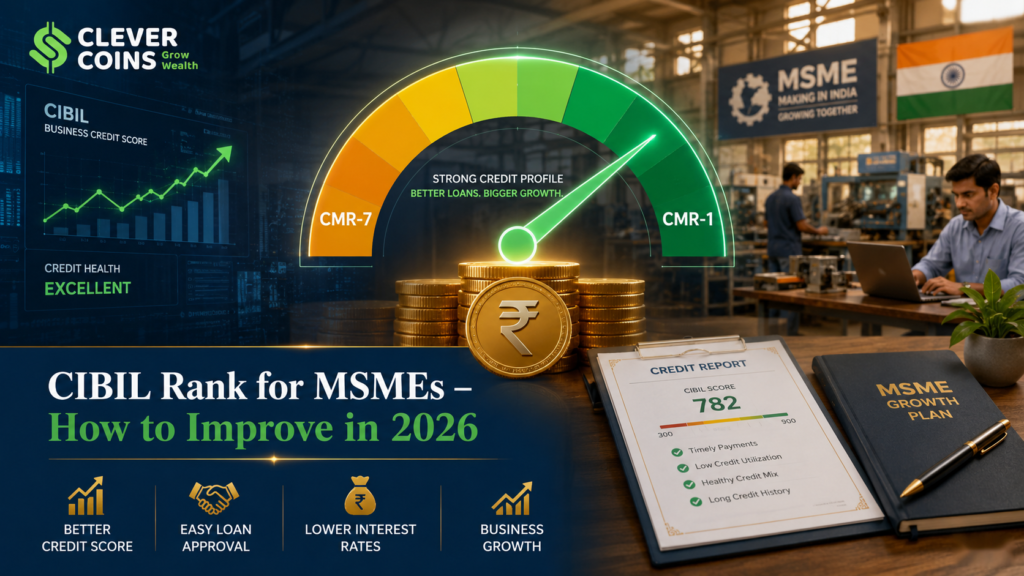
Why CIBIL Rank Matters for Your MSME in 2026
In India’s rapidly evolving credit ecosystem, the CIBIL Rank has become the single most important determinant of an MSME’s ability to access formal finance. Whether you are a micro-enterprise in Surat seeking a working capital loan of ₹5 Lakh, a small manufacturer in Pune applying for a term loan of ₹50 Lakh under a government scheme, or a medium enterprise in Delhi eyeing a ₹5 Crore expansion facility — your CIBIL Rank is the first number every bank and NBFC will examine.
As of 2026, with the Indian government’s emphasis on making credit accessible to all 6.3 Crore MSMEs registered on the Udyam portal, and with RBI’s revised guidelines on MSME lending, credit scoring has taken centre stage. Yet, millions of business owners remain unaware of what the CIBIL Rank actually means, how it is calculated, and — most importantly — how they can actively improve it.
This comprehensive guide demystifies the CIBIL Rank for MSMEs from every angle — its definition, scoring methodology, factors that damage it, actionable strategies to improve it, and the direct impact a higher rank has on loan approvals and interest rates.
What is CIBIL Rank? Understanding the Basics
▸ Definition of CIBIL Rank
The CIBIL Rank — formally known as the CIBIL MSME Rank (CMR) — is a credit ranking system developed by TransUnion CIBIL specifically for Micro, Small, and Medium Enterprises. Unlike the CIBIL Score (300–900) used for individuals, the CIBIL Rank is assigned on a scale of 1 to 10, where:
|
CIBIL Rank |
Credit Risk Category |
Indicative Meaning |
|
CMR-1 |
Lowest Risk |
Excellent creditworthiness – best loan terms |
|
CMR-2 to CMR-3 |
Low Risk |
Very good credit profile – easy loan access |
|
CMR-4 to CMR-5 |
Moderate Risk |
Average credit health – normal loan terms |
|
CMR-6 to CMR-7 |
High Risk |
Below-average credit – lenders may impose conditions |
|
CMR-8 to CMR-9 |
Very High Risk |
Poor credit – limited loan access, high interest |
|
CMR-10 |
Highest Risk |
Severe credit issues – loan rejection likely |
|
NR (No Rank) |
Insufficient Data |
No credit history or insufficient data to rank |
💡 Key Insight: CMR-1 is the BEST rank (lowest risk) and CMR-10 is the WORST. This is opposite to how most people think — lower is better for CIBIL Rank.
▸ CIBIL Rank vs CIBIL Score – Key Differences
|
Parameter |
CIBIL Score (Individual) |
CIBIL Rank / CMR (MSME) |
|
Who it applies to |
Individual / Sole Proprietor (personal) |
Business entity (Pvt Ltd, LLP, Partnership, OPC, etc.) |
|
Scale |
300 to 900 |
1 to 10 (1 = Best) |
|
Issued by |
TransUnion CIBIL |
TransUnion CIBIL (CMR) |
|
Based on |
Personal credit behaviour |
Business credit behaviour + financials |
|
Used for |
Personal loans, home loans, credit cards |
Business loans, working capital, CC/OD limits |
|
Lenders using it |
All retail banks and NBFCs |
Banks, NBFCs, SIDBI, Mudra, CGTMSE lenders |
How is the CIBIL MSME Rank (CMR) Calculated?
TransUnion CIBIL calculates the CMR using a proprietary algorithm that analyses data furnished by banks and financial institutions. The key data inputs and their approximate weightage are:
|
Factor |
Approx. Weightage |
What Lenders See |
|
Repayment History (EMI / Loan) |
~35% |
Timely payment of existing loans, CC/OD, TL, WC |
|
Credit Utilisation Ratio |
~25% |
How much of sanctioned credit limit is used |
|
Length of Credit History |
~15% |
Age of oldest credit account of the business |
|
Credit Mix |
~10% |
Diversity — TL, WC, CC, OD, BG, LC etc. |
|
Number of Enquiries (Hard Pulls) |
~10% |
How often business has applied for new credit |
|
Financial Data (Turnover, Profitability) |
~5% |
GST returns, ITR, audited financials |
📌 Note: These weightages are indicative. TransUnion CIBIL’s exact algorithm is proprietary and not publicly disclosed. RBI has issued guidelines requiring CICs (Credit Information Companies) to maintain transparency in methodology under the Credit Information Companies (Regulation) Act, 2005.
▸ Data Sources Used to Calculate CMR
- Scheduled Commercial Banks (SCBs) — all public, private, and foreign banks
- Non-Banking Financial Companies (NBFCs) registered with RBI
- Small Industries Development Bank of India (SIDBI)
- Regional Rural Banks (RRBs)
- State Financial Corporations (SFCs)
- Micro Finance Institutions (MFIs) — for micro-enterprises
- GST Network (GSTN) data integration — expanded in 2025
- Account Aggregator (AA) Framework data — introduced under RBI’s 2021 framework, expanded 2025-26
Which MSMEs Get a CIBIL Rank & When?
▸ Eligibility for CMR Assignment
A CIBIL MSME Rank is typically assigned to a business entity when it has at least one active or closed credit facility with a lender who is a CIBIL member. The entity types covered include:
- Private Limited Companies
- Limited Liability Partnerships (LLPs)
- Partnership Firms
- One Person Companies (OPCs)
- Proprietorship Firms — when credit is taken in the business name
- Trusts, Societies, and Co-operatives with formal credit facilities
⚠️ Important: Sole Proprietors who avail credit in their personal name (not business name) will reflect in their personal CIBIL Score, not in CMR. For CMR to be generated, credit must be availed under the business PAN / entity name.
▸ The ‘NR’ (No Rank) Category
Many MSMEs — especially those registered on Udyam in 2020-2026 — may find ‘NR’ (No Rank) on their CIBIL report. This means insufficient credit data exists to generate a rank. NR is not necessarily bad, but it means the business has no credit history, which lenders treat with caution. Building credit history is the first step for these enterprises.
Factors That Damage Your CIBIL MSME Rank
▸ 1. Loan / EMI Defaults and Delayed Payments
The single biggest destroyer of CMR is defaulting on loan repayments. Even a delay of 30 days (reported as SMA-0 — Special Mention Account) is noted on your CIBIL report. Delays beyond 90 days result in NPA (Non-Performing Asset) classification, severely impacting the rank. For 2026, RBI’s revised Prudential Framework requires lenders to report account stress within 30 days of default, making the impact faster than ever.
▸ 2. High Credit Utilisation
Using more than 75–80% of your sanctioned Cash Credit (CC) or Overdraft (OD) limit consistently signals financial stress. For example, if your CC limit is ₹50 Lakh and you are regularly drawing ₹45–48 Lakh, this high utilisation negatively impacts your CMR. Ideal utilisation: below 40% of sanctioned limits.
▸ 3. Multiple Loan Applications in Short Period
Every time you apply for credit, the lender makes a ‘hard enquiry’ on your CIBIL report. Multiple hard enquiries in a short span signal credit-hunger and financial desperation to lenders, pulling down your CMR. This is especially relevant in 2026 as digital lending platforms have made applying for loans a single-click activity, leading many MSMEs to over-apply.
▸ 4. Loan Settlements and Write-offs
If you have settled a loan for less than the outstanding amount (i.e., ‘one-time settlement’ with the bank), this is reported as ‘Settled’ — a negative tag that stays on your CIBIL report for 7 years. Similarly, loans written off by the bank appear as ‘Written Off’, a severe negative. Both directly impact CMR and can result in near-immediate CMR-8 to CMR-10 ratings.
▸ 5. Guarantor Defaults
If you have stood as a guarantor for another business’s loan and that borrower has defaulted, your CMR is also impacted — even though you did not borrow the money directly. Under RBI guidelines, guarantors are co-obligants and their credit profiles reflect the primary borrower’s defaults.
▸ 6. Errors in CIBIL Report
Incorrect data — wrong loan accounts showing in your report, someone else’s credit data due to PAN mismatch, outdated status (loan closed but shown as active) — can artificially depress your CMR. According to CIBIL’s own data, a significant portion of credit report disputes stem from data errors. Regular monitoring is essential.
▸ 7. Absence of Credit Mix
Businesses with only one type of credit (e.g., only a term loan) score lower on the credit mix parameter than businesses with a healthy mix of term loans, working capital limits, business credit cards, and invoice financing facilities.
How to Improve Your CIBIL MSME Rank – 15 Proven Strategies for 2026
▸ Strategy 1: Pay All Dues on Time — Every Time
This is non-negotiable. Set up auto-debit mandates (NACH) for all EMIs, CC interest, and OD charges. Even a single missed payment can drop your CMR by 1–2 ranks. If you foresee a cash crunch, proactively approach your bank for a temporary moratorium or loan restructuring before the due date — not after. Under RBI’s 2025 MSME restructuring framework, banks are required to consider restructuring requests from viable MSMEs without classifying them as NPA if approached proactively.
▸ Strategy 2: Reduce Credit Utilisation Below 40%
Actively manage your CC/OD usage. If your limit is ₹30 Lakh, try to maintain the outstanding at or below ₹12 Lakh. If business needs require higher utilisation, request a limit enhancement from your bank — a higher sanctioned limit with the same usage automatically lowers the utilisation ratio, improving your CMR.
💡 Tip: Requesting a credit limit enhancement when your business is performing well (good turnover, healthy bank statements) is a proactive CMR improvement strategy.
▸ Strategy 3: Do Not Apply for Multiple Loans Simultaneously
Research lenders and their eligibility criteria before applying. Use aggregator platforms (BankSathi, Lendingkart, Indifi, etc.) that perform ‘soft enquiries’ to show pre-approved offers — these do NOT impact your CMR. Apply only when you meet the criteria and only to 1–2 lenders at a time.
▸ Strategy 4: Build a Credit History If You Are ‘NR’
If your business has ‘No Rank’, start building credit:
- Apply for a small secured business loan against FD or property — easier to get and helps build history
- Get a Business Credit Card (₹1 Lakh–₹5 Lakh limit) and use it regularly, paying dues in full
- Avail Invoice Discounting / TReDS (Trade Receivables Discounting System) — government-backed platform for MSME receivable financing
- Take a small MUDRA loan (Shishu: up to ₹50,000; Kishor: ₹50,000–₹5 Lakh; Tarun: ₹5 Lakh–₹10 Lakh) and repay it perfectly
▸ Strategy 5: Resolve All Settlements and Write-offs
Contact the bank for loans showing ‘Settled’ or ‘Written Off’ status. Many banks are open to accepting the remaining dues in exchange for updating the status to ‘Closed’. After payment, get a ‘No Dues Certificate’ (NDC) and submit it to CIBIL via the dispute resolution process. While the negative record may remain for 7 years, having it closed is far better than the original negative status.
▸ Strategy 6: Dispute and Correct Errors in Your CIBIL Report
How to raise a CIBIL dispute in 2026:
- Visit www.cibil.com and log in to your MSME account
- Download your CIR (Company Credit Information Report)
- Identify errors — wrong account, wrong status, wrong amount
- Click ‘Dispute’ and fill the online dispute form with documentary evidence
- CIBIL forwards the dispute to the concerned lender for verification
- Resolution must happen within 30 days as per RBI’s CIC guidelines
- After resolution, your CMR is recalculated — improvements visible in 30–45 days
▸ Strategy 7: Maintain a Diversified Credit Mix
Aim to have a healthy mix of:
- Term Loan (TL) — for capex or long-term needs
- Cash Credit (CC) or Overdraft (OD) — for working capital
- Business Credit Card — for routine business expenses
- Invoice Financing / Bill Discounting — for receivables management
- Bank Guarantee (BG) or Letter of Credit (LC) — for trade credibility
▸ Strategy 8: Maintain Clean and Healthy Bank Account Statements
As lenders increasingly use bank statement analysis (via Account Aggregator framework, 2026) to supplement CIBIL data, maintaining a business account with:
- Regular credit entries (sales receipts, collections)
- No cheque bounces or ECS returns
- Consistent average monthly balance (AMB)
- No frequent round-trip transactions
…all positively influence the holistic credit assessment that improves CMR over time.
▸ Strategy 9: File GST Returns Regularly and on Time
Since 2025, GSTN data is increasingly integrated into credit assessment for MSMEs. Regular, timely GSTR-1, GSTR-3B, and Annual Return filing demonstrates business activity and revenue consistency. Non-filers or erratic filers are viewed as higher risk, indirectly affecting creditworthiness assessments that feed into CMR.
▸ Strategy 10: File Income Tax Returns (ITR) on Time
ITR filing — particularly ITR-3 (business income for proprietors) or ITR-6 (companies) — is mandatory and is used by lenders to verify turnover, profitability, and tax compliance. Companies with audited financials and clean ITR history get better CMR outcomes as this data feeds into lender reporting to CIBIL.
▸ Strategy 11: Reduce Outstanding Debt Wherever Possible
High overall debt burden (Total Outstanding / Net Worth ratio) is a red flag. If business cash flows permit, consider pre-closing smaller loans to reduce total outstanding, improve the Debt-to-Equity ratio, and demonstrate financial discipline — all of which are positively reflected in CMR over time.
▸ Strategy 12: Avoid Being a Guarantor for Poor Credit Businesses
Carefully evaluate before becoming a guarantor. If the primary borrower defaults, your CMR suffers even though you didn’t borrow. If you are already a guarantor for a business in financial stress, proactively work with the bank to either get yourself released as guarantor (with bank consent) or ensure the primary borrower’s loan remains standard.
▸ Strategy 13: Use SIDBI and Government Scheme Loans Strategically
Loans availed under government schemes — MUDRA, CGTMSE, Stand-Up India, PM Vishwakarma, Credit Guarantee for MSMEs — are reported to CIBIL and, when repaid regularly, significantly improve CMR. In 2026, SIDBI’s MSME Credit Assessment System has been linked to CMR tracking, providing additional data points for rank improvement.
▸ Strategy 14: Monitor Your CIBIL Report Quarterly
As per RBI guidelines and CIBIL policy, MSMEs can access their credit report:
- Free: Once per year (as mandated by RBI for all CICs from 2022 onwards)
- Paid: Additional reports at ₹550 per report (approximate 2026 pricing) via CIBIL website
- Via Account Aggregator: Real-time monitoring through AA-enabled banking apps (HDFC, SBI, ICICI, Axis, Kotak — all AA-live in 2026)
Regular monitoring catches errors early, tracks improvement, and alerts to fraudulent credit applications in your business name.
▸ Strategy 15: Engage a CA / Credit Counsellor for CMR Improvement Plan
For MSMEs with CMR-7 to CMR-10 ratings, a structured credit remediation plan prepared by a Chartered Accountant (CA) or certified credit counsellor can be transformative. This typically involves negotiating with banks, restructuring existing loans, resolving disputes, and rebuilding credit systematically over 12–24 months.
Realistic Timeline to Improve CIBIL MSME Rank
MSME owners often ask: ‘How long will it take?’ The answer depends on your starting CMR and the actions taken. Here is a realistic guide:
|
Starting CMR |
Issue Type |
Actions Required |
Expected Improvement Timeline |
|
CMR-1 to 3 |
Maintaining good rank |
Continue on-time payments, manage utilisation |
Maintain – no negative action needed |
|
CMR-4 to 5 |
Minor delays, high utilisation |
Clear overdues, reduce utilisation, stop new enquiries |
Improvement in 3–6 months |
|
CMR-6 to 7 |
Irregular payments, one settlement |
Dispute errors, close settlement, diversify credit |
Improvement in 6–12 months |
|
CMR-8 to 9 |
Multiple defaults, NPA history |
Restructure loans, CA-assisted plan, clear overdues |
Improvement in 12–24 months |
|
CMR-10 / NPA |
Severe default, write-off |
Comprehensive rehabilitation, NCLT if needed, rebuild |
24–36 months minimum |
|
NR (No Rank) |
No credit history |
Start with secured loans, MUDRA, Business CC |
CMR assigned in 6–12 months |
📌 Important: Credit score improvement is a marathon, not a sprint. Consistent positive behaviour over 12–24 months yields the most durable improvement in CMR.
How CIBIL Rank Directly Impacts Your MSME Loan Terms in 2026
Your CMR directly translates to real rupee savings (or costs) on your business loans. Here is a comparative illustration:
|
CMR |
Typical Interest Rate (2026) |
Loan Amount Eligible |
Collateral Requirement |
Processing Time |
|
CMR-1 to 2 |
8.5% – 10.5% p.a. |
Up to ₹5 Crore (unsecured) |
Minimal / NIL for CGTMSE |
24–48 hours (digital) |
|
CMR-3 to 4 |
10.5% – 13% p.a. |
Up to ₹2 Crore (unsecured) |
Low collateral |
3–7 days |
|
CMR-5 to 6 |
13% – 16% p.a. |
Up to ₹75 Lakh |
Moderate collateral required |
7–15 days |
|
CMR-7 to 8 |
16% – 21% p.a. |
Up to ₹25 Lakh |
High collateral required |
15–30 days |
|
CMR-9 to 10 |
21%+ or rejection |
Very limited / rejection |
Full collateral + guarantors |
Often rejected |
💰 Illustration: Interest Saving With Better CMR Loan Amount: ₹50 Lakh | Tenure: 5 Years CMR-2 at 10%: Total Interest = ₹13.74 Lakh CMR-7 at 18%: Total Interest = ₹26.27 Lakh Difference = ₹12.53 Lakh SAVINGS with a better CMR!
CIBIL Rank and Government MSME Schemes in 2026
▸ CGTMSE (Credit Guarantee Fund Trust for Micro and Small Enterprises)
CGTMSE provides collateral-free loan guarantees to MSMEs. In 2026, CGTMSE has enhanced its scheme with higher guarantee covers:
- Micro enterprises: Up to ₹2 Crore — 85% guarantee cover
- Small enterprises: Up to ₹5 Crore — 75% guarantee cover
- Women / SC/ST / NE region MSMEs: Enhanced cover of 90%
Banks use CMR as a primary eligibility criterion — CMR-1 to CMR-5 businesses are generally eligible, while CMR-6 and below face higher scrutiny. Good CMR enables collateral-free access to institutional credit under CGTMSE.
▸ MUDRA Loans 2026 – Enhanced Limits
Under the Pradhan Mantri MUDRA Yojana (PMMY), loan limits were enhanced in 2024. In 2026 the three categories are:
|
Category |
Loan Amount |
Typical CMR Required (indicative) |
|
Shishu |
Up to ₹50,000 |
NR or any rank (starter) |
|
Kishor |
₹50,001 – ₹5 Lakh |
NR to CMR-7 |
|
Tarun |
₹5 Lakh – ₹20 Lakh |
CMR-1 to CMR-6 preferred |
|
Tarun Plus (new 2024) |
₹20 Lakh – ₹20 Lakh (enhanced) |
CMR-1 to CMR-5 required |
▸ PM Vishwakarma Yojana (2023–2028)
Launched in 2023 and fully operational in 2026, PM Vishwakarma provides collateral-free loans at concessional rates (5% p.a.) to traditional artisans and craftspersons. For higher-value loans under this scheme, CMR plays a role in determining quantum.
▸ Emergency Credit Line Guarantee Scheme (ECLGS) 2026
ECLGS — originally launched post-COVID and extended through 2026 — continues to provide 100% government-backed emergency credit to MSMEs. Banks use CMR as a supplementary metric for determining loan quantum under ECLGS top-up facilities.
▸ TReDS (Trade Receivables Discounting System)
TReDS platforms (M1xchange, RXIL, Invoicemart) allow MSMEs to discount their receivables from large corporates at favourable rates. Active TReDS participation, with regular and timely settlements, is reported to CIBIL from 2025 onwards and positively improves CMR for participating MSMEs.
How to Check Your CIBIL MSME Rank – Step-by-Step (2026)
- Visit www.cibil.com → ‘Company Credit Report’ section
- Register / log in with your business PAN, entity name, and authorised signatory details
- Select the ‘MSME Rank Report’ or ‘Company Credit Information Report (CCIR)’ product
- Pay the applicable fee (₹550–₹1,200 depending on report type, approximate 2026 pricing)
- Receive your CCIR via email within 24–48 hours
- Alternatively: Your bank relationship manager can pull the CMR report as part of loan assessment — ask them to share a copy
- Via AA Framework: Use Account Aggregator enabled apps (like ICICI iMobile, SBI YONO, HDFC Mobile) to view credit summary linked to your business PAN
📌 RBI Mandate: As per RBI’s 2022 circular, all Credit Information Companies (CICs) including CIBIL, Equifax, Experian, and CRIF High Mark must provide one free credit report per year to every registered entity (individual or company).
Udyam Registration and Its Link to CIBIL Rank in 2026
The Udyam Registration portal (udyamregistration.gov.in), mandated by the Ministry of MSME, is now deeply integrated with the credit ecosystem:
- Udyam data (turnover, investment in plant & machinery, NIC code) is accessible to lenders via the Udyam Assist Portal and Jan Samarth portal
- Banks are mandated by RBI to classify MSME borrowers based on Udyam registration for priority sector lending
- CIBIL uses Udyam-verified turnover data as one of the financial data inputs in CMR calculation since 2025
- MSMEs without Udyam registration may have incomplete financial profiles on CIBIL, potentially keeping them at ‘NR’ status
✅ Action Point: If not already done, register on the Udyam portal immediately. It is free, paperless (Aadhaar-based for proprietors, PAN + ITR based for companies), and directly benefits your CMR by enriching your credit profile data.
Key RBI Guidelines Impacting MSME Credit in 2025–2026
|
RBI Guideline / Circular |
Year |
Impact on MSME CMR |
|
Revised Regulatory Framework for MSMEs |
2025 |
Banks must restructure viable MSME loans without NPA classification if approached proactively |
|
Account Aggregator Framework Expansion |
2025-26 |
MSME financial data (bank statements, GST, ITR) accessible to lenders with consent — enriches CMR |
|
MSME Sector Lending Priority |
2026 |
Increased PSL targets for MSME — 7.5% of ANBC for banks — incentivises MSME lending |
|
CIC Data Accuracy Regulations |
2025 |
CICs must resolve disputes within 30 days; penalties for inaccurate data reporting by lenders |
|
ONDC for MSME Credit |
2025-26 |
Open Network for Digital Commerce integrates with credit assessment — digital MSME transaction history counted |
|
Digital Lending Guidelines |
2022 (updated 2025) |
All digital lenders must report to CICs within 30 days of disbursement |
Common Myths About CIBIL Rank for MSMEs — Busted
|
Myth |
Reality |
|
CMR-1 means you will definitely get a loan |
CMR-1 improves chances but lenders also consider turnover, profitability, collateral, and sector risk |
|
Checking your own CMR reduces your rank |
Self-enquiries are ‘soft pulls’ and do NOT affect CMR |
|
Closing a loan account immediately improves CMR |
Closed accounts in good standing stay on report for 7 years and continue to positively influence CMR |
|
Only banks affect CMR |
NBFCs, MFIs, TReDS platforms, SIDBI — all report to CIBIL and impact CMR |
|
NR (No Rank) = Bad CMR |
NR simply means no data. Many lenders are willing to lend to NR businesses on the basis of GST, ITR, and bank statements |
|
Settling a loan is better for CMR than defaulting |
Settlement is negative but less severe than an active default/NPA — but ‘Closed/Fully Paid’ is always far better |
|
Director’s personal CIBIL Score does not affect MSME loan |
For small MSMEs, especially proprietorships and small Pvt Ltds, lender also evaluates director’s personal CIBIL Score |
Conclusion – Your CIBIL Rank Is in Your Hands
For India’s 6.3 Crore+ MSMEs, the CIBIL MSME Rank is not just a number — it is the financial passport to growth, expansion, and resilience. A strong CMR (CMR-1 to CMR-3) can mean the difference between a ₹2 Crore collateral-free loan at 10% and being turned away by every lender. It can save your business lakhs of rupees in interest costs every year.
The good news? Unlike many business parameters you cannot control, your CIBIL Rank is entirely within your control. Every EMI paid on time, every CC limit kept under 40%, every error disputed and corrected, every GST return filed on time — each of these actions is a brick in the foundation of a strong credit profile.
In 2026, with digital lending at your fingertips, government schemes offering unprecedented access to collateral-free credit, and the Account Aggregator framework giving lenders a 360-degree view of your financial health, MSMEs that invest time in understanding and improving their CMR will have a decisive competitive advantage.
Start today. Check your CIBIL MSME Rank. Identify the gaps. Build a plan. Your next business loan — at the best possible terms — is a strong CMR away.
Disclaimer: This blog is intended for general informational and educational purposes only. The interest rates, loan limits, and government scheme parameters mentioned are indicative as of 2026 and subject to change by respective authorities. Readers are advised to consult a qualified Chartered Accountant (CA), Certified Credit Counsellor, or Financial Advisor for advice specific to their MSME’s credit situation.