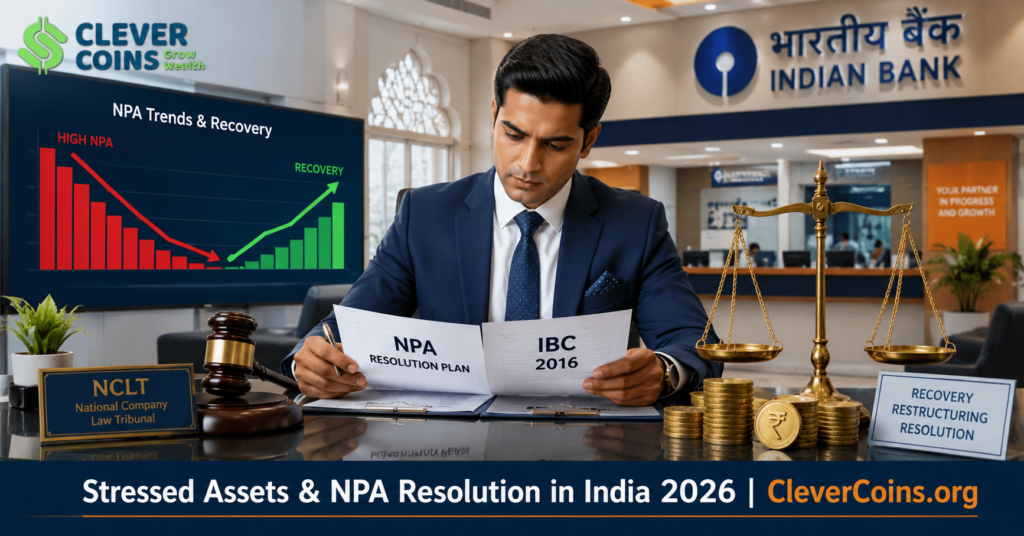
The Growing Challenge of Stressed Assets in India
India’s banking sector is one of the largest and most critical pillars of the country’s economy. However, in recent decades, a persistent challenge has loomed over the financial system — the problem of Stressed Assets and Non-Performing Assets (NPAs). Whether you are a small business owner who has availed a term loan, an entrepreneur seeking working capital finance, or a financial professional tracking RBI guidelines, understanding stressed assets and NPA resolution mechanisms is essential knowledge in 2026.
A Stressed Asset is any loan or credit exposure where the borrower is showing early signs of financial distress — missed payments, restructured accounts, or declining financial health. When this distress reaches a critical threshold, the account becomes a Non-Performing Asset (NPA). As of Q4 2025 (data released early 2026), India’s Gross NPA ratio for Scheduled Commercial Banks stood at approximately 2.6% — the lowest in over a decade — yet in absolute terms, this represents NPAs worth over Rs. 3.5 lakh crore across the banking system.
This blog is a comprehensive, detailed guide covering every important aspect of Stressed Assets and NPA Resolution in India as per 2026 laws and RBI guidelines — including definitions, classifications, resolution frameworks, legal tools, real-world impacts on borrowers, and the road ahead.
What Are Stressed Assets? A Clear Definition
The term ‘Stressed Assets’ is a broad umbrella that includes three categories of problematic loans on a bank’s balance sheet:
|
Three Components of Stressed Assets |
|
1. Non-Performing Assets (NPAs) — Loans where interest or principal has not been paid for 90 days or more. |
|
2. Restructured Standard Assets — Loans where terms have been renegotiated but the borrower is technically still paying. |
|
3. Written-Off Assets — Bad loans that have been removed from the bank’s balance sheet but recovery action may still be ongoing. |
The 90-Day NPA Rule
As per RBI’s IRAC (Income Recognition and Asset Classification) norms, a loan account is classified as NPA if:
- Interest or principal remains overdue for a period of more than 90 days for term loans
- The account remains ‘out of order’ for 90 days in case of Cash Credit / Overdraft accounts
- The bill remains overdue for 90 days in case of bills purchased / discounted
- In case of agricultural loans — one crop season for short-duration crops and two crop seasons for long-duration crops
Classification of NPAs: Sub-Standard, Doubtful & Loss Assets
Once a loan is classified as an NPA, it is further categorised based on the duration it has remained NPA and the recoverability of the outstanding amount:
|
Category |
Duration as NPA |
Key Characteristics |
|
Sub-Standard Assets |
Up to 12 months |
Weaknesses jeopardising liquidation; bank retains some recovery possibility |
|
Doubtful Assets |
More than 12 months |
Collection in full is highly questionable; collateral value uncertain |
|
Loss Assets |
Beyond doubtful |
Uncollectible; loss identified but not written off. Must be fully provided for |
Causes of NPAs in India — Why Do Loans Go Bad?
Understanding the root causes of NPAs is critical to building effective resolution strategies. NPAs in India arise from multiple interlinked factors:
Macro-Economic Factors
- Economic slowdowns reducing revenue for businesses (e.g., post-COVID impact in 2020-2021)
- Commodity price crashes affecting mining, steel, power, and textile sectors
- Global supply chain disruptions impacting export-oriented industries
- Rise in interest rates increasing EMI burden on borrowers
Project & Borrower-Level Factors
- Over-leveraging — Companies borrowing beyond their repayment capacity
- Diversion of funds — Loan proceeds used for purposes other than the sanctioned end-use
- Promoter fraud and willful default — A significant contributor to large NPA cases
- Poor project appraisal by banks leading to lending to non-viable projects
- Land acquisition delays and regulatory hurdles stalling infrastructure projects
Banking System Factors
- Evergreening of loans — Rolling over bad loans to show them as performing
- Politically influenced lending decisions in public sector banks
- Inadequate monitoring of loan accounts post-disbursement
- Aggressive credit growth without proportionate credit risk management
The Scale of India’s NPA Problem — Numbers That Matter (2026)
To truly understand the gravity of the issue, let us look at the numbers as reported in 2026:
|
Key Statistics — NPA Landscape 2026 |
|
Gross NPA of Scheduled Commercial Banks: ~Rs. 3.5 Lakh Crore (Gross NPA Ratio: 2.6%) |
|
Net NPA Ratio of SCBs: ~0.6% — A historic improvement from the peak of 11.5% in FY2018 |
|
Provision Coverage Ratio (PCR): Over 76% — meaning banks have set aside buffers for most NPAs |
|
Public Sector Banks: Still hold the largest share of NPAs, though the ratio has improved significantly |
|
MSME Sector NPAs: A continuing concern, particularly post-COVID restructured loans |
|
Insolvency Cases Filed under IBC (as of 2025-26): Over 7,500 cases, with total claims exceeding Rs. 12 Lakh Crore |
Key Legal Frameworks for NPA Resolution in India
India has developed a robust — though evolving — legal ecosystem for resolving stressed assets. Below is a detailed overview of each major framework:
1. The Insolvency and Bankruptcy Code, 2016 (IBC)
The IBC is the cornerstone of India’s modern NPA resolution architecture. It provides a time-bound, market-driven insolvency resolution process for corporate debtors, partnership firms, and individuals.
Key Highlights of IBC 2016 (as amended up to 2026): The Corporate Insolvency Resolution Process (CIRP) must be completed within 330 days (including litigation time). The National Company Law Tribunal (NCLT) adjudicates all insolvency matters. A Resolution Professional (RP) manages the company during CIRP. Creditors form a Committee of Creditors (CoC) that has sweeping decision-making powers.
- Financial Creditors (banks, NBFCs) can initiate CIRP with a default of just Rs. 1 crore or more
- Operational Creditors (vendors, employees) can also initiate CIRP after serving a demand notice
- The Liquidation process kicks in if no resolution plan is approved within the CIRP timeline
- Pre-packaged insolvency resolution process (PPIRP) is available for MSMEs for faster resolution
2. SARFAESI Act, 2002 (Securitisation and Reconstruction of Financial Assets and Enforcement of Security Interest Act)
SARFAESI enables secured creditors (primarily banks) to enforce security interests — such as mortgaged properties, hypothecated assets, or pledged securities — without court intervention, provided the NPA amount exceeds Rs. 1 lakh.
- Banks can issue a 60-day notice to the borrower/guarantor to repay the outstanding amount
- If the borrower fails to comply, the bank can take possession of the secured assets
- Assets are sold through auction (e-auction platforms in 2026) to recover dues
- Borrowers can approach the Debt Recovery Tribunal (DRT) to challenge SARFAESI actions
- Amendments in 2016 extended SARFAESI applicability to housing finance companies, small finance banks, and other regulated lenders
3. Debt Recovery Tribunals (DRTs) — Recovery of Debts and Bankruptcy Act, 1993
DRTs are quasi-judicial bodies that handle recovery cases from banks and financial institutions for loans above Rs. 20 lakh. As of 2026, there are 39 DRTs across India. DRTs provide a faster alternative to civil courts for debt recovery.
4. Asset Reconstruction Companies (ARCs)
ARCs purchase NPAs from banks at a discounted price (haircut) and then attempt to recover value from the borrower. This allows banks to clean up their balance sheets and focus on fresh lending.
- ARCs are regulated by RBI under the SARFAESI Act
- They issue Security Receipts (SRs) to the selling bank as part of the consideration
- Major ARCs in India (2026): ARCIL (Asset Reconstruction Company India Ltd.), JM Financial ARC, Edelweiss ARC, Phoenix ARC
- As per revised RBI norms (2021 onwards), ARCs must pay a minimum 15% cash upfront at the time of acquiring NPAs from banks
5. One-Time Settlement (OTS)
OTS is a negotiated settlement where the bank agrees to accept a lump-sum payment that is less than the total outstanding dues, in full and final settlement of the loan. This is typically offered for small and medium borrowers and is a highly practical resolution route.
- RBI has issued revised OTS guidelines as part of its Prudential Framework for Resolution of Stressed Assets (June 2019, updated 2024)
- OTS amount, eligibility, and timelines are bank-specific and require board-level approval for large accounts
- Willful defaulters are typically ineligible for OTS — though courts have seen disputes on this
6. RBI’s Prudential Framework for Resolution of Stressed Assets (June 2019 — Updated 2024-25)
This circular replaced the earlier February 12, 2018 circular (struck down by the Supreme Court). It mandates that lenders implement a resolution plan within 180 days from the date of default (for accounts with aggregate exposure of Rs. 100 crore or more). If no resolution is implemented, banks must make additional provisions (20% of the outstanding) — rising to 35% if still unresolved.
The NCLT & IBC Process — Step by Step for Business Owners
If your business is facing a severe financial crisis and a lender has filed for insolvency, here is how the NCLT-IBC process works in 2026:
- Lender (Financial Creditor) files an application before the NCLT
- NCLT admits the application (typically within 14 days) and declares a moratorium — all legal proceedings against the company are stayed
- An Interim Resolution Professional (IRP) is appointed to manage the company’s affairs
- IRP files a public announcement inviting claims from all creditors
- Committee of Creditors (CoC) is constituted — financial creditors have voting rights proportionate to their debt
- CoC appoints a Resolution Professional (RP) who manages the company and invites Resolution Plans
- Prospective Resolution Applicants (PRAs) submit resolution plans within the CIRP timeline
- CoC approves the resolution plan (requires 66% voting share)
- NCLT approves the plan — which is binding on all creditors
- If no plan is approved, the company goes into Liquidation
|
Important IBC 2026 Update |
|
Section 29A of IBC bars promoters/related parties of defaulting companies from submitting resolution plans — preventing the original management from regaining control at a haircut. However, for MSMEs, a special exception exists allowing promoters to submit plans subject to conditions. |
|
The Supreme Court has reaffirmed in multiple 2024-25 judgments that CoC decisions are commercial decisions and NCLT has limited jurisdiction to interfere with CoC-approved resolution plans. |
Pre-packaged Insolvency Resolution Process (PPIRP) for MSMEs
Introduced in 2021 via the IBC Amendment Ordinance and later codified, the Pre-packaged Insolvency Resolution Process (PPIRP) is a faster, debtor-in-possession model designed specifically for MSMEs (those with defaults up to Rs. 1 crore). Key features include:
- The debtor prepares a ‘Base Resolution Plan’ in advance, with majority creditor consent
- The NCLT admits the case and the CD continues operations under its management (unlike CIRP where the RP takes over)
- Timeline: Resolution must be completed within 120 days
- Significantly lower costs and less disruption for MSME businesses compared to full CIRP
- If the base plan is rejected by CoC, the process can be converted to CIRP
Impact of NPAs on Borrowers — Rights & Responsibilities
If your loan has been classified as NPA, understanding your rights as a borrower is crucial to protecting your interests:
Your Rights as an NPA Borrower
- Right to receive 60-day notice before SARFAESI action is initiated
- Right to be heard — Borrower can approach DRT/DRAT to challenge SARFAESI measures
- Right to redeem the property by paying full outstanding before the date of publication of auction notice
- Right to receive a fair and transparent valuation of secured assets before auction
- Right to be informed of your account’s NPA status — banks must communicate classification
- Right to approach the Banking Ombudsman for grievances related to unfair practices
- Right to request an OTS or loan restructuring — though banks are not obligated to agree
Credit Bureau Impact — CIBIL & Beyond
In 2026, NPA classification of any loan account has an immediate and severe negative impact on the borrower’s CIBIL score and reports with other credit bureaus (Equifax, Experian, CRIF High Mark). An NPA tag can:
- Reduce CIBIL score to below 600 — severely restricting access to future credit
- Remain on the credit report for up to 7 years even after full repayment
- Affect all co-borrowers, guarantors, and sometimes related entities
- Lead to rejection of home loans, business loans, vehicle loans, and credit cards
Loan Restructuring vs. OTS vs. IBC — Which Route Is Best?
|
Parameter |
Loan Restructuring |
One-Time Settlement (OTS) |
IBC / CIRP |
|
Who Initiates |
Borrower / Bank |
Borrower / Bank |
Creditor / Debtor |
|
Loan Status |
Standard/SMA/NPA |
NPA/Written-off |
After Default |
|
Principal Written Off |
No (typically) |
Yes (haircut) |
Yes (as per plan) |
|
Credit Impact |
Moderate negative |
Severe negative |
Severe negative |
|
Time to Resolve |
1-3 months |
2-6 months |
180-330 days |
|
Legal Involvement |
Minimal |
Minimal |
High (NCLT) |
|
Best For |
Early-stage stress |
Small/medium loans |
Large corporate debt |
|
Business Continuity |
Yes |
Yes |
May change ownership |
Role of RBI in NPA Resolution — Regulatory Framework 2026
The Reserve Bank of India plays a pivotal role in shaping NPA resolution through its regulatory and supervisory functions:
Key RBI Guidelines and Circulars (Updated 2026)
- Prompt Corrective Action (PCA) Framework: RBI places banks with high NPA ratios, low capital adequacy, or negative ROA under PCA — restricting their ability to expand credit and requiring improvement plans
- Expected Credit Loss (ECL) Framework: RBI is transitioning banks from the current IRAC-based incurred loss model to an Expected Credit Loss (ECL) framework (implementation roadmap being finalised for 2026-27), which will require banks to provision earlier
- Special Mention Accounts (SMA): RBI mandates reporting of SMA-0, SMA-1, SMA-2 accounts to CRILC (Central Repository of Information on Large Credits) for aggregate exposures above Rs. 5 crore — enabling early warning for lenders
- Inter-Creditor Agreement (ICA): For consortium lending, RBI requires ICA to ensure coordinated resolution — majority (75% by value and 60% by number) can bind all lenders
- Stressed Asset Monitoring System: RBI’s enhanced supervisory framework includes offsite monitoring of stressed sectors
Wilful Defaulters — A Special Category
India’s banking system distinguishes between borrowers who genuinely cannot repay due to business failure and those who willfully evade repayment despite having the capacity to do so. Willful defaulters face much harsher consequences:
- Defined under RBI’s Master Circular on Wilful Defaulters — a willful defaulter is one who defaults despite having the capacity to repay, diverts funds, or siphons assets
- Banks must constitute a Grievance Redressal Committee before classifying a borrower as willful defaulter
- Willful defaulters are ineligible for fresh credit from any bank or NBFC
- They cannot be a promoter or director of any company
- As of 2026, there are over 2,500 large willful defaulters on RBI’s list, with total dues exceeding Rs. 3.5 lakh crore
- Government is actively pursuing criminal prosecution under IPC, PMLA (Prevention of Money Laundering Act), and FEMA against large wilful defaulters
Stressed Assets in the MSME Sector — Special Provisions in 2026
MSMEs (Micro, Small and Medium Enterprises) are the backbone of India’s economy, contributing 30% of GDP and 45% of exports. However, they are also among the most vulnerable to NPA classification. Here is what MSME borrowers need to know in 2026:
RBI’s MSME Restructuring Guidelines
- One-time restructuring without downgrade to NPA was permitted for MSMEs (extended multiple times post-COVID)
- For MSMEs with aggregate credit exposure up to Rs. 25 crore, banks can restructure loans without the account being classified as NPA, subject to satisfactory performance post-restructuring
- Emergency Credit Line Guarantee Scheme (ECLGS) — a Government of India initiative — provided guaranteed credit to COVID-hit MSMEs; collection and NPA monitoring is ongoing in 2026 for these accounts
MSME Samadhan Portal
The Ministry of MSME operates the MSME Samadhaan portal for filing delayed payment complaints against buyers. Unpaid MSME invoices can lead to stress. MSMEs can file online complaints, and the portal tracks resolution.
Udyam Registration & Credit Benefits
In 2026, Udyam Registration (previously Udyog Aadhaar) is mandatory for MSME recognition and availing priority sector lending benefits. Banks must lend 40% of Adjusted Net Bank Credit (ANBC) to priority sectors, which includes MSMEs — a regulatory requirement that positively impacts MSME credit access.
Bad Bank — National Asset Reconstruction Company Ltd. (NARCL)
India established the National Asset Reconstruction Company Limited (NARCL) — often called India’s ‘Bad Bank’ — in 2021 as a government-backed entity to acquire and resolve large stressed assets from public sector banks. Here is the current status in 2026:
- NARCL acquires NPAs from banks at an agreed valuation, paying 15% in cash and 85% in government-guaranteed Security Receipts (SRs)
- India Debt Resolution Company Ltd. (IDRCL), NARCL’s partner, manages the resolution of acquired assets
- Initial target: Acquiring Rs. 2 lakh crore of stressed assets — though progress has been slower than projected
- As of early 2026, NARCL has acquired NPAs worth approximately Rs. 35,000-40,000 crore with resolution ongoing
- The government guarantee backing SRs gives banks regulatory comfort on provisioning requirements
How Businesses Can Avoid NPA Classification — Practical Tips
Prevention is always better than cure. Here are actionable steps business owners and entrepreneurs should take to avoid falling into the NPA trap:
Financial Discipline & Early Action
- Monitor cash flows weekly — a cash flow shortfall is the earliest warning sign of impending NPA
- Communicate proactively with your bank’s relationship manager at the first sign of difficulty — do not avoid the conversation
- Request restructuring or moratorium before the account slips into SMA-2 (overdue more than 60 days)
- Maintain a debt service coverage ratio (DSCR) of at least 1.25x — this is a key metric lenders monitor
Documentation & Compliance
- Always submit audited financials and stock/book debt statements on time
- Ensure end-use of funds is strictly as per the loan sanction — avoid any diversion of funds
- Keep all loan-related correspondences documented for future reference
- Do not create multiple entities to shuffle funds — this is flagged as a fraud indicator
When to Seek Professional Help
- Engage a Chartered Accountant (CA) or debt resolution advisor early when stress becomes visible
- Consider a CleverCoins expert consultation for tax implications of OTS, loan write-offs, and credit rehabilitation
Tax Implications of NPA Resolution for Business Owners
NPA resolution — whether through OTS, IBC, or loan write-offs — has significant Income Tax implications that many borrowers overlook. Here is a summary for 2026:
Income Tax on OTS/Debt Waiver
When a bank waives off a portion of the outstanding loan (as in OTS), the waived amount is considered taxable income in the hands of the borrower under Section 41(1) of the Income Tax Act, 1961 (trading liability written back). This can create a significant tax liability even when the borrower is financially distressed.
Capital Gains on Asset Transfer in IBC
When assets are transferred as part of an IBC resolution plan, capital gains tax implications arise. Section 45 of the Income Tax Act applies to the transfer of capital assets. However, courts and the CBDT have clarified several exemptions and relief provisions applicable to IBC resolution.
GST Implications
Sale of assets under SARFAESI or IBC may attract GST. The 2026 GST framework requires that:
- Sale of immovable property (other than plots) in business context attracts 18% GST on the service component
- Sale of business assets under liquidation may attract GST at applicable rates — the liquidator/RP acts as a taxable person
- Input Tax Credit (ITC) on previous purchases may be required to be reversed if the business is wound up
Future Outlook: NPA Resolution in India — 2026 and Beyond
India’s NPA landscape is improving significantly, but challenges remain. Here is what to expect:
Positive Trends
- Gross NPA ratio at 2.6% is the lowest since FY2012 — a result of aggressive resolution under IBC, SARFAESI, and ARC sales
- Digital lending frameworks and GSTN-based cash flow monitoring are enabling better credit underwriting — reducing future NPA formation
- RBI’s Account Aggregator framework is revolutionizing credit assessment, especially for MSMEs
- NARCL gradually gaining traction in resolving large sticky assets
Challenges Ahead
- ECL provisioning transition will require banks to hold more capital and may impact profitability
- MSME and agricultural NPA stress remains elevated — the next area of focus
- Global economic uncertainties (rising inflation, geopolitical risks) could push corporate stress higher
- Capacity constraints in NCLT/DRTs leading to delays — judicial infrastructure needs expansion
- Post-resolution asset monetization challenges — even after IBC resolution, realized value often well below book value