Complete Guide to GST on Printing and Publishing: Rates, HSN Codes, and ITC Rules
The printing and publishing sector forms the backbone of communication, education, media, and marketing in the economy. With the implementation of the Goods and Services Tax (GST), tax compliance for publishers, printers, advertising agencies, and commercial stationery creators underwent a massive transformation. Understanding how GST applies to various print formats—ranging from school textbooks and newspapers to commercial brochures and packaging materials—is crucial for avoiding tax disputes and optimizing cash flow.
This comprehensive guide breaks down everything you need to know about GST on printing and publishing, covering tax slabs, HSN/SAC classification, job work rules, and Input Tax Credit (ITC) strategies.
Table of Contents
Introduction to the Printing and Publishing Industry under GST
Core Classification: Goods vs. Services in Printing
Detailed Breakdown of GST Rates on Printed Products (Chapter 49)
GST on Printing Services and Job Work (SAC 9988 & SAC 9989)
The Impact of Recent Rate Rationalization (5% and 18% Slabs)
Input Tax Credit (ITC) Rules for Publishers and Printers
Common Compliance Pitfalls and How to Avoid Them
Conclusion and Best Practices for Tax Compliance
1. Introduction to the Printing and Publishing Industry under GST
The printing and publishing industry does not fit neatly into a single category. It straddles manufacturing, service provision, media, and education. Because a printed product can be created through various contractual arrangements—such as a publisher supplying content to a third-party printer, or a commercial printer selling finished marketing collateral directly off the shelf—tax authorities look closely at the ownership of inputs and the nature of the final supply.
Under the tax framework, determining the correct tax liability requires answering three fundamental questions:
Are you selling a good (like a book or a poster) or rendering a service (like printing on customer-supplied paper)?
Who owns the content, intellectual property, and raw materials (paper/board)?
What is the specific HSN code (for goods) or SAC code (for services) applicable to the transaction?
2. Core Classification: Goods vs. Services in Printing
A foundational concept in evaluating GST for this sector is distinguishing between a supply of goods and a supply of services.
A. Supply of Printed Goods (Chapter 49)
When a printer uses their own paper, ink, and materials to produce and supply finished goods—such as books, corporate brochures, mono cartons, or posters—the transaction is treated as a supply of goods. The GST rate is determined by the classification of the specific item under Chapter 49 of the HSN schedule.
B. Printing Services and Job Work (Chapter 99)
If a customer provides the content, design, or raw paper stock to a printer who merely performs the mechanical printing process, the transaction is treated as a service or job work:
Job Work (SAC 9988): Printing carried out on physical inputs/paper owned by the registered customer.
Contract Printing Services (SAC 9989): General printing services where the customer supplies the content/design specifications, but the operational classification depends on execution specifics.
3. Detailed Breakdown of GST Rates on Printed Products (Chapter 49)
Chapter 49 of the HSN classification system covers printed books, newspapers, pictures, and other products of the printing industry. Tax rates vary drastically based on the educational, informational, or commercial nature of the item.
A. Exempt and Nil-Rated Print Items (0% GST)
To support education, literacy, and public information, several core publishing products carry a Nil or Exempt GST rate:
Printed Books (HSN 4901): Printed books, professional volumes, children’s storybooks, and educational textbooks are exempt or taxed at 0%.
Newspapers, Journals, and Periodicals (HSN 4902): Periodicals, journals, and newspapers published at least four times weekly attract Nil GST.
Children’s Drawing and Coloring Books (HSN 4903): Dedicated picture, drawing, or coloring books for children are tax-free.
Maps, Charts, and Atlases (HSN 4905): Printed maps, hydrographic charts, wall maps, topographical plans, and globes incur 0% tax.
B. Concessional and Standard Goods Rates (5% and 18%)
Following policy updates to streamline tax structures into simplified slabs, many essential paper and packaging products have shifted:
Paper-Based Packaging & Cartons (HSN 4819): Mono cartons, folding cartons, rigid luxury boxes, and display boxes used by pharmaceutical, FMCG, and cosmetic brands attract a 5% GST rate (with full Input Tax Credit).
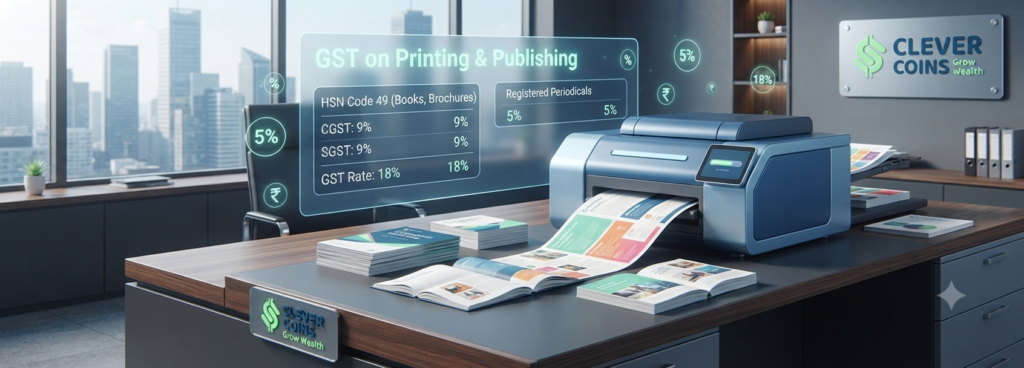
Commercial Printing & Marketing Materials (HSN 4911 / Chapter 49): Finished promotional materials—such as real estate brochures, corporate product catalogues, flyers, posters, commercial calendars, and greeting cards—generally attract an 18% GST rate when supplied as finished goods by the printer.
Printing Paper Inputs (Chapter 48): Raw printing and writing paper, art paper, and coated paper carry a 5% GST rate, minimizing inverted duty structure issues for publishers and manufacturers.
4. GST on Printing Services and Job Work (SAC 9988 & SAC 9989)
When businesses outsource printing tasks without buying a pre-printed stock product, service accounting codes (SAC) apply.
A. Job Work on Customer-Supplied Paper (SAC 9988)
Concessional 5% Rate: If a printer performs job work on paper or physical inputs supplied by a client to produce goods that fall under the 5% or Nil category (such as book printing or low-rate packaging cartons), the job work rate is 5%.
Residual 18% Rate: Commercial job work printing where the output goods do not qualify for concessional brackets is taxed at 18%.
B. Contract Printing and Publishing Services (SAC 9989)
General printing services where the client provides content specifications while the printer manages production operations generally attract an 18% GST rate.
5. Input Tax Credit (ITC) Rules for Publishers and Printers
A critical advantage of the GST framework for the printing and publishing industry is the seamless flow of Input Tax Credit (ITC).
A. Claiming ITC on Raw Materials
Publishers and commercial printers can claim full ITC on business-related purchases, including:
Raw printing paper, cardstock, and specialized binding materials (taxed at 5%).
Printing inks, toners, plates, and chemical consumables (taxed at 18%).
Capital expenditure on high-speed commercial printers, digital presses, cutting plotters, and binding machinery (taxed at 18%).
B. Conditions for Claiming ITC
To legally claim ITC on printing and publishing operations, businesses must ensure:
Possession of a valid tax invoice or debit note issued by a registered supplier.
Receipt of the goods or services.
The supplier has filed their outward supplies return (GSTR-1) and the details reflect correctly in the recipient’s GSTR-2B.
The tax charged has been paid to the government treasury by the supplier.
The printing expense is strictly incurred for business and commercial operations, not personal use.
6. Common Compliance Pitfalls and How to Avoid Them
Operating in the publishing and printing trade involves subtle classification traps. Avoiding these common mistakes protects businesses from audits and penalties:
Misclassifying Commercial Print as Educational Books: Printers often mistakenly apply the 0% textbook rate to commercial magazines, corporate diaries, or training workbooks that do not qualify as statutory school/college curriculum textbooks.
Incorrect HSN/SAC Selection on Invoices: Invoicing software must explicitly differentiate between supply of goods (Chapter 49 HSN codes) and job work services (SAC 9988/9989) to prevent mismatched tax filings.
Ignoring Reverse Charge Mechanism (RCM) on Freight: Publishing houses heavily rely on logistics for distributing books and print runs pan-India. Ensure proper accounting and compliance for RCM on Goods Transport Agency (GTA) services.
7. Conclusion
The GST framework on printing and publishing balances social welfare goals—such as keeping education and public news accessible through Nil/low tax rates—with structured revenue collection on commercial and luxury print media. By correctly identifying whether your transactions involve goods or job-work services, maintaining accurate HSN/SAC records, and efficiently claiming Input Tax Credit, print businesses can streamline their compliance and optimize financial performance.
Website: org
Email: client@clevercoins.org
Phone: +91 77389 59862
Address: Ideal Market, Mumbra, Thane-400612
Days
Hours
Minutes
Seconds
Related posts:
UPI vs NEFT vs RTGS vs IMPS
GST
The Ultimate Guide to Trademark Registration in India: Protecting Your Brand in 2026
GST
Navigating the GST Portal Helpdesk & Grievance Redressal System: The Ultimate Taxpayer’s Manual
GST
Algorithmic Trading in India: The Ultimate 2026 SEBI Rules & Tax Compliance Guide
GST
GST on Works Contract – Budget 2026 Changes: The Ultimate Compliance & Tax Guide
GST
GST on Financial Services: The Ultimate Comprehensive Compliance, Tax Rates, and Strategy Guide
GST
Delayed Possession: Legal Remedies and Comprehensive Rights for Homebuyers
GST
Ultimate Gold Investment Guide: SGB vs. Gold ETF vs. Physical Gold
GST
ISD – Input Service Distributor Mechanism: The Complete 2026 Compliance Guide
GST
Security Agency License (PSARA): The 2026 Compliance and Registration Guide
GST