Comprehensive Blog Content: Drug License – Types & How to Apply
Introduction: Navigating the Pharmaceutical Compliance Landscape
The pharmaceutical industry stands as one of the most rigorously regulated sectors globally. Because medicines, vaccines, and medical devices directly impact public health and safety, governments maintain strict oversight over their manufacture, storage, distribution, and sale. For any entrepreneur, pharmacist, or corporation looking to step into this lucrative ecosystem, obtaining a Drug License is not merely a legal formality—it is the foundational license required to operate legitimately.Whether you intend to open a retail chemist shop in your neighborhood, run a massive wholesale distribution network, or establish a state-of-the-art manufacturing plant, compliance is mandatory. Operating without this legal authorization attracts severe penalties, heavy fines, and potential imprisonment.This comprehensive guide breaks down everything you need to know about a drug license, the distinct types available, eligibility criteria, necessary documentation, and an actionable, step-by-step roadmap on how to apply successfully.What is a Drug License?
A Drug License is an official clearance or permit issued by the State or Central licensing authorities (such as the Central Drugs Standard Control Organization – CDSCO or state-level Food and Drug Administration – FDA) under the provisions of the Drugs and Cosmetics Act. It grants permission to individuals or business entities to carry out business activities concerning drugs, cosmetics, and medical devices.The primary objective of this regulatory framework is to ensure that:- Drugs available to the public are safe, effective, and of standard quality.
- The supply chain is transparent, traceable, and free from counterfeit medicines.
- Only qualified professionals handle potent substances and prescription drugs.
- Storage conditions (such as temperature control and spatial hygiene) are stringently maintained.
Core Types of Drug Licenses
Depending on the nature of your business model, scale, and operational scope, authorities issue several distinct types of drug licenses. Choosing the right category is the first critical step in your application journey.1. Retail Drug License
This is required by anyone intending to sell drugs directly to the end consumer or retail patients. It is further divided into two primary sub-categories:- General Retail Drug License (Form 20 & 21): Issued for selling general allopathic medicines that do not fall under restricted schedules. Form 20 covers Schedule C and C(1) drugs, while Form 21 covers other categories.
- Restricted Retail Drug License (Form 20A & 21A): Issued to dealers who deal in specific household remedies or vendors who are not full-scale pharmacies but are permitted to stock certain OTC (Over-The-Counter) drugs under specific state guidelines.
2. Wholesale Drug License (Form 20B & 21B)
If your business plan involves bulk distribution, supplying medicines to retail pharmacies, hospitals, or nursing homes, you must secure a wholesale drug license.- Wholesalers cannot sell directly to retail consumers.
- Premises requirements for wholesale are different, focusing more on storage capacity, ventilation, and secure warehousing rather than customer counter space.
3. Manufacturing Drug License
For enterprises looking to formulate, manufacture, and produce medicines, active pharmaceutical ingredients (APIs), or cosmetics:- Allopathic Manufacturing License: Issued under Form 25 or Form 28, depending on whether the drugs belong to conventional schedules.
- Homeopathic Manufacturing License: Issued under Form 25C.
- Cosmetics Manufacturing License: Issued under Form 32.
4. Loan Drug License
A loan license is granted to an applicant who does not own a manufacturing plant themselves but intends to manufacture drugs on Clever/leased premises owned by another licensed manufacturing licensee.5. Importing Drug License
If your business model focuses on importing drugs from international manufacturers into the home country for distribution or sale, you must obtain an import license via Form 10 through the Central Drugs Standard Control Organization (CDSCO).Eligibility Criteria: Who Can Apply?
Authorities do not grant drug licenses indiscriminately. Specific baseline qualifications must be met:- For Retail Pharmacies: The applicant must possess a degree or diploma in pharmacy (B.Pharm or D.Pharm) from a recognized university, and must be registered with the State Pharmacy Council. Alternatively, if the proprietor is not a pharmacist, they must employ a full-time, registered competent pharmacist to supervise sales.
- For Wholesale Businesses: The applicant must either be a registered pharmacist or possess significant experience (typically 1 year to 4 years depending on jurisdiction, backed by graduation or intermediate education) in dealing with drugs.
- Premises Specifications: The proposed location must possess adequate carpet area. For a retail store, a minimum carpet area (usually 10 to 15 square meters) is required, equipped with proper ventilation, cooling appliances (like refrigerators for storing insulin and vaccines), and clean interiors.
- Storage Integrity: Essential storage infrastructure, such as air conditioning and digital temperature monitors, must be installed to protect thermolabile medicines.
Detailed Documentation Checklist
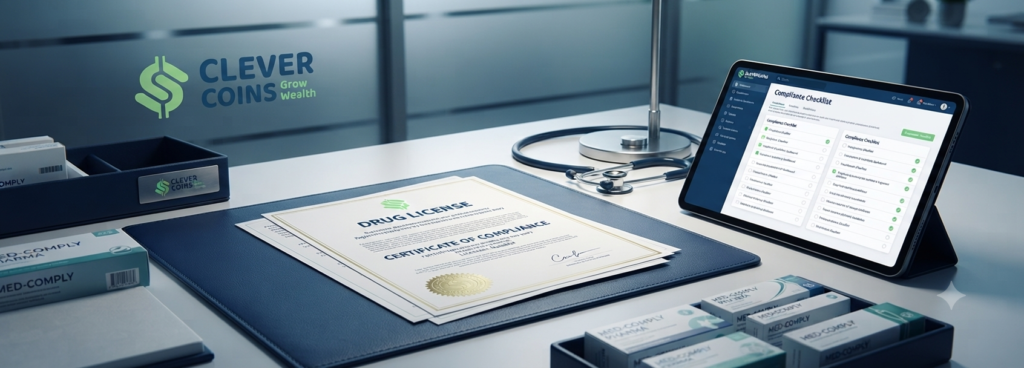
Incomplete paperwork is the number one reason applications face rejections or prolonged delays. Keep the following documents ready before initiating your application:- Proof of Constitution of Business: Incorporation certificate, Partnership Deed, or Memorandum of Association (MoA) / Articles of Association (AoA), along with Udyam / MSME registration.
- Identity & Address Proof: PAN card, Aadhaar card, and passport-size photographs of the directors, partners, or sole proprietor.
- Proof of Premises: Registered lease agreement (if rented) or property ownership papers (if owned), accompanied by clear utility bills.
- Blueprint / Layout Plan: Scaled layout map of the premises showing exact dimensions, storage racks, counter spaces, and cold-chain storage zones.
- Proof of Competent Person / Pharmacist:
- Degree or Diploma certificate in Pharmacy.
- State Pharmacy Council registration certificate.
- Appointment letter, bio-data, and declaration form signed by the pharmacist.
- Non-Conviction Declaration: An affidavit stating that the applicant or partners have not been convicted under the Drugs and Cosmetics Act.
- Refrigerator Purchase Invoice: Proof of purchase for a standard medical refrigerator used for cold-chain storage.
Step-by-Step Guide on How to Apply for a Drug License
Step 1: Establish Your Business Entity and Secure PremisesBefore touching any government portal, finalize your business structure (Proprietorship, Partnership, LLP, or Private Limited Company) and lock down a compliant commercial property with adequate space and storage capacity.Step 2: Hire a Competent Person / PharmacistRecruit a verified, registered pharmacist (for retail) or an experienced manager (for wholesale). Their credentials will anchor your application’s technical legitimacy.Step 3: Register on the State FDA PortalNavigate to your respective state’s online Food and Drug Administration (FDA) or public health portal. Create an enterprise account by submitting basic organizational details, email, and mobile verification.Step 4: Fill Out the Application Form and Upload DocumentsSelect the appropriate license type (Retail, Wholesale, etc.), fill out the digital application form accurately, and upload clean, scanned PDF copies of all mandatory documents, floor plans, and pharmacist registrations.Step 5: Pay the Prescribed FeesPay the requisite government processing fees securely through the portal’s payment gateway. Fees vary depending on the state and the category of the license selected.Step 6: Inspection by the Drug InspectorOnce submitted, a Drug Inspector assigned to your jurisdiction will review your digital application. They will schedule a physical inspection of your premises to verify space dimensions, cleanliness, fire safety, and cold storage arrangements.Step 7: License IssuanceIf the inspector is satisfied with the infrastructure, documentation, and compliance readiness, the application is approved, and the official digital copy of your Drug License is issued through the portal.Common Pitfalls to Avoid During the Application Process
- Inaccurate Floor Plans: Submitting hand-drawn or non-scaled sketches often results in immediate rejection. Ensure a professional layout designer drafts your blueprint.
- Cold Chain Non-Compliance: Failing to show a functional refrigerator or temperature log book during inspection.
- Unverified Pharmacist Credentials: Ensure your pharmacist is actively registered with the current State Pharmacy Council and not attached to multiple active licenses simultaneously.
Conclusion
Securing a drug license requires meticulous attention to detail, adherence to legal mandates, and structural readiness. While the administrative red tape can feel overwhelming, approaching the process systematically ensures a smooth transition from an aspiring entrepreneur to a fully licensed pharmaceutical stakeholder.Looking for professional support to fast-track your business incorporation, tax structuring, or licensing compliance? Partner with experts like CleverCoins to streamline your regulatory journey and build a rock-solid foundation for corporate growth.Frequently Asked Questions (FAQs)
1. Can I use residential premises for a retail drug license? No, drug licenses are strictly issued for commercial properties that meet zoning and health standards. Residential properties are not eligible.2. How long does it take to get a drug license approved? Typically, the entire process takes anywhere between 30 to 60 days, heavily dependent on state processing speeds and the success of the physical inspection.3. Is a drug license transferable if I shift my shop to a new location? No, a drug license is tied to specific premises. If you relocate, you must surrender the old license and apply for a fresh modification or new license for the new address.- Website: clevercoins.org
- Email: client@clevercoins.org
- Phone: +91 77389 59862
- Address: Ideal Market, Mumbra, Thane-400612
Days
Hours
Minutes
Seconds
Related posts:
Exchange Traded Funds (ETFs) – Complete Guide
GST
Letter of Undertaking (LUT) under GST: The Definitive Compliance Guide for Exporters (2026)
GST
GST Classification Disputes: The Ultimate Case Law Digest (2026)
GST
Decoding GST on Del-Credere Agents (DCAs): The Ultimate Compliance and Legal Framework
GST
Comprehensive Guide: GST on Agricultural Produce, Exemptions, and Compliance
GST
GST Registration Cancellation: Comprehensive Process, Legal Impact, and Compliance Roadmap
GST
Authority for Advance Rulings (AAR & AAAR): How to Seek Legal Certainty on Ambiguous Transactions
GST
GST on Works Contract – Budget 2026 Changes: The Ultimate Comprehensive Guide
GST
GSTR-1 vs. GSTR-3B: Purpose, Interdependence, and Return Mismatch Liabilities
GST
Demystifying GST on Employee Benefits & CTC Components: A Comprehensive Compliance Guide for Busines...
GST