
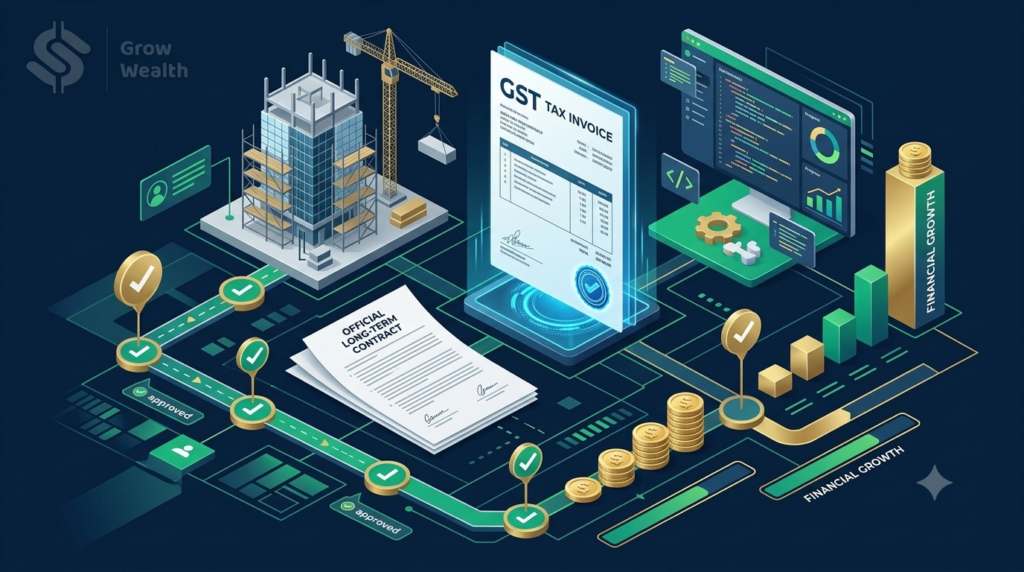
Continuous Supply of Goods and Services: Invoicing Rules for Milestone Contracts under Indian GST
Navigating the tax compliance landscape in India requires an acute understanding of how time of supply intersects with invoicing requirements under the Goods and Services Tax (GST) framework. Among the various transaction models governed by the Central Goods and Services Tax (CGST) Act, 2017, contracts based on a Continuous Supply of Goods and Services present unique challenges.
When businesses enter into long-term contracts involving phased deliverables, milestone payments, or recurring performance, standard invoicing rules—which tie tax invoice generation strictly to the physical movement or removal of goods—do not apply. Misunderstanding these provisions can lead to delayed Input Tax Credit (ITC) realization for buyers, interest liabilities for suppliers under Section 50, and severe penalty provisions during audit assessments.
1. Defining Continuous Supply under the CGST Act
To apply the correct invoicing timeframe, one must first evaluate whether a commercial arrangement meets the statutory definitions provided under Section 2 of the CGST Act, 2017.
Continuous Supply of Goods — Section 2(32)
Under Section 2(32) of the CGST Act, 2017, a “continuous supply of goods” is defined as:
A supply of goods which is provided, or agreed to be provided, continuously or on a recurrent basis, under a contract, whether or not by means of a wire, cable, pipeline or other conduit, and for which the supplier invoices the recipient on a regular or periodic basis and includes supply of such goods as the Government may, subject to such conditions, as it may, by notification, specify.
Essential Elements:
Recurrent or Ongoing Flow: The transaction cannot be a one-off supply or an isolated sale.
Contractual Obligation: An explicit contract outlining continuous or periodic delivery must exist.
Periodic Invoicing: The commercial arrangement specifies periodic billing intervals or milestone-based statements.
Modes of Delivery: Covers physical goods delivered in installments, as well as utility-style supplies (oil/gas via pipelines, power via cables, water via networks).
Continuous Supply of Services — Section 2(33)
Under Section 2(33) of the CGST Act, 2017, a “continuous supply of services” is defined as:
The supply of services which is provided, or agreed to be provided, continuously or on a recurrent basis, under a contract, for a period exceeding three months with periodic payment obligations and includes supply of such services as the Government may, subject to such conditions, as it may, by notification, specify.
Key Distinctions for Services:
The 3-Month Threshold: Unlike goods, a service contract must exceed 3 months in duration to qualify statutorily as a continuous supply. A 60-day or 80-day consulting or construction engagement with weekly billing does not qualify as a continuous supply of services under Section 2(33); it defaults to general invoicing rules under Section 31(2).
Periodic Payment Obligations: The contract must legally bind the recipient to pay on specific calendar dates or upon reaching defined performance milestones.
2. Invoicing Timeline Framework: Section 31 Analysis
Section 31 of the CGST Act dictates the mandatory timeline for issuing a tax invoice. For continuous supply arrangements, standard principles are replaced by specialized sub-sections to match invoice generation with financial or physical milestones.
Invoicing Rules for Continuous Supply of Goods — Section 31(4)
When goods are supplied continuously or on a recurrent basis under Section 2(32), Section 31(4) specifies:
Statutory Requirement: Where successive statements of accounts or successive payments are involved, the invoice shall be issued before or at the time each such statement is issued or, as the case may be, each such payment is received.
Key Takeaway for Goods:
Every time a statement of account (like a monthly running ledger) is issued to the client, or whenever a periodic payment is received—whichever happens first—a tax invoice must be issued immediately.
Invoicing Rules for Continuous Supply of Services — Section 31(5)
In continuous supply of service contracts exceeding three months, Section 31(5) establishes three distinct scenarios based on how payment terms are structured in the agreement:
| Scenario | Contractual Term | Mandatory Time of Invoice Issuance |
| Scenario A | Due date of payment is ascertainable from the contract. | On or before the due date of payment. |
| Scenario B | Due date of payment is NOT ascertainable from the contract. | Before or at the time when the supplier receives the payment. |
| Scenario C | Payment is linked to the completion of an event (Milestone Contract). | On or before the date of completion of that specific event. |
3. Milestone Contracts: Deep Dive & Real-World Case Studies
Milestone contracts are common in engineering, construction, software development, management consultancy, and turnkey infrastructure projects. In these contracts, payments are triggered by verified progress rather than calendar dates.
Application of Section 31(5)(c)
Under Section 31(5)(c), when payment is linked to the completion of an event (e.g., “Completion of Foundation Work,” “Passage of User Acceptance Testing (UAT),” or “Submission of Draft Financial Audit”):
The supplier cannot defer issuing the invoice until the client approves the invoice draft or releases the physical payment. The statutory deadline is tied directly to the date the event/milestone is completed.
Real-World Case Study 1: Enterprise Software Implementation
Context: Software Solutions Pvt Ltd enters into an agreement with Global Logistics Ltd on January 1, 2026, for a custom ERP system overhaul spanning 8 months (Total Contract Value: ₹80,000,000 + GST).
Payment Terms:
Milestone 1: Requirement Gathering & Architecture Approval — 20% (Target: Feb 28, 2026)
Milestone 2: UAT Sign-off — 50% (Target: May 31, 2026)
Milestone 3: Go-Live & Final Handover — 30% (Target: Aug 31, 2026)
Scenario Analysis:
Duration Evaluation: The contract spans 8 months (> 3 months) with periodic payments. It qualifies as a continuous supply of services under Section 2(33).
Milestone 2 Execution:
Actual UAT Sign-off Date: May 20, 2026.
Client Payment Authorization Date: June 15, 2026.
Payment Received in Bank Account: June 28, 2026.
Tax Compliance Determination:
Incorrect Practice: Deferring the tax invoice to June 28 (when payment arrived) or June 15 (when payment was authorized).
Correct Statutory Practice: Under Section 31(5)(c), the event was completed on May 20, 2026 (UAT Sign-off). The GST tax invoice for ₹40,000,000 (50%) + GST must be dated on or before May 20, 2026.
Real-World Case Study 2: Commercial Construction Project (RA Bills)
Context: BuildCorp Infrastructure contracts with Zenith Malls to construct an annex building over 18 months. Payments are governed by monthly Running Account (RA) Bills verified by an independent Chartered Engineer.
Timeline of Events:
March 31, 2026: BuildCorp completes the structural slab for Floor 3 and submits RA Bill No. 6 for ₹15,000,000 to the Project Architect.
April 10, 2026: Chartered Engineer inspects the site and certifies structural completion.
April 25, 2026: Zenith Malls processes RA Bill No. 6 and releases payment.
Tax Compliance Determination:
In construction contracts tied to architect/engineer certificates, the date of certification or completion of the structural stage forms the event completion date.
The tax invoice under Section 31(5)(c) must be issued on or before April 10, 2026 (Certification of Event Completion) or March 31, 2026 (if the milestone contract specifies end-of-month physical progress evaluation). Deferring the invoice to April 25 constitutes a compliance delay under GST audit rules.
4. Time of Supply under Section 12 & Section 13
Determining when an invoice must be issued under Section 31 directly impacts the Time of Supply under Section 12 (Goods) and Section 13 (Services) of the CGST Act. The Time of Supply dictates the precise tax period (month/quarter) in which the liability to pay GST arises in Form GSTR-3B.
Time of Supply for Services — Section 13(2)
Detailed Breakdown:
If the invoice IS issued within the time prescribed under Section 31:
$$\text{Time of Supply} = \min\left(\text{Date of Invoice}, \text{Date of Payment Receipt}\right)$$If the invoice IS NOT issued within the time prescribed under Section 31:
$$\text{Time of Supply} = \min\left(\text{Date of Provision of Service (Milestone Date)}, \text{Date of Payment Receipt}\right)$$
Impact of Advances Received in Milestone Contracts
Under Notification No. 66/2017 – Central Tax, suppliers of goods are exempt from paying GST on mobilization advances at the time of receipt (GST is due only upon invoicing or delivery).
However, this exemption DOES NOT apply to services.
Crucial Rule for Service Contracts: If a client pays an advance or mobilization fee prior to achieving a milestone, Section 13(2) dictates that the Time of Supply for that amount is the exact date of advance receipt. A Receipt Voucher must be issued immediately under Section 31(3)(e), and GST must be remitted in the GSTR-3B of that tax period.
5. Input Tax Credit (ITC) Alignment for Recipients
Invoicing timing directly affects the buyer’s ability to claim Input Tax Credit under Section 16 of the CGST Act, 2017.
The Milestone Reconciliation Challenge
In continuous milestone contracts, recipients often face ITC mismatches in Form GSTR-2B:
Premature Invoicing by Supplier: If a supplier issues an invoice before the physical milestone is met, the recipient cannot claim ITC immediately, as the condition of actual receipt of service under Section 16(2)(b) remains unfulfilled until stage completion.
Delayed Invoicing by Supplier: If the supplier delays raising the milestone invoice past the statutory deadline, the invoice will not reflect in the buyer’s GSTR-2B for the relevant period. This blocks ITC claims and impacts working capital.
The 180-Day Payment Rule (Proviso to Section 16(2)): If the recipient fails to pay the supplier the value of supply plus GST within 180 days from the date of invoice issuance, the recipient must reverse the claimed ITC along with interest under Section 50. In milestone contracts with extended retention periods or delayed sign-offs, this rule can create unintended tax liabilities.
6. Contract Drafting Guidelines & Risk Mitigation Checklist
To prevent tax compliance exposure, legal, finance, and procurement teams should align commercial contracts with GST statutory provisions.
Essential Clauses to Draft in Continuous & Milestone Agreements:
A. Precise Milestone Mapping Clause
Bad Clause: “Payments will be made as the work progresses based on mutual understanding.”
Compliant Clause: “Payments are linked strictly to verified stage completions as specified in Schedule B. Each milestone shall be deemed completed only upon the formal issuance of a Milestone Completion Certificate (MCC) by the designated Project Manager. The supplier shall issue a GST tax invoice within 3 days of MCC issuance in accordance with Section 31(5)(c) of the CGST Act, 2017.”
B. Retention Money & Security Deposit Clarification
Clear language distinguishing retention money (a portion of payment withheld until warranty completion) from un-invoiced work. Tax invoices must be raised for the full value of the completed milestone, even if a portion is held back as retention money.
C. Dispute Resolution & Price Adjustments
Incorporate clauses governing Section 34 Credit and Debit Notes. If a milestone value is adjusted post-invoicing due to quality deductions or liquidated damages (LD), a formal Credit Note must be issued before the statutory deadline (November 30 following the end of the financial year).
Technical Comparison Summary
| Compliance Aspect | Continuous Supply of Goods | Continuous Supply of Services | Milestone Contracts (Services) |
| Primary Statutory Provision | CGST Act Section 2(32) & 31(4) | CGST Act Section 2(33) & 31(5) | CGST Act Section 31(5)(c) |
| Minimum Contract Duration | None defined by statute | Must exceed 3 months | Must exceed 3 months |
| Invoicing Trigger | Issuance of account statement or payment receipt (whichever is earlier) | Due date of payment / Payment receipt / Event completion | On or before the date of completion of the specific event |
| GST on Advances? | No (Exempt via Notification 66/2017) | Yes (GST due on advance receipt date) | Yes (GST due on advance receipt date) |
| Primary Audit Risk | Omission of running ledger entries | Supply treated as standard service (<3 months) | Delayed invoicing past milestone sign-off |
Practical Checklist for Tax Practitioners & CFOs
[ ] Contract Duration Audit: Confirm all continuous service contracts exceed the mandatory 3-month statutory threshold.
[ ] Event Tracker Setup: Cross-functional coordination between engineering/operations and finance to ensure tax invoices are generated on the date of milestone completion rather than waiting for client payment approvals.
[ ] Advance Tracking System: Ensure all mobilization advances received for service contracts generate a corresponding Receipt Voucher with GST paid in the same tax month.
[ ] GSTR-2B Matching Routine: Perform monthly GSTR-2B reconciliations against physical progress certificates to verify that ITC claims comply with Section 16(2)(b).
[ ] 180-Day Payment Monitoring: Maintain an automated ledger alert for retention amounts and milestone invoices to track the 180-day payment period and prevent mandatory ITC reversals.
Section 31 & Section 13 Flowchart
Conclusion
Managing tax liability under continuous supply and milestone agreements requires a proactive approach rather than relying on traditional accounting schedules. By coordinating operational stage-completion records with accounting systems and tax filings, businesses can maintain full compliance under Section 31, protect their buyers’ Input Tax Credit, and avoid high-interest penalties during statutory GST audits.
Disclaimer: This article is intended solely for educational and informational purposes. GST laws, notifications, and judicial precedents are subject to frequent amendments. Businesses should consult a qualified Chartered Accountant or GST legal advisor before taking action based on





