
Form DRC-01B Explained: How to Respond to Outward Supply Differences (GSTR-1 vs. GSTR-3B)
Understanding and navigating Goods and Services Tax (GST) compliance in India has undergone a massive digital transformation. The Goods and Services Tax Network (GSTN) has shifted from manual audit routines to automated, real-time data analytics and system-driven risk assessment tools. One of the most prominent compliance mechanisms introduced under this modern architecture is Form GST DRC-01B, mandated under Rule 88C of the Central Goods and Services Tax (CGST) Rules.
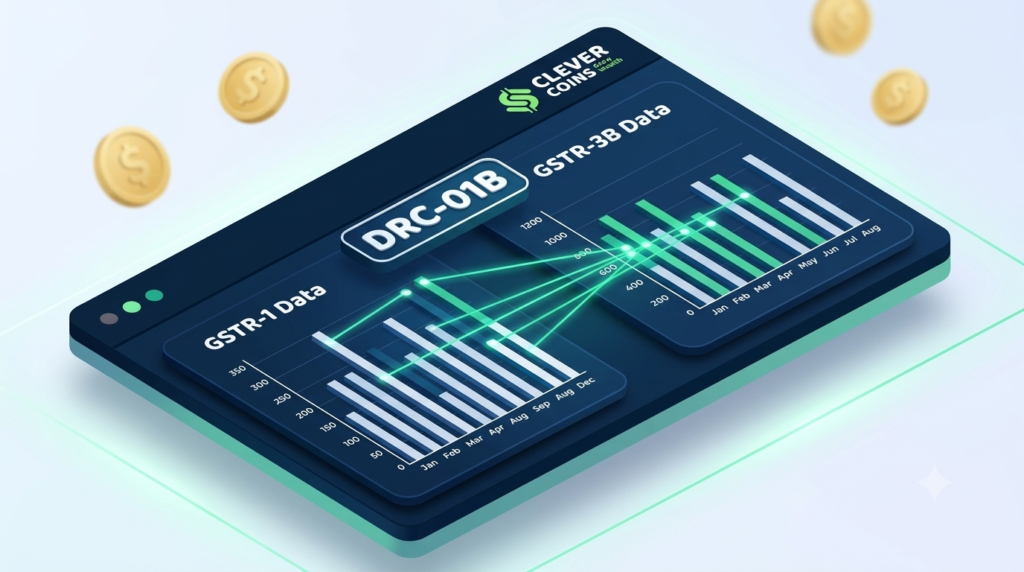
If your business or client has received an automated intimation in Form GST DRC-01B via email, SMS, or the GST portal, it indicates that the system detected a variance between the outward supplies declared in GSTR-1 / IFF (Invoice Furnishing Facility) and the liability paid in GSTR-3B for a specific tax period.
Ignoring this notice can lead to immediate operational bottlenecks, such as the blocking of subsequent GSTR-1 filings or direct tax recovery proceedings. This complete guide breaks down everything you need to know about Form DRC-01B, the statutory framework behind Rule 88C, step-by-step procedures to file a reply in Part B, common technical reasons for mismatch, and strategies to prevent future occurrences.
1. What is Form GST DRC-01B?
Form GST DRC-01B is an automated system-generated intimation issued under Rule 88C of the CGST Rules, 2017. It serves as a formal notice informing taxpayers that their outward liability declared in GSTR-1/IFF exceeds the tax paid in GSTR-3B for the same period by a system-configured percentage and monetary threshold.
The Structural Division of Form DRC-01B
Form DRC-01B is divided into two distinct sections:
-
Part A (System Generated Intimation): Contains the automated breakdown of differential liability identified by the portal, categorized across Integrated Tax (IGST), Central Tax (CGST), State/UT Tax (SGST/UTGST), and Cess.
-
Part B (Taxpayer’s Reply): The interactive compliance form where the taxpayer must either confirm payment of the differential amount using Form GST DRC-03 or provide a valid factual explanation for the variance.
2. Legal Statutory Framework: Understanding Rule 88C
Rule 88C was inserted into the CGST Rules to eliminate systemic delays in tax collection and prevent revenue leakage caused by taxpayers declaring higher sales to pass on Input Tax Credit (ITC) to buyers while under-reporting tax payments in monthly summary returns.
Key Legal Aspects of Rule 88C:
-
Automated Intimation: The notice does not require physical signatures or manual intervention by a tax officer prior to issuance.
-
Strict 7-Day Window: Upon receipt of the intimation in Part A, taxpayers are legally allowed 7 days from the date of generation to file their response in Part B.
-
Pre-requisite for Subsequent Filings: Filing Part B or clearing the tax difference is mandatory to unlock future GSTR-1 or IFF submissions.
3. Why Do GSTR-1 and GSTR-3B Mismatches Occur?
While intentional non-payment is a primary focus for tax authorities, a vast majority of DRC-01B intimations arise due to operational mistakes, timing differences, or reporting errors. Understanding the root cause is necessary before filing a reply.
| Scenario | Root Cause | Example / Context |
| Typographical Errors | Taxpayer enters extra zeros or wrong tax rates in GSTR-1. | Invoicing ₹10,000 as ₹1,00,000 in GSTR-1, but paying correct tax on ₹10,000 in GSTR-3B. |
| Prior Period Tax Adjustments | Excess tax paid in earlier periods is adjusted in GSTR-3B without altering GSTR-1. | Tax was overpaid in January’s GSTR-3B. In February, GSTR-1 reflects full sales, but GSTR-3B reflects net liability after adjustment. |
| Delayed Invoicing Reporting | Outward supplies paid in GSTR-3B of a past period are reported in GSTR-1 later. | Tax paid on advance or unbilled revenue in GSTR-3B of Month A, but tax invoice uploaded in Month B’s GSTR-1. |
| Advance Adjustments | Incorrect or duplicate reporting of advance receipts and invoice adjustments. | Advances received in Month 1 reported in Table 11 of GSTR-1, but invoice issued in Month 2 was not properly offset in Table 11B. |
| B2C Summary Discrepancies | Netting off credit notes against B2C sales incorrectly. | Entering net B2C sales in GSTR-3B after deducting credit notes, while GSTR-1 shows gross sales figures. |
4. Consequences of Ignoring or Delaying DRC-01B Replies
Failing to respond within the stipulated 7-day window carries severe administrative and operational implications under the GST regime:
-
Immediate Blocking of GSTR-1 / IFF: The GST portal automatically restricts the taxpayer from filing GSTR-1 or using the IFF for subsequent tax periods. This prevents you from passing ITC to your business customers, risking commercial relationships.
-
Direct Recovery Proceedings under Section 79: Unlike regular audit procedures requiring a formal Show Cause Notice (SCN) under Section 73 or Section 74, unresolved DRC-01B liabilities can be recovered directly by tax officers under Section 79.
-
Interest Liabilities under Section 50: If the differential amount represents genuine unpaid tax, mandatory interest at 18% per annum accrues on the unpaid liability until full settlement.
5. Step-by-Step Guide: How to Respond to Form DRC-01B (Part B)
When a DRC-01B intimation is triggered, you must access the GST Portal, review Part A, and furnish your reply in Part B.
Step 1: Accessing the Form
-
Log into the official GST Portal (
www.gst.gov.in). -
Navigate to:
Services>Returns>Return Compliance>Liability Mismatch (DRC-01B). -
Locate the reference intimation by selecting the tax period or entering the ARN / Reference Number.
Step 2: Reviewing Part A
Review the system-generated differential liability figures displayed in Part A. Download the PDF copy for detailed reconciliation against your sales register and return copies.
Step 3: Choosing Your Resolution Path in Part B
Option A: Paying the Differential Liability (If the Mismatch is Genuine)
If reconciliation reveals that liability was understated in GSTR-3B, you must pay the unpaid amount along with applicable Section 50 interest:
-
File Form GST DRC-03 under the cause code “Liability Mismatch – GSTR-1 to GSTR-3B”.
Razorpay -
Enter the ARN of the filed DRC-03 in Part B.
-
Click on “Validate ARN”. The portal will pull liability payment details directly.
Option B: Explaining the Difference (If Tax is Not Due)
If the mismatch is due to a reporting error, prior adjustment, or timing difference, select the appropriate reason from the portal’s dropdown menu in Part B:
-
Excess Liability paid in earlier tax periods in FORM GSTR-3B.
-
Transactions of earlier periods reported in GSTR-1/IFF of current period where tax was paid in earlier GSTR-3B.
-
GSTR-1/IFF filed with incorrect details (typos, wrong tax rates) to be amended in next tax period.
-
Mistake in reporting advance receipts and adjustments.
-
Any other reasons (Allows up to 500 characters of detailed text).
Razorpay
Step 4: Verification and Submission
-
Check the declaration box.
-
Select the Authorized Signatory from the drop-down.
-
Submit the form using Digital Signature Certificate (DSC) or Electronic Verification Code (EVC).
-
Upon successful submission, a confirmation message and ARN are generated. GSTR-1 filing capability is unblocked instantly.
Razorpay
6. Difference Between Form DRC-01B and Form DRC-01C
Taxpayers often confuse DRC-01B with DRC-01C. Both are automated compliance tools under the GST architecture, but they monitor opposing sides of your returns:
| Parameter | Form GST DRC-01B | Form GST DRC-01C |
|---|---|---|
| Governing CGST Rule | Rule 88C | Rule 88D |
| Type of Mismatch | Outward Tax Liability Mismatch | Inward Input Tax Credit (ITC) Mismatch |
| Returns Compared | GSTR-1 / IFF vs. GSTR-3B | GSTR-2B vs. GSTR-3B |
| Trigger Condition | Output tax in GSTR-1 is higher than GSTR-3B | ITC claimed in GSTR-3B is higher than GSTR-2B |
| Mandatory Timeline | 7 Days | 7 Days |
| Operational Impact | Blocks GSTR-1 / IFF filing | Blocks GSTR-1 / IFF filing |
7. Best Practices to Prevent Receiving Form DRC-01B
To ensure smooth business operations and eliminate automated intimations, implement these pre-filing reconciliation controls:
-
Perform Pre-Filing Monthly Reconciliations: Never submit GSTR-3B without cross-verifying the liability figures generated in GSTR-1/IFF for the same tax period.
-
Utilize Tax Analytics Software: Leverage enterprise automated compliance tools that run pre-validation checks prior to final submission.
-
Document Invoicing Corrections: Maintain detailed schedules and working papers for any prior period tax adjustments, advance adjustments, or credit note offsets.
-
Rectify Typos Promptly: If a clerical error occurs in GSTR-1, document the error immediately so you can provide a swift response if a DRC-01B is generated before the next amendment window.
Frequently Asked Questions (FAQs)
1. What happens if I file DRC-01B Part B after the 7-day limit?
Filing after 7 days will keep your GSTR-1/IFF facility blocked until the reply is submitted or the tax paid. Prolonged delays may invite direct recovery proceedings under Section 79.
2. Can I edit GSTR-1 directly to fix the mismatch instead of replying to DRC-01B?
No. Once a DRC-01B intimation is generated, submitting a reply in Part B (or paying through DRC-03) is legally required to unblock the portal. Amendments to GSTR-1 can be made in the subsequent tax period.
3. Does paying tax via DRC-03 automatically resolve DRC-01B?
No. Filing Form DRC-03 alone is not sufficient. You must enter the DRC-03 ARN in Part B of Form DRC-01B and complete the portal submission.
4. Is interest mandatory if there was a genuine tax shortfall?
Yes. Under Section 50 of the CGST Act, interest at 18% per annum is payable on any delayed payment of tax.
Expert Tax Compliance Services: Need professional help resolving GST liability mismatches or filing replies to automated intimations? CleverCoins provides comprehensive tax litigation, reconciliation, and GST return advisory services. Visit clevercoins.org or consult with our compliance team today!
clevercoins.org





