
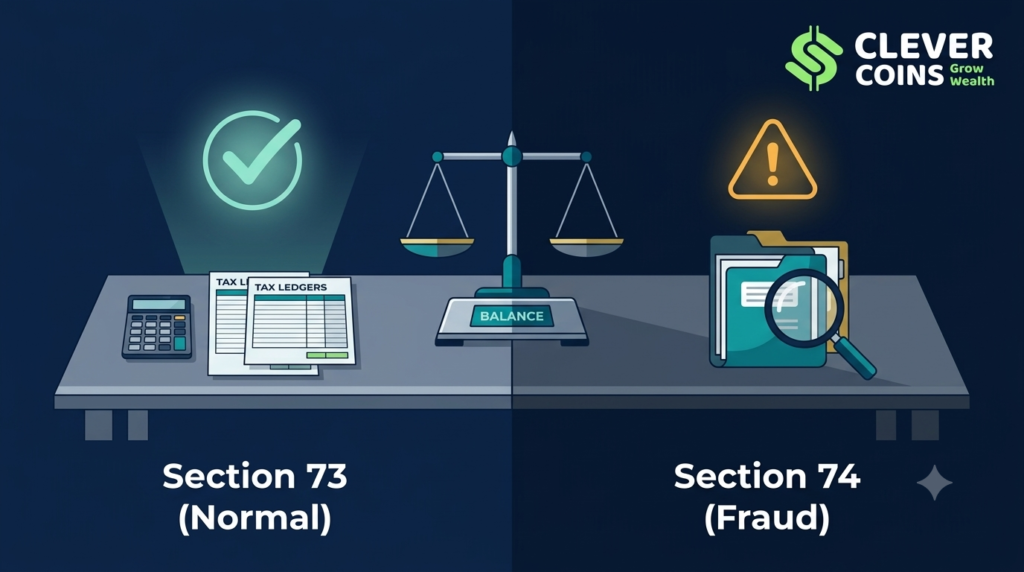
Section 73 vs. Section 74 of the CGST Act: Normal vs. Fraudulent Assessments and Penalties
Introduction: The High-Stakes Divide in GST Compliance
The Goods and Services Tax (GST) framework in India is built fundamentally on the bedrock of trust, self-assessment, and electronic transparency. However, due to complex rule interpretations, system glitches, reconciliation gaps (such as mismatches between GSTR-3B and GSTR-2A/2B), and genuine human errors, discrepancies between declared and expected tax liabilities are common.
When a tax shortfall, erroneous refund, or wrongful Input Tax Credit (ITC) utilization is detected by tax authorities, the Central Goods and Services Tax (CGST) Act, 2017 sets into motion statutory recovery mechanisms. At the center of this dispute resolution and adjudication architecture lie two pivotal provisions: Section 73 and Section 74.
While both sections deal with the recovery of tax not paid, short-paid, erroneously refunded, or wrongly availed/utilized, the legal implications, limitation timelines, burden of proof, and financial penalties vary dramatically. Placing a tax discrepancy under Section 73 treats it as an honest, non-fraudulent administrative mistake, whereas invoking Section 74 brands the taxpayer with deliberate fraud, willful misstatement, or suppression of facts.
Understanding the dividing line between these two sections is not merely an academic exercise—it is an absolute corporate defense necessity. This comprehensive guide breaks down every facet of Section 73 and Section 74, examining their procedural workflows, legal definitions, penalty structures, and landmark judicial trends.
Part 1: Section 73 of the CGST Act – The “Honest Mistake” Track
1. Scope and Applicability
Section 73 of the CGST Act applies universally when tax has not been paid, has been short-paid, has been erroneously refunded, or when Input Tax Credit has been wrongly availed or utilized for any reason other than fraud, willful misstatement, or suppression of facts with an intent to evade tax.
In simple terms, Section 73 is designed for bona fide errors. Common scenarios include:
-
Misinterpretation of complex GST rate notifications or classifications.
-
Clerical or data-entry mistakes while filing monthly GSTR-3B returns.
-
Technical transmission discrepancies where invoices failed to reflect correctly due to portal glitches.
-
Genuine calculation errors or timing mismatches in tracking time of supply.
2. Time Limits and Limitation Periods
Time is of the essence in tax administration. Under Section 73, strict statutory timelines govern how long the revenue department has to issue a Show Cause Notice (SCN) and pass a final adjudication order:
-
Issuance of Show Cause Notice (SCN): The proper officer must issue the SCN at least 3 months prior to the time limit specified for issuing the adjudication order.
-
Adjudication Order Timeline: The final order must be issued within 3 years from the due date for furnishing the annual return for the financial year to which the tax shortfall relates, or within 3 years from the date of erroneous refund.
Vertari Legal
3. Penalty and Financial Exposure Structure
The penalty framework under Section 73 is lenient compared to Section 74 because it recognizes the absence of malicious intent:
-
Pre-Notice Payment: If the taxpayer identifies the short payment and pays the tax along with applicable interest before the SCN is officially served, no penalty is leviable, and proceedings are closed.
DSRV India -
Post-Notice Waiver (Within 30 Days): If the SCN is issued and the taxpayer pays the tax, interest, and a penalty of 10% of the tax amount or INR 10,000 (whichever is higher) within 30 days of the notice issuance, all proceedings are deemed concluded with no further liability.
Medium -
Adjudication Penalty: If the matter proceeds to an adjudication order and the demand is confirmed, the penalty stands at 10% of the tax due or INR 10,000, whichever is higher.
DSRV India
Part 2: Section 74 of the CGST Act – The “Fraud and Evasion” Track
1. Scope and Applicability
Section 74 is invoked when the short payment, non-payment, erroneous refund, or wrongful ITC utilization is attributable to fraud, willful misstatement, or suppression of facts with an explicit intent to evade tax.
This is a stringent penal provision. It is meant to target bad actors who deliberately orchestrate tax evasion schemes. Common triggers include:
-
Operating fake or shell companies to pass on fraudulent ITC without underlying goods or services.
-
Maintaining parallel sets of account books to conceal taxable outward supplies.
-
Deliberately hiding major turnover channels to stay below registration or composition thresholds.
-
Fabricating invoices, e-way bills, or transport documentation.
2. Time Limits and Extended Limitation Periods
Because detecting deliberate fraud requires extensive forensic investigation, the legislature grants authorities an extended timeline under Section 74:
-
Issuance of Show Cause Notice (SCN): The SCN must be issued at least 6 months prior to the time limit for passing the order.
Vertari Legal -
Adjudication Order Timeline: The final order must be passed within 5 years from the due date of the annual return for the relevant financial year, or within 5 years from the date of erroneous refund.
Medium
3. Penalty and Financial Exposure Structure
The financial repercussions under Section 74 are severe, reflecting the gravity of the underlying allegations:
-
Standard Penalty: The baseline penalty under Section 74 is 100% of the tax amount demanded (Equal to Tax).
Vertari Legal -
Payment Before Notice: If the tax and interest are paid before the SCN is issued, the penalty is restricted to 15% of the tax.
Medium -
Payment Within 30 Days of Notice: If paid along with interest and 25% of the tax as a penalty within 30 days of communication of the notice, proceedings conclude.
Medium -
Payment After Adjudication Order: If paid within 30 days of the order communication, the penalty is 50% of the tax.
Bihar Tax Consultant
Part 3: Head-to-Head Comparison Matrix
| Feature / Parameter | Section 73 (Normal Assessments) | Section 74 (Fraudulent Assessments) |
|---|---|---|
| Core Allegation | Bona fide errors, oversight, or general short-payment | Fraud, willful misstatement, suppression of facts |
| Intent Requirement (Mens Rea) | Absent; simple compliance default | Mandatory; deliberate intent to evade tax |
| Limitation Period (Order) | 3 years from annual return due date | 5 years from annual return due date |
| Standard Penalty | 10% of tax or INR 10,000 (whichever is higher) | 100% of tax amount (equal to tax) |
| Pre-Notice Settlement Penalty | 0% (Zero penalty if paid before SCN) | 15% of tax amount |
| Post-Notice Settlement Window | 30 days (Penalty reduced to statutory minimum) | 30 days (Penalty reduced to 25% of tax) |
| Risk of Criminal Prosecution | None | High (triggers Section 69 arrest/prosecution risks for major thresholds) |
Part 4: The Critical Evolution – Section 74A and Post-2024 Regimes
It is vital to note that Sections 73 and 74 apply primarily to financial periods up to 2023–24. Recognizing the continuous disputes surrounding the artificial separation of fraud vs. non-fraud for minor discrepancies, the Government introduced Section 74A via amendments effective from November 1, 2024.
Section 74A harmonizes the time limits for issuing notices and orders for both fraudulent and non-fraudulent cases into a single unified timeline, while retaining differentiation in the penalty quantum depending on whether fraud or suppression was genuinely established. Nonetheless, legacy disputes and ongoing audits for prior years continue to be fiercely litigated under the traditional Section 73 vs. Section 74 framework.
Part 5: The Litigated Gray Area – Arbitrary Invocation of Section 74
One of the most contentious aspects of GST administration in India is the routine, mechanical invocation of Section 74 for cases that clearly belong under Section 73. Tax authorities facing internal revenue targets or dealing with high-value shortfalls often label standard classification disputes or portal discrepancies as “suppression of facts”.
Key Judicial Protections and Principles Established by Courts:
-
Burden of Proof Lies on the Department: Multiple High Courts and the Supreme Court have reiterated that the burden of proving fraud, suppression, or willful misstatement lies squarely on the shoulders of the proper officer. Fraud cannot be assumed merely because there is a tax shortfall.
Medium -
Public Domain and Regular Disclosures: If data, invoices, or financial figures are already accessible within statutory returns, financial statements, or electronic ledgers, they cannot legally be classified as “suppressed”.
-
Difference in Interpretation is Not Fraud: Adopting a legally defensible, albeit incorrect, interpretation of tax rates or supply exemptions does not amount to a willful misstatement or fraud.
Medium -
The “Copy-Paste” Notice Trap: Courts frequently strike down SCNs where allegations of fraud under Section 74 are inserted via generic, pre-printed templates without citing specific factual evidence of deliberate deception.
DSRV India
Part 6: Strategic Roadmap for Taxpayers Facing SCNs
When your business receives a Show Cause Notice under CGST provisions, follow this multi-step tactical response framework:
-
Step 1: Check the Statutory Section Immediately Verify whether the notice cites Section 73 or Section 74. If it cites Section 74, examine whether the department has provided independent reasoning and concrete evidence of intent to evade tax, or if it is merely a high-value normal default.
DSRV India -
Step 2: Audit Your Disclosure Trail Gather all filed GSTR-3B, GSTR-1, GSTR-2A/2B reconciliations, and audited financial statements. Prove that all transactions were transparently recorded in your books of accounts to dismantle any allegations of “suppression”.
All India Federation of Tax Practitioners -
Step 3: Evaluate Pre-Deposit and Settlement Options If the discrepancy is minor and genuine, utilizing early payment windows to wipe out 10% penalties under Section 73 or avoiding prolonged appellate overheads is often commercially prudent. However, if a false fraud allegation under Section 74 is made, contest it aggressively before appellate authorities to prevent reputational damage and penal exposure.
DSRV India -
Step 4: Challenge Jurisdiction and Limitation Check if the notice was issued within the statutory 3-year or 5-year limitation limits. Notices issued beyond time limits without valid grounds are legally void ab initio.
Vertari Legal
Conclusion
The distinction between Section 73 and Section 74 of the CGST Act is the ultimate dividing line between routine administrative compliance errors and criminal economic offenses. For businesses, maintaining immaculate documentation, conducting regular internal GST health checks, and understanding procedural rights are essential shields. When faced with arbitrary Section 74 notices, informed legal pushback ensures that honest taxpayers are not penalized with the severe consequences reserved for deliberate fraudsters.
Would you like us to draft a customized legal reply template for responding to a Section 74 Show Cause Notice?





