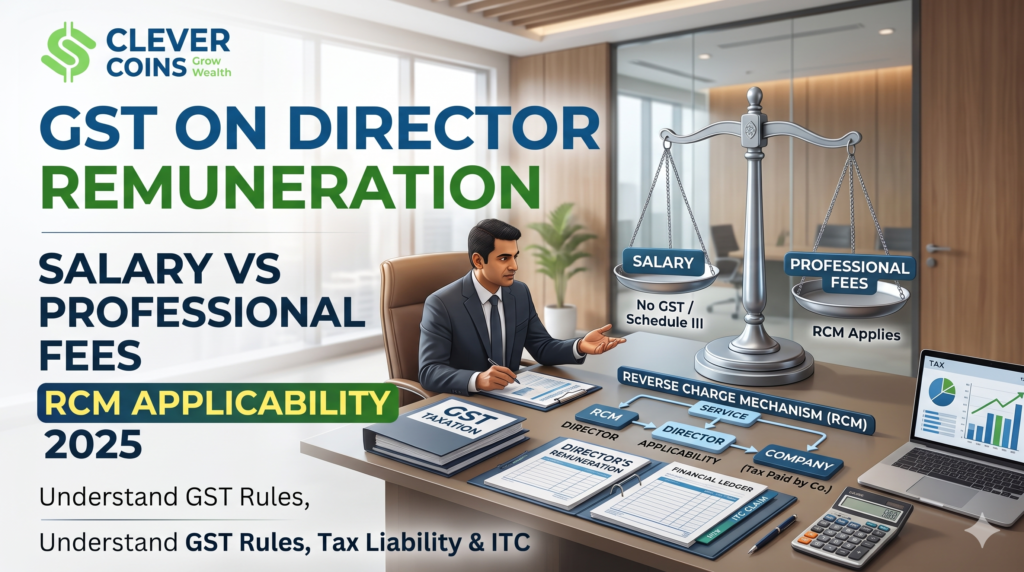
GST on Director’s Remuneration: Salary vs Professional Fees – RCM Applicability 2025
Understanding GST Applicability, Reverse Charge Mechanism, Independent Directors, Sitting Fees, Professional Fees, Input Tax Credit and Compliance Requirements
Published by: CleverCoins
Introduction
The applicability of Goods and Services Tax (GST) on remuneration paid to company directors has been a subject of considerable discussion among business owners, finance professionals, Chartered Accountants and tax consultants in India.
One of the most frequently asked questions is:
Is GST applicable on remuneration paid to directors, or is it exempt because directors are part of the company’s management?
The answer is not always straightforward. GST applicability depends primarily on the nature of the relationship between the director and the company, the capacity in which the director provides services, and the manner in which the remuneration is classified and accounted for.
A company may pay its directors through different arrangements, including:
- Monthly salary.
- Sitting fees for attending board meetings.
- Commission based on company profits.
- Professional or technical fees.
- Performance-linked remuneration.
- Other contractual payments.
While certain payments may qualify as salary and fall outside the scope of GST, others may attract GST under the Reverse Charge Mechanism (RCM).
The Central Board of Indirect Taxes and Customs (CBIC) addressed this issue through Circular No. 140/10/2020-GST dated 10 June 2020. The circular clarified the distinction between remuneration paid to employee-directors and non-employee directors.
According to this clarification:
- Remuneration paid to independent directors and other directors who are not employees of the company is taxable under GST, with the company responsible for paying GST under RCM.
- Remuneration paid to employee-directors, when classified as salary in the company’s books and subjected to TDS under Section 192 of the Income Tax Act, is not taxable under GST.
- Where an employee-director receives professional or technical fees separately from salary and such fees are subjected to TDS under Section 194J, GST is payable by the company under RCM.
These distinctions are particularly important for companies that have managing directors, whole-time directors, executive directors, non-executive directors and independent directors.
In this comprehensive guide, we will explain the GST applicability on director remuneration in India for 2025, covering relevant legal provisions, applicable GST rates, RCM calculations, practical examples, accounting treatment, input tax credit, compliance requirements and frequently asked questions.
Whether you are a business owner, director, accountant, CFO, Chartered Accountant or GST practitioner, this article will help you understand the applicable GST provisions and avoid unnecessary tax complications.
1. What Is Director’s Remuneration?
Director’s remuneration refers to any compensation, payment, fee or financial benefit provided by a company to an individual for services performed in the capacity of a director.
Under the Companies Act, 2013, directors are appointed to manage, supervise and guide the affairs of a company. Depending on their responsibilities and employment arrangements, they may receive different forms of remuneration.
Director remuneration may include:
1. Salary: A fixed monthly or annual payment made to a director who is employed by the company.
2. Sitting Fees: Payments made to directors for attending meetings of the Board of Directors or its committees.
3. Commission: Performance-based or profit-linked payments made to directors for their contribution to the company.
4. Professional Fees: Payments made for professional, technical, consultancy or other services provided by a director outside the scope of employment.
5. Other Benefits: Certain allowances, reimbursements, contractual payments and other benefits provided under the terms of appointment or employment.
However, the fact that a payment is described as remuneration does not automatically determine its GST treatment.
The important consideration is whether the payment is made under an employer-employee relationship or represents consideration for an independent service supplied by the director.
This distinction determines whether GST is applicable and whether the company must discharge tax under RCM.
2. Understanding GST Applicability on Director Remuneration
The GST treatment of director remuneration is primarily governed by three important legal provisions:
- Section 7 of the CGST Act, 2017.
- Schedule III of the CGST Act, 2017.
- Section 9(3) of the CGST Act, 2017, read with Notification No. 13/2017-Central Tax (Rate).
Let us understand these provisions.
2.1 Section 7 of the CGST Act – Meaning of Supply
Section 7 of the CGST Act defines the scope of supply under GST.
Generally, services provided by one person to another in the course or furtherance of business may qualify as a supply, subject to the applicable statutory conditions.
When a director provides services to a company in a non-employment capacity, such services may qualify as a taxable supply.
However, there is an important exception under Schedule III.
2.2 Schedule III – Services by an Employee to an Employer
Schedule III of the CGST Act specifies activities that are treated neither as a supply of goods nor as a supply of services.
Entry 1 of Schedule III covers:
“Services by an employee to the employer in the course of or in relation to his employment.”
This provision is extremely important when determining GST applicability on director remuneration.
Where a director is also an employee of the company and provides services under a genuine employer-employee relationship, the consideration received for those employment services is outside the scope of GST.
Therefore, salary paid to an employee-director is not subject to GST merely because the individual also holds the position of director.
However, where a director provides services in an independent or professional capacity, the Schedule III exclusion may not apply.
2.3 Section 9(3) – Reverse Charge Mechanism
Section 9(3) of the CGST Act empowers the Government to notify specified categories of services on which GST must be paid by the recipient rather than the supplier.
This arrangement is known as the Reverse Charge Mechanism.
Notification No. 13/2017-Central Tax (Rate), dated 28 June 2017, specifies various services subject to RCM.
Serial Number 6 of the notification covers:
“Services supplied by a director of a company or a body corporate to the said company or the body corporate.”
The supplier is the director, and the recipient responsible for paying GST is the company or body corporate located in the taxable territory.
Consequently, where the director’s service constitutes a taxable supply, the company must discharge the applicable GST under RCM.
This notification is important because it does not restrict the RCM entry exclusively to independent directors. It covers services supplied by a director to the company, subject to the distinction between taxable services and employment services excluded under Schedule III.
3. CBIC Circular No. 140/10/2020-GST: The Most Important Clarification
The most significant clarification regarding GST on director remuneration was issued through CBIC Circular No. 140/10/2020-GST dated 10 June 2020.
Before this circular, businesses had faced uncertainty regarding whether remuneration paid to directors should be treated as salary or consideration for taxable services.
The circular divided director remuneration into two broad categories.
Category A: Independent Directors and Non-Employee Directors
The first category covers independent directors and other directors who are not employees of the company.
CBIC clarified that remuneration paid to these directors is taxable under GST.
The reasoning is that services provided by directors who are not employees do not fall within the employee-employer exclusion under Schedule III.
Therefore, the company receiving these services must pay GST under RCM in accordance with Serial Number 6 of Notification No. 13/2017-Central Tax (Rate).
Category B: Employee-Directors
The second category covers whole-time directors, managing directors and other directors who are also employees of the company.
CBIC clarified that remuneration declared as salary in the company’s books and subjected to TDS under Section 192 of the Income Tax Act, 1961, is not taxable under GST.
However, where an employee-director receives separate professional or technical fees, which are recorded separately from salary and subjected to TDS under Section 194J, the payment is taxable under GST.
In such cases, the company is required to pay GST under RCM.
Summary of the CBIC Clarification
| Particulars | GST Applicability | GST Liability |
|---|---|---|
| Salary paid to an employee-director | Not taxable | Not applicable |
| Remuneration paid to an independent director | Taxable | Company under RCM |
| Fees paid to a non-employee director | Taxable | Company under RCM |
| Professional fees paid separately to an employee-director and subjected to Section 194J | Taxable | Company under RCM |
| Salary subjected to Section 192 | Not taxable | Not applicable |
Important: Section 192 and Section 194J are important indicators under Circular No. 140/10/2020-GST. Businesses should also examine the actual employment agreement, appointment terms, nature of duties, accounting treatment and contractual relationship rather than relying on the TDS section in isolation.
4. GST on Salary Paid to Managing Directors and Whole-Time Directors
One of the most common questions among business owners is whether GST is applicable to salary paid to a managing director or whole-time director.
The answer is generally No, provided the remuneration represents genuine employment compensation.
A managing director or whole-time director may perform managerial, administrative, operational and strategic responsibilities as an employee of the company.
Where the individual has entered into an employer-employee relationship and the remuneration is:
- Declared as salary in the company’s books.
- Paid under the terms of employment.
- Subjected to TDS under Section 192 of the Income Tax Act.
- Supported by appropriate employment and appointment documentation.
Such remuneration is covered by Entry 1 of Schedule III of the CGST Act.
Consequently, GST is not applicable to that salary component.
Example 1: Monthly Salary to a Managing Director
ABC Private Limited appoints Mr. Rahul as its Managing Director.
The company pays him a monthly salary of ₹2,00,000.
The salary is recorded under employee salary expenses and TDS is deducted under Section 192.
GST treatment:
- Monthly salary: ₹2,00,000.
- Applicable GST: Nil.
- RCM liability: Nil.
- Reason: Employer-employee relationship under Schedule III.
Therefore, ABC Private Limited is not required to pay GST on the above salary.
What If the Managing Director Receives a Performance Bonus?
A performance bonus or commission does not automatically become taxable merely because it is linked to performance.
If the amount forms part of the genuine employment remuneration, is declared as salary and is subjected to the appropriate salary TDS treatment under Section 192, the Schedule III exclusion may apply.
However, if the payment represents separate professional or technical services and is treated as a non-salary payment under Section 194J, GST under RCM may become applicable.
The actual nature of the arrangement must be examined.
5. GST on Independent Directors’ Remuneration
Independent directors generally do not have an employer-employee relationship with the company in which they serve as independent directors.
They are appointed to provide independent oversight, governance, strategic guidance and professional judgment.
Their remuneration may include:
- Sitting fees.
- Commission.
- Other eligible payments for their services.
Since independent directors are not employees of the company, their remuneration generally falls outside the scope of Schedule III.
As clarified by CBIC Circular No. 140/10/2020-GST, such remuneration is taxable under GST.
The company receiving the services must discharge GST under RCM.
Example 2: Sitting Fees Paid to an Independent Director
XYZ Limited has appointed an independent director who receives ₹50,000 as sitting fees for attending board meetings during a particular month.
Assuming the applicable GST rate is 18%:
| Particulars | Amount |
|---|---|
| Sitting fees | ₹50,000 |
| GST rate | 18% |
| GST payable under RCM | ₹9,000 |
| Total economic outflow | ₹59,000 |
The company is responsible for depositing ₹9,000 as GST under RCM.
The director does not collect this GST from the company under the forward charge mechanism for this notified service.
Is GST Applicable to Commission Paid to Independent Directors?
Yes.
Commission paid to an independent director for services rendered in that capacity is generally taxable under GST.
The company must discharge the applicable tax under RCM.
For example, if an independent director receives ₹3,00,000 as commission for services rendered during a financial year, and the applicable rate is 18%, the company must calculate GST on the taxable value of ₹3,00,000.
GST payable = ₹3,00,000 × 18% = ₹54,000.
6. GST on Professional Fees Paid to Directors
Professional fees paid to directors are another important area of GST compliance.
Sometimes, a person serves as a director of a company and also provides separate professional, technical or consultancy services.
For example:
- A director provides professional consultancy.
- A director receives separate technical fees.
- A director provides independent advisory services.
- A director receives fees for specific non-employment assignments.
Where such payments are separate from salary and represent services provided outside the employment relationship, they may be taxable under GST.
Circular No. 140/10/2020-GST specifically clarifies that professional or technical fees paid separately to an employee-director and subjected to TDS under Section 194J are taxable under GST, with the company liable under RCM.
Example 3: Professional Fees Paid to an Employee-Director
PQR Limited employs Mr. Amit as its whole-time director.
He receives:
- Monthly salary: ₹1,50,000.
- Separate professional consultancy fees: ₹75,000.
The salary is subjected to TDS under Section 192.
The consultancy fees are separately recorded and subjected to TDS under Section 194J.
GST treatment:
| Particulars | Amount | GST Treatment |
|---|---|---|
| Monthly salary | ₹1,50,000 | Not taxable |
| Professional fees | ₹75,000 | Taxable under RCM |
| GST at 18% on professional fees | ₹13,500 | Payable by company |
Therefore, the company must pay GST of ₹13,500 under RCM on the professional fees.
The salary component remains outside GST.
This example demonstrates why companies should not treat all payments to a director as a single category.
7. Difference Between Salary and Professional Fees for GST Purposes
Understanding the difference between salary and professional fees is essential for determining GST applicability.
Although both payments may be made to the same individual, their GST treatment can be different.
| Basis | Salary | Professional Fees |
|---|---|---|
| Nature of payment | Employment compensation | Consideration for independent services |
| Relationship | Employer-employee | Service provider-recipient |
| Income-tax TDS reference in Circular 140 | Section 192 | Section 194J |
| GST applicability | Not taxable under Schedule III | Generally taxable under RCM when covered by director-services entry |
| GST payment responsibility | Not applicable | Company |
| GST invoice | Not applicable for salary | RCM documentation and applicable self-invoicing requirements |
| Employment agreement | Relevant | Separate service arrangement may be relevant |
| Accounting treatment | Employee salary expenses | Professional or consultancy expenses |
Can a Director Receive Both Salary and Professional Fees?
Yes.
A director may function in two different capacities:
- As an employee of the company.
- As an independent service provider.
However, the company must maintain a clear distinction between these capacities.
The employment-related remuneration should be properly documented and recorded as salary.
Any separate professional service arrangement should have its own contractual basis, accounting treatment and tax documentation.
The company should not artificially divide salary into professional fees or classify professional fees as salary merely to obtain a favourable GST treatment.
The substance of the arrangement is important.
8. What Is Reverse Charge Mechanism (RCM) Under GST?
Reverse Charge Mechanism is a system under which the recipient of goods or services becomes responsible for paying GST instead of the supplier.
Under the normal forward charge mechanism:
- The supplier collects GST from the recipient.
- The supplier deposits GST with the Government.
Under RCM:
- The recipient calculates the applicable GST.
- The recipient deposits the tax directly with the Government.
- The recipient follows the relevant RCM documentation and return requirements.
In the context of director remuneration, the company is the recipient of the director’s taxable services.
Therefore, where the services are covered by Serial Number 6 of Notification No. 13/2017-Central Tax (Rate), the company must pay GST under RCM.
Why Is RCM Applicable to Directors’ Fees?
The Government has specifically notified services supplied by a director to a company under the reverse charge provisions.
The notification places the responsibility for paying tax on the recipient company.
This means that even if the director is not registered under GST, the company may still have to pay GST under RCM on the taxable director services.
The GST liability is not dependent solely on whether the director has obtained GST registration.
9. Applicable GST Rate on Director Remuneration
For taxable director services covered by the applicable RCM entry, the generally applicable GST rate is 18%, subject to verification of the relevant classification and rate notification.
The applicable tax structure depends on the location of the supplier and recipient under the GST place-of-supply rules.
For an intra-State supply:
- CGST: 9%.
- SGST: 9%.
- Total GST: 18%.
For an inter-State supply:
- IGST: 18%.
Example 4: Calculation of GST Under RCM
A company pays ₹1,00,000 as taxable professional fees to a non-employee director.
Assuming an applicable GST rate of 18%:
| Particulars | Amount |
|---|---|
| Professional fees | ₹1,00,000 |
| CGST at 9% | ₹9,000 |
| SGST at 9% | ₹9,000 |
| Total GST | ₹18,000 |
The company must pay ₹18,000 under RCM.
If the transaction is inter-State, the tax would generally be IGST of ₹18,000 instead of CGST and SGST.
Note: The applicable rate should be confirmed against the prevailing rate notification and classification for the relevant transaction.
10. GST on Sitting Fees Paid to Directors
Sitting fees are payments made to directors for attending meetings of the Board of Directors or committees.
Under the Companies Act, 2013, companies may pay sitting fees to directors subject to the applicable provisions and prescribed limits.
However, the GST treatment depends on the capacity in which the director receives the payment.
Sitting Fees to Independent Directors
Sitting fees paid to independent directors are generally taxable under GST.
The company must pay GST under RCM.
Sitting Fees to Non-Executive Directors
Where a non-executive director is not an employee of the company, sitting fees paid for services rendered in the capacity of director are taxable under RCM.
Sitting Fees to Executive Directors
Where an executive director is also an employee, the treatment requires examination of the actual arrangement.
If the payment is genuinely part of employment remuneration, is declared as salary and is subjected to TDS under Section 192, it may fall outside GST under Schedule III.
If it is separately treated as professional or technical fees and subjected to Section 194J, GST under RCM applies in accordance with the CBIC clarification.
Therefore, the title “sitting fees” alone should not determine GST applicability.
11. GST on Commission Paid to Directors
Commission is another form of remuneration paid to directors.
Companies may provide commission based on:
- Annual profits.
- Business performance.
- Sales growth.
- Achievement of financial targets.
- Other performance indicators.
The GST treatment depends on whether the commission forms part of employment remuneration or is consideration for independent director services.
Commission Paid to Employee-Directors
Where commission is part of genuine employment remuneration, recorded as salary and subjected to TDS under Section 192, it may be excluded from GST.
Commission Paid to Independent Directors
Commission paid to independent directors for services provided in their capacity as directors is generally taxable under GST.
The company must pay the applicable GST under RCM.
Important Compliance Consideration
Companies should ensure that commission arrangements are consistent with:
- The appointment terms.
- Board and shareholder approvals, wherever required.
- The Companies Act, 2013.
- Applicable Income Tax provisions.
- GST provisions and the CBIC clarification.
12. Is GST Applicable When the Director Is Not Registered Under GST?
Yes.
This is one of the most common misunderstandings among businesses.
A company may assume that GST is not payable because the director does not possess a GST registration number.
However, under RCM, the recipient company is responsible for paying GST on notified services.
Therefore, the absence of GST registration of the director does not automatically remove the company’s RCM liability.
For example:
A private limited company pays ₹2,00,000 as remuneration to an independent director who does not have GST registration.
If the payment represents taxable director services, the company must calculate and discharge GST under RCM at the applicable rate.
The company should also comply with the applicable self-invoicing and payment voucher requirements.
13. Input Tax Credit (ITC) on GST Paid Under RCM
Another important question is whether a company can claim Input Tax Credit on GST paid under RCM on director remuneration.
The answer is generally Yes, subject to the conditions prescribed under Section 16 and other applicable provisions of the CGST Act.
Section 16 of the CGST Act provides the eligibility conditions for claiming ITC.
A company may claim credit of GST paid under RCM when:
- The company is registered under GST.
- The services are used or intended to be used in the course or furtherance of business.
- The applicable GST has actually been paid to the Government.
- The company possesses the required supporting documents.
- The credit is not restricted or blocked under Section 17(5).
- The company satisfies the prescribed time limits and other ITC conditions.
Example 5: ITC on GST Paid on Director Fees
A company pays ₹1,00,000 as taxable fees to an independent director.
GST under RCM at 18% amounts to ₹18,000.
The company deposits the GST with the Government.
If the services are used for its taxable business activities and all applicable ITC conditions are fulfilled, the company may claim ITC of ₹18,000.
| Particulars | Amount |
|---|---|
| Director fees | ₹1,00,000 |
| GST under RCM | ₹18,000 |
| GST paid to Government | ₹18,000 |
| Eligible ITC, assuming all conditions are satisfied | ₹18,000 |
The company must first discharge the RCM liability in cash through the electronic cash ledger. Eligible ITC can subsequently be claimed and utilised in accordance with GST rules.
Important: Payment of GST under RCM does not automatically guarantee ITC. Eligibility must be independently established.
14. GST Registration Requirements for Companies Paying Director Remuneration
Companies should also examine their GST registration obligations when they pay taxable director fees.
Section 24(iii) of the CGST Act generally requires persons liable to pay tax under reverse charge to obtain GST registration, subject to applicable statutory exceptions and exemptions.
Therefore, a company that is liable to pay GST under RCM on director services should evaluate its registration obligations even if its turnover is below the normal registration threshold.
However, companies should distinguish between:
- Salary paid to an employee-director, which is outside GST.
- Taxable services supplied by a director, which may attract RCM.
A company paying only genuine employment salary does not become liable for GST registration merely because its directors receive salary.
Registration requirements should be evaluated based on the company’s overall taxable activities and statutory position.
15. Self-Invoicing Requirements Under RCM
Where taxable services are received from an unregistered supplier and the recipient is required to pay GST under RCM, the recipient may be required to issue an invoice under Section 31(3)(f) of the CGST Act.
In the context of director remuneration, this is relevant when the director providing the taxable service is not registered under GST.
The company should examine the applicable invoicing requirements and issue the prescribed self-invoice within the statutory time limit.
Following the amendment effective from 1 November 2024, Section 31(3)(f) requires the recipient to issue the invoice within 30 days from the date of receipt of the goods or services.
The invoice should contain the applicable particulars, including:
- Name and address of the company.
- GSTIN of the company.
- Name and address of the director.
- Description of services.
- Taxable value.
- Applicable GST rate.
- GST amount payable under RCM.
- Place of supply, wherever relevant.
- Other prescribed invoice particulars.
Payment Voucher Under RCM
Section 31(3)(g) also requires a registered person liable to pay tax under RCM to issue a payment voucher at the time of making payment to the supplier.
Therefore, companies should maintain appropriate payment vouchers and supporting records.
16. Time of Supply for Director Services Under RCM
The time of supply determines when GST liability arises.
For services taxable under RCM, Section 13(3) of the CGST Act generally provides that the time of supply is the earlier of:
- The date of payment entered in the books of account of the recipient or the date on which payment is debited in the bank account, whichever is earlier.
- The date immediately following 60 days from the date of issue of the invoice or other prescribed document by the supplier.
Where it is not possible to determine the time of supply under these provisions, the date of entry in the books of account of the recipient is relevant.
Companies should carefully track:
- The date on which director services are received.
- The invoice or supporting document date.
- The payment date.
- The applicable statutory time of supply.
Where the company is required to issue a self-invoice because the director is unregistered, it should separately ensure compliance with Section 31(3)(f).
17. Reporting RCM Liability in GST Returns
Companies paying taxable director remuneration under RCM must ensure that the liability is correctly reported in their GST returns.
GSTR-3B
RCM liability is generally reported in Table 3.1(d) of GSTR-3B.
The company should report the applicable taxable value and tax amount under the appropriate tax heads.
Input Tax Credit
Eligible ITC on RCM payments is generally reported in Table 4(A)(3) of GSTR-3B, subject to the applicable reporting instructions and eligibility conditions.
Payment of GST
GST payable under RCM must be discharged through the electronic cash ledger.
It cannot be paid directly by utilising existing ITC.
After payment, eligible credit can be claimed in accordance with the law.
Reconciliation
Companies should reconcile:
- Director remuneration records.
- General ledger entries.
- Self-invoices.
- Payment vouchers.
- RCM liability.
- GSTR-3B disclosures.
- ITC claimed.
A proper reconciliation helps prevent reporting errors and potential interest or penalty exposure.
18. Practical Accounting Entries for GST on Director Remuneration
Correct accounting treatment is essential for maintaining accurate financial records.
Let us understand the accounting entries through a practical example.
A company pays ₹1,00,000 to an independent director as professional fees.
GST at 18% under RCM is ₹18,000.
Assuming the company is eligible for full ITC, the following accounting entries may be recorded.
Entry 1: Recording Director Fees
| Particulars | Debit | Credit |
|---|---|---|
| Director Fees Expense A/c | ₹1,00,000 | |
| Director Payable A/c | ₹1,00,000 |
Entry 2: Recording GST Under RCM
| Particulars | Debit | Credit |
|---|---|---|
| Input CGST A/c | ₹9,000 | |
| Input SGST A/c | ₹9,000 | |
| CGST RCM Payable A/c | ₹9,000 | |
| SGST RCM Payable A/c | ₹9,000 |
The accounting presentation should be aligned with the company’s accounting policy and applicable GST requirements. Some companies initially record RCM tax payable and recognise eligible ITC after payment.
Entry 3: Payment of GST Under RCM
| Particulars | Debit | Credit |
|---|---|---|
| CGST RCM Payable A/c | ₹9,000 | |
| SGST RCM Payable A/c | ₹9,000 | |
| Bank / Electronic Cash Ledger A/c | ₹18,000 |
Entry 4: Payment of Director Fees
| Particulars | Debit | Credit |
|---|---|---|
| Director Payable A/c | ₹1,00,000 | |
| Bank A/c | ₹1,00,000 |
These are illustrative accounting entries. The exact posting sequence may vary depending on the accounting system and whether ITC is recognised only after the RCM tax payment.
19. Important Documents Companies Should Maintain
Companies should maintain proper documentation to establish whether a payment is salary or consideration for independent services.
Important documents include:
- Board resolutions approving the director’s appointment and remuneration.
- Employment agreement, where applicable.
- Letter of appointment.
- Terms and conditions of engagement.
- Salary structure and payroll records.
- TDS returns and supporting records under Section 192 or Section 194J.
- Ledger accounts showing salary and professional fees separately.
- Director fee statements.
- Self-invoices, wherever required.
- Payment vouchers.
- GST return records.
- Proof of RCM payment.
- ITC reconciliation statements.
- Supporting documents for reimbursements and other payments.
Proper documentation becomes especially important when the same individual performs multiple roles within the company.
20. Common Mistakes Companies Make Regarding GST on Director Remuneration
Despite the clarification issued by CBIC, many companies continue to make mistakes while determining GST applicability.
Some of the most common errors are discussed below.
Mistake 1: Assuming That All Director Remuneration Is Exempt
A common misconception is that directors are part of the company’s management and therefore all payments made to them are outside GST.
This is incorrect.
Only remuneration qualifying as consideration for employment services falls under Schedule III.
Non-employee director services are generally taxable under RCM.
Mistake 2: Assuming That Every Managing Director’s Payment Is Salary
A managing director may function in both employee and non-employee capacities.
If separate professional fees are paid for services outside employment, GST may apply.
The company must examine the actual nature of each payment.
Mistake 3: Ignoring GST Because the Director Does Not Have GST Registration
The company’s RCM liability does not automatically disappear because the director is unregistered.
Where the services are taxable under the relevant RCM notification, the company must discharge the applicable tax.
Mistake 4: Not Maintaining Separate Ledger Accounts
Companies sometimes record salary, sitting fees, commission and professional fees under a single director remuneration account.
This can make it difficult to identify the taxable and non-taxable components.
Maintaining separate ledger accounts helps improve GST compliance.
Mistake 5: Not Claiming Eligible ITC
Some companies pay GST under RCM but fail to evaluate their entitlement to ITC.
Where the applicable conditions are satisfied, eligible ITC may be available.
Mistake 6: Incorrect RCM Reporting
Failure to report RCM liability correctly in GSTR-3B can create compliance problems.
Companies should reconcile their director remuneration records with GST returns regularly.
Mistake 7: Treating TDS Classification as the Only Test
The CBIC circular uses Sections 192 and 194J as important indicators.
However, companies should not make artificial classifications solely to obtain a favourable GST result.
The contractual relationship, nature of services, employment terms and accounting records must support the treatment.
21. Relevant Advance Rulings on GST Applicability of Director Remuneration
Before the CBIC clarification of June 2020, different Advance Ruling Authorities examined GST applicability on director remuneration.
Two important cases frequently discussed in this context are:
21.1 Clay Craft India Private Limited
In the case of Clay Craft India Private Limited, the Rajasthan Authority for Advance Ruling considered GST applicability on remuneration paid to directors.
The ruling broadly treated remuneration paid to directors as taxable under RCM.
However, the later CBIC Circular No. 140/10/2020-GST clarified the distinction between employee-directors and non-employee directors.
Consequently, businesses should consider the subsequent CBIC clarification while evaluating the GST treatment.
21.2 Alcon Consulting Engineers (India) Private Limited
The Karnataka Authority for Advance Ruling also examined the GST implications of remuneration paid to directors in Alcon Consulting Engineers (India) Private Limited.
The matter involved the interpretation of director services and the applicability of reverse charge provisions.
These rulings are useful for understanding the earlier interpretative position. However, their facts and jurisdictional scope must be considered carefully.
Important: Advance rulings generally have the statutory binding effect prescribed under Section 103 of the CGST Act for the applicant and the concerned or jurisdictional officer. They should not automatically be treated as universally binding precedents for all companies.
The CBIC clarification is the principal administrative guidance for the salary-versus-professional-fees distinction.
22. Special Considerations: Directors Performing Multiple Roles
A director may perform several activities for the same company.
For example, a director may:
- Work as a whole-time employee.
- Provide separate consultancy services.
- Own property rented to the company.
- Provide personal guarantees.
- Supply other services in an independent capacity.
Each transaction must be examined separately.
Director Providing Separate Consultancy Services
If the director provides consultancy services in the capacity of a director, the RCM entry for director services may be relevant.
However, if the service is genuinely a separate professional engagement, the applicable GST provisions must be examined according to the nature of the supply and the contractual relationship.
The director-services entry should not be applied mechanically to every transaction involving a person who happens to be a director.
Director Renting Property to the Company
Where a director rents immovable property to the company, the transaction should be analysed under the applicable GST provisions for renting services.
The applicable RCM or forward charge treatment must be determined independently.
Director Providing a Personal Guarantee
Personal guarantees provided by directors are governed by separate GST considerations.
CBIC Circular No. 204/16/2023-GST dated 27 October 2023 clarifies the GST treatment of personal guarantees provided by directors to banks and financial institutions.
In certain circumstances, a personal guarantee provided without consideration may have a nil taxable value under the clarification.
This issue should not be confused with GST on remuneration or sitting fees.
Corporate Guarantees
Corporate guarantees are also subject to separate GST valuation rules and clarifications, including Circular No. 225/19/2024-GST dated 11 July 2024.
These transactions require independent analysis under the applicable provisions.
23. Compliance Checklist for Companies Paying Director Remuneration
Companies should follow a structured approach to determine GST applicability.
Step 1: Identify the director’s capacity
Determine whether the director is an employee or a non-employee.
Step 2: Examine the appointment and employment documents
Review the appointment letter, employment agreement, service terms and Board resolutions.
Step 3: Identify the nature of each payment
Separate salary, sitting fees, commission, professional fees and other payments.
Step 4: Verify the income-tax TDS treatment
Examine whether salary is subjected to Section 192 or professional fees are subjected to Section 194J, in accordance with the CBIC clarification.
Step 5: Determine GST applicability
Apply Schedule III to employment services and the relevant RCM notification to taxable director services.
Step 6: Calculate GST
Apply the relevant rate, generally 18% for the taxable director services discussed in this article, after verifying the applicable classification.
Step 7: Complete RCM documentation
Issue self-invoices and payment vouchers wherever required.
Step 8: Deposit GST
Pay RCM liability through the electronic cash ledger within the applicable time limits.
Step 9: Evaluate ITC
Check eligibility under Sections 16 and 17.
Step 10: File and reconcile GST returns
Ensure correct reporting in GSTR-3B and reconcile the figures with accounting records.
24. Frequently Asked Questions (FAQs) on GST on Director Remuneration
Q1. Is GST applicable on salary paid to a managing director?
Generally, no. Salary paid to a managing director who is an employee of the company, recorded as salary and subjected to TDS under Section 192, is covered under Schedule III of the CGST Act.
Q2. Is GST applicable on remuneration paid to independent directors?
Yes. Remuneration paid to independent directors for services rendered in their capacity as directors is taxable under GST. The company must pay GST under RCM.
Q3. What is the applicable GST rate on director remuneration?
The generally applicable rate for taxable director services discussed in this article is 18%, subject to the applicable rate notification and classification.
Q4. Who is responsible for paying GST on director fees?
The company receiving the taxable director services is responsible for paying GST under RCM, in accordance with Notification No. 13/2017-Central Tax (Rate).
Q5. Is GST applicable on sitting fees paid to independent directors?
Yes. Sitting fees paid to independent directors for services rendered in their capacity as directors are generally taxable under RCM.
Q6. Is GST applicable on professional fees paid to a whole-time director?
Yes, where professional or technical fees are paid separately from salary, treated as non-salary fees and subjected to TDS under Section 194J, GST is payable under RCM.
Q7. Is GST applicable if a director does not have GST registration?
Yes. The absence of GST registration of the director does not automatically remove the company’s RCM liability.
Q8. Can a company claim ITC on GST paid under RCM on director fees?
Yes, subject to the conditions of Section 16, restrictions under Section 17 and other applicable provisions.
Q9. Is GST applicable on commission paid to directors?
It depends on the nature of the commission. Commission forming part of genuine employment salary and subjected to Section 192 may be outside GST. Commission paid to a non-employee director for director services is generally taxable under RCM.
Q10. Is GST payable on salary and professional fees separately?
Yes, where a director receives both salary and separate taxable professional fees, the company should evaluate each component independently. GST may apply to the professional fee component while salary remains outside GST.
Q11. Is GST payable under RCM even when the director is unregistered?
Yes. The recipient company is responsible for paying GST under RCM on taxable director services.
Q12. Which GST notification covers services provided by directors?
Notification No. 13/2017-Central Tax (Rate), dated 28 June 2017, Serial Number 6, covers services supplied by a director of a company or body corporate to the company or body corporate.
Q13. Which CBIC circular explains GST applicability on director remuneration?
CBIC Circular No. 140/10/2020-GST dated 10 June 2020 clarifies the GST treatment of remuneration paid to employee-directors and non-employee directors.
Q14. Is a self-invoice required for director remuneration under RCM?
Where the taxable service is received from an unregistered supplier and the company is required to pay GST under RCM, the company must comply with the self-invoicing requirement under Section 31(3)(f), including the applicable 30-day time limit.
Q15. Can an employee-director receive professional fees without GST?
Where the payment is genuinely for separate professional or technical services, declared separately from salary and subjected to TDS under Section 194J, GST under RCM applies in accordance with Circular No. 140/10/2020-GST.
Q16. Is GST applicable to all executive directors?
No. The classification as executive director alone does not determine GST applicability. The actual employment relationship and nature of the remuneration must be examined.
Q17. Is GST applicable on reimbursement of expenses paid to directors?
Genuine reimbursements and allowances require examination of their nature, contractual treatment and valuation under the GST law. Pure reimbursements should not automatically be treated as exempt. The conditions for exclusion from taxable value, including the pure-agent requirements under Rule 33 where relevant, must be evaluated.
Q18. Is GST payable on director remuneration even if the company is not profitable?
GST applicability does not depend on whether the company earns a profit. If taxable director services are received, the RCM liability may arise even if the company is operating at a loss.
Q19. Does RCM apply to remuneration paid to nominee directors?
The actual relationship, capacity and recipient of the director’s services must be examined. Where taxable services are supplied by a director to the company, the applicable RCM provisions may apply.
Q20. What happens if a company fails to pay GST under RCM?
Failure to discharge applicable RCM liability may result in interest, tax demands and other consequences under the CGST Act, depending on the facts and circumstances.
25. Key Takeaways: GST on Director Remuneration in 2025
The GST treatment of director remuneration is based primarily on the distinction between employment services and independent services.
The following points summarise the position:
- Salary paid to an employee-director under a genuine employer-employee relationship is not taxable under GST when covered by Schedule III.
- Independent directors are generally not employees of the company, and their remuneration for director services is taxable under RCM.
- Professional or technical fees paid separately to employee-directors and subjected to Section 194J are taxable under RCM.
- Notification No. 13/2017-Central Tax (Rate), Serial Number 6, is the key RCM notification.
- The generally applicable GST rate for the taxable services discussed is 18%, subject to applicable classification and rate provisions.
- The company, rather than the director, is responsible for depositing GST under RCM.
- Eligible ITC may be claimed subject to Sections 16 and 17 of the CGST Act.
- Companies must maintain appropriate documentation and ensure correct GST return reporting.
The most important legal reference remains CBIC Circular No. 140/10/2020-GST dated 10 June 2020.
Conclusion
GST applicability on director remuneration is not determined simply by the designation of the individual or the amount of compensation received.
The deciding factor is the actual capacity in which the director provides services to the company.
Where the director works as an employee and receives genuine salary subjected to TDS under Section 192, the remuneration is covered under Schedule III of the CGST Act and is not taxable under GST.
On the other hand, where an independent director or other non-employee director provides services to the company, GST is generally payable under RCM.
Similarly, professional or technical fees paid separately to employee-directors and subjected to TDS under Section 194J are taxable under RCM, in accordance with CBIC Circular No. 140/10/2020-GST.
For companies, the most important compliance requirement is to properly identify the nature of each payment, maintain separate accounting records, calculate the applicable RCM liability, deposit GST within the prescribed timelines and evaluate ITC eligibility.
Businesses should regularly review their director remuneration structures to ensure that their GST and income-tax treatments are consistent with the applicable legal provisions.
At CleverCoins, we believe that understanding taxation and regulatory compliance is essential for making informed business decisions. Stay informed, maintain accurate records and ensure that your business follows the applicable GST regulations.