GST on Free Samples, Donations, and Expired Goods Distributed by MSMEs: The Ultimate Compliance Guide
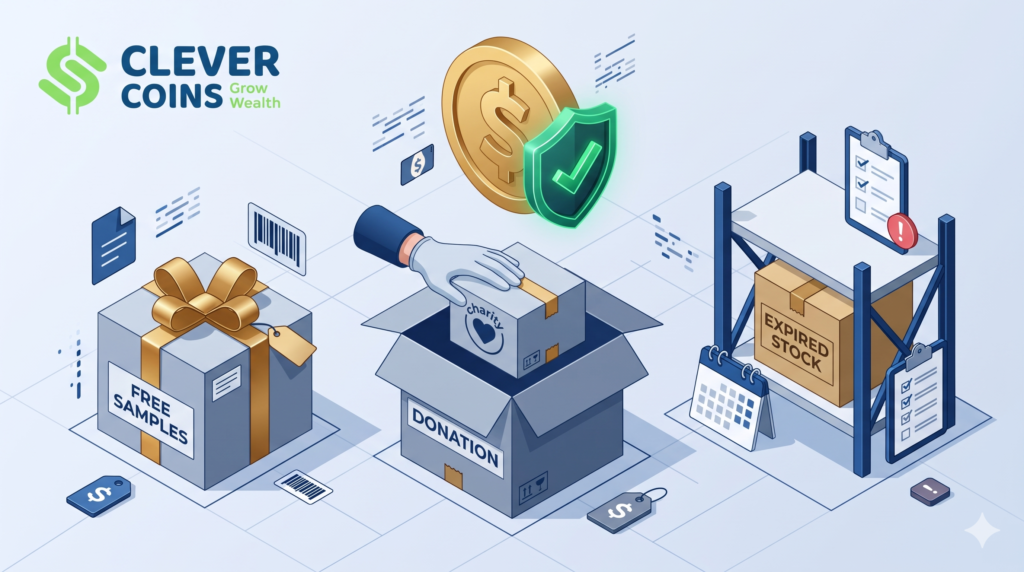
For Micro, Small, and Medium Enterprises (MSMEs) operating across manufacturing, FMCG, pharmaceuticals, retail, and e-commerce, distributing goods without receiving direct monetary consideration is a routine business reality. Whether you are handing out promotional product samples to onboard new distributors, donating surplus inventory to charitable trusts during festive seasons, or writing off expired, damaged, and obsolete stock in your warehouse, every physical movement of inventory carries strict Goods and Services Tax (GST) implications.
Many MSME owners operate under a dangerous misconception: “If I am not charging the customer any money, there is no sale, and therefore no GST applies.”
Under the Central Goods and Services Tax (CGST) Act, 2017, tax liability is not triggered solely by cash inflow. Instead, it is governed by the legal definition of “Supply” under Section 7, the deeming fiction of Schedule I, and the strict Input Tax Credit (ITC) blockage provisions of Section 17(5)(h). Overlooking these rules during routine accounting frequently results in hefty demand notices under Sections 73 or 74 (or the unified Section 74A for recent financial years), compounded by 18% annual interest and severe penalties during departmental GST audits.
In this comprehensive guide, we break down the exact legal framework, CBIC circulars, accounting entries, valuation rules, and practical compliance checklists every Indian MSME must follow when dealing with free samples, gifts, donations, and expired or damaged goods.
1. The Core Legal Framework Governing Non-Monetary Distributions
To understand how GST applies when goods leave your business premises without an invoice value, you must examine three foundational pillars of the CGST Act, 2017:
A. Section 7(1)(a): The Primary Definition of Supply
Under Section 7(1)(a), “supply” includes all forms of supply of goods or services such as sale, transfer, barter, exchange, licence, rental, lease, or disposal made or agreed to be made for a consideration by a person in the course or furtherance of business. Because free samples, gifts, and donations lack monetary or non-monetary consideration, they generally fall outside Section 7(1)(a).
B. Section 7(1)(c) Read with Schedule I: Supply Without Consideration
Schedule I of the CGST Act lists four specific activities that are treated as a taxable “supply” even if made without consideration. Two entries in Schedule I directly impact MSMEs:
Paragraph 1 of Schedule I: Permanent transfer or disposal of business assets where Input Tax Credit (ITC) has been availed on such assets. (Note: This primarily applies to capital goods/fixed assets like computers, machinery, or furniture given away for free, rather than regular trading stock/inventory).
Paragraph 2 of Schedule I: Supply of goods or services or both between related persons or between distinct persons (such as branches in different states or separate GST registrations under the same PAN), when made in the course or furtherance of business.
Crucial Exception: Gifts not exceeding ₹50,000 in value in a financial year by an employer to an employee are excluded from supply.
C. Section 17(5)(h): The Blocked Credit Rule
Section 17(5) is the non-obstante clause governing blocked credits. Specifically, Section 17(5)(h) states that Input Tax Credit shall not be available in respect of:
“Goods lost, stolen, destroyed, written off or disposed of by way of gift or free samples.”
This single clause forms the backbone of GST litigation for MSMEs. When you purchase raw materials or finished goods, you claim ITC on the GST paid to your suppliers. That ITC is granted on the fundamental premise that those inputs will be used to make taxable outward supplies on which output GST will be collected and paid to the government. When those goods are instead given away free or destroyed due to expiry, the tax chain breaks—requiring you to reverse the ITC previously claimed.
D. CBIC Circular No. 92/11/2019-GST (Dated March 7, 2019)
Recognizing widespread confusion across industries, the Central Board of Indirect Taxes and Customs (CBIC) issued Circular No. 92/11/2019-GST, which remains the definitive authority clarifying taxability, ITC reversal, and documentation for:
Free samples and gifts
“Buy One, Get One Free” (BOGO) offers
Discounts (buy more, save more)
Secondary discounts
2. GST on Free Samples Distributed by MSMEs
Promotional sampling is indispensable for MSMEs launching new food products, cosmetics, pharmaceuticals, textiles, or industrial consumables. However, the GST treatment depends entirely on who receives the sample and how the transaction is structured.
Scenario 1: Free Samples Given to Unrelated Customers, Retailers, or Prospects
When an MSME distributes free samples to unrelated third parties (such as potential buyers at a trade fair, retail consumers, or doctors in the pharma sector):
Is Output GST Payable? No. Because there is no consideration and the recipient is not a “related person” or “distinct person” under Section 25, the transaction does not qualify as a supply under Section 7(1)(a) or Schedule I. Therefore, you do not charge GST on the outward movement.
What Happens to Input Tax Credit (ITC)? Mandatory ITC Reversal. Under Section 17(5)(h), ITC is strictly blocked on goods disposed of by way of free samples. If you already availed ITC on the purchase of those finished goods—or on the raw materials, packaging, and direct input services used to manufacture those samples—you must reverse that proportionate ITC in your monthly GSTR-3B (Table 4B(1)).
Scenario 2: Free Samples Sent to Related Persons or Distinct Persons (Branch Transfers)
Suppose your MSME has a manufacturing unit in Maharashtra (Registered GSTIN-1) and sends free promotional samples to your own sales depot in Gujarat (Registered GSTIN-2) or to a sister concern controlled by the same directors.
Under Paragraph 2 of Schedule I, any transfer between distinct persons or related persons in the course of business is deemed a taxable supply, even without consideration.
Tax Treatment: The sending unit must issue a Tax Invoice, charge applicable IGST/CGST+SGST based on valuation rules (Rule 28 of CGST Rules), and pay output tax.
ITC Impact: Because output GST is paid on this deemed supply, the sending unit does not need to reverse ITC under Section 17(5)(h). Meanwhile, the receiving branch (GSTIN-2) can claim ITC of the tax charged, provided it uses the goods for taxable business purposes—though if the Gujarat branch subsequently distributes them for free to end customers, the Gujarat branch will have to reverse that ITC!
Scenario 3: “Buy One, Get One Free” (BOGO) and Promotional Combos
Many MSMEs confuse “free samples” with “Buy One, Get One Free” offers (e.g., “Buy 1 Carton of Biscuits, Get 2 Packets Free” or “Buy 10 Shirts, Get 1 Free”).
CBIC Clarification: As clarified in Circular 92/11/2019-GST, a BOGO offer is not a free sample or a gift. It is a commercial strategy where two or more individual supplies are offered at a single combined price. In reality, the price of the “free” item is already factored into the price of the paid item.
Tax Treatment: Output GST is charged on the total transaction value collected from the buyer.
ITC Impact: Full ITC is allowed. You do not need to reverse ITC on the “free” item bundled in a BOGO offer, provided your tax invoice clearly lists both items (showing the paid item with its price and the promotional item at zero/discounted value as part of the composite/mixed bundle).
Scenario 4: Trade Samples Sent for Testing or Quality Certification
Sometimes an MSME sends product samples to a third-party laboratory (such as BIS, FSSAI-approved labs, or NABL testing facilities) for quality testing, where the samples are consumed or destroyed during the testing process.
Tax Treatment: Testing is an essential business requirement to ensure compliance and marketability, not a promotional “gift” or “free sample” to consumers. No output GST is payable on sending goods for testing under a Delivery Challan.
ITC Impact: Judicial precedents and Advance Rulings generally hold that inputs consumed in mandatory quality testing are used “in the course or furtherance of business” under Section 16(1) and are not hit by Section 17(5)(h), meaning ITC remains eligible—provided proper lab testing reports and delivery challans are maintained on record.
3. GST on Donations and Charitable Distributions by MSMEs
Corporate Social Responsibility (CSR) initiatives, disaster relief contributions, and festive donations to NGOs, temples, mosques, trusts, or schools are common among Indian MSMEs. However, generosity does not exempt a business from GST compliance.
A. Donation of Trading Stock / Inventory Goods
When an MSME donates goods from its regular inventory (e.g., a garment manufacturer donating 500 blankets to an NGO, or a food processor donating rice bags during flood relief):
Output GST: Since the donation is made voluntarily without consideration to an unrelated charity, it is not a supply under Section 7. No output GST is payable.
Mandatory ITC Reversal: Under Section 17(5)(h), goods disposed of by way of gift are ineligible for ITC. Because a donation without consideration is legally a gift, the MSME must reverse the entire ITC claimed on the purchase or manufacture of those donated goods.
B. Donation of Used Business Assets / Capital Goods
What if an MSME donates old office computers, delivery vans, or machinery to a charitable school?
Paragraph 1 of Schedule I states that permanent transfer or disposal of business assets where ITC has been availed is treated as a supply, even without consideration.
Tax Treatment: The MSME must issue a Tax Invoice and pay GST calculated under Section 18(6) read with Rule 40(2) (i.e., reducing the ITC taken by 5% per quarter or part thereof from the date of invoice, or tax on the open market value/transaction value, whichever is higher).
Exception: If no ITC was ever claimed at the time of purchasing that capital asset (for instance, it was purchased prior to GST or ITC was voluntarily foregone), Paragraph 1 of Schedule I does not apply, and no GST is payable on the donation.
C. Goods Distributed Under Mandatory or Voluntary CSR Activities
For larger MSMEs crossing the net worth, turnover, or net profit thresholds under Section 135 of the Companies Act, 2013, Corporate Social Responsibility (CSR) spending is mandatory.
Following the Finance Act, 2023 amendment, Section 17(5)(fa) was inserted into the CGST Act, explicitly blocking Input Tax Credit on:
“Goods or services or both received by a taxable person, which are used or intended to be used for activities relating to his obligations under corporate social responsibility referred to in section 135 of the Companies Act, 2013.”
Key Takeaway: Whether your donation is voluntary charity (covered under Section 17(5)(h)) or statutory CSR (covered under Section 17(5)(fa)), ITC is 100% blocked. You cannot claim ITC on goods or services procured specifically for donation or CSR projects.
D. Gifts to Employees vs. Gifts to Clients/Vendors
During Diwali, Eid, New Year, or company anniversaries, MSMEs frequently distribute sweet boxes, dry fruits, electronics, or gift vouchers:
Gifts to Clients, Dealers, and Vendors: Treated purely as gifts under Section 17(5)(h). No output GST is payable, but 100% ITC reversal is mandatory on the purchase of those gift items. (Even if the gift carries your company logo, GST authorities treat promotional gifts given without consideration as blocked credit under Section 17(5)(h)).
Gifts to Employees: Under Schedule I (Paragraph 2), gifts by an employer to an employee are exempt from output GST up to ₹50,000 per employee per financial year. However, even if output GST is not payable below ₹50,000, the employer cannot claim ITC on the purchase of gift items distributed to employees, as Section 17(5)(h) blocks ITC on all goods disposed of by way of gift. If the value exceeds ₹50,000 in a year, the entire value becomes liable to output GST!
4. GST on Expired, Damaged, and Obsolete Goods
Inventory wastage, shelf-life expiration, transit damage, and technological obsolescence are unavoidable operational risks—especially for MSMEs in pharmaceuticals, food & beverages, agro-chemicals, cosmetics, and electronics.
A. Expired Goods Written Off or Destroyed in the Warehouse
When finished goods or raw materials cross their expiration date and are written off in the books of account or physically destroyed:
No Output GST: Destruction or write-off is not a supply to any recipient, so no output tax applies.
Mandatory ITC Reversal under Section 17(5)(h): Section 17(5)(h) explicitly blocks ITC on “goods lost, stolen, destroyed, written off…”. The moment you write off expired inventory in your financial statements or scrap it, you are legally obligated to reverse the ITC originally availed on those goods (or on the inputs used to manufacture them).
B. Return and Destruction of Expired Drugs / Medicines (Circular No. 72/46/2018-GST)
The pharmaceutical and FMCG supply chains involve multi-tier returns of expired stock from retailers to wholesalers and back to manufacturers. CBIC Circular No. 72/46/2018-GST prescribes two distinct procedures for handling expired goods returns:
Option 1: Return via GST Credit Note (Within Statutory Time Limit)
Under Section 34(2) of the CGST Act, a supplier can issue a GST Credit Note for returned goods up to 30th November following the end of the financial year in which the original supply was made (or the date of filing the Annual Return, whichever is earlier).
Step 1: The retailer/wholesaler returns the expired goods under a Delivery Challan.
Step 2: The manufacturer/supplier issues a GST Credit Note (with tax) to the buyer and reduces their outward tax liability in GSTR-1/GSTR-3B.
Step 3: The buyer reverses the ITC they had originally claimed when buying those goods.
Step 4: When the manufacturer subsequently destroys those returned expired goods, the manufacturer must reverse the ITC originally availed on the raw materials/inputs used to manufacture those expired goods under Section 17(5)(h)!
Option 2: Return via Fresh Tax Invoice (Treat as a Fresh Supply)
If the time limit for issuing a GST Credit Note under Section 34 has expired, or if the parties prefer invoice-to-invoice accounting:
Step 1: The registered retailer/wholesaler returning the expired goods issues a Tax Invoice charging GST on the value of the expired goods (usually at the original purchase value or agreed return value).
Step 2: The manufacturer receives the goods, claims ITC on that return Tax Invoice, and then immediately reverses that exact ITC under Section 17(5)(h) when the expired goods are destroyed.
(Note: If the retailer returning the expired goods is an unregistered person or a Composition Taxpayer, they cannot issue a Tax Invoice. They must return the goods under a commercial document/bill of supply, and if the Section 34 time limit has lapsed, the manufacturer cannot adjust output GST via a GST Credit Note—they can only issue a Commercial/Financial Credit Note without GST).
C. Goods Sold as Scrap at a Reduced Value (Instead of Destruction)
What if damaged or expired goods are not destroyed, but are instead sold as scrap, animal feed, industrial waste, or discounted clearance stock for a valid monetary consideration?
Crucial Distinction: If goods are sold for a price (even at 10% of their original cost), they are not “destroyed” or “written off” under Section 17(5)(h). They are a taxable supply for consideration under Section 7(1)(a).
Tax Treatment: You must issue a Tax Invoice and pay output GST on the actual scrap transaction value (under Section 15, provided the buyer is unrelated and price is the sole consideration).
ITC Impact: No ITC reversal is required! Because you are paying output GST on the scrap sale, your original ITC remains completely valid and protected. For MSMEs, selling damaged inventory as taxable scrap—whenever legally permissible—is significantly more tax-efficient than destroying it.
D. Normal Process Loss vs. Abnormal Loss / Theft
During manufacturing, a certain percentage of raw material evaporates, shrinks, or turns into invisible process waste (e.g., moisture loss in food processing or cutting waste in garments).
Normal Manufacturing Loss: Judicial rulings consistently confirm that inputs lost due to inherent, unavoidable normal manufacturing process loss are deemed to be consumed in the production of finished goods. No ITC reversal is required for normal process loss within industry benchmarks.
Abnormal Loss (Fire, Flood, Theft, Pilferage): If goods are destroyed in a factory fire, damaged by monsoon flooding, or stolen from a godown, they fall squarely under “goods lost, stolen, destroyed” in Section 17(5)(h). 100% ITC reversal is mandatory, even if you receive an insurance claim settlement for the lost stock!
5. Summary Matrix: Quick Reference Table for MSMEs
| Transaction / Event Type | Output GST Liability? | ITC Reversal Required? | Mandatory Document to Issue |
| Free Samples to Unrelated Customers/Prospects | No | Yes (Sec 17(5)(h)) | Delivery Challan (Rule 55) |
| Free Samples to Different State Branch (Distinct Person) | Yes (Schedule I) | No (Recipient branch reverses if given free) | Tax Invoice |
| “Buy 1 Get 1 Free” (BOGO) Offer | Yes (On combined value) | No (Circular 92/11/2019) | Tax Invoice listing both items |
| Donations of Inventory to Charity / NGO | No | Yes (Sec 17(5)(h)) | Delivery Challan |
| CSR Goods / Services Distribution | No | Yes (Sec 17(5)(fa)) | Delivery Challan |
| Gifts to Clients / Dealers (Festive / Promo) | No | Yes (Sec 17(5)(h)) | Delivery Challan |
| Gifts to Employees (Up to ₹50,000/year) | No (Schedule I) | Yes (Sec 17(5)(h)) | Internal Voucher / Delivery Challan |
| Gifts to Employees (Exceeding ₹50,000/year) | Yes (On full value) | No (Since output GST is paid) | Tax Invoice |
| Expired / Damaged Goods Destroyed or Written Off | No | Yes (Sec 17(5)(h)) | Destruction Certificate & Internal Memo |
| Damaged / Obsolete Goods Sold as Scrap | Yes (On scrap price) | No | Tax Invoice |
| Goods Lost in Fire, Flood, or Theft | No | Yes (Sec 17(5)(h)) | Police FIR / Insurance Survey Report |
| Normal Manufacturing Process Loss | No | No | Production Yield Record |
6. How to Calculate and Report ITC Reversal in GSTR-3B
When an MSME distributes free samples, donates goods, or writes off expired stock, reversing ITC accurately is critical to avoid interest under Section 50(3).
Step 1: Identify the Exact Quantum of ITC to Reverse
For Traded Goods (Bought and Distributed/Destroyed as-is): Reverse the exact CGST + SGST (or IGST) claimed on the purchase invoice of those specific units. If batch-wise tracking is unavailable, use the FIFO (First-In, First-Out) or Weighted Average Cost method consistently.
For Manufactured Goods: Calculate the proportionate ITC attributable to:
Direct raw materials and components consumed in manufacturing those sample/expired units.
Primary and secondary packaging materials used on those units.
Any direct input services exclusively attributable to those goods.(Note: Common overhead services like office rent, audit fees, or general electricity generally do not require reversal unless directly linked under Rule 42).
Step 2: Report in Monthly GSTR-3B
Open your monthly GSTR-3B return for the tax period in which the goods were distributed, donated, or written off.
Navigate to Table 4: Eligible ITC.
Under Table 4(B) – ITC Reversed, enter the reversed CGST, SGST, and IGST amounts in Row 4(B)(1): As per rules 38, 42 & 43 of CGST Rules and section 17(5).
Ensure your Electronic Credit Ledger balance reduces accordingly.
Step 3: Check Interest Liability (Section 50(3))
Under Section 50(3) read with Rule 88B of the CGST Rules, interest at 18% per annum is payable on wrongly availed ITC only if that wrongly availed ITC has actually been utilized to pay output tax. If your Electronic Credit Ledger balance never dipped below the amount of ITC requiring reversal between the date of availment and the date of reversal, zero interest is payable.
7. Essential Documentation Checklist for GST Audits
During departmental scrutiny under Section 61 or audits under Section 65, GST officers routinely cross-check Schedule II / Notes to Financial Statements (specifically looking at line items like “Sales Promotion Expenses”, “Samples Distributed”, “Charity & Donations”, “Inventory Written Off”, and “Loss by Fire/Theft”) against your GSTR-3B Table 4(B)(1) reversals.
To make your MSME 100% audit-proof, maintain the following records:
Delivery Challans (Rule 55): Never transport free samples or donated goods without a serially numbered Delivery Challan clearly marked “Free Samples – Not for Sale” or “Charitable Donation – Not for Sale”, specifying HSN codes, quantity, and taxable value for transit/E-Way Bill compliance.
E-Way Bill Compliance: Even though no Tax Invoice is issued, if the consignment value of free samples or donated goods exceeds ₹50,000 (or state-specific limits for intra-state movement), generating an E-Way Bill (selecting Document Type: Delivery Challan and Sub-Type: Others / For Own Use / Exhibition) is mandatory for inter-state transport.
Sample & Gift Distribution Register: Maintain a simple Excel or ERP register recording Date, Recipient Name & Address, Purpose, SKU/Item Description, Quantity, Cost Value, and GST ITC Reversed.
Destruction Panchnama / Certificate: Whenever expired or damaged inventory is destroyed, prepare a formal Destruction Memo signed by the Warehouse Manager, Accounts Head, and an independent witness (or third-party waste disposal vendor receipt/photograph) detailing batch numbers, quantities, and the corresponding ITC reversal voucher number.
Accounting Entries in Tally / ERP: Pass distinct journal entries so your auditors can trace every rupee:
For Free Samples: Debit
Sales Promotion / Free Samples A/c(inclusive of reversed GST) | CreditPurchases / Inventory A/c(at cost) | CreditCGST/SGST/IGST Input Reversal A/c.For Expired Goods: Debit
Loss on Expired Inventory Written Off A/c(inclusive of reversed GST) | CreditInventory A/c| CreditCGST/SGST/IGST Input Reversal A/c.
8. Frequently Asked Questions (FAQs)
Q1. Can an MSME avoid ITC reversal on free samples by charging a token amount of ₹1 per unit?
No. Charging a nominal token price of ₹1 for a product worth ₹500 to an unrelated party does not automatically validate ₹1 as the taxable value if the transaction lacks commercial substance, and tax authorities frequently challenge artificial undervaluation as a colorable device to evade Section 17(5)(h). Genuine commercial discounts must follow standard trade practices under Section 15.
Q2. Is E-Way Bill required when sending free samples worth ₹60,000 to another state?
Yes. Under Rule 138 of the CGST Rules, E-Way Bill generation is triggered by the movement of goods exceeding ₹50,000 in consignment value, regardless of whether it is a sale or a non-supply movement like free samples or donations. You must generate the E-Way Bill using a Delivery Challan.
Q3. What if we forgot to reverse ITC on free samples or expired goods in the previous financial year?
You should immediately calculate the unreversed ITC, reverse it in your upcoming GSTR-3B under Table 4(B)(1) (or pay via Form DRC-03), and compute applicable 18% interest under Rule 88B if the credit was utilized. Voluntary reversal prior to receiving a departmental show-cause notice protects your business from heavy penalties.
Q4. If we buy ready-made diaries and pens with our MSME’s logo printed on them and give them to customers on Diwali, can we claim ITC?
No. Even though the items bear your brand logo and serve a marketing purpose, they are handed over to customers without consideration. Under Section 17(5)(h) and CBIC Circular 92/11/2019-GST, they are classified as “gifts,” and ITC is strictly blocked.
Q5. Does GST apply when an MSME donates money (cash/bank transfer) instead of goods to an NGO?
No. Money is excluded from the definition of both “goods” and “services” under Sections 2(52) and 2(102) of the CGST Act. Pure monetary donations attract neither output GST nor ITC reversal.
Need Help With GST Audits, ITC Reconciliations, or Litigation?
Navigating blocked credits under Section 17(5)(h), responding to ASMT-10 scrutiny notices, and reconciling annual financial statements with GSTR-9/9C requires precision. At CleverCoins, our GST compliance and litigation specialists help MSMEs across India structure promotional schemes, audit ITC registers, and resolve departmental notices cleanly.
Reach out to CleverCoins today to schedule a GST compliance health check for your business.