
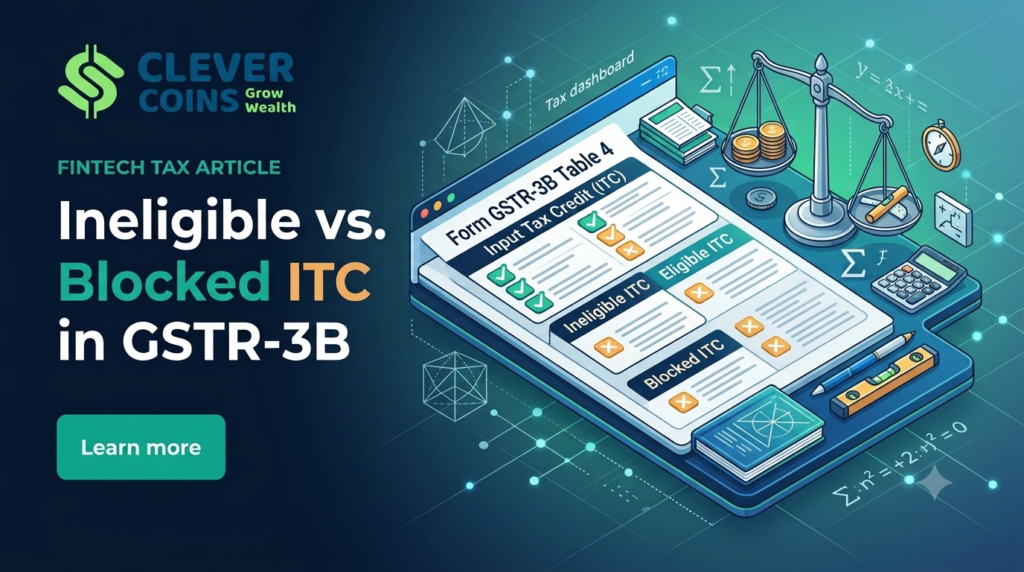
Ineligible vs. Blocked ITC: Correct Classification in Table 4 of Form GSTR-3B
1. Executive Summary & Introduction
The Goods and Services Tax (GST) framework in India relies heavily on a seamless flow of Input Tax Credit (ITC). Under GST law, ITC acts as the core mechanism eliminating the cascading effect of taxes. However, claiming ITC is not an absolute right; it is strictly regulated by procedural conditions and statutory exclusions.
For years after the implementation of GST in 2017, taxpayers and practitioners struggled with inconsistencies in reporting credit availments, reversals, and ineligibility in Form GSTR-3B. The Central Board of Indirect Taxes and Customs (CBIC) addressed these discrepancies by introducing systemic changes via CBIC Circular No. 170/02/2022-GST (dated July 6, 2022), followed by corresponding portal enhancements in September 2022.
Despite these updates, confusion remains regarding the operational distinction between Ineligible ITC and Blocked ITC, and how both must be classified within Table 4 of Form GSTR-3B. Incorrect reporting can trigger automated tax notices (Form DRC-01B), misalign auto-populated GSTR-2B data, lead to interest liabilities under Section 50, or cause permanent loss of eligible tax credits.
This comprehensive guide clarifies statutory definitions, dissects Table 4 of Form GSTR-3B line-by-line, explains temporary vs. permanent reversals, and provides practical accounting examples to ensure total compliance.
2. Core Definitions & Statutory Distinctions
To ensure accurate classification in GSTR-3B, one must first understand the legal distinction between general statutory ineligibility and specifically blocked credits.
Statutory Conditions for ITC (Section 16)
Section 16(1) of the CGST Act allows every registered person to claim ITC on goods or services used or intended to be used in the course or furtherance of business. However, Section 16(2) lays down four non-negotiable prerequisites:
-
The buyer must possess a valid tax invoice or debit note.
-
The goods or services must have been received.
-
The tax charged in respect of such supply has been actually paid to the Government by the supplier.
-
The buyer must have furnished the return under Section 39 (Form GSTR-3B).
If any of these conditions are unmet, the credit is legally Ineligible.
Ineligible ITC Defined
Ineligible ITC refers to tax credits that fail fundamental statutory criteria under Section 16 or jurisdictional restrictions. Key categories include:
-
Section 16(4) Time-Barred Credits: Invoices or debit notes pertaining to a financial year where the deadline for claiming credit (November 30 following the end of the financial year or the date of filing the annual return, whichever is earlier) has passed.
-
Place of Supply (PoS) Restrictions: Inward supplies where the Place of Supply rules restrict credit. For example, an Maharashtra-registered business owner attending a conference in Goa pays CGST + SGST in Goa; this tax cannot be claimed as ITC by the Maharashtra entity due to state boundary restrictions.
Blocked ITC Defined (Section 17(5))
Blocked ITC refers to tax credits on inward supplies that meet Section 16 business test requirements, but are explicitly restricted by Parliament under Section 17(5) of the CGST Act.
The primary categories blocked under Section 17(5) include:
-
Motor Vehicles & Conveyances: Motor vehicles for transportation of persons having approved seating capacity of $\le 13$ persons (including the driver), except when used for further supply, passenger transport, or driving school training.
-
Personal Goods & Services: Food and beverages, outdoor catering, beauty treatment, health services, cosmetic and plastic surgery.
-
Club Memberships & Fitness: Memberships to health clubs, sports facilities, and recreational centers.
-
Works Contract for Immovable Property: Works contract services for construction of an immovable property (other than plant and machinery), except where it is an input service for further supply of works contract service.
-
Self-Construction of Immovable Property: Goods or services received by a taxpayer for construction of an immovable property on his own account.
-
Lost, Stolen, or Gifted Goods: Goods lost, stolen, destroyed, written off, or disposed of by way of gift or free samples.
3. Comparison Framework: Ineligible vs. Blocked ITC
| Parameter | Blocked Credit (Section 17(5)) | Ineligible ITC (Section 16(4) / PoS) |
| Primary Statutory Provision | Section 17(5) of the CGST Act | Section 16(2), Section 16(4), and Section 12/13 (PoS) |
| Nature of Restriction | Policy restriction on specific goods/services. | Procedural failure, time limitations, or jurisdictional bar. |
| Presence in GSTR-2B | Reflected in GSTR-2B as “ITC Available” (marked as blocked). | Reflected in GSTR-2B as “ITC Not Available”. |
| GSTR-3B Table 4 Routing | Grossed in Table 4(A)(5), then reversed in Table 4(B)(1). | Reported directly in Table 4(D)(2) for information only. |
| Effect on Net Available ITC | Neutralized (Gross Credit minus Permanent Reversal = 0). | Does not enter Table 4(A); zero effect on Net ITC. |
| Reclaim Possibility | Never Reclaimable (Permanent Reversal). | Never Reclaimable (Statutorily Barred). |
4. Line-by-Line Breakdown of GSTR-3B Table 4
As amended by CBIC Circular 170/02/2022-GST
Table 4 is structured to capture total auto-populated credit from GSTR-2B, apply necessary reversals, and derive the exact net credit available for electronic credit ledger entry.
Table 4(A): Total ITC Available
Under the mechanism introduced in 2022, all ITC reflected in GSTR-2B as “ITC Available” must be reported in Table 4(A), regardless of whether it is eligible, ineligible, or blocked.
-
4(A)(1) Import of Goods: Auto-populated via ICEGATE integration.
-
4(A)(2) Import of Services: Self-assessed reverse charge ITC on imported services.
-
4(A)(3) RCM Supplies: Inward supplies subject to reverse charge under Section 9(3)/9(4).
-
4(A)(4) ISD Credit: Distributed credit from Input Service Distributor.
-
4(A)(5) All Other ITC: Auto-populated from GSTR-2B. Crucial Rule: All Section 17(5) blocked credits that show up in GSTR-2B must remain included in this figure and are subsequently removed via reversal in Table 4(B)(1).
Table 4(B): ITC Reversals (Permanent vs. Temporary)
Table 4(B) is split into two distinct sub-sections to segregate permanent credit losses from temporary credit holds.
Table 4(B)(1): Permanent Reversals
This sub-clause captures non-reclaimable credit reversals. Once reversed here, credit cannot be reclaimed in future returns.
-
Section 17(5) Blocked Credits: Motor vehicles, catering, employee insurance, works contract for immovable property.
-
Rule 42: Reversal of input/input service ITC attributed to exempt supplies or non-business purposes.
-
Rule 43: Reversal of capital goods ITC attributed to exempt supplies.
-
Rule 38: Reversal of 50% credit by banking companies and financial institutions.
Table 4(B)(2): Temporary Reversals
This sub-clause captures reclaimable credit reversals. Credit reversed under this head can be re-claimed in Table 4(A)(5) in a future tax period once statutory conditions are fulfilled.
-
Rule 37 Non-Payment within 180 Days: Reversal when payment to supplier is not made within 180 days from the invoice date.
-
Section 16(2)(b) Non-Receipt of Goods/Services: Invoices where the vendor uploaded the invoice in GSTR-1 (reflecting in buyer’s GSTR-2B), but actual physical delivery occurs in a subsequent month.
-
Clerical/Accounting Errors: Inadvertent excess ITC claims made in Table 4(A).
Table 4(C): Net ITC Available
Calculated automatically by the portal as:
This net amount flows directly into the taxpayer’s Electronic Credit Ledger.
Table 4(D): Disclosures and Reclaims
Table 4(D)(1): Reclaimed ITC
When a temporary reversal previously reported under Table 4(B)(2) becomes eligible (e.g., vendor payment completed after 180 days or goods received), the taxpayer re-claims the amount in Table 4(A)(5) and mandatorily discloses it in Table 4(D)(1). This ensures transparent tracking and prevents tax authority scrutiny over mismatched 2B vs 3B claims.
Table 4(D)(2): Statutorily Ineligible ITC
Captures items that appear as “ITC Not Available” in GSTR-2B:
-
Invoices barred by Section 16(4) time limit.
-
Invoices restricted due to Place of Supply rules.
5. Practical Business Scenarios & Accounting Examples
To contextualize these rules, consider the following practical scenarios faced by Apex Technologies Ltd. during a tax month.
Comprehensive Operational Data (Monthly Inward Supplies)
Table 4(A): Total ITC Available
Under the mechanism introduced in 2022, all ITC reflected in GSTR-2B as “ITC Available” must be reported in Table 4(A), regardless of whether it is eligible, ineligible, or blocked.
-
4(A)(1) Import of Goods: Auto-populated via ICEGATE integration.
-
4(A)(2) Import of Services: Self-assessed reverse charge ITC on imported services.
-
4(A)(3) RCM Supplies: Inward supplies subject to reverse charge under Section 9(3)/9(4).
-
4(A)(4) ISD Credit: Distributed credit from Input Service Distributor.
-
4(A)(5) All Other ITC: Auto-populated from GSTR-2B. Crucial Rule: All Section 17(5) blocked credits that show up in GSTR-2B must remain included in this figure and are subsequently removed via reversal in Table 4(B)(1).
Table 4(B): ITC Reversals (Permanent vs. Temporary)
Table 4(B) is split into two distinct sub-sections to segregate permanent credit losses from temporary credit holds.
Table 4(B)(1): Permanent Reversals
This sub-clause captures non-reclaimable credit reversals. Once reversed here, credit cannot be reclaimed in future returns.
-
Section 17(5) Blocked Credits: Motor vehicles, catering, employee insurance, works contract for immovable property.
-
Rule 42: Reversal of input/input service ITC attributed to exempt supplies or non-business purposes.
-
Rule 43: Reversal of capital goods ITC attributed to exempt supplies.
-
Rule 38: Reversal of 50% credit by banking companies and financial institutions.
Table 4(B)(2): Temporary Reversals
This sub-clause captures reclaimable credit reversals. Credit reversed under this head can be re-claimed in Table 4(A)(5) in a future tax period once statutory conditions are fulfilled.
-
Rule 37 Non-Payment within 180 Days: Reversal when payment to supplier is not made within 180 days from the invoice date.
-
Section 16(2)(b) Non-Receipt of Goods/Services: Invoices where the vendor uploaded the invoice in GSTR-1 (reflecting in buyer’s GSTR-2B), but actual physical delivery occurs in a subsequent month.
-
Clerical/Accounting Errors: Inadvertent excess ITC claims made in Table 4(A).
Table 4(C): Net ITC Available
Calculated automatically by the portal as:
This net amount flows directly into the taxpayer’s Electronic Credit Ledger.
Table 4(D): Disclosures and Reclaims
Table 4(D)(1): Reclaimed ITC
When a temporary reversal previously reported under Table 4(B)(2) becomes eligible (e.g., vendor payment completed after 180 days or goods received), the taxpayer re-claims the amount in Table 4(A)(5) and mandatorily discloses it in Table 4(D)(1). This ensures transparent tracking and prevents tax authority scrutiny over mismatched 2B vs 3B claims.
Table 4(D)(2): Statutorily Ineligible ITC
Captures items that appear as “ITC Not Available” in GSTR-2B:
-
Invoices barred by Section 16(4) time limit.
-
Invoices restricted due to Place of Supply rules.
5. Practical Business Scenarios & Accounting Examples
To contextualize these rules, consider the following practical scenarios faced by Apex Technologies Ltd. during a tax month.
Comprehensive Operational Data (Monthly Inward Supplies)
Breakdown of Calculations
-
Eligible Purchase: ₹1,800,000 (Goes to Table 4(A)(5)).
-
Blocked Items (Section 17(5)): Director’s Car (₹560,000) + Diwali Gifts (₹36,000) = ₹596,000. Grossed into Table 4(A)(5), then permanently reversed in Table 4(B)(1).
-
Goods in Transit (Non-receipt): ₹90,000. Grossed into Table 4(A)(5), then temporarily reversed in Table 4(B)(2).
-
Section 16(4) Time-Barred & POS Restricted: ₹18,000 + ₹9,000 = ₹27,000. Excluded from 4(A); reported directly in Table 4(D)(2).
-
Reclaimed ITC: ₹54,000. Added to Table 4(A)(5) and disclosed in Table 4(D)(1).
Step-by-Step Reporting in Table 4 of Form GSTR-3B
| Table Head | Description | Integrated Tax | Central Tax | State/UT Tax | Calculation / Source |
| 4(A) | ITC Available (whether in full or part) | ||||
| 4(A)(1) | Import of Goods | ₹0 | – | – | ICEGATE Data |
| 4(A)(2) | Import of Services | ₹0 | – | – | Self-Assessed |
| 4(A)(3) | Inward Reverse Charge Supplies | ₹0 | ₹0 | ₹0 | Table 3.1(d) linked |
| 4(A)(4) | Inward ISD Supplies | ₹0 | ₹0 | ₹0 | ISD GSTR-6 linked |
| 4(A)(5) | All Other ITC | ₹2,540,000 | ₹0 | ₹0 | 1,800k + 596k + 90k + 54k |
| 4(B) | ITC Reversed | ||||
| 4(B)(1) | As per Rules 38, 42 & 43 & Sec 17(5) | ₹596,000 | ₹0 | ₹0 | Permanent Reversal (Car + Gifts) |
| 4(B)(2) | Others | ₹90,000 | ₹0 | ₹0 | Temporary Reversal (Goods in transit) |
| 4(C) | Net ITC Available [4(A) – 4(B)] | ₹1,854,000 | ₹0 | ₹0 | Credit credited to Ledger |
| 4(D) | Other Details | ||||
| 4(D)(1) | ITC reclaimed reversed in 4(B)(2) earlier | ₹54,000 | ₹0 | ₹0 | Information Disclosure |
| 4(D)(2) | Ineligible ITC u/s 16(4) & PoS provisions | ₹27,000 | ₹0 | ₹0 | Information Disclosure |
6. Common Reporting Errors & Risk Mitigation
Navigating Table 4 requires strict process controls to avoid common pitfalls:
1. Directly Netting Off Blocked Credit Before Table 4(A)
-
The Error: Excluding Section 17(5) blocked credits prior to populating Table 4(A)(5) and skipping Table 4(B)(1).
-
The Consequence: Creates a direct variance between auto-populated GSTR-2B figures and Table 4(A)(5). This triggers automated system flags and Form DRC-01B notices requesting clarification for under-reporting or gross mismatch.
-
Remediation: Always allow GSTR-2B to auto-populate gross credit into Table 4(A)(5) and explicitly execute reversals in Table 4(B)(1).
2. Using Table 4(B)(1) for Temporary Reversals
-
The Error: Entering Rule 37 (180-day non-payment) or goods-in-transit reversals under Table 4(B)(1) instead of Table 4(B)(2).
-
The Consequence: Audit trails will classify the reversal as permanent. Subsequent reclaims in Table 4(A)(5) will trigger scrutiny from tax officers alleging unauthorized credit reclaims.
-
Remediation: Reserve Table 4(B)(1) exclusively for permanent reversals (Sec 17(5), Rule 42/43). Route all re-claimable items through Table 4(B)(2).
3. Forgetting Disclosure in Table 4(D)(1) Upon Reclaim
-
The Error: Re-claiming a previously reversed credit in Table 4(A)(5) without making a corresponding entry in Table 4(D)(1).
-
The Consequence: Causes Table 4(A)(5) to exceed the month’s GSTR-2B auto-populated figure. Automated audit engines flag this as an excess ITC claim.
-
Remediation: Ensure that whenever Table 4(A)(5) contains reclaimed credit, the exact reclaimed portion is simultaneously disclosed in Table 4(D)(1).
7. Actionable Checklist for Tax Compliance Officers
To maintain audit readiness, tax teams should implement this monthly workflow:
-
[ ] Automated GSTR-2B Inward Ledger Matching: Reconcile monthly purchase registers against auto-populated GSTR-2B files down to the line-item level.
-
[ ] Flag Section 17(5) Line Items: Mark blocked expenses (catering, motor vehicles, personal care, gifts) during the purchase ledger posting stage.
-
[ ] Isolate Section 16(4) Invoices: Filter out invoices where the filing deadline under 16(4) has expired and route their tax values directly to Table 4(D)(2).
-
[ ] Maintain an Internal Reclaim Ledger: Track items reversed under Table 4(B)(2) with fields for invoice date, vendor name, payment date, and re-claim period.
-
[ ] Verify Net Credit Equations: Ensure that $\text{Table 4(C)} = \text{Table 4(A)} – \text{Table 4(B)}$ matches the credit ledger addition before submitting Form GSTR-3B.
- Phone: +91 77389 59862
- Email: client@clevercoins.org
- Address: Ideal Market, Mumbra, Thane-400612
Related posts:
GST Portal Helpdesk & Grievance Redressal: The Ultimate Taxpayer's Manual
Demystifying the Prepaid Payment Instrument (PPI) License: The Ultimate Guide for Fintech Visionarie...
GST for Charitable Trusts & Societies: The Definitive Compliance & Exemption Guide
The Ultimate Masterclass on Statutory Registers for Companies: Compliance, Maintenance, and Best Pra...
IPO PROCESS EXPLAINED
CIBIL Rank for MSMEs – How to Improve, Maintain, and Leverage It for Ultimate Business Growth
Navigating Foreign Direct Investment (FDI) Rules in India: The Ultimate Compliance & Strategy Gu...
GST on Goods Transport by Road (GTA): The Ultimate Compliance and Operational Guide
Section 73 vs. Section 74 of the CGST Act: Normal vs. Fraudulent Assessments and Penalties
Liquor License in India – State-Wise Process, Fees, and Complete Compliance Guide
Related posts:
 Comprehensive Guide: GST on Employee Benefits & CTC Components in India
 Comprehensive Marketing Team Deliverable: GSTR-2B – Auto-Drafted ITC Statement
 ISD – Input Service Distributor Mechanism: The Complete 2026 Compliance Guide
 GST on Goods Transport by Road (GTA): The Complete 2026 Compliance Guide

