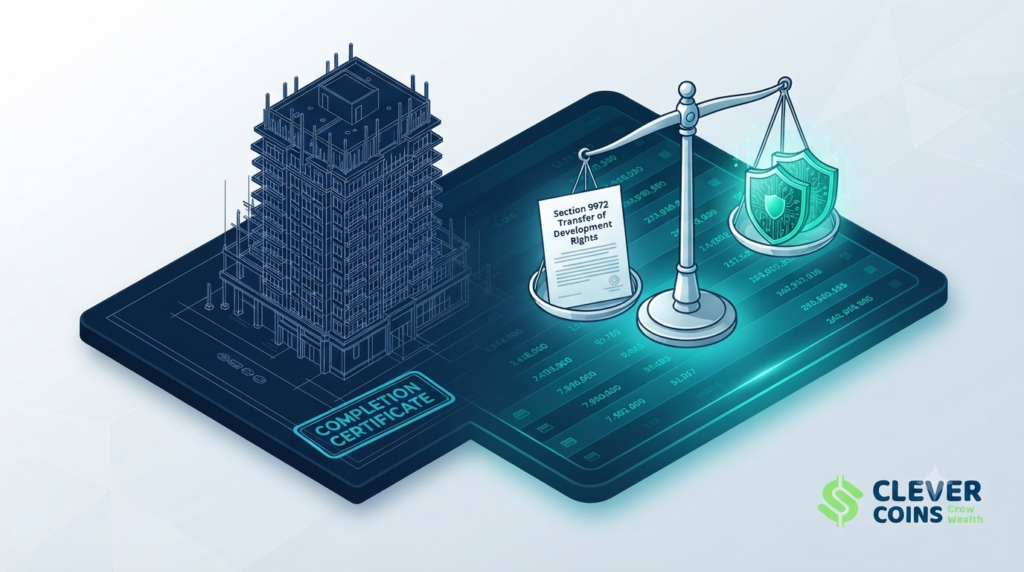
GST on Development Rights: The 2026 Compliance Guide for Developers & Landowners
Key Takeaways
- Classification as Service: Transfer of Development Rights (TDR), Floor Space Index (FSI), and long-term lease premium (upfront premium) are classified as supply of services under SAC code 9972 / 9986 under GST laws.
- Exemption for Residential Real Estate: Transfer of development rights or FSI for the construction of residential apartments is exempt from GST, provided all units in the project are sold before the issuance of the Completion Certificate (CC) or first occupation.
- Unsold Inventory Reversal Liability: If residential apartments remain unsold at the time of receiving the Completion Certificate (CC) or first occupation, GST becomes payable on a pro-rata basis on the development rights attributable to those unsold units under Reverse Charge Mechanism (RCM).
- 100% Taxable for Commercial Real Estate: TDR, FSI, and long-term lease premium transferred for commercial real estate projects (offices, retail, industrial parks) attract a flat 18% GST under RCM, without CC-linked exemptions.
- Reverse Charge Mechanism (RCM) Shift: Liability to deposit GST on TDR/FSI shifts from the landowner to the promoter/developer under Notification No. 04/2019-Central Tax (Rate).
Introduction: Why GST on Development Rights Controls Real Estate Working Capital
In joint development arrangements—such as Joint Development Agreements (JDAs), redevelopment projects, and long-term land leases—the landowner transfers the legal right to construct upon land in exchange for constructed area or revenue sharing. Under the GST framework, this transfer is legally categorized as a service transaction rather than a simple sale of land.
Navigating the tax treatment of Transfer of Development Rights (TDR), Floor Space Index (FSI), and long-term leases requires deep structural knowledge. The rules governing when tax liability attaches, who pays it, and how exemptions apply upon project completion dictate the cash flow and profitability of real estate ventures.
At CleverCoins, we have created this 2026 compliance guide to help real estate developers, landowners, and investors master GST on development rights and avoid working capital traps.
1. What Are Development Rights under GST Law?
Transfer of Development Rights (TDR) refers to an agreement where a landowner grants a developer exclusive rights to build structures on their parcel of land. While sale of land itself is excluded from GST under Schedule III of the CGST Act, 2017, the rights arising out of land—such as TDR, additional FSI, and long-term lease premiums—are treated as a taxable supply of services.
Key Categories Covered:
- Transfer of Development Rights (TDR): Rights granted by a private landowner to a developer.
- Floor Space Index (FSI) / Additional FSI: Permission granted by municipal corporations or state authorities to build additional square footage.
- Long-Term Lease Premium: Upfront premiums or upfront development fees paid for leases granted for 30 years or more (e.g., land leases from government development authorities like MIDC, MMRDA, DDA).
2. Reverse Charge Mechanism (RCM) on TDR and FSI
Under Notification No. 04/2019-Central Tax (Rate), the liability to pay GST on TDR, FSI, and long-term lease premium transferred on or after April 1, 2019 was shifted entirely to the promoter/developer under the Reverse Charge Mechanism (RCM).
Key RCM Rules:
- Supplier (Landowner): Issues an invoice without charging GST.
- Recipient (Developer): Must deposit GST directly into the government treasury via the Electronic Cash Ledger.
- Time of Supply: For residential and commercial units, the time of supply under RCM for TDR/FSI is deferred to the date of issuance of the Completion Certificate (CC) or first occupation of the project, whichever is earlier.
3. GST Exemption & RCM Reversal Matrix for Residential Projects
To promote affordable and residential housing, Notification No. 12/2017-Central Tax (Rate), as amended, provides a conditional exemption on TDR/FSI transferred for residential real estate projects.
The Exemption Rule:
GST on TDR/FSI is 0% (exempt) if the constructed residential apartments are sold prior to the issuance of the Completion Certificate (CC) or first occupation (since output GST of 1% for affordable housing or 5% for standard housing is paid by buyers during construction).
The Unsold Inventory Reversal Trap:
If any residential apartments remain unsold on the date of issuance of CC or first occupation, the exemption is proportionately withdrawn. The developer must pay GST on TDR/FSI under RCM for the portion corresponding to the unsold carpet area.
UNSOLD INVENTORY RCM CALCULATOR (RESIDENTIAL) Taxable Value of Unsold TDR = Total Value of TDR/FSI × (Unsold Area / Total Area) GST Payable under RCM = Min [ (Taxable Value × 18%), (Unsold Value × Applicable GST Rate*) ] *Applicable GST Rate: 1% for Affordable Residential Apartments; 5% for Other Apartments.
4. Master Comparison Table: Residential vs. Commercial Real Estate
Parameter | Residential Real Estate Projects (RREP / REP) | Commercial Real Estate Projects |
GST Rate on TDR/FSI | 18% (Subject to Conditional Exemption) | Flat 18% |
Conditional Exemption | Available for units sold before Completion Certificate (CC) | Not Available |
Tax Rate Cap on Unsold Units | Capped at 1% (Affordable) or 5% (Standard) of unsold value | No Capping (Flat 18% on total TDR value) |
Person Liable to Pay | Promoter / Developer (under RCM) | Promoter / Developer (under RCM) |
Time of Supply | Date of CC or First Occupation | Date of CC or First Occupation |
Input Tax Credit (ITC) Availability | Blocked under Section 17(5) / RREP rules | Claimable against commercial output tax |
5. Input Tax Credit (ITC) Restrictions on Real Estate
Under the post-2019 GST real estate framework:
- Residential Real Estate Projects (RREP): Developers pay concessional output GST rates (1% without ITC for affordable housing, 5% without ITC for standard housing). Consequently, ITC cannot be claimed on GST paid under RCM for TDR, FSI, or construction inputs.
- Commercial Real Estate Projects: Developers charging standard 18% output GST with ITC benefits can claim ITC on GST paid under RCM on development rights, provided it is utilized against output tax liability on commercial leases or sales prior to CC.
6. Real-World Case Studies
Case Study 1: Residential Project with Partial Unsold Inventory
- Project Details: Developer acquires TDR valued at ₹10,00,000,000 for a residential tower with total carpet area of 100,000 sq. ft.
- Completion Status: At the time of receiving the Completion Certificate:
- 80,000 sq. ft. (80%) was sold prior to CC.
- 20,000 sq. ft. (20%) remained unsold, valued at ₹3,00,000,000 (standard housing rate: 5%).
Tax Calculation:
- Exempt Portion: 80% attributable to sold units = ₹0 GST.
- Unsold Portion TDR Value: ₹10,00,000,000 × 20% = ₹2,00,000,000.
- Standard 18% GST on Unsold TDR: ₹2,00,000,000 × 18% = ₹36,00,000.
- Cap Limit Check (5% of Unsold Value): ₹3,00,000,000 × 5% = ₹15,00,000.
- Final RCM Payable by Developer: ₹15,00,000 (due to the 5% capping benefit).
Case Study 2: Long-Term Industrial Lease from Government Authority
- Project Details: An industrial developer pays an upfront lease premium of ₹50,00,000,000 to a state industrial development corporation for a 99-year lease for commercial park development.
- Compliance Requirement: Long-term lease premiums for commercial development attract 18% GST under RCM. The developer must deposit ₹9,00,000,000 via Electronic Cash Ledger and can claim it as ITC against commercial output obligations.
7. Frequently Asked Questions (FAQs)
Q1: Is GST applicable on the direct sale of land?
No. Under Entry 5 of Schedule III of the CGST Act, 2017, the sale of land is neither a supply of goods nor a supply of services, and is completely outside the purview of GST.
Q2: Who deposits GST on TDR—the landowner or the developer?
Under Notification No. 04/2019-Central Tax (Rate), the developer/promoter is legally liable to deposit GST on TDR, FSI, and long-term lease premiums under the Reverse Charge Mechanism (RCM).
Q3: What is the due date for paying GST on TDR under RCM for residential projects?
The GST liability under RCM arises on the date of issuance of the Completion Certificate (CC) or first occupation of the project, whichever occurs earlier.
Q4: Can a developer claim ITC on GST paid under RCM for residential TDR?
No. Under the concessional residential tax structure (1% and 5% rates), Input Tax Credit is strictly blocked. GST paid on TDR under RCM becomes a direct cost factor for unsold inventory.
Optimize Your Real Estate GST Strategy with CleverCoins
Structuring joint development agreements, managing RCM reversals on unsold inventory, and protecting project cash flows requires specialized real estate tax expertise. At CleverCoins, our corporate tax strategists help real estate developers and landowners navigate GST compliance with precision.
- Website: org
- Email: client@clevercoins.org
- Phone: +91 77389 59862
Address: Ideal Market, Mumbra, Thane-400612