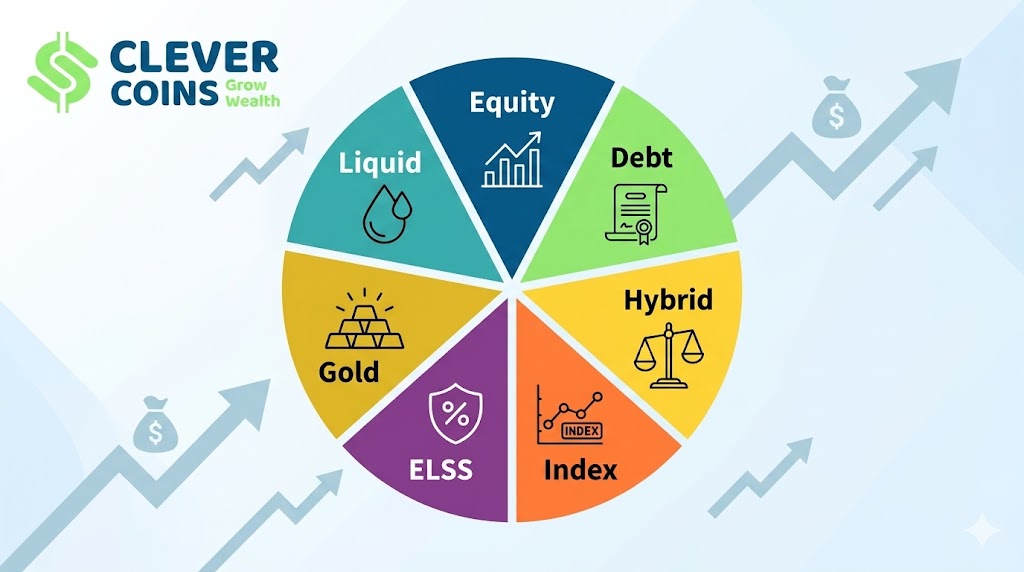
Investing your hard-earned money is one of the most important financial decisions you will ever make. Among all the investment vehicles available today, mutual funds remain one of the most popular and accessible options for both beginners and seasoned investors. But with hundreds of mutual fund types available in the market, it can be overwhelming to figure out which one is right for you.
This comprehensive guide breaks down every major type of mutual fund, explains how each one works, highlights the risks and rewards involved, and helps you match the right fund to your financial goals and risk appetite. Whether you are saving for retirement, planning a child’s education, or simply trying to grow your wealth, understanding mutual fund types is your first step toward smart investing.
💡 Quick Tip Mutual funds pool money from thousands of investors and invest it across a diversified portfolio managed by professional fund managers — giving you access to the stock market, bonds, and other assets with as little as ₹500. |
What Is a Mutual Fund?
A mutual fund is a professionally managed investment vehicle that pools capital from multiple investors and allocates it across a diversified portfolio of assets such as stocks, bonds, gold, real estate instruments, or a combination thereof. Each investor holds units proportional to their investment, and the value of those units fluctuates based on the performance of the underlying portfolio.
Mutual funds in India are regulated by the Securities and Exchange Board of India (SEBI), which ensures transparency, investor protection, and standardized categorization. The Association of Mutual Funds in India (AMFI) further facilitates industry growth and investor education.
Key Participants in a Mutual Fund
- Asset Management Company (AMC) — The company that manages the fund
- Fund Manager — The professional who makes investment decisions
- Custodian — Holds the securities on behalf of investors
- Registrar and Transfer Agent (RTA) — Handles investor records and transactions
- Trustees — Oversee the AMC and protect investor interests
Broad Classification of Mutual Funds
Mutual funds can be broadly classified on multiple bases: structure, asset class, investment objective, specialty, and risk profile. Let us explore each category in comprehensive detail.
1. Classification Based on Structure
1.1 Open-Ended Funds
Open-ended mutual funds do not have a fixed number of units. Investors can buy (subscribe) or sell (redeem) units at any time at the current Net Asset Value (NAV). This makes them highly liquid and flexible.
Best For: Investors who want flexibility and easy access to their money.
Examples: Most equity diversified funds, liquid funds, debt funds.
Key Feature: No fixed maturity date; NAV is declared daily.
1.2 Closed-Ended Funds
Closed-ended funds issue a fixed number of units only during the New Fund Offer (NFO) period. After the NFO, units are listed on stock exchanges and can be traded like shares. Investors can only exit by selling on the exchange or at maturity.
Best For: Investors with a long-term horizon willing to lock in their investment.
Examples: Fixed Maturity Plans (FMPs), Capital Protection Oriented Funds.
Key Feature: Market price may differ from NAV (traded at premium or discount).
1.3 Interval Funds
Interval funds combine features of both open-ended and closed-ended funds. They allow purchases and redemptions only during specific intervals (e.g., quarterly or annually) as defined in the scheme documents.
Best For: Investors who can commit money for short intervals but need occasional liquidity.
2. Classification Based on Asset Class
2.1 Equity Mutual Funds
Equity mutual funds invest primarily in stocks and equity-related instruments. They are best suited for long-term wealth creation and carry higher risk compared to debt funds due to market volatility.
Types of Equity Funds
Large-Cap Funds: Invest at least 80% in the top 100 companies by market capitalization. More stable, lower volatility, suitable for moderate risk-takers. Examples: Axis Bluechip Fund, Mirae Asset Large Cap Fund.
Mid-Cap Funds: Invest at least 65% in mid-cap companies (101st–250th by market cap). Higher growth potential than large caps but with greater volatility. Examples: HDFC Mid-Cap Opportunities Fund.
Small-Cap Funds: Invest at least 65% in small-cap companies (251st and beyond). Highest growth potential but also highest risk. Not suitable for short-term investors.
Multi-Cap Funds: Invest at least 25% each in large, mid, and small-cap stocks. Provide diversification across market caps in a single fund.
Flexi-Cap Funds: Invest across market caps with no fixed allocation limit. Fund manager has full flexibility to shift allocations based on market conditions.
Large & Mid-Cap Funds: Invest at least 35% each in large-cap and mid-cap stocks. Balance between stability and growth.
ELSS (Equity Linked Saving Scheme): Invest at least 80% in equities with a mandatory 3-year lock-in period. Offer tax deduction up to ₹1.5 lakh under Section 80C of the Income Tax Act.
Sectoral/Thematic Funds: Invest in specific sectors (banking, pharma, IT, energy) or themes (ESG, consumption, infrastructure). High concentration risk but can deliver extraordinary returns in bullish sectors.
Focused Funds: Invest in a maximum of 30 stocks only. High conviction fund with concentrated portfolio, higher risk but potential for higher alpha.
Value Funds / Contra Funds: Follow contrarian or value-investing strategies — buying undervalued or out-of-favor stocks. Long-term alpha generation but requires patience.
Dividend Yield Funds: Focus on high dividend-paying companies. Suitable for investors seeking regular income from equities.
⚠️ Risk Note — Equity Funds Equity mutual funds are subject to market risks. Returns are not guaranteed and can be negative in the short term. However, historical data shows that long-term investments (5+ years) in diversified equity funds have consistently delivered inflation-beating returns. |
2.2 Debt Mutual Funds
Debt mutual funds invest in fixed-income instruments such as government securities, corporate bonds, treasury bills, commercial papers, and certificates of deposit. They are generally considered safer than equity funds but offer lower returns.
Types of Debt Funds
Overnight Funds: Invest in securities with 1-day maturity. Extremely low risk, used for parking surplus money overnight. Ideal for institutional investors and high-net-worth individuals.
Liquid Funds: Invest in instruments with maturity up to 91 days. Low risk, high liquidity. Ideal alternative to savings accounts for short-term parking of funds (7 days to 3 months).
Ultra Short Duration Funds: Invest in instruments with Macaulay duration of 3–6 months. Slightly higher returns than liquid funds with marginally more risk.
Low Duration Funds: Macaulay duration of 6–12 months. Suitable for 6–12 month investment horizon.
Money Market Funds: Invest in money market instruments with maturity up to 1 year. Good alternative for short-term investors seeking better returns than FDs.
Short Duration Funds: Macaulay duration of 1–3 years. Moderate interest rate risk, suitable for 1–3 year investment horizon.
Medium Duration Funds: Macaulay duration of 3–4 years. Higher interest rate risk but better returns over medium term.
Medium to Long Duration Funds: Macaulay duration of 4–7 years. Suitable for investors with a view on falling interest rates.
Long Duration Funds: Macaulay duration greater than 7 years. High interest rate sensitivity; ideal for tactical bets during rate-cutting cycles.
Dynamic Bond Funds: Fund manager actively adjusts portfolio duration based on interest rate outlook. Suitable for investors who trust the fund manager’s market calls.
Corporate Bond Funds: Invest at least 80% in highest-rated corporate bonds (AA+ and above). Relatively safe debt option with good yield.
Credit Risk Funds: Invest at least 65% in below-highest-rated instruments. Higher yield potential but significant credit risk (risk of default).
Banking & PSU Funds: Invest at least 80% in debt instruments of banks and public sector undertakings. Low default risk, suitable for conservative investors.
Gilt Funds: Invest at least 80% in government securities (G-Secs) across maturities. Zero credit risk (sovereign guarantee) but high interest rate risk.
Gilt Funds with 10-Year Constant Duration: Maintain portfolio Macaulay duration at 10 years. Pure interest rate play, high volatility.
Floater Funds: Invest at least 65% in floating rate instruments. Returns move with interest rate changes; suitable during rising rate environments.
Fixed Maturity Plans (FMPs): Closed-ended debt funds with a fixed maturity date. Low risk, tax-efficient alternative to fixed deposits.
2.3 Hybrid Mutual Funds
Hybrid mutual funds invest in a mix of equity and debt instruments, offering a balanced approach to risk and return. They are ideal for investors who want growth but cannot tolerate pure equity volatility.
Conservative Hybrid Funds: Invest 10–25% in equity and 75–90% in debt. Very low equity exposure; suitable for risk-averse investors seeking slight equity upside.
Balanced Hybrid Funds: Invest 40–60% in equity and 40–60% in debt. No arbitrage allowed. True balanced allocation.
Aggressive Hybrid Funds (Balanced Advantage Funds — BAF): Invest 65–80% in equity. Popularly known as Balanced Advantage Funds when dynamic allocation is used. Suitable for moderate-to-aggressive investors.
Dynamic Asset Allocation Funds: Dynamically shift between equity and debt based on market valuation models (e.g., P/E ratio, P/B ratio). Aim to buy more equity when markets are cheap and shift to debt when expensive.
Multi-Asset Allocation Funds: Invest in at least three asset classes (equity, debt, gold, REITs, etc.) with a minimum 10% in each. True diversification across asset classes.
Arbitrage Funds: Exploit price differences between cash and derivatives markets. Returns are similar to short-term debt funds but taxed as equity (held >1 year = 10% LTCG). Low risk, tax-efficient.
Equity Savings Funds: Invest in equity, arbitrage, and debt. Minimum 65% in equity and arbitrage. Moderate risk with tax efficiency.
3. Solution-Oriented Mutual Funds
SEBI has categorized specific funds designed to meet life goals such as retirement and children’s education.
Retirement Funds: Lock-in period of 5 years or until retirement age, whichever is earlier. Designed for long-term retirement corpus building.
Children’s Fund: Lock-in of at least 5 years or until the child turns 18. Invest for a child’s education, marriage, or other milestones.
4. Other / Specialty Mutual Funds
4.1 Index Funds
Index funds passively replicate the performance of a specific index (Nifty 50, Sensex, Nifty Midcap 150, etc.) by investing in the same stocks in the same proportion. They have very low expense ratios and are ideal for long-term, cost-conscious investors.
Key Advantage: No fund manager bias; returns closely mirror the index. Expense ratios as low as 0.05–0.20%.
Popular Indices Tracked: Nifty 50, BSE Sensex, Nifty Next 50, Nifty 100, Nifty Midcap 150, Nifty Smallcap 250.
4.2 Exchange-Traded Funds (ETFs)
ETFs are similar to index funds but are listed and traded on stock exchanges like shares. They offer intraday liquidity, high transparency, and very low costs. To invest in ETFs, you need a Demat account.
Types of ETFs: Equity ETFs, Debt ETFs, Gold ETFs, Silver ETFs, International ETFs.
Key Difference from Index Funds: ETFs can be bought/sold intraday at real-time market prices; index funds transact only at end-of-day NAV.
4.3 Fund of Funds (FoF)
A Fund of Funds invests in other mutual fund schemes rather than directly in stocks or bonds. They are useful for investing in international markets or gaining exposure to a curated basket of funds.
Types: Domestic FoF, International/Overseas FoF, Gold FoF, Multi-Manager FoF.
Note: FoFs have a two-layer expense structure but offer unique diversification benefits.
4.4 International / Overseas Funds
These funds invest in equity or debt of foreign companies. They allow Indian investors to participate in global markets like the US, Europe, or emerging markets. Subject to currency risk in addition to market risk.
Popular Options: Funds investing in US markets (S&P 500, NASDAQ 100), China, global emerging markets, or global commodities.
4.5 Gold Funds & Gold ETFs
Gold mutual funds invest in Gold ETFs and allow investors to take exposure to gold without physically owning it. Ideal as an inflation hedge and portfolio diversifier.
Gold ETF vs Gold Fund: Gold ETFs require a Demat account; Gold Funds (FoF) do not and can be invested via SIP.
4.6 Real Estate Mutual Funds (REMFs) and REITs
Real Estate Mutual Funds and Real Estate Investment Trusts (REITs) give investors exposure to income-generating real estate assets without direct property ownership. REITs in India are traded on exchanges.
4.7 ESG Funds (Environmental, Social & Governance)
ESG funds invest in companies that score high on environmental responsibility, social impact, and good governance practices. These are increasingly popular among millennial investors who align their investments with their values.
4.8 Commodity Funds
These funds invest in commodity markets including metals (gold, silver), agricultural products, or oil. In India, commodity exposure is typically gained through international funds or ETFs.
5. Classification Based on Investment Objective
Growth Funds: Aim for long-term capital appreciation; primarily equity-oriented. Reinvests dividends back into the fund.
Income Funds: Focus on generating regular income through dividends and interest. Primarily debt-oriented.
Liquid Funds: Preserve capital with high liquidity; invest in very short-term instruments.
Tax-Saving Funds (ELSS): Provide tax benefits under Section 80C along with equity growth potential.
Capital Protection Funds: Closed-ended funds that protect invested capital at maturity through a blend of debt and derivatives.
Fixed Maturity Plans: Offer predictable returns at the end of a defined period, similar to fixed deposits.
Pension Funds: Build a retirement corpus over a long investment horizon.
6. Classification Based on Risk Profile
Risk Level | Fund Types | Suitable For |
Low Risk | Liquid, Overnight, Gilt, Banking & PSU | Conservative investors, short-term goals |
Low-Moderate Risk | Ultra Short, Low Duration, Money Market | Capital preservation + slight yield |
Moderate Risk | Hybrid Conservative, Short Duration, Corporate Bond | Balanced investors, 1–3 years |
Moderately High Risk | Aggressive Hybrid, Large Cap, Balanced Advantage | Moderate risk takers, 3–5 years |
High Risk | Mid Cap, Multi Cap, Thematic, Sectoral | Risk-tolerant, 5+ years |
Very High Risk | Small Cap, Credit Risk, International, Small & Midcap | Aggressive investors, 7+ years |
7. How to Choose the Right Mutual Fund
Selecting the right mutual fund depends on multiple factors. Here is a step-by-step framework:
Step 1 — Define Your Financial Goal: Are you saving for retirement, a house, a car, or emergency funds? Your goal determines the investment horizon.
Step 2 — Know Your Risk Appetite: Are you comfortable seeing your investment fall 20–30% in the short term for long-term gains? Or do you prefer stable, predictable returns?
Step 3 — Determine the Investment Horizon: Short-term (< 1 year): Liquid, ultra-short funds. Medium-term (1–5 years): Debt, hybrid funds. Long-term (5+ years): Equity funds.
Step 4 — Check Expense Ratio: A lower expense ratio means more of the returns belong to you. Prefer direct plans over regular plans.
Step 5 — Analyze Fund Performance: Compare rolling returns vs benchmark and peer funds over 3, 5, and 10-year periods, not just recent 1-year returns.
Step 6 — Evaluate Fund Manager Track Record: Consistency matters. Check how the fund has performed across different market cycles.
Step 7 — Use SIP for Discipline: Systematic Investment Plans (SIPs) enforce disciplined investing and benefit from rupee cost averaging.
🎯 Pro Tip — Direct vs Regular Plans Direct plans have no distributor commission and have a lower expense ratio (typically 0.5–1% lower). Over 20 years, this seemingly small difference can result in significantly higher corpus due to compounding. Always choose Direct Plans if you can invest independently. |
8. Mutual Fund Taxation in India (2025)
Understanding the tax implications of mutual funds is crucial for maximizing post-tax returns.
Equity Funds — Short-Term Capital Gains (STCG): Held less than 1 year. Taxed at 20% (revised in Budget 2024).
Equity Funds — Long-Term Capital Gains (LTCG): Held more than 1 year. LTCG above ₹1.25 lakh per year taxed at 12.5% without indexation.
Debt Funds — All Gains: Taxed at the investor’s income tax slab rate (no separate LTCG benefit after April 2023 amendment).
ELSS Funds: Investments up to ₹1.5 lakh eligible for deduction under Section 80C. LTCG tax rules apply on gains.
Arbitrage Funds: Taxed as equity funds due to 65%+ equity exposure (even though returns resemble debt funds).
Dividend Income: Dividends are added to the investor’s income and taxed at applicable slab rates. TDS of 10% applies if dividends exceed ₹5,000.
9. Common Myths About Mutual Funds — Busted
Myth 1: Mutual funds are only for rich people. Fact: You can start investing with as little as ₹100–₹500 via SIP.
Myth 2: Higher NAV means expensive fund. Fact: NAV has nothing to do with future returns. What matters is fund performance and quality.
Myth 3: Mutual funds guarantee returns. Fact: All market-linked funds are subject to market risks. Returns are never guaranteed.
Myth 4: You need a Demat account to invest in mutual funds. Fact: Most mutual funds (except ETFs) do not require a Demat account. You can invest directly via AMC websites or apps.
Myth 5: NFOs are like IPOs and always give good returns. Fact: NFOs have no performance track record. Prefer existing funds with proven history.
Myth 6: More diversification = Better returns. Fact: Over-diversification dilutes returns. A portfolio of 3–5 well-chosen funds is better than 20+ funds.
10. Essential Mutual Fund Glossary
NAV (Net Asset Value): The per-unit price of a mutual fund, calculated daily.
AUM (Assets Under Management): Total market value of assets managed by a fund.
Expense Ratio: Annual fee charged by the fund, expressed as a percentage of AUM.
Exit Load: Fee charged when you redeem units before a specified period (typically 1–3%).
SIP (Systematic Investment Plan): Regular, fixed-amount investments at defined intervals.
STP (Systematic Transfer Plan): Automated transfer from one fund to another within the same AMC.
SWP (Systematic Withdrawal Plan): Regular withdrawal of a fixed amount from a mutual fund.
Benchmark: The index against which a fund’s performance is compared.
Alpha: Excess return generated by the fund above its benchmark.
Beta: Measure of a fund’s volatility relative to its benchmark.
Sharpe Ratio: Risk-adjusted return; higher is better.
CAGR: Compound Annual Growth Rate — the annualized rate of return.
Standard Deviation: Measures the volatility of a fund’s returns.
Portfolio Turnover: How frequently the fund buys and sells securities.
Conclusion
Mutual funds are a powerful wealth-creation tool, but choosing the right type requires a clear understanding of your financial goals, risk tolerance, and investment horizon. From safe liquid funds for emergency savings to aggressive small-cap funds for long-term wealth creation, the Indian mutual fund industry offers a solution for every investor profile.
Start with a clear goal, choose Direct Plans, invest via SIP for discipline, review your portfolio annually, and stay invested through market cycles. Remember — it is time in the market, not timing the market, that creates lasting wealth.
If you are new to mutual funds, consider consulting a SEBI-registered financial advisor before making investment decisions.
📌 Disclaimer This blog is for educational purposes only and does not constitute financial advice. Mutual fund investments are subject to market risks. Please read all scheme-related documents carefully before investing. Past performance is not indicative of future results. |