PM Vishwakarma Yojana 2026: Complete Guide to Benefits, Eligibility, and Online Application for MSMEs
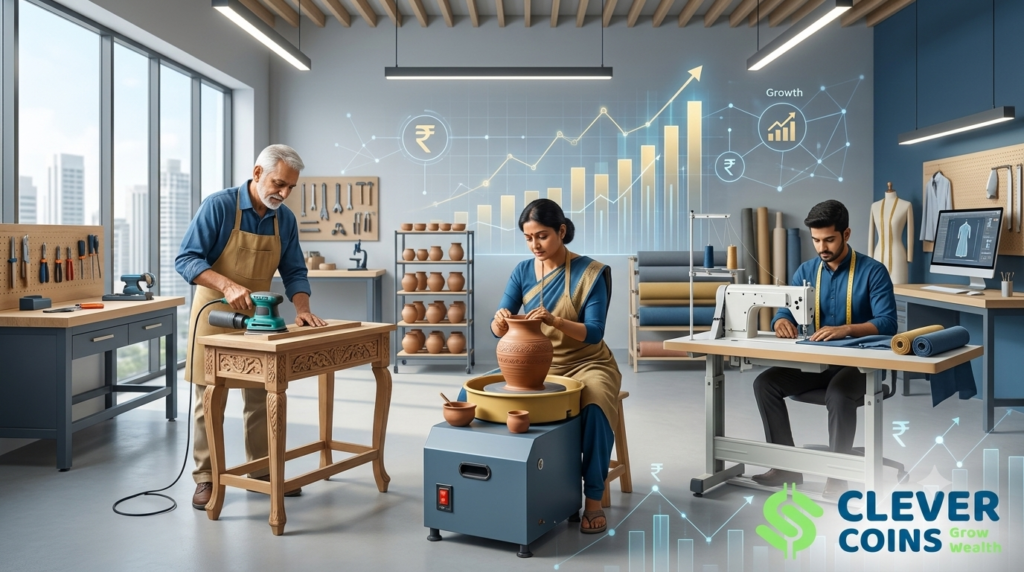
The backbone of the Indian economy relies heavily on the unorganized sector, particularly the millions of artisans, craftspeople, and micro-entrepreneurs who preserve traditional skills while driving local commerce. To uplift this critical demographic, the Government of India launched the PM Vishwakarma Yojana with an initial financial outlay of ₹13,000 crore. As we move into 2026, the scheme continues to serve as a transformative catalyst for the Micro, Small, and Medium Enterprises (MSME) sector, bridging the gap between traditional craftsmanship and modern economic integration.
This comprehensive guide by CleverCoins provides an exhaustive breakdown of the PM Vishwakarma Yojana 2026. Whether you are a traditional artisan seeking to scale your operations, or an MSME consultant guiding local businesses, this resource covers everything from the foundational objectives to the granular details of the online application process.
1. What is the PM Vishwakarma Yojana?
The PM Vishwakarma Yojana is a Central Sector Scheme launched by Prime Minister Narendra Modi on September 17, 2023, specifically designed to provide end-to-end holistic support to artisans and craftspeople—collectively referred to as “Vishwakarmas”.
The primary objective of the scheme is to integrate traditional artisans into both domestic and global value chains, ensuring their trades remain viable, profitable, and respected in a rapidly modernizing economy. By offering a combination of skill upgradation, modern toolkit incentives, collateral-free credit, and digital market linkages, the government aims to formalize the unorganized artisan sector and stimulate grassroots economic growth.
Core Objectives of the Scheme
Skill Preservation & Upgradation: Ensuring that centuries-old traditional skills are passed down to future generations while being enhanced by modern techniques.
Financial Inclusion: Providing immediate, collateral-free financing at highly concessional interest rates to artisans who traditionally lack access to formal banking.
Quality & Productivity Enhancement: Equipping artisans with modern toolkits to drastically improve the efficiency, scale, and quality of their output.
Digital Empowerment: Encouraging the adoption of digital payment ecosystems among rural and semi-urban artisans through direct financial incentives.
Market Integration: Connecting local craftspeople with broader markets through branding, Udyam registration, and e-commerce platform onboarding (like GeM).
2. The 18 Eligible Trades Under PM Vishwakarma Yojana
To ensure targeted and effective intervention, the Ministry of Micro, Small & Medium Enterprises (MoMSME) has identified 18 specific traditional trades eligible for the scheme. These trades encompass individuals who work primarily with their hands and traditional tools.
Wood, Iron, and Metal Based
Carpenter (Suthar/Badhai): Artisans involved in furniture making, structural woodwork, and traditional wooden crafting.
Boat Maker: Craftsmen building and repairing traditional wooden boats, essential for coastal and riverine economies.
Armourer: Specialists in crafting and maintaining traditional armor and metal gear.
Blacksmith (Lohar): Metalworkers forging iron and steel into tools, agricultural implements, and structural components.
Hammer and Tool Kit Maker: Artisans exclusively dedicated to forging specialized hand tools.
Locksmith: Craftsmen designing, building, and repairing traditional and custom locking mechanisms.
Gold, Silver, Clay, and Stone Based
Goldsmith (Sonar): Artisans crafting fine jewelry, ornaments, and traditional metalworks.
Potter (Kumhaar): Craftspeople working with clay to produce pottery, earthenware, and traditional terracotta items.
Sculptor (Moortikar/Stone Carver): Artists carving intricate designs and statues out of stone.
Stone Breaker: Workers involved in the manual shaping and breaking of large stones for construction and masonry.
Leather, Architecture, and Lifestyle Trades
Cobbler (Charmkar/Shoesmith): Leatherworkers manufacturing and repairing traditional footwear and leather goods.
Mason (Rajmistri): Master builders and bricklayers forming the backbone of rural and semi-urban construction.
Basket/Mat/Broom Maker/Coir Weaver: Artisans utilizing natural fibers to create essential household utility items.
Doll & Toy Maker (Traditional): Craftsmen producing localized, culturally significant toys and dolls using wood, cloth, or clay.
Barber (Naai): Traditional grooming professionals.
Garland Maker (Malakaar): Floral artisans creating ceremonial and religious garlands.
Washerman (Dhobi): Traditional laundry and fabric care service providers.
Tailor (Darzi): Artisans providing bespoke clothing fabrication and repair services.
3. Comprehensive Benefits for MSMEs and Artisans
The PM Vishwakarma Yojana 2026 is not merely a loan scheme; it is a multi-tiered capacity-building initiative. The benefits are disbursed in a phased, logical manner to ensure sustainable business growth.
A. Recognition and Certification
Upon successful registration and verification, every beneficiary receives an official PM Vishwakarma Certificate and a unique ID Card. This serves as formal recognition of their skill and integrates them into the organized MSME framework, allowing them to access broader government tenders and corporate supply chains.
B. Skill Upgradation and Stipend
Before capital is disbursed, the government ensures the artisan is equipped to use it effectively.
Basic Training: A mandatory 5 to 7-day training program focusing on modernizing traditional techniques, basic business management, and financial literacy.
Advanced Training: An optional, intensive 15-day (or more) program for artisans looking to drastically scale their operations.
Daily Stipend: To compensate for the loss of daily wages during the training period, the government provides a direct stipend of ₹500 per day to the artisan.
C. Toolkit Incentive (e-Voucher)
A lack of modern tools is the primary bottleneck for productivity in the unorganized sector. At the commencement of the Basic Skill Training, beneficiaries are granted a toolkit incentive of up to ₹15,000. This amount is not disbursed in cash, but rather as an e-voucher to ensure the funds are strictly utilized for purchasing modern, high-quality equipment relevant to their specific trade.
D. Collateral-Free Credit Support (Enterprise Development Loans)
The flagship benefit of the PM Vishwakarma scheme is the provision of affordable capital. Artisans can access up to ₹3 Lakh in collateral-free loans, distributed in two strategic tranches.
| Feature | First Tranche | Second Tranche |
|---|---|---|
| Maximum Loan Amount | Up to ₹1,000,000 (₹1 Lakh) | Up to ₹2,000,000 (₹2 Lakh) |
| Repayment Tenure | Up to 18 Months | Up to 30 Months |
| Interest Rate (Cost to Borrower) | 5% per annum | 5% per annum |
| Eligibility for Disbursement | Upon successful verification and basic training completion | Upon full repayment of the 1st Tranche and adoption of digital transactions |
The Interest Subvention Mechanism: The actual cost of borrowing in the market is significantly higher than 5%. The Government of India provides an interest subvention of up to 8%, which is paid upfront directly to the lending banks by the Ministry of MSME. Furthermore, no prepayment penalties are levied if the borrower chooses to clear the loan early (after a minimum of 6 months from disbursement), allowing for flexible financial management.
E. Digital Transaction Incentives
To pull the rural economy into the digital age, the scheme actively pays artisans to use UPI and digital banking. Beneficiaries receive a cash incentive of ₹1 for every successful digital transaction they process, capped at a maximum of 100 transactions (₹100) per month. This directly offsets the minor costs associated with maintaining a bank account and encourages a transparent, trackable financial footprint, which is crucial for future MSME credit scaling.
F. Marketing, Branding, and E-Commerce Support
Producing a good product is only half the battle; selling it is where MSMEs often fail. The National Committee for Marketing (NCM) steps in to provide:
Quality Certification: Helping artisans meet standard industry quality benchmarks.
Branding & Packaging: Assistance in creating professional packaging that commands higher retail prices.
GeM Onboarding: Facilitating the registration of artisans on the Government e-Marketplace (GeM), allowing them to sell directly to government departments.
4. Strict Eligibility Criteria for 2026 Applicants
To ensure the funds reach the genuine grassroots craftspeople who need them most, the government has established strict eligibility parameters. It is crucial to evaluate these before initiating the application process to avoid rejection.
Occupation: The applicant must be actively engaged as an artisan or craftsperson in one of the 18 stipulated trades, operating in the unorganized sector on a self-employment basis.
Age Limit: The applicant must be at least 18 years of age on the date of registration.
One Beneficiary Per Family: The scheme is strictly restricted to one member per family. For the purposes of this scheme, a “family” is legally defined as a husband, wife, and their unmarried children.
Government Employment Restriction: Individuals currently employed in any Central or State government service, as well as their immediate family members, are entirely ineligible for this scheme.
Previous Loan Exclusions: The applicant must not have availed of any similar credit-based Central or State Government schemes for business development (such as PMEGP, PM SVANidhi, or MUDRA) within the last 5 years.
Crucial Exception: If an applicant previously took a MUDRA or PM SVANidhi loan, but has fully and successfully repaid the entire principal and interest, they are considered eligible for the PM Vishwakarma Yojana. The 5-year restriction is calculated from the date the previous loan was sanctioned.
5. Required Documents for Online Registration
The government has intentionally streamlined the documentation process to reduce bureaucratic friction. Unlike older schemes that required piles of physical paperwork, the PM Vishwakarma Yojana relies heavily on digital fetching through Aadhaar integration.
Keep the following details and documents ready before approaching a Common Service Centre (CSC) or logging into the portal:
Aadhaar Card: The primary foundational document for identity verification.
Aadhaar-Linked Mobile Number: An active mobile phone number that is officially linked to the applicant’s Aadhaar card. This is mandatory for OTP generation and initial login.
Bank Account Details: Passbook copy or canceled cheque showing the Account Number, IFSC code, and Branch details. If the artisan does not have a bank account, the CSC will assist in opening one prior to registration.
Ration Card: Used primarily to fetch and verify family details to enforce the “one beneficiary per family” rule. If a ration card is unavailable, the Aadhaar numbers of all family members must be provided manually.
Caste Certificate: Required only if the applicant wishes to avail of specific category-based sub-benefits or statistical tracking.
Active UPI ID: Highly recommended to ensure the applicant can immediately begin receiving the ₹1 per transaction digital incentive.
6. Step-by-Step Online Application Process
The application process is completely free of charge. No agents, middlemen, or brokers are required, and the entire enrollment cost is subsidized and covered by the government via Common Service Centres (CSCs).
Here is the exact workflow for completing the PM Vishwakarma Yojana online application in 2026:
Step 1: Portal Access and Initial Login
Navigate to the official government portal:
pmvishwakarma.gov.in.Locate and click on the “Apply for PM Vishwakarma” or “Login” button.
For CSC operators facilitating the application, select “CSC – Register Artisans” from the login dropdown menu.
Step 2: E-KYC and Aadhaar Authentication
Enter the artisan’s Aadhaar-linked mobile number and the 12-digit Aadhaar number.
Click on “Generate OTP” and enter the code sent to the mobile device to verify ownership.
Complete the biometric authentication process (if applying via CSC) to finalize the e-KYC. This step automatically fetches the applicant’s name, date of birth, and gender directly from the UIDAI database.
Step 3: Entering Personal and Family Details
Initial Declarations: The system will prompt a verification check. You must confirm that no family member is a government employee and that no similar scheme loans (like MUDRA) have been availed and left unpaid in the last 5 years.
Family Validation: The system will attempt to fetch family details automatically using the Ration Card data. If the data is missing or incorrect, manually enter the Aadhaar details of the spouse and unmarried children.
Address Verification: Confirm the address fetched from Aadhaar. If the current working address is different, provide the updated location details and specify if the business operates within a Gram Panchayat or Urban Local Body (ULB).
Step 4: Trade and Business Configuration
Select Trade: Choose the specific profession from the drop-down menu of the 18 eligible trades (e.g., Blacksmith, Tailor).
Business Address: Indicate where the work is carried out. This helps the government map artisan clusters.
Step 5: Financial Integration
Enter the bank account details carefully (Bank Name, Account Number, IFSC Code). This is the account where the training stipend, loan disbursement, and digital incentives will be credited.
Opt-in for Credit Support. Specify the required loan amount (up to ₹1 Lakh for the first tranche) and provide a brief description of the loan’s purpose (e.g., buying raw materials, expanding shop space).
Enter the artisan’s UPI ID and linked mobile number to activate the Digital Transaction Incentive program.
Step 6: Final Review and Submission
Review the mandatory sections regarding Skill Training, Toolkit procurement, and Marketing Support.
Thoroughly check all entered data for typographical errors. Blurry documents or mismatched names can cause severe delays in verification.
Accept the Scheme’s Terms and Conditions and click “Submit”.
The system will immediately generate a unique Application Registration Number. Save this number, as it is required to track the status of the file.
7. How to Check PM Vishwakarma Application Status
After submission, the application undergoes a multi-tier verification process, often involving local authorities such as Gram Panchayat heads or urban municipal officers who verify the physical existence of the artisan’s business.
To check your status:
Visit the official portal
pmvishwakarma.gov.in.Click on the “Beneficiary Login” link.
Enter your registered mobile number and complete the Captcha verification.
Enter the OTP sent to your phone.
The dashboard will display the live status of your file, categorizing it as Pending, Approved, or Rejected.
Once approved, this same dashboard is used to track the Toolkit Incentive Payment Status and Loan Disbursement Status.
8. Frequently Asked Questions (FAQs)
Q: Is there any application fee for the PM Vishwakarma Scheme? No. The application is completely free of charge. The government covers all enrollment costs through the Common Service Centres (CSCs), and there is no fee for the issuance of the certificate or ID card.
Q: Do I need to pledge my house or machinery to get the ₹3 Lakh loan? No. The Enterprise Development Loans provided under the PM Vishwakarma Yojana are 100% collateral-free. You do not need to pledge any assets to secure the financing.
Q: Can both a husband and wife apply for the scheme if they run different businesses? No. The scheme’s guidelines strictly state that the registration and benefits are restricted to only one member per family (husband, wife, and unmarried children).
Q: What happens if I miss the basic training? Basic skill training is a mandatory prerequisite. The ₹15,000 toolkit e-voucher and the subsequent credit support (loan) are only unlocked and disbursed after the artisan begins and successfully completes the initial training program.
Q: When is the last date to apply for the scheme?Eligible citizens can apply for the PM Vishwakarma Yojana until its currently mandated closure date in the year 2028, ensuring ample time for artisans across the country to organize their documentation and apply.
Conclusion
The PM Vishwakarma Yojana 2026 is an unprecedented, highly structured intervention by the Government of India, addressing the core vulnerabilities of the MSME and unorganized artisan sectors. By combining low-cost capital (5% interest), free modern toolkit vouchers (₹15,000), paid skill training, and aggressive marketing support, the scheme offers a holistic roadmap for traditional businesses to modernize without losing their cultural essence.
If you are a craftsperson operating in one of the 18 eligible trades, or if you advise MSMEs on financial compliance, integrating with this scheme should be a priority. The streamlined digital application process ensures that support reaches the ground level faster than ever before. Prepare your Aadhaar, link your mobile number, and take the first step toward scaling your traditional enterprise today.
Related posts:
Section 43B(h) 45-Day MSME Payment Rule: Impact on Purchases, Deductions, and Working Capital
The Complete Guide to the Maharashtra Stamp Act: 2026 Duty Rates on Agreements, Leases, and Business...
Stand-Up India Scheme for SC/ST and Women Entrepreneurs: Full Guide
MSME Samadhaan: Complete Legal Process for Recovering Delayed Payments from Buyers
PM MUDRA Yojana 2026: Shishu, Kishor, Tarun Loan Limits and Interest Rates
Credit Linked Capital Subsidy Scheme (CLCSS): The Ultimate Guide to MSME Technology Upgradation &...
Comprehensive Guide to the PM Formalisation of Micro Food Processing Enterprises (PMFME) Scheme 2026
RAMP Scheme 2026: The Ultimate World Bank Funded Guide for MSME Competitiveness
Credit Linked Capital Subsidy Scheme (CLCSS) Upgraded to MSME Champions (TECH): The Ultimate Strateg...
Mahila Coir Yojana & Coir Udyami Yojana: Complete Guide to Government Schemes for Women MSMEs
Related posts:
 Udyam Registration Benefits: Top 10 Subsidies, Collateral-Free Loans, and Concessions
 Section 43B(h) 45-Day MSME Payment Rule: Impact on Purchases, Deductions, and Working Capital
 Form AOC-4 and MGT-7 Filing Guide: Documents, Balance Sheet Attachments, and Penalties
 The Ultimate Guide to MIDC Land Allotment and Industrial Incentives: Package Scheme of Incentives (PSI)