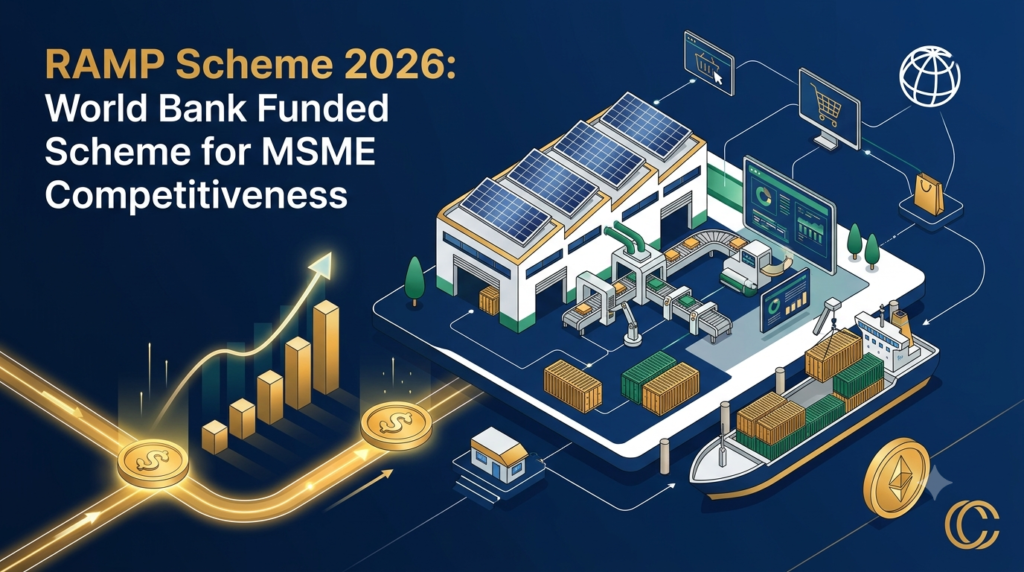
RAMP Scheme 2026: The Definitive Guide to the World Bank Funded Scheme for MSME Competitiveness in India
India’s Micro, Small, and Medium Enterprises (MSMEs) are widely recognized as the growth engine of the Indian economy. Contributing roughly 30% to India’s Gross Domestic Product (GDP), accounting for over 45% of manufacturing output, and generating employment for more than 110 million people, the sector is indispensable to India’s ambition of becoming a $5 trillion economy. Yet, despite their resilience, Indian MSMEs have historically battled structural headwinds: high cost of credit, collateral bottlenecks, delayed payments from large corporate buyers, limited access to national and global digital markets, and steep capital barriers when transitioning toward green, sustainable manufacturing.
To systematically dismantle these bottlenecks, the Government of India, in strategic partnership with the World Bank, launched the Raising and Accelerating MSME Performance (RAMP) Scheme. Approved by the Union Cabinet in March 2022 and formally launched on June 30, 2022, RAMP operates across a five-year implementation window from FY 2022–23 to FY 2026–27.
As we move through 2026—the decisive final stretch of the scheme’s five-year operational window—RAMP has evolved from a policy blueprint into an active, multi-pronged execution ecosystem. With four major operational sub-schemes (MSE-GIFT, MSE-SPICE, MSME TEAM, and MSE-ODR), active Strategic Investment Plans (SIPs) across participating States and Union Territories, and billions of rupees in leveraged credit and subsidies, 2026 represents a critical window of opportunity for Udyam-registered enterprises to upgrade their competitiveness before the current cycle concludes in March 2027.
In this comprehensive guide, our advisory team breaks down every facet of the RAMP Scheme 2026: its financial architecture, how the World Bank’s Programme-for-Results (PforR) model works, deep dives into each of its four flagship sub-schemes, state-level Strategic Investment Plans, eligibility norms, documentation checklists, and a step-by-step application roadmap.
1. What is the RAMP Scheme? Understanding the Strategic Vision
RAMP stands for Raising and Accelerating MSME Performance. Unlike traditional government schemes that operate as standalone, single-window cash subsidies, RAMP is structured as a Central Sector Scheme designed to act as an umbrella institutional and market-enabling program.
Its primary mandate is to strengthen the institutional governance of the MSME ecosystem at both the Central and State levels while simultaneously upgrading the technological, financial, and commercial capabilities of individual enterprises. Rather than duplicating existing schemes of the Ministry of Micro, Small and Medium Enterprises (MoMSME), RAMP amplifies their reach, plugs delivery leakages, modernizes digital infrastructure, and introduces targeted interventions where market failures persist.
Key Overview at a Glance (2026 Status)
| Parameter | Official Details |
| Scheme Name | Raising and Accelerating MSME Performance (RAMP) |
| Scheme Type | Central Sector Scheme (100% Central/World Bank Funded) |
| Nodal Ministry | Ministry of Micro, Small and Medium Enterprises (MoMSME), Govt. of India |
| International Partner | The World Bank (Programme-for-Results / PforR Instrument) |
| Total Financial Outlay | ₹6,062.45 Crore (approx. USD 808 Million) |
| World Bank Contribution | ₹3,750 Crore (USD 500 Million Loan) |
| Government of India Share | ₹2,312.45 Crore (USD 308 Million Counterpart Funding) |
| Implementation Period | 5 Years (FY 2022–23 to FY 2026–27) |
| Target Outreach | 5,55,000 (5.55 Lakh) MSMEs nationwide |
| Primary Sub-Schemes | MSE-GIFT, MSE-SPICE, MSME TEAM, MSE-ODR |
| Official Portal | ramp.msme.gov.in |
2. Financial Architecture & The World Bank PforR Model
To understand why the RAMP Scheme 2026 operates differently from legacy MSME programs, business owners and financial advisors must look at how the funds are structured and released.
Total Outlay Breakdown
The total approved corpus of ₹6,062.45 crore is split between multilateral development financing and domestic budgetary support:
World Bank Financing (₹3,750 Crore / USD 500 Million): Provided as an International Bank for Reconstruction and Development (IBRD) loan to the Government of India.
Government of India Counterpart Funding (₹2,312.45 Crore / USD 308 Million): Allocated through the annual budgetary provisions of the Ministry of MSME.
How the Programme-for-Results (PforR) Mechanism Works
The World Bank does not release its USD 500 million commitment upfront based merely on administrative expenditure. Instead, RAMP utilizes the World Bank’s Programme-for-Results (PforR) financing instrument. Under PforR, disbursements from the World Bank to the Government of India are strictly tied to the verified achievement of pre-agreed Disbursement Linked Indicators (DLIs).
This outcome-driven design ensures accountability across every tier of administration. By 2026, hundreds of projects across 36 States and Union Territories have been sanctioned under RAMP, impacting hundreds of thousands of enterprises and unlocking substantial tranches of World Bank reimbursement as milestones are met.
The Two Key Result Areas (KRAs) & Six DLIs
All RAMP funding and policy interventions map directly onto two overarching Key Result Areas (KRAs) governed by six Disbursement Linked Indicators (DLIs):
Key Result Area 1: Strengthening Institutions and Governance of the MSME Programme
DLI 1 – Implementing the National MSME Reform Agenda: Establishment of the apex National MSME Council, chaired by the Union Minister for MSME, alongside a unified Single Sign-On National MSME Portal to eliminate fragmented scheme discovery.
DLI 2 – Accelerating Centre-State Collaboration: Incentivizing States and UTs to formulate data-backed Strategic Investment Plans (SIPs) tailored to local industrial clusters.
Key Result Area 2: Support to Market Access, Firm Capabilities, and Access to Finance
DLI 3 – Enhancing Effectiveness of Technology Upgradation: Modernizing legacy technology schemes (such as CLCS-TUS) and accelerating clean/circular technology adoption.
DLI 4 – Strengthening the Receivable Financing Market: Expanding MSME onboarding and invoice discounting volumes on the TReDS (Trade Receivables Discounting System) platform.
DLI 5 – Enhancing CGTMSE & Greening/Gender Delivery: Scaling up collateral-free credit guarantees through the Credit Guarantee Fund Trust for Micro and Small Enterprises (CGTMSE), with dedicated targets for women-owned MSEs and green technology loans.
DLI 6 – Reducing the Incidence of Delayed Payments: Deploying technology-enabled Online Dispute Resolution (ODR) mechanisms to resolve buyer-seller payment defaults faster than traditional Micro and Small Enterprises Facilitation Councils (MSEFCs).
3. Core Objectives of the RAMP Scheme
For an MSME founder evaluating where RAMP fits into their 2026–27 growth strategy, the program’s objectives can be distilled into seven actionable pillars:
Bridging the Centre-State Delivery Gap: Historically, central MSME schemes struggled to penetrate Tier-2, Tier-3, and rural industrial clusters due to weak state-level execution capacity. RAMP funds state-level Program Management Units (PMUs) and grants to ensure last-mile delivery.
Democratizing Access to Formal Credit: By strengthening CGTMSE risk-sharing facilities and integrating TReDS receivable discounting, RAMP reduces lenders’ risk perception of micro and small borrowers.
Accelerating Green & Circular Economy Transition: Preparing Indian MSMEs for global carbon compliance (such as the EU’s Carbon Border Adjustment Mechanism – CBAM) and India’s Net-Zero 2070 target by subsidizing clean energy, energy efficiency, and waste-to-wealth machinery.
Solving the Working Capital & Delayed Payment Crisis: Delayed receivables choke MSME cash flows. RAMP tackles this through digitized ODR portals and tighter integration with MSME Samadhaan and TReDS.
Enabling Digital Market Access via ONDC: Moving small manufacturers and service providers away from high-commission private e-commerce monopolies onto India’s open digital commerce network (ONDC).
Prioritizing Women-Owned Enterprises: Across almost every RAMP sub-scheme—from ONDC onboarding (50% target for women entrepreneurs) to higher CGTMSE guarantee coverage—women-led MSMEs receive preferential incentives and dedicated outreach.
Formalization & Capacity Building: Encouraging unregistered micro-units to obtain Udyam Registration, adopt Zero Defect Zero Effect (ZED) quality standards, and upgrade managerial capabilities.
4. Deep Dive: The 4 Flagship Sub-Schemes Under RAMP (2026)
While RAMP’s institutional reforms happen behind the scenes, individual MSMEs directly access financial subsidies, interest subventions, and digital onboarding through four specialized sub-schemes launched under the RAMP umbrella. Understanding the exact mechanics of these four schemes is critical for maximizing your enterprise’s benefits in 2026.
Sub-Scheme 1: MSE-GIFT (Green Investment and Financing for Transformation)
As energy costs rise and global supply chains demand low-carbon footprints, upgrading to clean technology has become an economic necessity rather than an optional ESG exercise. However, green machinery often carries higher upfront capital expenditure. MSE-GIFT, implemented by the Small Industries Development Bank of India (SIDBI), directly lowers the cost of borrowing for green investments.
Total Outlay: ₹478 Crore (₹350 Crore for Interest Subvention, ₹125 Crore for Risk-Sharing Facility, and ₹3 Crore for Information, Education & Communication/Energy Audits).
Key Financial Benefits:
2% Per Annum Interest Subvention: Eligible MSMEs receive an interest rate reduction of 2% per annum on term loans up to ₹2 Crore taken for approved clean or green technology adoption. The subvention applies across the loan tenure (typically up to 5 years), directly lowering monthly EMIs.
75% Credit Guarantee Coverage (Risk-Sharing Facility): To encourage banks and NBFCs to lend without demanding heavy collateral, MSE-GIFT provides 75% credit guarantee coverage to participating Member Lending Institutions (MLIs) on green loans up to ₹2 Crore.
Energy Audit Vouchers: Under the IEC component, voucher-based support helps enterprises conduct energy audits and benchmark studies before purchasing machinery.
Eligible Green Sectors & Technologies:
Energy efficiency upgrades (high-efficiency motors, Variable Frequency Drives, waste heat recovery systems, solar thermal/rooftop installations).
Water management, wastewater treatment, and zero-liquid discharge (ZLD) plants.
Clean transportation (electric commercial vehicles, hybrid fleets, EV charging infrastructure).
Waste-to-energy, Compressed Biogas (CBG), bio-ethanol, and e-waste recycling.
Pollution control equipment and certified green industrial buildings.
Priority Focus: Special emphasis is placed on energy-intensive clusters (textiles, ceramics, foundries, forging, food processing, chemicals) and enterprises located in the North Eastern Region (NER).
How to Avail: Apply through any SIDBI-empanelled Member Lending Institution (Scheduled Commercial Banks, Small Finance Banks, or registered NBFCs) at the time of sanctioning a green term loan.
Sub-Scheme 2: MSE-SPICE (Scheme for Promotion and Investment in Circular Economy)
While MSE-GIFT subsidizes interest rates on green loans, MSE-SPICE provides a direct upfront capital subsidy to help Micro and Small Enterprises transition from a traditional linear economy (“take-make-waste”) to a circular economy (“reduce-reuse-recycle-recover”). Like MSE-GIFT, this sub-scheme is implemented by SIDBI.
Total Outlay: ₹472.50 Crore over a four-year operational window running through FY 2026–27.
Key Financial Benefit:
25% Credit-Linked Capital Subsidy: Eligible Micro and Small Enterprises receive a 25% capital subsidy on the cost of eligible plant and machinery for circular economy projects.
Project & Subsidy Ceiling: Applicable on projects costing up to ₹2 Crore, with the maximum capital subsidy capped at ₹12.50 Lakh per enterprise.
Crucial Eligibility Conditions (Read Carefully):
Micro & Small Only: Strictly restricted to Udyam-registered Micro and Small enterprises. Medium enterprises are not eligible under MSE-SPICE.
Brownfield Projects Only: MSE-SPICE is designed to upgrade existing operating units. Only brownfield projects (existing enterprises upgrading processes or adding circular recycling/recovery lines) qualify; greenfield startups are excluded.
Credit-Linked Requirement: The project must be financed via a term loan from an eligible lending institution to trigger the capital subsidy.
Strategic Advantage: For manufacturing units generating scrap, plastic waste, effluent sludge, metal shavings, or packaging waste, MSE-SPICE effectively pays for a quarter of the machinery required to convert waste back into usable raw material or marketable by-products.
Sub-Scheme 3: MSME TEAM Initiative (Trade Enablement and Marketing)
Customer acquisition and e-commerce commissions are two of the biggest hurdles preventing small Indian manufacturers from scaling nationwide. Launched under RAMP and implemented by the National Small Industries Corporation (NSIC) in collaboration with the Open Network for Digital Commerce (ONDC), the MSME TEAM Initiative democratizes digital commerce for 5 lakh micro and small enterprises.
Total Outlay: ₹277.35 Crore (operational through FY 2026–27).
Target & Women Entrepreneurship Mandate: Targets 5,00,000 Micro and Small Enterprises, with 50% (2,50,000 slots) specifically reserved for women-owned enterprises.
What MSMEs Receive (Zero Registration Fee):
Free ONDC Onboarding: Complete handholding through empanelled Seller Network Participants (SNPs) to register on the ONDC network, making your products discoverable across multiple buyer apps simultaneously (such as Paytm, Mystore, Ola, Craftsvilla, etc.).
Digital Catalogue Creation Support: Financial assistance up to ₹2,500 per MSE (routed to the SNP) to build high-converting, ONDC-compliant digital product catalogues with proper taxonomy, pricing, and imagery.
Account Management Assistance: Support capped at ₹5,000 per MSE for ongoing account management, inventory syncing, and digital storefront optimization during the crucial initial months.
Logistics & Packaging Subsidies: Subsidized support for order fulfillment—typically covering logistics assistance (up to ₹50 per B2C order or ₹200 per B2B order for initial orders) and packaging material/design support (in collaboration with the Indian Institute of Packaging – IIP).
Eligibility Rules for MSME TEAM:
Must be a Udyam-registered Micro or Small Enterprise (Medium enterprises are excluded).
Primary business activity must be Manufacturing or Services (pure retail/wholesale trading firms are excluded from scheme subsidies).
Must not already be selling on ONDC prior to applying.
GST Note: Enterprises with Udyam Registration but without GSTIN can still join under TEAM, though their sales are restricted to intra-state transactions as per GST laws.
Sub-Scheme 4: MSE-ODR (Online Dispute Resolution for Delayed Payments)
Delayed payments from corporate buyers and government agencies remain the number-one killer of MSME working capital. Even when an MSME files a claim under Section 18 of the MSMED Act, 2006 via the MSME Samadhaan portal, physical hearings at state Facilitation Councils (MSEFCs) can drag on for months or years.
To solve this, RAMP introduced the MSE-ODR Scheme, creating an end-to-end, AI-enabled Online Dispute Resolution architecture (with technical implementation support from NICSI).
How MSE-ODR Transforms Recovery:
Digital-First Conciliation & Arbitration: Integrates automated digital notices, virtual conciliation rooms, and online arbitration workflows so MSMEs in remote districts do not have to hire expensive lawyers or travel to state capitals for hearings.
Integration with MSME Samadhaan: Seamlessly links existing delayed-payment filings with accredited ODR institutions, targeting fast-track disposal within statutory timelines (aiming toward the 90-day benchmark under the MSMED Act).
Receivables Financing Synergy: Works hand-in-hand with RAMP’s push to onboard more corporate buyers and MSMEs onto TReDS, preventing payment delays before they happen by allowing MSMEs to auction unpaid corporate invoices for instant cash.
Summary Comparison of RAMP Sub-Schemes (2026)
| Sub-Scheme | Implementing Agency | Core Benefit | Financial Cap / Support | Eligible Category |
| MSE-GIFT | SIDBI | 2% Interest Subvention + 75% Credit Guarantee on Green Loans | Loans up to ₹2 Crore | Udyam-registered MSMEs (Micro, Small & Medium) |
| MSE-SPICE | SIDBI | 25% Credit-Linked Capital Subsidy for Circular Economy | Max ₹12.50 Lakh subsidy (on projects up to ₹2 Cr) | Udyam-registered Micro & Small (Brownfield only) |
| MSME TEAM | NSIC & ONDC | Free ONDC Onboarding, Catalogue, Logistics & Packaging Support | Up to ₹2,500 catalogue + ₹5,000 account mgmt + order subsidies | Udyam-registered Micro & Small (Mfg & Services) |
| MSE-ODR | MoMSME / NICSI | AI-powered Online Dispute Resolution for Delayed Payments | End-to-end digital legal resolution portal | Udyam-registered Micro & Small Enterprises |
5. State-Level Strategic Investment Plans (SIPs): Where Local Benefits Live
One of the least understood—yet most lucrative—aspects of the RAMP Scheme 2026 is how funds flow to individual states. RAMP is not run purely from New Delhi; 36 States and Union Territories participate in the program by drafting bespoke Strategic Investment Plans (SIPs).
What is a Strategic Investment Plan (SIP)?
An SIP is a multi-year diagnostic and investment roadmap prepared by a State Government’s Department of Industries/MSME, approved by the National MSME Council. Based on the approved SIP, the Ministry of MSME releases direct grants to the state to execute localized competitiveness projects.
What State SIPs Fund for Local MSMEs:
Depending on your state’s approved SIP (for example, Maharashtra, Gujarat, Tamil Nadu, Karnataka, Uttar Pradesh, Rajasthan, Punjab, or Odisha), state-level RAMP grants frequently cover:
Common Facility Centres (CFCs) & Testing Labs: subsidized access to R&D labs, tool rooms, packaging testing, and quality certification centers within local industrial clusters.
Export Promotion & International Trade Fairs: Financial reimbursement for participating in international exhibitions, Reverse Buyer-Seller Meets (RBSMs), and export compliance training.
ZED Certification Handholding: Subsidized consultancy and assessment fees to achieve MSME Sustainable (ZED) Certification (Bronze, Silver, or Gold).
Intellectual Property & Technology Clinics: Grants for patent/trademark filings, Lean Manufacturing competitiveness workshops, and ERP/cloud digitalization adoption.
District-Level Facilitation Desks: Dedicated RAMP enterprise clinics at District Industries Centres (DICs) offering free DPR (Detailed Project Report) vetting and credit linkage support.
Pro Tip from Our Advisory Desk: Even if your business does not need a green loan (MSE-GIFT) or ONDC onboarding (TEAM), check your State Directorate of Industries portal or local District Industries Centre (DIC) for active RAMP State SIP tenders and cluster programs. Many state-level RAMP interventions offer 50% to 80% fee reimbursements for quality certifications, export readiness, and lean manufacturing audits.
6. Comprehensive Eligibility Criteria for RAMP Scheme 2026
Because RAMP operates as an umbrella program with multiple sub-schemes, eligibility works on two tiers: Baseline Umbrella Eligibility and Sub-Scheme Specific Filters.
Tier 1: Mandatory Baseline Eligibility
Valid Udyam Registration: Your enterprise must be registered on the official Udyam Registration Portal (
udyamregistration.gov.in) under the MSMED Act, 2006. Unregistered businesses cannot access any RAMP intervention.Enterprise Classification: Must fall within the official MSME turnover and investment thresholds (Micro, Small, or Medium enterprises, noting that certain sub-schemes restrict access strictly to Micro and Small units).
Active Operational Status: The enterprise must have active business operations, a valid PAN, and a dedicated current bank account in the enterprise’s name.
Tier 2: Sub-Scheme Specific Checks
For MSE-GIFT: Open to Micro, Small, and Medium enterprises. Requires sanction of an eligible green-technology term loan (up to ₹2 Crore) from a SIDBI-empanelled bank or NBFC.
For MSE-SPICE: Restricted to Micro and Small Enterprises only (Medium enterprises excluded). Must be an existing brownfield unit upgrading to circular economy machinery via an institutional term loan.
For MSME TEAM: Restricted to Micro and Small Enterprises engaged in Manufacturing or Services (pure traders excluded). Enterprise must not have previously onboarded onto ONDC or claimed duplicate state/central ONDC subsidies.
For MSE-ODR: Open to Udyam-registered Micro and Small sellers facing delayed payment disputes against institutional/corporate buyers.
7. Essential Documents Required for Application
Having a clean, audit-ready documentation file dramatically speeds up approval times—especially when applying through banks (for MSE-GIFT/SPICE) or Seller Network Participants (for MSME TEAM). Prepare scanned PDF copies of the following:
Udyam Registration Certificate (updated with latest NIC codes and turnover details).
Entity KYC & Constitution Documents:
Proprietorship: Proprietor PAN, Aadhaar, and shop/establishment license.
Partnership / LLP: Registered Partnership Deed / LLP Agreement, Certificate of Incorporation, and PAN.
Private Limited Company: Certificate of Incorporation (COI), Memorandum & Articles of Association (MoA/AoA), and Board Resolution authorizing the application.
GST Registration Certificate (mandatory for inter-state ONDC sales under TEAM and standard for term loans under GIFT/SPICE).
Financial Statements: Audited Balance Sheets, Profit & Loss (P&L) accounts, and Income Tax Returns (ITRs) for the last 2–3 financial years (along with last 6–12 months’ bank statements for credit-linked schemes).
Project-Specific Technical Documents:
For MSE-GIFT & MSE-SPICE: Detailed Project Report (DPR), vendor quotations/proforma invoices for the green or circular machinery, energy audit report (if applicable), and Pollution Control Board NOC/Consent to Operate (where applicable).
For MSME TEAM: High-resolution product photographs, SKU list with dimensions/weights, HSN codes, MRP/selling price list, and FSSAI/BIS certifications (if selling food or regulated goods).
For MSE-ODR: Purchase orders, signed contracts, tax invoices, delivery challans/e-way bills, and ledger statements proving overdue receivables beyond 45 days.
8. Step-by-Step Guide: How to Apply for RAMP Scheme Benefits in 2026
Because RAMP routes its benefits through specialized nodal agencies rather than a single form, follow this exact workflow based on the benefit you want to unlock:
Route A: Applying for Green Loans & Capital Subsidies (MSE-GIFT & MSE-SPICE)
Verify Udyam & Project Fit: Confirm whether your investment is a clean/energy-saving upgrade (MSE-GIFT) or a circular recycling/waste-recovery upgrade (MSE-SPICE). Ensure your Udyam certificate reflects your current enterprise size.
Prepare Your DPR & Machinery Quotes: Obtain formal quotations from machinery vendors clearly specifying technical parameters (energy savings, emission reduction, or circular material recovery).
Approach a Participating Lender (MLI): Visit your existing commercial bank, Small Finance Bank, or any SIDBI-empanelled financial institution. Explicitly request that your term loan application (up to ₹2 Crore) be tagged under SIDBI’s MSE-GIFT (for 2% interest subvention + 75% guarantee cover) or MSE-SPICE (for 25% capital subsidy).
Portal Registration & Lender Submission: Your lending institution uploads the sanction details onto SIDBI’s dedicated green finance portal for subvention/subsidy validation.
Disbursement & Benefit Credit: Upon verification by SIDBI, the 2% interest subvention is credited periodically against your loan interest, or the 25% capital subsidy (up to ₹12.50 Lakh) is released toward your term loan principal.
Route B: Applying for Free ONDC Digital Onboarding (MSME TEAM)
Visit the Official Portal: Go to the official RAMP portal (ramp.msme.gov.in) and navigate to the MSME TEAM Initiative section (or visit
team.msmemart.com).Authenticate via Udyam: Enter your Udyam Registration Number and verify via OTP sent to your Udyam-registered mobile number.
Select Your Seller Network Participant (SNP): Review the list of empanelled ONDC Seller Apps categorized by product domain, regional language, and state coverage. Tip: Compare commercial terms (post-subsidy commission and settlement cycles) before selecting your SNP, as you are only allowed to switch your SNP once.
Complete KYC & Digital Catalogue: Upload your product SKUs, images, and pricing. Your chosen SNP builds your ONDC-compliant storefront using the government-funded ₹2,500 cataloguing grant.
Go Live & Claim Order Subsidies: Once your store goes live and you fulfill your first two orders, account management (up to ₹5,000), logistics, and packaging incentives activate automatically for your first six months of trading.
Route C: Accessing State-Level RAMP Programs (SIPs)
Visit ramp.msme.gov.in and click on State Collaboration.
Select your State/UT to view approved Strategic Investment Plan (SIP) interventions, state nodal officers, and active cluster schemes.
Contact your local District Industries Centre (DIC) or State MSME Directorate to enroll in active training, ZED certification, export, or technology upgrade cohorts.
9. Common Mistakes & Pitfalls MSMEs Must Avoid
When advising MSME founders on government-backed financing and subsidies, we repeatedly see preventable errors delay or disqualify strong applications:
Paying Middlemen for “MSME TEAM / ONDC Registration”: Registration on the official MSME TEAM portal is 100% free. The government pays milestone incentives directly to empanelled Seller Network Participants (SNPs) to onboard you. Never pay an unauthorized agent a “registration fee” to enroll you under TEAM.
Applying for MSE-SPICE for a Greenfield Startup: MSE-SPICE strictly covers brownfield projects—meaning your manufacturing or service unit must already exist and be upgrading to circular processes. Greenfield setups will be rejected at screening.
Mismatched NIC Codes on Udyam Certificates: If your Udyam certificate lists your primary activity as “Trading” (NIC Division 45, 46, or 47), you will be disqualified from MSME TEAM (which requires Manufacturing or Services) and industrial capital subsidies. Ensure your Udyam NIC codes accurately reflect your manufacturing or service operations before applying.
Waiting Until the Last Quarter of FY 2026–27: RAMP’s current five-year mandate concludes in March 2027. Sub-scheme budgets (like the ₹478 Cr for MSE-GIFT and ₹472.5 Cr for MSE-SPICE) operate on a committed corpus basis. Submitting applications in mid-to-late 2026 gives banks and SIDBI sufficient processing runway before fiscal year-end cutoffs.
Ignoring TReDS & ODR Integration: Many MSMEs wait until an invoice is 180 days overdue before taking action. Registering on TReDS alongside using RAMP’s MSE-ODR framework creates both preventive liquidity and rapid legal recourse.
10. Frequently Asked Questions (FAQs) About RAMP Scheme 2026
Q1. Does the RAMP Scheme provide direct cash grants into an MSME’s bank account?
No. RAMP is an ecosystem-strengthening umbrella program rather than a direct unconditional cash handout. Financial benefits reach MSMEs in the form of 2% interest subvention on loans (MSE-GIFT), 25% credit-linked capital subsidies on machinery (MSE-SPICE), collateral-free credit guarantees (CGTMSE/RSF), and sponsored digital onboarding, logistics, and packaging credits (MSME TEAM).
Q2. What is the deadline to apply for RAMP Scheme benefits?
The RAMP Scheme operates over a five-year period from FY 2022–23 to FY 2026–27 (ending March 31, 2027). However, individual sub-schemes (such as MSE-GIFT, MSE-SPICE, and MSME TEAM) and state-level SIP calls have rolling windows that close once their allocated financial corpus is fully committed. MSMEs should initiate applications in 2026 without delay.
Q3. Are Medium Enterprises eligible for all RAMP sub-schemes?
No. While Medium Enterprises are eligible for MSE-GIFT (green technology interest subvention and guarantee) and broader state-level SIP market/export programs, sub-schemes like MSE-SPICE (circular economy capital subsidy), MSME TEAM (ONDC onboarding), and MSE-ODR are restricted exclusively to Micro and Small Enterprises (MSEs).
Q4. Can I combine RAMP sub-schemes with other Government of India MSME schemes?
Yes, provided there is no double-dipping on the exact same cost component. For example, an enterprise can obtain MSME ZED Certification, onboard onto ONDC via MSME TEAM for digital sales, and simultaneously take a green machinery term loan under MSE-GIFT—as each intervention addresses a distinct operational area. However, you cannot claim two different central/state capital subsidies on the exact same machine.
Q5. How does RAMP specifically support women entrepreneurs?
Women-owned MSMEs receive targeted priority across RAMP. Under the MSME TEAM Initiative, 50% of the 5 lakh beneficiary target (2.5 lakh enterprises) is reserved for women-led businesses. Additionally, RAMP’s CGTMSE enhancement and MSE-GIFT guidelines provide higher guarantee coverage and dedicated outreach for women entrepreneurs to overcome collateral barriers.
Related posts:
RAMP Scheme Cluster Development: How Industrial Clusters Get Liveability Grants
Agri Infra Fund for Food Processing MSMEs: Complete Guide to 3% Interest Subvention, Eligibility, Be...
PM-DAKSH Yojana for MSME Artisans: Free Training with Stipend 2025
SRIJAN Scheme for SC/ST Entrepreneurs Under NSIC: Benefits & Eligibility
National SC-ST Hub Scheme: Benefits, Eligibility & Complete Guide for SC/ST MSME Entrepreneurs
ECLGS Extension 2025: Is Emergency Credit Line Still Available for MSMEs?
NSIC Single Point Registration Scheme: How MSMEs Get Tender Benefits
Atal Innovation Mission (AIM): Complete Guide to Grants for Startups and MSMEs in 2026
PM MUDRA Yojana 2026: Shishu, Kishor, Tarun & Tarun Plus Loan Limits, Interest Rates, and Comple...
PM Surya Ghar Muft Bijli Yojana for MSME Factory Rooftop: Subsidy, Rules & Tax Benefits (2026 Co...
Related posts:
 Self Reliant India (SRI) Fund: Rs 50,000 Cr Equity Infusion for MSMEs Explained
 Credit Guarantee Scheme for Exporters (CGSE): New 2025 Scheme for MSME Exporters
 Agri Infra Fund for Food Processing MSMEs: Complete Guide to 3% Interest Subvention, Eligibility, Benefits and Application Process
 GST on Corporate Guarantee to Subsidiary MSME: New Valuation Rule 2025 – Complete Guide to Rule 28(2), 1% GST Valuation and ITC