Section 80D – Health Insurance Tax Deduction: The Ultimate Guide for Indian Taxpayers (2025–26)
Why Section 80D Matters More Than Ever
Healthcare costs in India have been rising at an alarming rate. According to various industry reports, medical inflation in India is consistently running at 14% to 15% per annum — nearly double the general inflation rate. A single hospitalisation today can wipe out years of savings for a middle-class family. Against this backdrop, having comprehensive health insurance is no longer a luxury; it is an absolute necessity.
The Government of India recognises this reality and, under the Income Tax Act, 1961, has provided a significant tax incentive for buying health insurance through Section 80D. This provision allows individuals and Hindu Undivided Families (HUFs) to claim a deduction from their gross total income for premiums paid towards health insurance policies, preventive health check-ups, and even contributions to the Central Government Health Scheme (CGHS).
In this comprehensive guide, we will walk you through every aspect of Section 80D — what it is, who is eligible, how much you can claim, what expenses qualify, the specific rules for senior citizens, how to maximise your deduction, common mistakes to avoid, and how to claim it correctly while filing your Income Tax Return (ITR). Whether you are a salaried employee, a self-employed professional, or a business owner, this guide will help you unlock the full tax-saving potential of Section 80D.
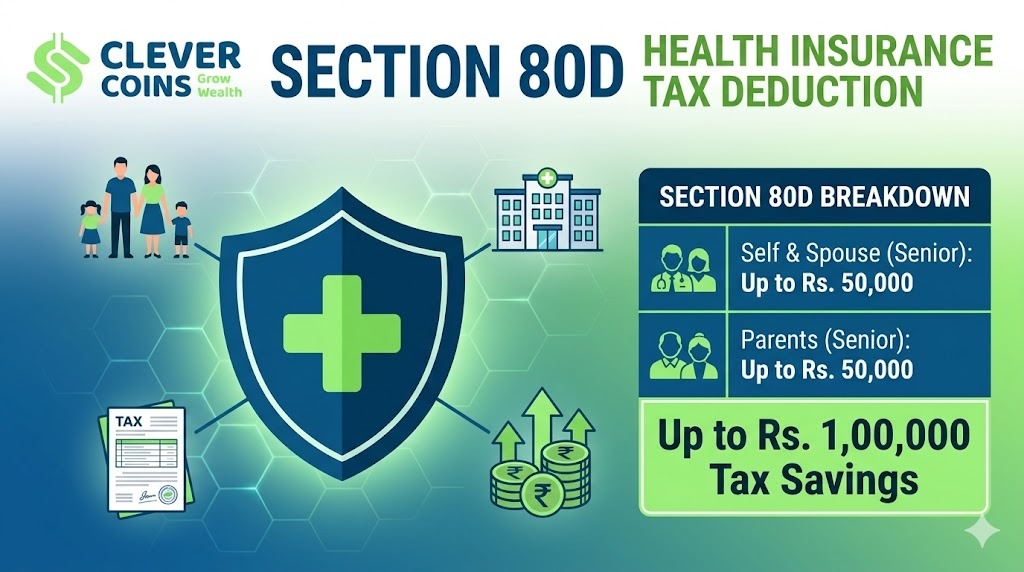
Key Insight: A family of four — self, spouse, two children, and both parents — can potentially claim a total Section 80D deduction of up to Rs. 1,00,000 in a single financial year, leading to tax savings of up to Rs. 31,200 (at the 30% tax bracket including 4% cess).
What is Section 80D of the Income Tax Act?
Section 80D is a provision under Chapter VI-A of the Income Tax Act, 1961, that allows a deduction from gross total income for amounts paid towards:
- Premiums for health insurance policies (mediclaim policies) for self, spouse, dependent children, and parents
- Contributions made to the Central Government Health Scheme (CGHS) or any other notified scheme
- Amounts paid for preventive health check-ups (subject to an inner limit)
- Medical expenditure incurred on senior citizens who are not covered by any health insurance policy
This deduction is available only to Individuals and HUFs. It is NOT available to companies, partnership firms, LLPs, or other entities. The deduction is over and above the Rs. 1.5 lakh limit under Section 80C, making it one of the most valuable additional tax deductions available to Indian taxpayers.
Important: Section 80D deductions are available only under the Old Tax Regime. If you have opted for the New Tax Regime under Section 115BAC, you CANNOT claim Section 80D deductions.
Section 80D Deduction Limits: A Complete Breakdown
1. For Self, Spouse, and Dependent Children (Below 60 Years)
If the individual (and/or their spouse and dependent children) is below 60 years of age, the maximum deduction allowed for health insurance premiums paid for them is Rs. 25,000 per financial year. This includes an inner limit of up to Rs. 5,000 specifically for preventive health check-ups.
2. For Parents (Below 60 Years)
An additional deduction of up to Rs. 25,000 is allowed for health insurance premiums paid for the taxpayer’s parents, provided the parents are below 60 years of age. This deduction is available regardless of whether the parents are financially dependent on the taxpayer or not.
3. For Self/Spouse/Children (Senior Citizen – 60 Years or Above)
If the taxpayer themselves is a senior citizen (60 years of age or above), the deduction limit for health insurance premiums (or medical expenditure if uninsured) increases to Rs. 50,000 per financial year.
4. For Parents (Senior Citizen – 60 Years or Above)
If the parents for whom the premium is being paid are senior citizens (60 years or above), the additional deduction limit is Rs. 50,000. This is a significant benefit given that health insurance premiums for senior citizens are considerably higher than for younger individuals.
5. Medical Expenditure for Uninsured Senior Citizens
A very important provision added in the Finance Act, 2018, allows a taxpayer to claim deduction for medical expenditure incurred on a senior citizen (aged 60 or above) even if the senior citizen is NOT covered by any health insurance policy. The limit for this deduction is Rs. 50,000, subject to the condition that no health insurance premium has been paid for that senior citizen during the financial year.
Section 80D Deduction: Quick Reference Master Table
Scenario | Self/Spouse/Children | Parents | Total Max Deduction |
Self & family below 60; Parents below 60 | Rs. 25,000 | Rs. 25,000 | Rs. 50,000 |
Self & family below 60; Parents Senior Citizen (60+) | Rs. 25,000 | Rs. 50,000 | Rs. 75,000 |
Self is Senior Citizen (60+); Parents also Senior Citizen (60+) | Rs. 50,000 | Rs. 50,000 | Rs. 1,00,000 |
Self is Senior Citizen (60+); Parents below 60 | Rs. 50,000 | Rs. 25,000 | Rs. 75,000 |
Medical Expenditure (Uninsured Senior Citizen – Self or Parents) | Up to Rs. 50,000 | Up to Rs. 50,000 | Up to Rs. 1,00,000 |
Note: The preventive health check-up amount of Rs. 5,000 is part of the overall limit (not in addition to it). For example, if your total limit is Rs. 25,000, you can claim Rs. 20,000 as premium and Rs. 5,000 as preventive health check-up.
What Expenses Qualify Under Section 80D?
A. Health Insurance Premiums
Premiums paid towards any health insurance policy that qualifies under the Insurance Regulatory and Development Authority of India (IRDAI) guidelines are eligible for deduction under Section 80D. This includes:
- Individual health insurance plans (mediclaim)
- Family floater health insurance plans
- Critical illness insurance policies
- Top-up health insurance plans
- Super top-up health insurance plans
- Health insurance plans offered by life insurance companies (as a rider or standalone)
- Group health insurance plans provided by employers (if premium is paid by the employee)
B. Preventive Health Check-Ups
Amounts paid for preventive health check-ups qualify for deduction up to Rs. 5,000 per year (within the overall limit). This inner sub-limit applies to preventive health check-ups for self, spouse, dependent children, and parents. Unlike health insurance premiums, preventive health check-up expenses can be paid in cash and still qualify for the deduction.
C. Central Government Health Scheme (CGHS) and Other Notified Schemes
Contributions made to the Central Government Health Scheme (CGHS) are eligible for deduction under Section 80D. Similarly, contributions to any other health scheme specifically notified by the Central Government also qualify. This provision is particularly relevant for central government employees who are covered under CGHS.
D. Medical Expenditure for Uninsured Senior Citizens
As mentioned earlier, actual medical expenditure (doctor fees, hospital bills, medicines, diagnostic tests, etc.) incurred on a senior citizen family member who is NOT covered by health insurance qualifies for a deduction of up to Rs. 50,000. This is a very practical relief for taxpayers who have elderly parents who may not be able to afford or obtain health insurance due to pre-existing conditions.
Who Can Claim Section 80D Deduction?
Eligible Assesses
- Individual taxpayers (resident or non-resident)
- Hindu Undivided Families (HUFs) — the HUF can claim deduction for insurance of its members
Family Members Covered
An individual can claim Section 80D deduction for premiums paid for health insurance covering:
- Self
- Spouse
- Dependent children (no age limit for dependent children, but must be financially dependent on the taxpayer)
- Parents (father and/or mother — independent of whether they are financially dependent or not)
Note: Siblings, grandparents, in-laws, and other relatives do NOT qualify for Section 80D deduction.
Who Cannot Claim Section 80D?
- Companies (public or private limited)
- Partnership firms and LLPs
- Associations of Persons (AOPs) or Bodies of Individuals (BOIs)
- Taxpayers who have opted for the New Tax Regime under Section 115BAC
- Taxpayers paying premiums in cash (except preventive health check-ups — see below)
Mode of Payment: A Critical Condition
This is one of the most commonly overlooked conditions of Section 80D. The deduction for health insurance premiums is available ONLY if the payment is made by any mode OTHER than cash. Acceptable payment modes include:
- Net banking / NEFT / RTGS / IMPS
- Debit card or credit card
- Cheque or demand draft
- UPI (Unified Payments Interface)
- Wallet or mobile payment apps (linked to bank account)
Exception: Preventive health check-up expenses up to Rs. 5,000 can be paid in CASH and still qualify for the Section 80D deduction. This is the only component where cash payment is permitted.
If you pay your health insurance premium in cash, the entire premium amount will be disallowed under Section 80D. Always pay your health insurance premiums through electronic or non-cash modes to ensure you can claim the deduction.
Section 80D for Hindu Undivided Families (HUFs)
A Hindu Undivided Family (HUF) is also eligible to claim deductions under Section 80D. An HUF can claim deduction for health insurance premiums paid for insuring the health of its members. The deduction limit for an HUF is:
- 25,000 if the member insured is below 60 years of age
- 50,000 if the member insured is a senior citizen (60 years or above)
The HUF can also claim deduction for medical expenditure on senior citizen members who are not covered by health insurance, subject to the Rs. 50,000 limit. However, the HUF CANNOT claim the preventive health check-up deduction of Rs. 5,000 — this sub-limit is available only to individuals.
Special Provisions for Senior Citizens Under Section 80D
Senior citizens (individuals aged 60 years or above) enjoy significantly enhanced benefits under Section 80D. The government’s rationale is that elderly individuals face much higher healthcare costs and may have limited income, particularly if retired. Here is a complete breakdown of the enhanced provisions:
Enhanced Deduction Limit of Rs. 50,000
A senior citizen taxpayer can claim deduction of up to Rs. 50,000 for health insurance premiums paid for themselves and their family (spouse and dependent children). Similarly, if a taxpayer’s parents are senior citizens, an additional Rs. 50,000 is available for their health insurance premiums.
Deduction Without Health Insurance: The Medical Expenditure Clause
The most significant provision for senior citizens is that even if a senior citizen is NOT covered by any health insurance policy, actual medical expenditure incurred on their treatment is eligible for deduction up to Rs. 50,000. This applies to:
- A senior citizen taxpayer who does not have health insurance for themselves
- A taxpayer’s senior citizen parents who do not have health insurance
This provision acknowledges the practical difficulty of elderly individuals obtaining affordable health insurance, especially those with pre-existing conditions. Eligible medical expenditures include hospital bills, doctor consultation fees, medicines, diagnostics, and other treatment-related costs.
Preventive Health Check-Up for Senior Citizens
Senior citizens can also claim the Rs. 5,000 sub-limit for preventive health check-ups. This is included within the overall Rs. 50,000 limit and not over and above it.
Section 80D for Multi-Year Health Insurance Policies
Many health insurers now offer multi-year health insurance policies where the premium is paid in a lump sum for 2 or 3 years. In such cases, the Section 80D deduction is proportionate — the lump sum premium is divided by the number of years and the proportionate amount is claimed each year.
For example, if you pay Rs. 60,000 as a 3-year premium for a family floater health insurance policy (covering self and family, all below 60), the deduction allowed each year would be Rs. 20,000 (Rs. 60,000 / 3), subject to the annual maximum limit of Rs. 25,000.
Tax Tip: Even if the proportionate annual premium exceeds the limit, only the maximum permissible limit (Rs. 25,000 or Rs. 50,000 as applicable) is allowed as deduction in each year.
Group Health Insurance Provided by Employer and Section 80D
Many employers provide group health insurance to their employees as part of the CTC (Cost to Company) or as a separate benefit. The tax treatment depends on who bears the premium:
When Employer Pays the Premium
If your employer pays the health insurance premium on your behalf, the premium amount is added to your salary as a perquisite and you are taxed on it. HOWEVER, since you have not paid the premium out of your own pocket, you CANNOT claim Section 80D deduction for the employer-paid portion.
When Employee Pays the Premium (Salary Deduction)
Some employers deduct the group health insurance premium from the employee’s salary. In this case, since the employee is effectively bearing the cost of the premium from their post-tax salary, they CAN claim Section 80D deduction for the premium amount deducted from their salary.
Top-Up Insurance in Addition to Group Cover
If your employer provides group health insurance but you purchase an additional individual or family floater policy for better coverage, you can claim Section 80D deduction for the additional policy premium you pay from your own funds.
How to Claim Section 80D Deduction While Filing ITR
Claiming Section 80D deduction is a straightforward process during ITR filing. Here is a step-by-step guide:
- Collect all health insurance premium payment receipts for the financial year from your insurer. The insurer typically provides a premium receipt or certificate that mentions the policy details and the premium amount paid.
- Ensure all premiums (except preventive health check-ups) have been paid through non-cash modes. Keep proof of payment (bank statement, UPI receipt, credit card statement, etc.).
- Collect preventive health check-up bills/receipts (up to Rs. 5,000).
- If claiming medical expenditure for uninsured senior citizens, maintain detailed bills, prescriptions, and payment records.
- While filing your ITR (typically ITR-1 for salaried employees, ITR-2 for individuals with capital gains or multiple income sources, etc.), navigate to the Chapter VI-A deductions section.
- Enter the eligible amount under Section 80D — separately for self/family and for parents, and separately for preventive health check-ups.
- The ITR forms have dedicated fields to enter: (a) Premium paid for self/family, (b) Premium paid for parents, (c) Preventive health check-up for self/family, (d) Preventive health check-up for parents, (e) Medical expenditure for senior citizens.
- You do not need to submit documents/proofs while filing your ITR online. However, you must retain all receipts and payment proofs for at least 6-7 years as the Income Tax Department can call for them during scrutiny.
Pro Tip: If you are a salaried employee, ensure you submit your health insurance premium payment details to your employer before the cut-off date (usually December or January) so that your employer considers Section 80D while computing TDS on salary. This avoids TDS being deducted at a higher rate and you having to claim a refund later.
Section 80D: Old Tax Regime vs New Tax Regime
Aspect | Old Tax Regime | New Tax Regime (115BAC) |
Section 80D Deduction | Available | NOT Available |
Health Insurance Premium Deduction | Yes – up to Rs. 25,000 / 50,000 | No |
Preventive Health Check-Up | Yes – up to Rs. 5,000 | No |
Medical Expenditure (Senior Citizen) | Yes – up to Rs. 50,000 | No |
CGHS Contribution | Yes | No |
Max Deduction for Family | Up to Rs. 1,00,000 | Nil |
Suitable For | Those with high insurance premiums & investments | Those with fewer deductions |
Taxpayers should carefully evaluate which tax regime is more beneficial for them. If your health insurance premiums (plus other deductions like 80C, HRA, etc.) are significant, the Old Tax Regime may result in a lower overall tax outgo despite having slightly higher tax rates at some income levels.
Section 80D vs Section 80DDB: Understanding the Difference
Section 80DDB is a separate but related provision that many taxpayers confuse with Section 80D. Here is a clear distinction:
Parameter | Section 80D | Section 80DDB |
Purpose | Health insurance premiums & preventive check-ups | Treatment of specified diseases |
Deduction Type | Premium-based (not actual medical cost) | Actual medical expenditure |
Diseases Covered | Any illness (preventive + insurance) | Specific diseases (cancer, neurological disorders, AIDS, chronic kidney disease, etc.) |
Maximum Deduction | Up to Rs. 1,00,000 | Up to Rs. 40,000 (or Rs. 1,00,000 for senior citizens) |
Certificate Required | Premium receipt from insurer | Certificate from specialist doctor in prescribed format |
Applicable To | Individuals and HUFs | Individuals and HUFs (resident) |
Taxpayers treating specified diseases can claim BOTH Section 80D and Section 80DDB simultaneously, subject to respective limits and conditions.
How to Maximise Your Section 80D Tax Savings: Expert Tips
Tip 1: Cover Parents Separately
Buy a separate health insurance policy for your parents instead of including them in your family floater. This unlocks the additional Rs. 25,000 or Rs. 50,000 (if parents are senior citizens) deduction over and above your own Rs. 25,000 limit.
Tip 2: Ensure Senior Citizen Parents Are Covered or Track Medical Bills
If your parents are senior citizens, either get them a dedicated senior citizen health insurance policy to claim the Rs. 50,000 deduction, OR systematically track all their medical expenditure bills throughout the year if they are not insured. Either way, you can claim up to Rs. 50,000.
Tip 3: Do Not Miss the Preventive Health Check-Up Deduction
Rs. 5,000 may seem small, but it is essentially a free tax deduction since you would typically pay for annual health check-ups anyway. Schedule annual preventive health check-ups for the family and collect the bills for tax purposes.
Tip 4: Pay Premiums Before March 31
Ensure all health insurance premium payments are made before March 31 of the financial year. Premiums paid after March 31 (for the next policy year) will count in the next financial year’s Section 80D claim.
Tip 5: Avoid Cash Payments for Premiums
Always pay health insurance premiums by cheque, net banking, UPI, or card. Never pay by cash (except for preventive health check-ups up to Rs. 5,000).
Tip 6: Submit Investment Declaration to Employer on Time
If you are salaried, submit your Section 80D investment declaration to your HR or accounts department before the cut-off date (typically December-January). Attach premium payment receipts so your employer reduces TDS deduction accordingly.
Tip 7: Consider Top-Up or Critical Illness Plans
Premiums for top-up and critical illness policies also qualify under Section 80D. If you already have a group cover from your employer, consider a top-up policy for additional coverage — you can claim the premium under Section 80D.
Tip 8: Claim CGHS Contributions
If you are a central government employee covered under CGHS, your monthly CGHS contribution qualifies for deduction under Section 80D. Ensure you claim the total annual CGHS deduction from your salary.
Common Mistakes to Avoid Under Section 80D
- Paying health insurance premiums in cash and expecting to claim the deduction (not allowed — only preventive check-ups can be paid in cash).
- Claiming deduction for health insurance premiums paid for siblings or in-laws (these are not eligible).
- Thinking you can claim Section 80D under the New Tax Regime (you cannot).
- Not claiming the preventive health check-up deduction of Rs. 5,000 (it is a sub-limit within the overall cap, not an additional Rs. 5,000 over and above it, but many taxpayers miss it entirely).
- Not maintaining bills and receipts for preventive health check-ups and medical expenditure for senior citizens.
- Not claiming medical expenditure for uninsured elderly parents — this provision is widely underutilised.
- Paying the premium for a non-qualifying insurance policy (e.g., pure term life insurance premiums do not qualify under 80D — only health insurance does).
- Not proportioning multi-year policy premiums correctly — claiming the full lump sum amount in one year.
- Missing the opportunity to claim parents’ health insurance separately as an additional deduction.
Frequently Asked Questions (FAQs) on Section 80D
Q1. Can I claim Section 80D for a health insurance policy taken for my in-laws?
No. Section 80D deduction is only available for health insurance premiums paid for self, spouse, dependent children, and parents (father and/or mother). Insurance premiums paid for in-laws, siblings, grandparents, or any other relatives do not qualify for deduction under Section 80D.
Q2. My employer provides health insurance. Can I still claim Section 80D for my own additional policy?
Yes. If you purchase an additional individual or top-up health insurance policy from your own funds (over and above the group cover provided by your employer), you can claim Section 80D deduction for the premium you pay for your additional policy.
Q3. Can I claim Section 80D for health insurance premiums paid for my adult married child?
The term ‘dependent children’ in Section 80D is generally interpreted to mean financially dependent children. A married adult child who is earning and not financially dependent on the taxpayer would typically not qualify. If the child is genuinely financially dependent, the claim may be defensible, but it is advisable to consult a tax professional.
Q4. What is the maximum deduction I can claim under Section 80D in one year?
The maximum possible deduction under Section 80D in a single financial year is Rs. 1,00,000. This is available when the taxpayer (or spouse) is a senior citizen and the parents are also senior citizens, and both sets are either covered by health insurance (up to Rs. 50,000 each) or the senior citizen parents have uninsured medical expenditure (up to Rs. 50,000).
Q5. Can a senior citizen who has no health insurance claim deduction under Section 80D?
Yes. A senior citizen who is not covered under any health insurance policy can claim deduction of actual medical expenditure incurred up to Rs. 50,000 under Section 80D. The key condition is that no health insurance premium should have been paid for that senior citizen during the financial year.
Q6. Is GST on health insurance premium eligible for Section 80D deduction?
Yes. The GST (currently 18%) paid on health insurance premiums is included in the total premium amount and qualifies for Section 80D deduction. So if your base premium is Rs. 20,000 and you pay Rs. 3,600 as GST, the total Rs. 23,600 qualifies for deduction (subject to the maximum limit).
Q7. Can I claim Section 80D if I pay my parents’ health insurance premium but they are not dependent on me?
Yes. Section 80D specifically states that parents need not be ‘dependent’ on the taxpayer for the premium paid on their behalf to qualify for deduction. Even if your parents are financially independent, if you pay their health insurance premium, you can claim the deduction.
Q8. What documents do I need to keep for Section 80D claims?
You should retain: (a) Premium payment receipts from the insurer, (b) Bank statements or payment proofs showing non-cash payment, (c) Bills and receipts for preventive health check-ups, (d) Medical bills, prescriptions, and payment records for uninsured senior citizens’ medical expenditure, (e) Policy documents of the health insurance plans. These documents should be kept for at least 6 to 7 years.
Q9. Can a freelancer or self-employed person claim Section 80D?
Absolutely. Section 80D is available to all individual taxpayers in India, whether salaried, self-employed, freelancers, business owners, or professionals. The rules and limits are the same for all individual taxpayers.
Q10. Is there any deduction for dental or eye care expenses under Section 80D?
No. Dental care, eye care, spectacles, and cosmetic procedures generally do not qualify under Section 80D unless they are part of a broader health insurance policy that covers such treatments. Medical expenditure under the senior citizen provision must be for genuine medical treatment, not elective or cosmetic procedures.
Real-World Illustration: Calculating Section 80D Deduction
Let us consider a practical example to understand how Section 80D works:
Scenario: Rajesh is 42 years old, married with two children, and both his parents are senior citizens (65 years each).
- Rajesh pays Rs. 18,000 per year as family floater health insurance premium for himself, wife, and children.
- He pays Rs. 5,000 for preventive health check-ups for the family (paid in cash).
- His parents are covered under a senior citizen health insurance plan — annual premium Rs. 45,000 (paid by Rajesh via net banking).
- Additionally, Rajesh’s father incurred Rs. 12,000 in medical expenses not covered by insurance during the year.
Section 80D Calculation for Rajesh:
Expense Item | Amount Paid | Deduction Allowed |
Family Floater Premium (self/wife/children) | Rs. 18,000 | Rs. 18,000 |
Preventive Health Check-Up (family – cash allowed) | Rs. 5,000 | Rs. 5,000 (sub-limit) |
Total for Self/Family (cap: Rs. 25,000) | – | Rs. 23,000 |
Parents’ Senior Citizen Health Insurance Premium | Rs. 45,000 | Rs. 45,000 |
Total for Parents (cap: Rs. 50,000) | – | Rs. 45,000 |
Total Section 80D Deduction | – | Rs. 68,000 |
In the 30% tax bracket, Rajesh saves approximately Rs. 68,000 x 31.2% (30% + 4% cess) = Rs. 21,216 in income tax solely through Section 80D — simply by ensuring his health insurance documentation is in order.
Conclusion: Make Section 80D Work Hard for You
Section 80D is one of the most generous and practically accessible tax deductions available to Indian taxpayers. Unlike many other deductions that require you to lock up funds in specific investment instruments (like ELSS, PPF, or NSC under Section 80C), Section 80D rewards you for doing something you should be doing anyway — protecting your family’s health.
The key takeaways from this guide are: pay premiums through non-cash modes, cover your parents separately to maximise the deduction, don’t forget the preventive health check-up sub-limit, track medical expenses of uninsured senior citizen parents, and always verify your deduction claim against actual receipts before filing your ITR.
As healthcare costs continue to rise in India, health insurance is both a financial safety net and a smart tax-saving tool. With the right planning and documentation, a family can save up to Rs. 31,200 in taxes every year through Section 80D — money that is better in your pocket than the government’s, within the framework of the law.
Disclaimer: This blog is for informational purposes only and does not constitute professional tax advice. Tax laws are subject to change. Please consult a qualified Chartered Accountant or tax professional for advice specific to your situation.
5 Recommended Next Blog Topics
These five blogs are strategically chosen to build a content cluster around health, insurance, and income tax deductions, creating strong internal linking opportunities and sustained organic traffic.
Blog 1
Section 80C vs 80D vs 80CCD: Complete Guide to All Tax Deductions Under Chapter VI-A
A comprehensive comparison of all major deductions under Chapter VI-A of the Income Tax Act — 80C (investments), 80D (health insurance), 80CCD (NPS), 80E (education loan), 80G (donations), and more. This positions your website as a one-stop resource for tax planning.
Blog 2
Best Health Insurance Plans for Senior Citizens in India 2024: Complete Buying Guide
A detailed review of the top health insurance plans available for senior citizens in India — features, premiums, coverage, claim settlement ratios, and how to maximise Section 80D benefits while choosing the right plan.
Blog 3
Section 80DDB: Tax Deduction for Treatment of Specified Diseases — Everything You Need to Know
A detailed guide on Section 80DDB, which allows deduction for actual medical expenditure on specified critical illnesses. Covers which diseases are covered, deduction limits, the doctor’s certificate requirement, and how to claim it alongside Section 80D.
Blog 4
Old Tax Regime vs New Tax Regime 2024-25: Which is Better for You? Complete Comparison with Examples
A data-driven comparison of the old and new tax regimes in India, with break-even analysis, income-wise examples, and guidance on when it makes sense to stick with the old regime (especially for those with significant Section 80D and 80C deductions).
Blog 5
How to Choose the Best Family Floater Health Insurance Plan in India: A to Z Buyer’s Guide
A buyer’s guide to selecting the optimal family floater health insurance plan — covering sum insured selection, network hospitals, claim settlement ratio, waiting periods, exclusions, and how the premium impacts your Section 80D deduction.