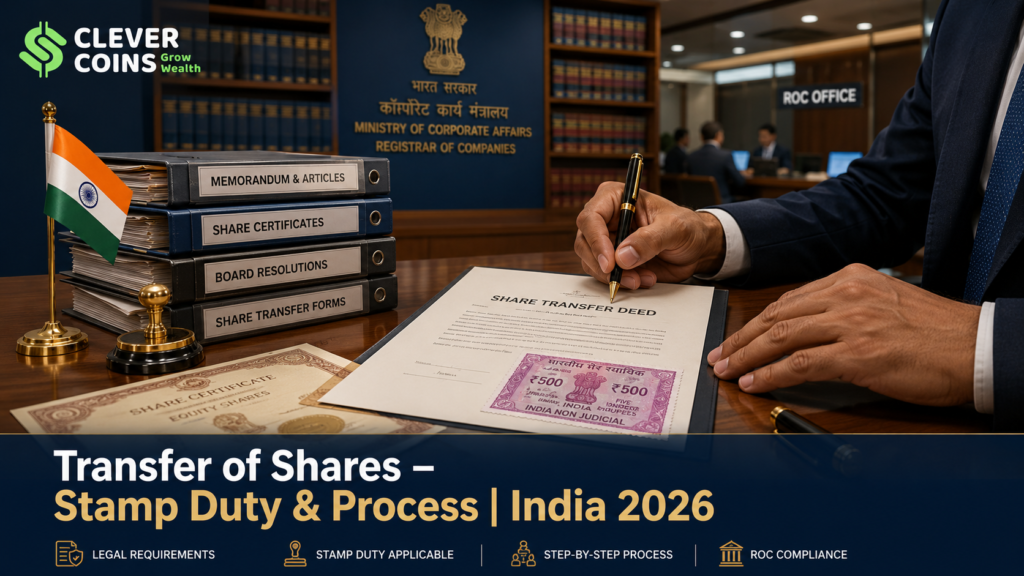
Transfer of Shares in India
The transfer of shares is a fundamental mechanism in corporate India that allows shareholders to legally convey their ownership rights in a company to another person or entity. Whether you are a promoter, investor, or a retail shareholder, understanding the process, documentation, and stamp duty implications of share transfer is critical for legal compliance and smooth corporate governance.
In India, share transfers are primarily governed by the Companies Act, 2013, the Indian Stamp Act, 1899 (as amended), and various state-level stamp duty notifications. As of 2026, significant changes have been implemented following the Stamp Duty (Amendment) Act and SEBI regulations that have streamlined the process, particularly for dematerialized (demat) shares.
This comprehensive guide walks you through every aspect of share transfers – from legal provisions and documentary requirements to stamp duty calculation with examples in Indian Rupees (INR), and the step-by-step process for private limited companies, public companies, and listed entities.
Legal Framework Governing Transfer of Shares in India
1. Companies Act, 2013
Section 56 of the Companies Act, 2013 is the cornerstone provision that governs share transfers in India. It mandates that:
- Every instrument of transfer must be in the prescribed form (Form SH-4) before its execution.
- The instrument of transfer must be duly stamped and delivered to the company within 60 days of execution.
- The company must register the transfer unless there is a valid reason for refusal under Section 58.
- In case of refusal, the company must send notice within 30 days from the date of receipt of the transfer instrument.
2. Indian Stamp Act, 1899 & Finance Act, 2019 Amendments
The Indian Stamp Act, 1899, as amended by the Finance Act, 2019 (effective from July 1, 2020), brought uniformity in stamp duty on securities across India. Prior to 2020, different states levied different stamp duties on share transfers, creating confusion and arbitrage. The 2019 amendment centralized stamp duty collection through stock exchanges and depositories for market transactions and prescribed fixed rates for off-market and physical share transfers.
3. SEBI Regulations (2026 Update)
The Securities and Exchange Board of India (SEBI) mandates that shares of listed companies can only be transferred in dematerialized (demat) form. Physical share certificates of listed companies are no longer transferable as of April 1, 2019, except in cases of transmission (by operation of law, such as death or succession). In 2026, SEBI has further tightened compliance for dematerialization before any transfer is permissible for listed entities.
4. Income Tax Act, 1961 – Capital Gains Implications
While not directly governing the procedure of transfer, the Income Tax Act, 1961 is crucial as it determines the tax liability on gains arising from share transfers. As of 2026:
- Short-Term Capital Gains (STCG) on listed shares held for less than 12 months: Taxed at 20% (revised upwards from 15% post Budget 2024).
- Long-Term Capital Gains (LTCG) on listed shares held for more than 12 months: Taxed at 12.5% on gains exceeding ₹1,25,000 per year (revised from ₹1,00,000).
- For unlisted shares: STCG taxed at applicable slab rates; LTCG at 12.5% without indexation benefit (as per Finance Act, 2024 amendment effective FY 2025-26).
Types of Share Transfer
A. Transfer of Physical Shares (Private Limited Companies / Unlisted Companies)
Physical share transfers are still relevant for private limited companies and unlisted public companies. These require the execution of Form SH-4, payment of stamp duty on the physical instrument, and registration in the company’s Register of Members.
B. Transfer of Demat Shares (Listed Companies / Unlisted Companies Opting for Demat)
For dematerialized shares, transfer takes place electronically through the depository system. No physical instrument is required. Stamp duty is collected electronically at the time of transfer by the depository (NSDL or CDSL).
C. Transmission of Shares
Transmission differs from transfer. It occurs by operation of law – upon death, insolvency, or succession of a shareholder. No stamp duty is payable on transmission. The legal heir or nominee is entitled to have shares transmitted upon submission of supporting documents such as death certificate, succession certificate, or probate of will.
D. Off-Market Transfer of Shares
An off-market transfer is a direct transfer between two parties outside the stock exchange. This is common in share pledging, gift transactions, or intra-group transfers. Stamp duty is applicable on off-market transfers at specified rates.
E. Transfer via Gift (Gift Deed)
Shares can be transferred as a gift. For listed companies in demat form, stamp duty at 0.015% is applicable. For physical/unlisted shares, stamp duty on the gift deed may apply based on state laws. Additionally, gift tax provisions under the Income Tax Act, 1961 apply when shares are gifted to non-relatives exceeding ₹50,000 in value.
Stamp Duty on Transfer of Shares – Updated Rates for 2026
Centralized Stamp Duty Rates (Post Finance Act, 2019 Amendment)
Effective from July 1, 2020, and applicable in 2026, the following uniform stamp duty rates apply across India:
Type of Transaction | Stamp Duty Rate | Applicable On |
Delivery-based purchase (Exchange) | 0.015% | Transaction value (Buy side) |
Non-delivery (Intraday / F&O) | 0.003% | Transaction value (Buy side) |
Off-Market Transfer (Demat) | 0.015% | Market value of shares |
Physical Share Transfer (Unlisted / Private) | 0.015% | Consideration value or Face Value (higher) |
Debentures (Market/Off-Market) | 0.0001% | Transaction / Market Value |
Stamp Duty Calculation Examples (In Indian Rupees – INR)
Example 1 – Physical Transfer of Private Company Shares: Mr. Arjun transfers 5,000 shares of XYZ Pvt. Ltd. to Ms. Priya. The agreed consideration is ₹2,00,000. The face value of shares is ₹10 each (total ₹50,000). Stamp Duty = 0.015% of ₹2,00,000 (higher of consideration and face value) = ₹30 Note: Minimum stamp duty of ₹1 applies. Stamps are affixed on Form SH-4. |
Example 2 – Off-Market Demat Transfer: Rajiv transfers 10,000 shares of ABC Ltd. (unlisted, demat) to Sunita. Market value = ₹50 per share. Total value = ₹5,00,000. Stamp Duty = 0.015% × ₹5,00,000 = ₹75 This is collected electronically by the depository (NSDL/CDSL) at the time of transfer. |
Example 3 – Listed Company Delivery-Based Purchase on Exchange: Investor buys 200 shares of Reliance Industries at ₹2,500 per share. Total value = ₹5,00,000. Stamp Duty = 0.015% × ₹5,00,000 = ₹75 This is automatically deducted at the time of settlement by the stock exchange. |
Who Pays Stamp Duty on Transfer of Shares?
As per the Indian Stamp Act and the Finance Act, 2019 amendment:
- For market-based transactions (exchange): Stamp duty is collected from the buyer through the stock exchange at the time of settlement.
- For off-market demat transfers: The depository (NSDL/CDSL) collects stamp duty from the transferor at the time of debiting the account.
- For physical share transfers: The stamp duty is to be paid by the transferor or as agreed between the parties on the instrument of transfer (Form SH-4) before execution.
Form SH-4 – Instrument of Transfer of Shares
What is Form SH-4?
Form SH-4, prescribed under Rule 11(1) of the Companies (Share Capital and Debentures) Rules, 2014, is the statutory instrument of transfer for physical shares of companies incorporated under the Companies Act, 2013. It serves as the legally valid deed for transferring ownership of shares from one person (transferor) to another (transferee).
Key Details Required in Form SH-4
- Name of the Company and CIN (Corporate Identification Number)
- Class and type of shares being transferred (Equity / Preference)
- Distinctive numbers (folio numbers) of shares being transferred
- Number of shares being transferred (in words and figures)
- Name, address, and PAN of the Transferor
- Name, address, and PAN of the Transferee
- Consideration amount (in ₹ and words)
- Date of execution
- Signature of the Transferor (with witnesses)
- Signature of the Transferee (acknowledgement)
- Witness details (name, address, signature)
Affixation of Stamp on Form SH-4
Revenue stamps of appropriate denomination must be affixed on Form SH-4 and cancelled by signature across the stamp. The stamp duty amount depends on the value of the transaction as illustrated above. Physical adhesive stamps may be affixed, or in states allowing e-stamping, e-stamps may be used.
Validity of Form SH-4
Form SH-4 must be presented to the company within 60 days from the date of execution. If not presented within 60 days, the form becomes invalid and a fresh form with fresh stamps needs to be executed.
Step-by-Step Process for Transfer of Shares
For Private Limited Companies / Unlisted Public Companies (Physical Shares)
- Review Articles of Association (AOA): Check if AOA contains any restrictions on share transfer. Most private limited companies have pre-emption rights – right of first refusal to existing shareholders.
- Obtain No-Objection / Board Approval: In private limited companies, the Board of Directors must approve the transfer. Convene a Board Meeting (BM) and pass a resolution approving the transfer.
- Execute Form SH-4: Both transferor and transferee must sign Form SH-4. Affix appropriate revenue stamps and cancel them.
- Submit to the Company: Form SH-4, along with original share certificates, must be submitted to the company within 60 days of execution.
- Verification by Company: The company verifies the form, stamps, and documents. It confirms authenticity of the transferor’s signature.
- Board Resolution for Registration: Pass a Board Resolution approving the registration of the transfer in the Register of Members.
- Update Register of Members (ROM): Enter the name of the new shareholder in the Register of Members maintained under Section 88 of the Companies Act, 2013.
- Issue New Share Certificate: Cancel the old share certificate and issue a new share certificate in the name of the transferee within 2 months from the date of submission (Section 56(4)(a)).
- File MGT-14 (if applicable): For public companies, if the share transfer requires special resolution or where the total paid-up capital transferred is significant, Form MGT-14 may need to be filed with the Registrar of Companies (ROC).
- Intimation to Depositories (if applicable): For companies with demat connectivity, update shareholding pattern accordingly.
For Listed Companies (Demat Transfer Through Depository)
- The transferor submits a Delivery Instruction Slip (DIS) to the Depository Participant (DP).
- The DIS contains details: ISIN of shares, quantity, beneficiary account of transferee, execution date.
- The DP processes the DIS and credits the shares to the transferee’s demat account.
- Stamp duty is automatically deducted and remitted to the State Government of Maharashtra (or as notified) by the depository.
- No physical form or certificate is required.
- Transfer is reflected in the demat account within T+1 or T+2 days depending on the depository settlement cycle.
Restrictions on Transfer of Shares
Restrictions in Private Limited Companies
Under Section 2(68) of the Companies Act, 2013, a private limited company must restrict the right to transfer its shares in its Articles of Association. Common restrictions include:
- Right of Pre-emption: Existing shareholders must be offered shares first before transferring to an outsider.
- Board Approval Required: Transfer is subject to Board approval.
- Lock-in Period: Founder shares may have a lock-in period as per shareholder agreements.
- Tag-Along and Drag-Along Rights: Common in investor-backed startups – investors may have the right to tag along in any transfer or drag all shareholders in case of a buyout.
Restrictions for Listed Companies
SEBI regulations restrict transfers of shares by promoters and designated persons:
- Insider Trading Prohibition: Shares cannot be transferred during trading windows when unpublished price-sensitive information (UPSI) is available.
- Promoter Lock-in: In IPOs, promoters’ minimum contribution shares are locked in for 18 months; the remaining promoter shares are locked in for 6 months.
- Block Deal / Bulk Deal Restrictions: Large block deals must be executed through the block deal window on stock exchanges.
Restrictions Under Shareholders’ Agreements (SHA)
Shareholders’ Agreements often contain contractual restrictions such as anti-dilution rights, ROFR (Right of First Refusal), ROFO (Right of First Offer), and veto rights that govern the transferability of shares.
Documents Required for Transfer of Shares
Document | Remarks |
Form SH-4 (Instrument of Transfer) | Duly filled, stamped and signed by both parties |
Original Share Certificate | To be surrendered for cancellation |
PAN Card (Transferor & Transferee) | Mandatory for all share transfers |
Aadhaar Card / Address Proof | KYC compliance |
Board Resolution | Required for corporate shareholders |
NOC from Lender (if pledged) | If shares are pledged |
No Objection Certificate (if required by AOA) | As per company’s AOA |
Share Transfer Agreement / MOU | Optional but recommended |
Indemnity Bond | In case of lost share certificate |
Death Certificate + Succession Certificate | In case of transmission |
Timelines and Penalties for Non-Compliance
Key Timelines
Action | Timeline |
Delivery of Form SH-4 to Company | Within 60 days of execution |
Issue of New Share Certificate | Within 2 months (private) / 1 month (listed) |
Notice of Refusal by Company | Within 30 days of receipt of application |
Appeal to NCLT against Refusal | Within 30 days of receipt of notice of refusal |
Stamp Duty Collection (Demat) | At the time of transfer processing by depository |
Penalties for Non-Compliance
- Failure to deliver Form SH-4 within 60 days: The instrument becomes invalid; fresh stamping and execution needed.
- Non-issue of share certificate within timeline: Company and every officer in default is liable to a penalty of ₹500 per day of default (maximum ₹5,00,000) under Section 56 read with Section 450 of the Companies Act, 2013.
- Inadequate Stamping: The instrument is inadmissible in evidence; penalty under the Indian Stamp Act may be up to 10 times the deficit stamp duty.
- Transfer in violation of SEBI Insider Trading Regulations: Penalty up to ₹25 crore or 3 times the profit made – whichever is higher.
Share Transfer in Startups and ESOP Exercises
Employee Stock Option Plans (ESOPs)
When employees exercise ESOPs, shares are transferred from the ESOP trust or company treasury to the employee. Key considerations:
- Stamp duty at 0.015% of the fair market value (FMV) at the time of allotment/transfer applies.
- Perquisite Tax: On exercise, the difference between FMV on exercise date and exercise price is taxed as perquisite (salary income) in the hands of the employee.
- At the time of sale by the employee, capital gains tax applies based on holding period from exercise date.
Secondary Sale by Angel Investors / Venture Capitalists
In secondary sales, an early investor sells their stake to a new investor. This is a share transfer and requires:
- Execution of Share Purchase Agreement (SPA).
- Form SH-4 and Board Approval if private company.
- Compliance with FEMA if the new investor is a foreign entity.
- Stamp duty at applicable rates on the SPA or Form SH-4.
- Reporting to RBI (via AD Bank) if FEMA applicable – Form FC-TRS within 60 days.
FEMA Compliance for Transfer Involving Non-Resident Indians (NRIs) or Foreign Entities
Transfer from Resident to Non-Resident
When a resident Indian transfers shares to a Non-Resident Indian (NRI) or Foreign National:
- The price must not be less than the FMV calculated by a SEBI-registered Merchant Banker or Chartered Accountant (for unlisted companies) or the market price (for listed companies).
- Form FC-TRS must be filed with the Authorized Dealer (AD) Bank within 60 days of receipt of consideration.
- FEMA 20(R) governs such transactions, read with RBI Master Directions on Foreign Investments.
Transfer from Non-Resident to Resident
When a Non-Resident transfers shares to a Resident Indian:
- Price should not exceed the FMV.
- Form FC-TRS must be filed with AD Bank within 60 days.
- Stamp duty at applicable rates on Form SH-4.
Key FEMA Prohibitions
- Transfer of shares of companies engaged in certain prohibited sectors (e.g., certain defence, lottery, gambling) to foreigners without prior government approval.
- Transfers that would result in breach of sectoral FDI caps.
Refusal of Transfer and Remedy
Grounds for Refusal
A company may refuse to register a transfer under Section 56 read with Section 58 of the Companies Act, 2013 on the following grounds:
- The transfer instrument is not in proper form or is not duly stamped.
- The instrument is not presented within the stipulated 60-day period.
- The transferor’s signature is forged or not authentic.
- The transfer is in violation of the Articles of Association.
- Pending litigation or court orders restraining transfer.
Remedy Against Wrongful Refusal
If a company wrongfully refuses to register a transfer, the aggrieved party may:
- Appeal to the National Company Law Tribunal (NCLT) under Section 58 of the Companies Act, 2013, within 30 days from date of receipt of notice of refusal.
- NCLT may direct the company to register the transfer and may award compensation.
Quick Compliance Checklist for Share Transfer (2026)
✔ Review AOA for restrictions on transfer ✔ Obtain Board Approval / Shareholder Approval as needed ✔ Execute Form SH-4 with correct details ✔ Affix and cancel revenue stamps (correct amount) ✔ Collect PAN / KYC of transferee ✔ Submit Form SH-4 within 60 days of execution ✔ Update Register of Members (ROM) ✔ Issue new Share Certificate within 2 months ✔ File Form MGT-14 if required ✔ File FC-TRS with AD Bank within 60 days if FEMA applicable ✔ Report SH-4 transaction for TDS (if applicable under Section 194Q) ✔ Assess Capital Gains Tax liability of transferor |
Conclusion
The transfer of shares in India is a multi-layered process involving procedural, legal, tax, and regulatory compliance. Whether you are transferring shares of a family-owned private company, a startup backed by investors, or dealing with listed securities, understanding the stamp duty implications, Form SH-4 requirements, FEMA provisions, and SEBI regulations is paramount.
With the centralization of stamp duty under the Finance Act, 2019 amendments, the process has become more streamlined, especially for demat shares. However, physical share transfers still require careful attention to stamping, timelines, and documentation.
Always consult a qualified Company Secretary, Chartered Accountant, or Corporate Lawyer before executing a share transfer to ensure full legal compliance and avoid penalties that can run into lakhs of rupees.