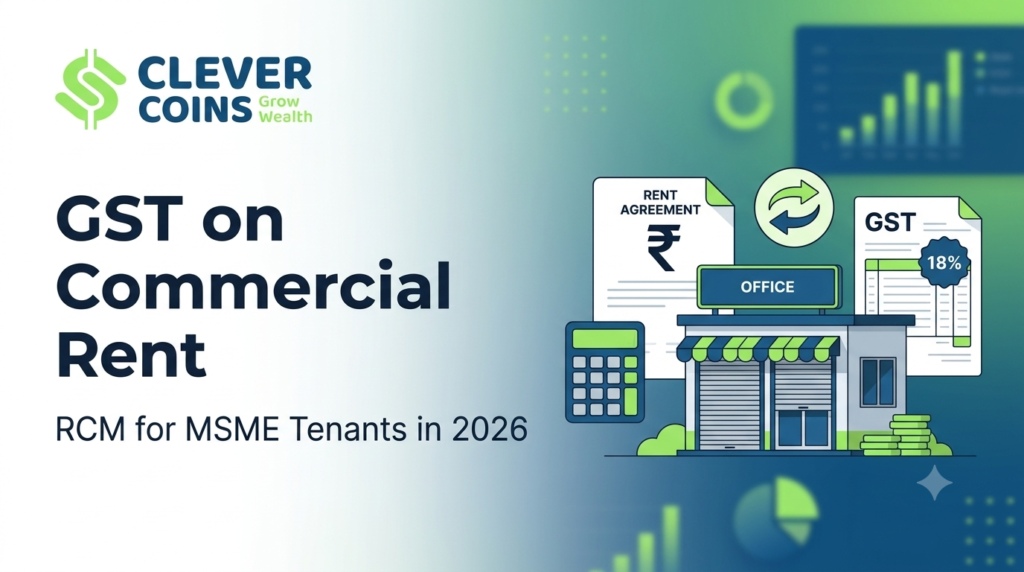
GST on Commercial Rent: RCM Applicable for MSME Tenants in 2026
Rent is one of the most predictable costs for a small business. A workshop in an industrial estate, a shop in a local market, an office on the second floor of a family-owned building: the amount is fixed, the agreement is signed, and the landlord asks for the same payment every month. Because it feels so settled, many MSME owners miss that a GST liability may sit on top of that rent, and that the liability may be theirs, not the landlord’s.
This is the Reverse Charge Mechanism (RCM) on commercial rent. If you are a GST-registered business and your landlord is not registered, you may have to calculate 18% GST on every rent payment, deposit it with the government in cash, and issue an invoice to yourself. This guide explains who is covered, who is not, how to comply step by step, how to claim input tax credit (ITC), and what mistakes to avoid in 2026.
Important clarification for MSMEs: The law does not ask whether you are a micro, small or medium enterprise. It asks whether you are a GST-registered person (other than certain composition taxpayers) and whether your landlord is unregistered. A Udyam certificate neither creates nor removes the liability.
Quick Answer: Key Takeaways
- Renting commercial or non-residential property is a taxable service at 18% GST (9% CGST + 9% SGST, or 18% IGST where applicable) under SAC 997212.
- If the landlord is GST-registered, they charge GST on the invoice (forward charge). You pay it to the landlord as part of the rent bill.
- If the landlord is unregistered and you are a registered tenant, the tenant pays the GST under reverse charge from 10 October 2024, under Entry 5AB of Notification 13/2017-Central Tax (Rate), as inserted by Notification 09/2024-Central Tax (Rate). taxqueries
- This applies irrespective of the rent amount. The landlord’s ₹20 lakh registration threshold does not shield you. taxguru
- Tenants registered under the composition scheme have been excluded since 16 January 2025. taxgarden
- If you are not registered under GST, this RCM entry does not apply to you.
- RCM tax must be paid in cash, not through the electronic credit ledger. You can generally claim ITC afterwards if you are eligible. taxqueries
What Is the Reverse Charge Mechanism (RCM)?
Normally the supplier collects GST from the customer and deposits it with the government. This is called the forward charge mechanism (FCM).
Under reverse charge, the roles flip. The recipient of the service calculates the GST, pays it to the government, and reports it in their own return. The supplier does not collect any GST.
RCM exists for practical reasons. Many suppliers, such as small landlords, individual professionals and transporters, are not registered under GST. The government cannot easily track their tax. Making the registered business recipient responsible brings those transactions into the tax net.
Key features of RCM:
- The recipient pays the tax. The supplier does not.
- The recipient issues a self-invoice for the supply.
- The tax is paid in cash, never through ITC balance.
- After payment, the recipient may claim ITC if conditions are met.
- It appears in GSTR-3B under outward supplies liable to reverse charge and again as ITC.
How the Rule on Commercial Rent Developed
The starting position
GST treats renting of immovable property as a supply of service. Renting of commercial property (shops, offices, warehouses, factory sheds, co-working spaces) is taxable at 18%. Renting of a residential dwelling for use as residence is exempt.
For years, commercial rent from an unregistered landlord was effectively outside GST. Rent from an unregistered individual meant no tax collected and none payable, because the general reverse-charge provision for supplies by unregistered persons to registered persons (Section 9(4) of the CGST Act) remained suspended for services.
The 2024 change
The GST Council recommended and the government notified a new entry. The new entry brings renting of any property other than a residential dwelling within reverse charge when an unregistered person supplies it to a registered person. It took effect on 10 October 2024 through Notification No. 09/2024-Central Tax (Rate), which inserted Entry 5AB into the reverse-charge notification. taxguru
The 2025 refinement
Registered persons under the composition scheme are excluded from this RCM entry from 16 January 2025. This recognises that composition taxpayers cannot claim ITC and pay tax at a flat turnover-based rate, so reverse charge would be a pure cost with no offset. taxgarden
Where this leaves MSMEs in 2026
For 2026, the rule from the sources I reviewed is stable: commercial rent + unregistered landlord + registered (regular) tenant = RCM at 18% on the tenant. Always check for any fresh notification or Council decision before relying on this for a large lease.
Who Is Liable? The Complete Scenario Matrix
| Landlord status | Tenant status | Property | Who pays GST? | Mechanism |
|---|---|---|---|---|
| GST-registered | Registered (regular) | Commercial | Landlord charges; tenant pays on invoice | Forward charge |
| GST-registered | Unregistered | Commercial | Landlord charges | Forward charge |
| Unregistered | Registered (regular scheme) | Commercial | Tenant pays to government | RCM (Entry 5AB) |
| Unregistered | Registered (composition) | Commercial | No RCM under this entry | Excluded from 16 Jan 2025 |
| Unregistered | Unregistered | Commercial | No RCM; landlord’s own liability depends on turnover | Entry 5AB not triggered |
If the landlord is registered and charges GST on the invoice, the tenant does not separately pay under RCM. RCM only applies where the landlord is unregistered. taxgarden
The MSME Myth: Udyam Registration vs GST Registration
Many small business owners assume RCM on commercial rent is a “big company” issue. It isn’t, and being an MSME offers no exemption.
| Question | Does it decide RCM? |
|---|---|
| Do you hold a Udyam/MSME certificate? | No |
| Are you micro, small or medium by investment/turnover? | No |
| Are you registered under GST (regular scheme)? | Yes |
| Is your landlord unregistered? | Yes |
| Is the property commercial/non-residential? | Yes |
A trader with ₹40 lakh turnover registered under GST is covered. A small manufacturer with a Udyam certificate but no GST registration is not. A tiny service business that voluntarily registered for GST is covered, even though it was not legally required to register.
The takeaway: your GST registration status decides this, not your MSME classification.
Does the ₹20 Lakh Threshold Protect You?
This is the most common misunderstanding.
A landlord whose only income is rent need not register for GST unless aggregate turnover crosses ₹20 lakh (₹10 lakh in special category states). So a landlord earning ₹8 lakh a year in rent is typically unregistered and does not charge GST.
That threshold applies to the landlord’s registration. It does not apply to your RCM liability. RCM on commercial rent applies irrespective of transaction value, even if the rent is below the registration threshold. taxguru
Example: You pay ₹15,000 a month (₹1.8 lakh a year) to an unregistered landlord. The landlord is far below the threshold, but as a registered tenant you owe 18% GST = ₹2,700 per month under RCM.
Composition Scheme MSMEs: A Special Case
Many small traders and manufacturers choose the composition scheme to pay GST at a low flat rate and file simpler returns. Composition taxpayers cannot claim ITC.
Before 16 January 2025, a composition tenant renting from an unregistered landlord faced RCM with no way to claim the tax back. The government addressed this: composition tenants are exempt from RCM on commercial rent from unregistered landlords since 16 January 2025. taxgarden
Practical notes for composition MSMEs:
- If you moved from composition to the regular scheme during the year, RCM begins from the date your regular status begins.
- If you are a composition taxpayer renting from a registered landlord, the landlord still charges you GST normally. You simply cannot claim ITC on it.
- Check how your composition status is shown on the GST portal before filing.
Step-by-Step: How to Comply with RCM on Commercial Rent
Step 1: Confirm your landlord’s GST status
Ask for the landlord’s GSTIN and verify it on the GST portal’s “Search Taxpayer” function. Do this before the first rent payment and re-check periodically. Landlords can register later, and registrations can be cancelled.
Step 2: Identify the type of supply
Confirm the property is commercial or non-residential: shop, showroom, office, godown, factory shed, co-working desk, or land used for business.
Step 3: Calculate GST
Apply 18% on the full taxable value. Taxable value generally includes rent and other charges the tenant pays for the right to occupy, such as maintenance charges, parking, and amenities billed with the rent. For unusual charges, take professional advice.
Step 4: Issue a self-invoice
The recipient issues an invoice to themselves for the supply. It should include:
- Your name, address and GSTIN (as recipient)
- Landlord’s name and address, and PAN where available
- Date and a serial number
- Description: “Renting of commercial property”, SAC 997212
- Taxable value, 9% CGST + 9% SGST (or 18% IGST where applicable)
- A note that tax is payable under reverse charge
Step 5: Pay the tax in cash
Reverse charge tax cannot be paid using ITC; it must be paid in cash. Deposit it through the cash ledger using a challan before filing GSTR-3B. Many MSMEs get caught here: your credit ledger may hold ITC from purchases, but it cannot be used for this payment. taxqueries
Step 6: Report in GSTR-3B
- Show the taxable value and tax in Table 3.1(d) (inward supplies liable to reverse charge).
- Claim eligible ITC in Table 4(A)(3) (inward supplies liable to reverse charge, other than imports and ISD).
Because reverse-charge supplies from unregistered persons don’t show in GSTR-2B, don’t rely on GSTR-2B alone to detect them. Maintain an internal RCM register.
Step 7: Maintain records
Keep the rent agreement, self-invoices, bank payment proof, challans, and the landlord’s PAN or identity details. These are the documents a GST officer will ask for.
Time of Supply: When Is the Liability Triggered?
For services under reverse charge, the tax point is generally the earlier of the date of payment or a date set by reference to 60 days from the supplier’s invoice (or from the supply, if no invoice is issued). For regular monthly rent paid on time, the practical position is simple: the liability arises in the month rent is paid. Delayed payments don’t postpone it indefinitely.
If rent is paid in advance (for example a quarterly or annual lump sum), the tax point is generally the payment date. Your accountant should apply the exact rule to your lease structure.
Place of Supply: CGST + SGST or IGST?
The place of supply for renting immovable property is the location of the property. Where the landlord is unregistered, the supplier’s location is generally treated as the same state as the property in practice. That makes the supply intra-state and attracts CGST + SGST of the state where the property is situated.
Two points follow:
- A business with registrations in several states should pay RCM under the registration of the state where the rented property sits.
- If you rent premises in a state where you are not registered, you need to discuss with your CA how to discharge the liability and whether a registration is required there.
Input Tax Credit (ITC) on RCM Rent
Paying 18% GST on rent only hurts cash flow if you can reclaim it. In most cases you can.
Conditions for claiming ITC
- You are registered under the regular scheme.
- The rent is for business use (furtherance of business).
- You paid the RCM tax in cash.
- You hold the self-invoice and records.
- You claim within the statutory time limit under Section 16(4), which is generally the earlier of the due date of the September return of the next financial year or the annual return filing date. (Check the current wording, as this provision has been amended.)
When ITC may be restricted
- Exempt supplies: If you make exempt supplies (for example some educational or healthcare services), ITC must be proportionately reversed.
- Personal use: If part of the premises is used for non-business purposes, claim ITC only for the business portion.
- Blocked credits: Section 17(5) blocks ITC on certain items. Renting for business generally does not fall in the blocked list, but check for unusual situations such as membership-type arrangements.
Cash flow impact
The key effect on a small business is timing. You pay cash today and reclaim credit in the same or following return, so the net cost is usually zero for fully taxable businesses. But a working-capital-tight MSME must still fund the cash outflow first.
Worked Examples
Example 1: Small trader in a rented shop
Ravi runs a GST-registered garment shop (regular scheme). He pays ₹40,000 monthly to an unregistered individual landlord.
- GST under RCM: 18% × ₹40,000 = ₹7,200 (₹3,600 CGST + ₹3,600 SGST)
- Annual RCM: ₹86,400
- Ravi pays ₹7,200 in cash each month, reports it in Table 3.1(d), and claims the same amount as ITC in Table 4(A)(3).
- Net annual cost: ₹0 (assuming eligibility), but ₹7,200 of cash is needed monthly.
Example 2: Composition-scheme tenant
Meena is a composition-scheme trader paying ₹25,000 monthly to an unregistered landlord.
- She is excluded from this RCM entry since 16 January 2025.
- She pays no GST on that rent.
Example 3: Landlord is registered
A registered manufacturer rents a shed at ₹1,00,000 a month from a GST-registered landlord who charges ₹18,000 GST on the invoice.
- The tenant pays ₹1,18,000 to the landlord, and RCM does not apply.
- The tenant claims ₹18,000 as ITC on the landlord’s invoice, once it appears in GSTR-2B.
Example 4: Unregistered tenant
A freelancer who isn’t GST-registered rents a small office from an unregistered landlord. Entry 5AB is not triggered, and no RCM is payable.
Special Situations and Edge Cases
Co-working spaces and business centres: A co-working operator is usually GST-registered, so forward charge applies. If an individual unregistered owner provides a space directly, RCM applies for a registered tenant.
Security deposits: A refundable deposit isn’t generally treated as consideration for rent. If it is adjusted against rent or forfeited, it may become taxable at that point.
Maintenance and other charges: If the unregistered landlord bills maintenance, parking or amenities with the rent for the same property, treat them as part of the supply value. Society maintenance paid directly to a society is a separate question and needs a case-by-case check.
Rent paid to multiple co-owners: Each co-owner is a separate supplier. If each is unregistered, RCM applies to the whole rent paid to them.
Rent paid to a registered person who isn’t charging GST: If a landlord is registered but fails to charge GST, that is the landlord’s compliance default. The recipient should get it corrected. RCM does not apply merely because the landlord forgot to charge.
Lease premium and one-time payments: Long-term lease premiums for commercial property are treated as supply of service and can be taxable. Take advice, because the position depends on the structure.
Residential property rented for business: This is covered separately under Entry 5AA, which puts RCM on registered recipients renting residential dwellings. Don’t mix the two rules. The commercial-rent entry is 5AB.
Rent to government or local authority: Different entries and exemptions may apply. Verify before assuming RCM.
Interest, Penalties and Notice Risk
Failing to pay RCM is a real risk because the transaction is invisible in GSTR-2B and the landlord won’t prompt you. Possible consequences:
- Interest at 18% per annum on delayed payment of tax.
- Interest at 24% on ITC wrongly claimed or utilised.
- Demand and penalty under the CGST Act’s demand provisions if short payment is detected, which can be higher where fraud or suppression is alleged.
- Loss of ITC if you can’t produce proper documents.
Since each month’s rent is a separate liability, errors accumulate over many months and can total a significant amount at audit.
Practical Strategies for MSME Tenants
- Do a rent audit now. List every rented premises, each landlord’s GSTIN status, and the monthly rent. Identify RCM exposure for the current and previous periods.
- Add GST clauses to the lease. State who bears the tax, that the landlord will notify you of any registration change, and that the rent is “exclusive of GST”.
- Negotiate with awareness. If a landlord is near the ₹20 lakh threshold, registration might benefit both parties. But it shifts the process to forward charge, and ITC flows through the landlord’s invoice.
- Plan cash. Keep a monthly RCM provision in the cash ledger.
- Automate. Set up a recurring RCM entry in your accounting software with a monthly self-invoice.
- Rectify past periods. If you’ve missed RCM, consult your CA about voluntary payment with interest before a notice arrives.
- Align income tax and GST. TDS on rent under the Income-tax Act is a separate compliance and should be tracked alongside GST.
Common Mistakes to Avoid
- Assuming “unregistered landlord means no GST”.
- Assuming Udyam or MSME status gives an exemption.
- Applying the landlord’s ₹20 lakh threshold to your own liability.
- Trying to pay RCM using the credit ledger.
- Skipping the self-invoice.
- Not reporting in Table 3.1(d) and 4(A)(3).
- Paying RCM when the landlord has in fact already charged GST (double payment).
- Continuing to pay RCM after moving to composition, or vice versa.
- Ignoring multi-state premises.
Monthly RCM Checklist for Rent
- Landlord GST status re-verified
- Rent amount and extra charges confirmed
- GST at 18% computed
- Self-invoice issued with SAC 997212
- Cash deposited via challan
- Reported in GSTR-3B Table 3.1(d)
- ITC claimed in Table 4(A)(3), if eligible
- Documents filed for audit
Frequently Asked Questions
1. Is GST on commercial rent applicable to MSMEs?
Yes, if the MSME is a registered taxpayer under the regular GST scheme and rents from an unregistered landlord. MSME status itself does not matter.
2. What is the GST rate on commercial rent?
18%, under SAC 997212.
3. Since when has RCM applied to commercial rent?
From 10 October 2024, under Entry 5AB inserted by Notification 09/2024-Central Tax (Rate).
4. My landlord earns below ₹20 lakh. Do I still pay RCM?
Yes. RCM depends on the landlord being unregistered, not on the rent amount.
5. I am a composition taxpayer. Do I pay RCM on rent?
Not on commercial rent from an unregistered landlord, since 16 January 2025.
6. Can I pay RCM from my ITC balance?
No. It must be paid in cash.
7. Can I claim ITC on the RCM paid?
Generally yes, if the rent is for business use and you meet the Section 16 conditions.
8. What if my landlord is registered?
The landlord charges GST on the invoice. You pay it and claim ITC. No separate RCM applies.
9. I am unregistered. Does RCM apply to me?
No. Entry 5AB applies only where the recipient is registered.
10. Where is RCM shown in GSTR-3B?
Liability in Table 3.1(d); ITC in Table 4(A)(3).
11. Do I need to issue an invoice?
Yes, a self-invoice for each rent payment or each period.
12. Does RCM apply to rent for my home office?
Residential rent to a registered person is governed by a different entry (5AA). Check your specific case.
Conclusion
RCM on commercial rent is a quiet but costly compliance trap for registered MSMEs. The rule is simple: registered regular tenant + unregistered landlord + commercial property = 18% GST payable by you in cash, creditable later. The size of your business, the size of the rent and your Udyam status do not change that.
Start by auditing your leases, verifying each landlord’s GST status and setting up a monthly RCM routine. Done once, it takes a few minutes a month. Missed for years, it becomes a notice with interest.
Need help with RCM compliance, GST registration or GST filing for your MSME? Reach out to the Clevercoins team for guidance tailored to your business.
Disclaimer: This article is for general information and reflects the law as understood at the time of writing. GST law is amended frequently. Please consult a qualified Chartered Accountant or tax professional for advice on your specific facts.
Related posts:
GSTR-2B – Auto Drafted ITC Statement: The Definitive Business Guide
Market Valuation: Is India Overvalued in 2026? A Data-Driven Analysis
GST Classification Disputes – Comprehensive Case Law Digest & Strategic Insights
Complete Guide to GST on Printing and Publishing: Rates, HSN Codes, and ITC Rules
GST ASMT-10 Discrepancy Notice: Complete Defense Checklist and Form ASMT-11 Reply Guide
Ultimate Compliance Guide: Time of Supply Rules for Goods & Services Under GST
Real Estate Investment Tax Implications: The Ultimate Wealth-Building Guide
GST Registration Cancellation: The Complete 2026 Process & Impact Guide
The Ultimate Guide to GST on Renting of Property: Rules, Rates, and Compliance
India-UK Free Trade Agreement Status 2026: The Comprehensive Implementation Breakdown
Related posts:
 The Deemed Acceptance Trap in GST IMS: How Unattended Invoices Trigger Penalties on the 14th
 How to Handle Rejected vs. Pending Invoices in GST IMS Without Blocking Working Capital
 GST 2.0 Tax Rate Restructuring: Navigating the 5% and 18% Slabs Without Systemic Mismatches
 How to Respond to GST Notice DRC-01 for Input Tax Credit Mismatches: Step-by-Step Draft