Introduction: The Hidden Threat to Your Business Continuity
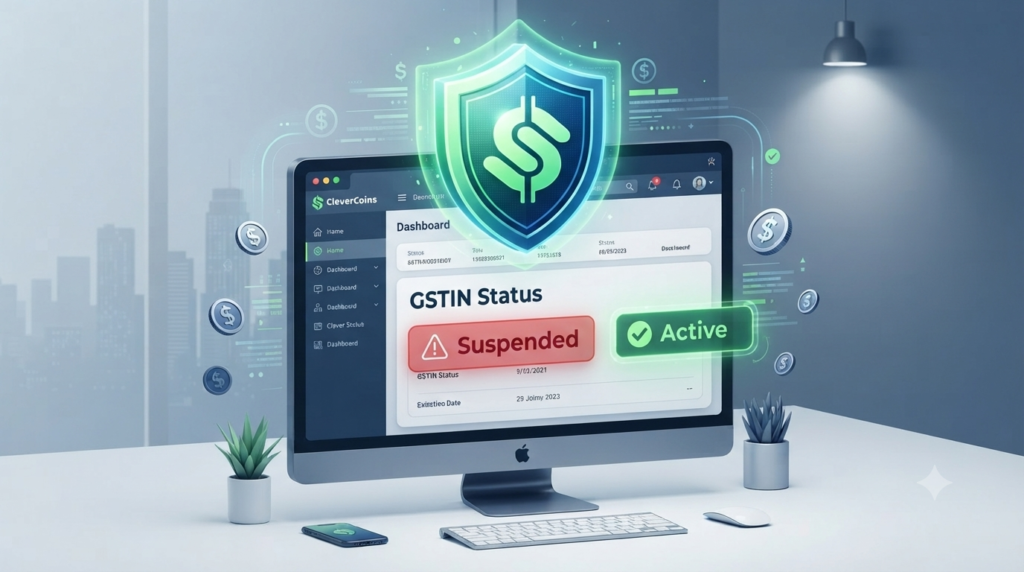
Imagine logging into the official Goods and Services Tax (GST) portal to file your monthly returns, only to be greeted by a chilling status flag: “Suspended.”
For any business owner, trader, manufacturer, or service provider in India, this single word can trigger an immediate wave of panic. A Goods and Services Tax Identification Number (GSTIN) is the absolute legal bedrock of modern Indian commerce. Without an active GSTIN, your enterprise loses its legal standing to collect tax, issue valid tax invoices, or pass on Input Tax Credit (ITC) to your buyers.
Worse still, unlike final cancellation, a suspension serves as an interim red flag—an automated warning or officer-initiated restriction giving you a narrow window of opportunity to rectify defaults before your registration is permanently wiped out.
At CleverCoins, we work closely with businesses navigating complex regulatory landscapes. In this exhaustive guide, we will unpack the mechanics of GSTIN suspension, explore the root causes, analyze the operational fallout, and provide a foolproof, step-by-step roadmap for swift revival.
1. Understanding GSTIN Suspension vs. Cancellation
Before diving into the triggers, it is vital to clear up a common misconception: Suspension is not Cancellation.
GSTIN Suspension: This is a temporary, restrictive holding status. Under Rule 21A of the CGST Rules, 2017, the system or a tax officer places your registration on hold while cancellation proceedings or compliance reviews are underway. Your core data remains on the portal, and if you cure the underlying defaults or successfully reply to show-cause notices, the suspension can be lifted, restoring your status to “Active”.
Bluman+ 2GSTIN Cancellation: This is the permanent termination of your registration. Once cancelled, your GSTIN ceases to exist legally. If you wish to conduct business again, you typically have to apply for revocation (if eligible) or register afresh.
Ebizfiling
During suspension, your compliance clock pauses in some areas (e.g., you cannot file normal returns or generate e-way bills), but your liability to answer notices and clear past dues intensifies.
2. Core Reasons Behind GSTIN Suspension
Why do systems or tax officers slam the brakes on a registration? GSTIN suspensions generally fall into two broad categories: System-Generated (Auto-Suspension) and Officer-Initiated (Manual Investigation). Let’s examine the primary catalysts.
A. Non-Filing of GST Returns (The #1 Culprit)
The most frequent trigger for auto-suspension is chronic default in furnishing periodic returns.
Under Section 29(2) read with Rule 21A, if a regular taxpayer fails to file returns (such as GSTR-3B or GSTR-1) for a consecutive period (typically more than six months, or shorter intervals for composition dealers), the GST Network (GSTN) analytics automatically flag the account.
BlumanThe system issues an automated warning or directly locks the GSTIN to prevent further accumulation of unfiled tax liabilities.
B. Significant Mismatches Between GSTR-1 and GSTR-3B
Data analytics engines deployed by the Central Board of Indirect Taxes and Customs (CBIC) monitor continuous data flows.
If your outward taxable supplies declared in your sales return (GSTR-1) drastically differ from the summary figures declared in your payment return (GSTR-3B), it triggers an automated anomaly flag.
5paisaLarge discrepancies imply either underreporting of sales or aggressive tax manipulation, prompting an immediate interim suspension under Rule 21A(2A).
C. Input Tax Credit (ITC) Anomalies and Excess Claiming
Claiming ITC that does not match your auto-populated GSTR-2B statement is a fast track to suspension.
If business entities engage with high-risk or fake invoice suppliers—or if the quantum of claimed ITC massively exceeds eligible parameters without corresponding vendor tax payments—the system flags the recipient GSTIN for fraudulent credit utilization.
D. Non-Compliance with Bank Account Verification (Rule 10A)
Recent amendments mandate that businesses update and validate their active bank account details on the GST portal within 30 days of registration or before filing GSTR-1/IFF.
If your bank account validation fails—due to name mismatches between PAN, bank records, and the GST portal, or due to invalid IFSC codes—the system locks your profile, leading to prolonged compliance holds.
TaxGuru
E. Business Premises Not Found or Non-Operational
Officer-initiated suspensions often stem from physical verification drives.
If a tax officer visits your registered principal place of business and finds the premises locked, non-existent, or occupied by an unrelated party who has no knowledge of your business, a show-cause notice (Form REG-17) is issued, and immediate suspension is enforced under Rule 21(a).
Bluman
F. Issuing Invoices Without Actual Supply of Goods or Services
Engaging in “bill trading”—issuing tax invoices without underlying movement of goods or actual rendering of services solely to pass on fake ITC—is treated as a grave economic offense. Detection by anti-evasion wings results in instant suspension followed by strict penal proceedings.
3. The Severe Business Impact of a Suspended GSTIN
Ignoring a suspension or treating it as a minor portal glitch can cripple your enterprise operations. The direct consequences include:
Prohibition on Charging Tax: You cannot collect GST from your customers during the suspension period. If you continue to issue tax invoices charging GST while suspended, it constitutes a penal offense.
5paisaDisabled E-Way Bill Portal: The generation of electronic way bills (E-Way Bills) is blocked instantly. Your logistics come to a dead stop because movement of goods worth more than the threshold value becomes legally impossible.
TaxGuruLoss of Customer Goodwill & Business Interruption: Your B2B clients check the GST portal before filing their returns. If your status shows “Suspended,” they will immediately halt payments, withhold tax credits, and distance themselves from your supply chain to protect their own compliance ratings.
Freezing of Input Tax Credit Chains: Your vendors and buyers cannot validate transactions linked to your GSTIN, creating cash flow gridlocks across the board.
4. How to Identify the Root Cause on the GST Portal
Before you can revive your GSTIN, you must diagnose why it was suspended. Follow this diagnostic checklist:
Log into the GST Portal: Access
www.gst.gov.inusing valid administrator credentials.5paisaCheck Dashboard Status: Note the registration status indicator displayed prominently on your post-login dashboard.
Navigate to User Services: Go to Services > User Services > View Notices and Orders.
Download Intimation Documents: Look for notices issued in:
Form REG-31: System-generated automated suspension notices detailing technical or data discrepancies.
BlumanForm REG-17: Officer-initiated show-cause notices requiring manual explanation and physical/documentary proof.
Bluman
Examine Compliance Dashboards: Check the status of your return filing history (GSTR-1, GSTR-3B) and electronic liability ledgers.
5. Step-by-Step Guide to GSTIN Revival and Revocation
Once you have identified the underlying trigger, you must act decisively within the statutory timeline (typically 7 days from the date of serving notice, though proactive measures can be initiated anytime). Here is the ultimate step-by-step framework to revive your suspended GSTIN:
Step 1: Clear All Pending Returns and Tax Liabilities
If your suspension stems from non-filing, the portal will generally restrict standard actions until baseline compliance is met.
Draft and file all pending GSTR-1 and GSTR-3B returns for the defaulted tax periods.
5paisaDeposit all outstanding tax dues, along with mandatory interest under Section 50 and late fees under Section 47, via the electronic cash/credit ledger.
Step 2: Rectify Data Mismatches and Reconcile ITC
If the suspension was triggered by GSTR-1 vs. GSTR-3B discrepancies or GSTR-2B credit anomalies:
Prepare a comprehensive vendor-wise reconciliation statement.
TaxGuruReverse any excess or ineligible ITC claimed erroneously in subsequent return cycles.
TaxGuruUpload correct explanatory documents or make necessary amendments on the portal.
TaxGuru
Step 3: Update Core Compliance Parameters (Bank Details & Aadhaar)
If your bank account validation failed under Rule 10A, visit Services > Registration > Amendment of Registration (Non-Core Fields), correct the bank account details, upload a valid bank statement or canceled cheque matching your legal entity name and PAN, and complete authentication.
TaxGuru
Step 4: File the Application for Revocation of Suspension
When the default has been cured, you must formally petition the tax authorities to lift the suspension:
Navigate to Services > Registration > Application for Revocation of Suspension of Registration (or access it directly via your notices tab).
Draft a clear, professional reply addressing every point raised in Form REG-17 or REG-31.
BlumanAttach all supporting attachments: challans of tax paid, reconciliation workbooks, rent agreements, electricity bills, and bank verification proofs.
Digitally sign and submit the application using DSC (Digital Signature Certificate) or EVC (Electronic Verification Code).
Step 5: Officer Review and Reinstatement
The proper officer will review your revocation application and digital submissions within the statutory timeframe.
5paisaIf the officer is satisfied that compliance has been restored and no fraudulent intent exists, an order of revocation will be passed.
5paisaYour GSTIN status on the public portal will automatically flip back from “Suspended” to “Active,” restoring your operational rights instantly.
6. Proactive Strategies to Prevent Future GSTIN Suspensions
Prevention is infinitely less costly than cure. Protect your enterprise from future compliance panics by implementing these internal controls:
Automated Calendar Tracking: Establish rigid internal cut-offs for GSTR-1 and GSTR-3B filings well ahead of official statutory due dates.
Monthly Reconciliation Rituals: Never file GSTR-3B blindly. Always match your outward sales data with GSTR-1 and verify your purchase register against auto-populated GSTR-2B data every single month.
TaxGuruVendor Health Scoring: Periodically audit your supply chain partners. Inactive or defaulting vendors can pull down your ITC eligibility and draw system scrutiny to your profile.
Keep Core Details Updated: Ensure your registered office address, authorized signatories, email addresses, and bank accounts match official documents seamlessly.
TaxGuru
Conclusion: Turn Compliance Into Your Competitive Advantage
A GSTIN suspension is a serious warning flare, but it does not spell the end of your business road if handled swiftly and methodically. By understanding the legal roots under the CGST Act, addressing automated notices promptly, and maintaining rigorous digital hygiene, you can successfully revive your registration and safeguard your market reputation.
Tax compliance doesn’t have to be a source of constant anxiety. At CleverCoins, our seasoned team of tax and government scheme consultants specializes in untangling complex tax disputes, performing deep compliance audits, and steering your enterprise toward friction-free financial growth.
Don’t let a suspended GSTIN stall your momentum. Reach out to CleverCoins today to turn regulatory complexity into your strategic business advantage!
Is your business facing a sudden GSTIN suspension notice, or do you need expert assistance with return reconciliations and revocation filings? Connect with the experts at CleverCoins today for a tailored compliance audit.
- Phone: +91 77389 59862
- Email: client@clevercoins.org
- Address: Ideal Market, Mumbra, Thane-400612
Related posts:
Delayed Possession: Legal Remedies and Comprehensive Rights for Homebuyers
Portfolio Rebalancing: When & How to Master Your Investment Mix
GSTIN Suspension: Reasons & Revival – The Ultimate Business Guide
GST on Works Contract – Budget 2026 Changes: The Ultimate Compliance & Tax Guide
Lean Startup Method for Indian Entrepreneurs: The Ultimate Guide to Building Agile Businesses
Comprehensive Guide: Anti-Profiteering Under GST in India
Udyam Registration for MSMEs
Comprehensive Guide: GST on Transfer of Business and Slump Sale (SLMP)
GST on Commission & Brokerage
Sovereign Gold Bond (SGB) 2026 Comprehensive Guide: Everything You Need to Know
Related posts:
 Comprehensive Guide: GST on Employee Benefits & CTC Components in India
 Comprehensive Marketing Team Deliverable: GSTR-2B – Auto-Drafted ITC Statement
 ISD – Input Service Distributor Mechanism: The Complete 2026 Compliance Guide
 GST on Goods Transport by Road (GTA): The Complete 2026 Compliance Guide