Belated Return & Updated Return (ITR-U): Complete Guide to Filing Late Income Tax Return in India
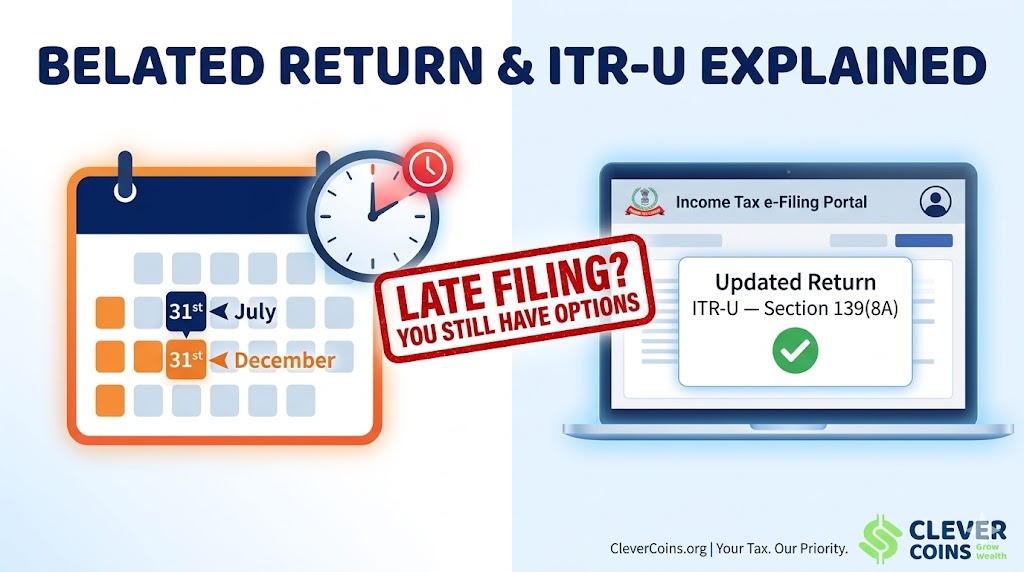
Every year, millions of Indian taxpayers miss the income tax return (ITR) filing deadline of 31st July. Whether due to lack of awareness, busy schedules, incomplete documents, or simply forgetting — a missed ITR deadline does not mean the end of the road. The Income Tax Act, 1961, provides two powerful mechanisms for late filers: the Belated Return under Section 139(4) and the Updated Return (ITR-U) under Section 139(8A).
In this comprehensive guide by CleverCoins — India’s trusted tax consultancy — we explain everything you need to know about both these provisions: what they mean, who can file them, the due dates, the financial cost, and a step-by-step process to file them online.
Part 1: Belated Return — Section 139(4)
What is a Belated Return?
A Belated Return is an income tax return filed after the original due date specified under Section 139(1) of the Income Tax Act, 1961. The original due date for individuals, HUFs, and firms not subject to audit is typically 31st July of the Assessment Year.
If you miss this deadline, you can still file your ITR as a Belated Return under Section 139(4). This provision allows taxpayers to file their return up to 31st December of the Assessment Year. For example, for FY 2024-25 (AY 2025-26), the belated return can be filed up to 31st December 2025.
⚠️ Important: Filing a belated return is not the same as filing a regular return. It attracts interest penalties and late fees — but it is always better to file late than to never file at all.
Who Can File a Belated Return?
- Any individual, HUF, firm, company, or other taxpayer who has missed the original ITR filing deadline
- Taxpayers who filed their original return but it was declared defective and was not rectified within the allowed time
- Salaried employees, business owners, professionals, freelancers, traders, NRIs with Indian income
- Taxpayers who need to claim refund of TDS deducted but could not file on time
What is the Due Date for Belated Return Filing?
Under Section 139(4), a belated return can be filed up to 31st December of the relevant Assessment Year. After 31st December of the AY, the window for belated return filing closes. However, taxpayers then have the option of filing an Updated Return (ITR-U) under Section 139(8A).
What Are the Consequences of Filing a Belated Return?
Filing a belated return comes with the following financial consequences:
- Interest Under Section 234A — Late Filing Interest
If you have a tax liability (i.e., you owe taxes after TDS), interest at 1% per month (simple interest) is charged on the outstanding tax amount from the day after the original due date (1st August) until the date of actual payment of taxes and filing. This can accumulate significantly if you delay by several months.
- Late Fee Under Section 234F — Fixed Penalty
Income | Filed on Time | Belated (234F penalty) |
Total income <= Rs. 5 lakh | No penalty | Rs. 1,000 |
Total income > Rs. 5 lakh | No penalty | Rs. 5,000 |
Nil income / below basic exemption limit | No penalty | No penalty (but interest may apply) |
- Loss of Carry-Forward Benefits
This is one of the most significant — and often overlooked — consequences of filing a belated return. If you have incurred losses under the following heads of income, you CANNOT carry them forward if you file a belated return:
- Business and Profession losses (non-speculative)
- Speculative business losses
- Capital gains losses (both STCG and LTCG)
- Losses under the head ‘Other Sources’ (certain cases)
⚠️ Exception: Loss from House Property (under Section 71B) CAN be carried forward even if the return is filed belatedly. This is the only exception.
- Prosecution Risk for Non-Filing
If you have a taxable income and do not file ITR at all (neither on time nor as belated return), you may be liable for prosecution under Section 276CC of the Income Tax Act. The penalty can range from three months to seven years of imprisonment along with a fine.
Can a Belated Return Be Revised?
Yes! A belated return can be revised under Section 139(5) up to 31st December of the Assessment Year — the same deadline as the belated return itself. So, if you file a belated return in October and later discover an error, you can revise it before 31st December.
Steps to File a Belated Return Online
- Log in to the Income Tax e-Filing portal: incometax.gov.in
- Go to ‘e-File’ → ‘Income Tax Returns’ → ‘File Income Tax Return’
- Select the Assessment Year (e.g., AY 2025-26 for FY 2024-25)
- Select ‘Filing Type’ as ‘Belated Return u/s 139(4)’
- Choose the appropriate ITR form (ITR-1, ITR-2, ITR-3, ITR-4, etc.)
- Pre-fill data from AIS / Form 26AS / TIS — verify all income details
- Enter all income, deductions, and tax payment details
- Compute tax, pay any outstanding demand via Challan 280
- Preview and submit the return
- E-verify the return via Aadhaar OTP, net banking, or DSC within 30 days
Part 2: Updated Return (ITR-U) — Section 139(8A)
What is the Updated Return — ITR-U?
The Updated Return (ITR-U) is a new facility introduced by the Finance Act, 2022, under Section 139(8A) of the Income Tax Act, effective from AY 2020-21 onwards. This provision allows any taxpayer — whether they have already filed a return (original, belated, or revised) or even if they have never filed — to update their income tax return within 2 years from the end of the relevant Assessment Year.
✅ Key Purpose: ITR-U allows taxpayers to voluntarily disclose additional income that was not reported earlier, correct errors or omissions that resulted in under-reporting of income, and avoid prosecution for concealment — by paying the additional tax due along with a prescribed additional tax payment.
Who Introduced ITR-U and Why?
The ITR-U facility was introduced by Finance Minister Nirmala Sitharaman in Union Budget 2022 as part of the government’s ‘Ease of Compliance’ initiative. The goal was to give taxpayers an opportunity to come clean on unreported or under-reported income without facing harsh prosecution, while simultaneously boosting income tax collections for the government.
It was also aimed at reducing tax litigation, as taxpayers could self-correct their errors by paying the applicable additional taxes rather than going through prolonged assessment disputes.
Key Features of ITR-U
- Extended time window of 2 years from the end of relevant Assessment Year
- Available for AY 2020-21 onwards (from the date of introduction in March 2022)
- Can be filed even if the taxpayer never filed any return for that year
- Can be filed even after original, belated, or revised return has been filed
- Requires payment of additional tax (25% or 50%) over and above the incremental tax and interest
- Only ONE ITR-U is allowed per Assessment Year — it cannot be filed multiple times
- The taxpayer must disclose a reason for updating the return
When Can ITR-U NOT Be Filed?
The law specifically bars filing of ITR-U in the following situations:
- If the updated return results in a LOSS or increases a loss (cannot be used to claim additional losses)
- If filing would result in a REFUND or increase an existing refund
- If filing would reduce tax liability (i.e., you cannot use ITR-U to claim additional deductions or reduce income already reported)
- If a search, survey, or any investigation has been initiated by tax authorities under Section 132 or 133A
- If assessment, reassessment, or revision proceedings are pending or completed for that AY
- If prosecution proceedings have been initiated under Chapter XXII for that AY
- If any information has been received from a tax authority abroad (double taxation treaties)
⚠️ Remember: ITR-U is ONLY for honest disclosure of additional income. You CANNOT use it to reduce tax or claim more refund.
Additional Tax Payable Under ITR-U
The most important feature of ITR-U is the mandatory additional tax that must be paid on top of the incremental tax and interest. This is calculated as follows:
Period of Filing ITR-U | Additional Tax on Incremental Tax + Interest |
Within 12 months from end of relevant AY (i.e., by 31st March, Year 1) | 25% of additional tax payable |
After 12 months but within 24 months from end of relevant AY (i.e., by 31st March, Year 2) | 50% of additional tax payable |
Formula: Additional Tax = (Tax Payable + Interest u/s 234A, 234B, 234C) as per updated return MINUS (Tax Paid / TDS / Advance Tax Already Paid)
Then apply 25% or 50% on this net incremental tax amount as additional tax.
Reasons Required for Filing ITR-U
While filing ITR-U, the taxpayer must select one of the following reasons for updating their return:
- Return previously not filed
- Income not reported correctly
- Wrong heads of income chosen
- Reduction of carried forward loss
- Reduction of unabsorbed depreciation
- Reduction of tax credit under Sections 115JB/115JC (MAT/AMT)
- Incorrect rate of tax applied
- Any other reason
Step-by-Step Process to File ITR-U Online
- Log in to the Income Tax e-Filing portal: incometax.gov.in
- Go to ‘e-File’ → ‘Income Tax Returns’ → ‘File Income Tax Return’
- Select the relevant Assessment Year (e.g., AY 2022-23 or AY 2023-24)
- Select ‘Filing Type’ as ‘Updated Return u/s 139(8A)’
- Select the appropriate ITR form for your income type
- Download and review the pre-filled data — do NOT change income downwards
- Add/correct the additional income or error that you are reporting
- Compute incremental tax + interest + additional tax (25% or 50%)
- Pay the total additional tax demand via Challan 280 (Tax Type: Self Assessment Tax)
- Enter the Challan details in the ITR-U form
- State your reason for updating the return
- Preview, submit, and e-verify the return within 30 days
✅ Pro Tip by CleverCoins: Always engage a tax professional before filing ITR-U. Calculation of additional tax involves precise computation of incremental tax, 234A/234B/234C interest, and the 25%/50% levy. An error here can attract further scrutiny.
Belated Return vs Updated Return (ITR-U) — Side-by-Side Comparison
Feature | Belated Return (Sec 139(4)) | Updated Return ITR-U (Sec 139(8A)) |
Who can file? | Any taxpayer who missed due date | Any taxpayer (original, belated, revised) |
Filing window | Up to 31st December of AY | Up to 2 years from end of relevant AY |
Can reduce tax liability? | Yes (no restriction) | NO — only to increase liability / reduce loss |
Reason required? | No specific reason needed | Yes — must state reason in ITR-U form |
Additional tax? | Interest u/s 234A/234F only | 25% or 50% additional tax on incremental tax |
Refund claim? | Yes, refund can be claimed | No refund can be claimed via ITR-U |
Penalty u/s 234F? | Yes — Rs.1,000 or Rs.5,000 | Not separately levied (covered in add. tax) |
Frequency of revision? | Can be revised till 31st Dec AY | Only ONE ITR-U per AY per taxpayer |
Available for? | All assessment years | AY 2020-21 onwards (from FY 2022 launch) |
Key Dates to Remember for FY 2024-25 (AY 2025-26)
- Original ITR due date: 31st July 2025 (individuals/HUF/non-audit)
- Belated / Revised return deadline: 31st December 2025
- ITR-U within 12 months (25% additional tax): by 31st March 2026
- ITR-U within 24 months (50% additional tax): by 31st March 2027
- For AY 2023-24 — ITR-U (50% additional tax): last chance by 31st March 2026
- For AY 2022-23 — ITR-U window: CLOSED as of 31st March 2025
Real-World Scenarios — Who Should Use Which Option?
Scenario 1 — Missed 31st July, Haven’t Filed Yet (AY 2025-26)
Action: File Belated Return under Section 139(4) before 31st December 2025. Pay interest u/s 234A and fee u/s 234F. Do not delay — after 31st December, only ITR-U (with additional 25%/50% tax) is available.
Scenario 2 — Filed Return But Forgot to Include Freelance Income
Action: File a Revised Return under Section 139(5) before 31st December of the AY. If 31st December has passed — file ITR-U under Section 139(8A) and pay the applicable additional tax (25% or 50%).
Scenario 3 — Trader Who Did Not Report All FNO Profits
Action: If within the ITR-U window — file ITR-U, report the additional trading income, compute incremental tax + interest, pay 25%/50% additional tax. This voluntary disclosure avoids detection and prosecution risk.
Scenario 4 — Received Rental Income But Filed Nil Return
Action: File ITR-U reporting the rental income. Pay the tax on rental income + 25%/50% additional tax. Ensure correct TDS credit is reflected via Form 26AS before filing.
Scenario 5 — NRI Forgot to Report Indian Interest Income
Action: File ITR-U for the relevant AY, report the interest income, pay applicable tax at NRI slab rates + additional tax. NRIs are covered under the ITR-U provisions as long as the income is Indian-sourced.
Common Mistakes to Avoid
- Waiting too long — Belated return window closes 31st December; after that only ITR-U applies with extra cost
- Not e-verifying the return within 30 days — Un-verified return is treated as invalid
- Filing ITR-U to claim additional deductions — This is NOT allowed and can trigger scrutiny
- Not computing 234A interest correctly while filing belated return — leads to demand notice later
- Filing ITR-U after a search or survey has been initiated — Will be invalid and rejected
- Choosing wrong ITR form while filing belated return — Causes defective return notice
- Not keeping the payment challan — Always save Challan 280 receipt for all tax payments
- Forgetting to reconcile AIS / Form 26AS before filing — Mismatch triggers automated scrutiny
How CleverCoins Can Help You File Belated Return & ITR-U
- Due Date Alerts: We remind all our clients of critical ITR deadlines well in advance
- Income Reconciliation: We match your income with AIS, Form 26AS, and TIS to ensure complete and accurate reporting
- Belated Return Filing: We prepare and file your belated return with accurate computation of interest and fees
- ITR-U Computation: We precisely calculate incremental tax, 234A/B/C interest, and additional tax (25%/50%) — ensuring no over- or under-payment
- Voluntary Disclosure Strategy: For taxpayers with unreported income, we advise on the best legal approach to disclose and regularise without unnecessary penalties
- E-Verification Assistance: We guide clients through e-verification to ensure the return is valid
- Notice Management: If a demand notice is received post-filing, we respond and resolve on your behalf
Missed Your ITR Deadline? Don’t Panic — CleverCoins Is Here!
www.clevercoins.org | DM on Instagram @clevercoins
Conclusion — File Late, But File Right!
Missing an ITR deadline is stressful — but it is not the end of your tax compliance journey. India’s tax law gives you multiple opportunities to correct your filing position: first through the Belated Return window up to 31st December, and then through the ITR-U route for up to 2 years.
The key message is this: the longer you delay, the more expensive it gets. File as soon as possible, pay the applicable interest and penalties, and get back on track with complete compliance.
At CleverCoins, we believe that every taxpayer deserves a second chance. Our team of tax experts is always ready to help you navigate late filing, penalty computation, voluntary disclosure, and complete ITR compliance — accurately and affordably.