GST on Agency Services – Del-Credere Agent (DCA): The Ultimate Legal, Tax & Compliance Masterclass
1. Executive Summary & Introduction
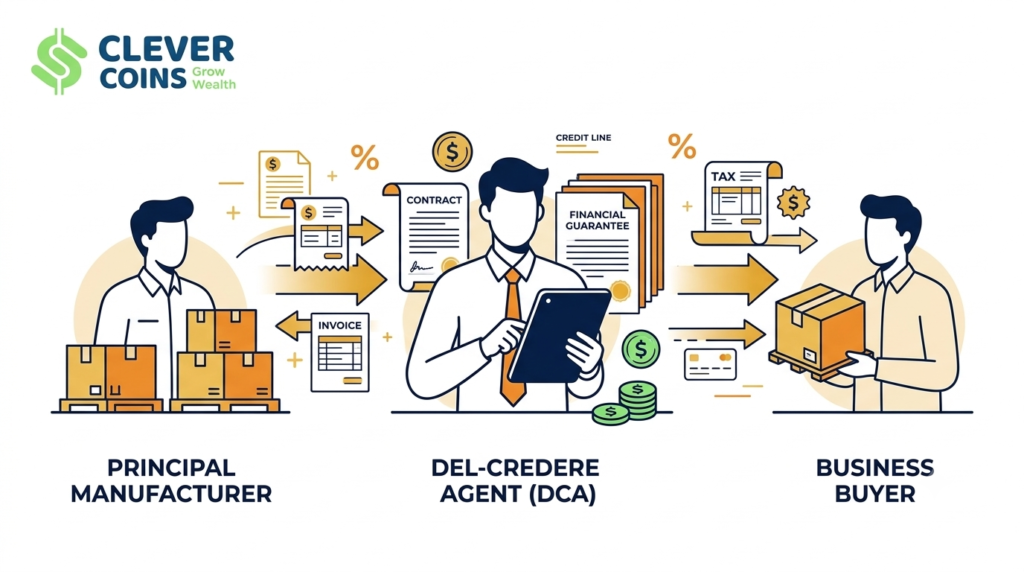
In the landscape of modern supply chain management and commercial distribution networks, the role of financial intermediaries is pivotal. Among various commercial agency relationships, the Del-Credere Agent (DCA) holds a unique position. A DCA acts not merely as a sales broker connecting seller and buyer, but also guarantees the payment obligations of the buyer to the principal seller. If the customer defaults on payment, the DCA compensates the principal, bearing the credit risk directly.
Under the Goods and Services Tax (GST) regime governed by the Central Goods and Services Tax (CGST) Act, 2017, the taxability of agency services—specifically DCA services—presents significant legal and procedural complexities. Key friction points arise around:
-
Determining whether the DCA qualifies as an “Agent” under Schedule I of the CGST Act.
-
The taxability of short-term interest charged by the DCA on buyer financing.
-
Valuation, invoicing structures, and Input Tax Credit (ITC) flow.
This comprehensive guide breaks down the statutory provisions, CBIC clarification circulars, accounting treatment, legal precedents, and practical workflows governing DCA operations under Indian GST.
2. Defining the Del-Credere Agent (DCA) in Commercial Law
A Del-Credere Agent (derived from the Italian word for “of belief” or “trust”) is a specific category of mercantile agent. Under Section 182 of the Indian Contract Act, 1872, an agent is a person employed to do any act for another, or to represent another in dealings with third parties.
Core Commercial Functions of a DCA:
-
Market Facilitation: Identifying prospective buyers, negotiating commercial terms, and securing sales orders for the principal’s products.
-
Del-Credere Guarantee: Providing an extra guarantee (for an additional commission called del-credere commission) that the buyer will pay for the supplied goods.
-
Credit Financing: Extending temporary credit to the buyer. If the buyer pays late, the DCA charges interest for the delayed period. If the buyer defaults entirely, the DCA indemnifies the principal directly.
3. Statutory Framework Under GST Law
To analyze the GST liability on transactions involving a DCA, four primary statutory pillars of the CGST Act, 2017 must be examined:
A. Section 2(5) – Definition of “Agent”
“Agent” means a person, including a factor, broker, commission agent, arhatia, del credere agent, an auctioneer or any other mercantile agent, by whatever name called, who carries on the business of supply or receipt of goods or services or both on behalf of another.
While Section 2(5) explicitly lists a “del credere agent”, inclusion under this definition depends on whether the DCA supplies or receives goods on behalf of the principal in a specific transaction.
B. Schedule I, Paragraph 3 – Transactions Without Consideration
Schedule I details activities to be treated as supply even if made without consideration:
Supply of goods— (a) by a principal to his agent where the agent undertakes to supply such goods on behalf of the principal; or (b) by an agent to his principal where the agent undertakes to receive such goods on behalf of the principal.
C. Section 15 – Valuation of Supply
Section 15 prescribes that the value of supply shall be the transaction value. Section 15(2)(d) explicitly includes interest, late fee, or penalty for delayed payment of any consideration for any supply within the taxable value.
D. Section 9 – Levying Provisions
GST is levied on intra-state supplies (CGST + SGST under Section 9 of CGST Act) and inter-state supplies (IGST under Section 5 of IGST Act). Determining whether the supply is goods or services dictates the applicable tax rate and place of supply.
4. The Agent vs. Independent Principal Relationship Test
The critical determinant of taxability under Schedule I is whether the transaction between the Principal and the DCA constitutes a principal-to-agent supply of goods.
CBIC issued Circular No. 57/31/2018-GST (dated 4th September 2018) establishing the operational test:
Key Parameter: Invoicing Mechanics
-
Scenario A (Invoice by DCA): If the DCA issues the final commercial invoice to the buyer in their own name, the DCA acts as an Agent under Schedule I. The transfer of goods from the Principal to the DCA is legally treated as a supply under GST, requiring tax payment at the time of movement/dispatch.
-
Scenario B (Invoice by Principal): If the invoice for goods is issued directly by the Principal to the Customer (with the DCA merely acting as a facilitator or guarantor), the DCA does not fall under Schedule I for the supply of goods.
5. Comprehensive Analysis of CBIC Circular No. 73/47/2018-GST
To eliminate ambiguity regarding DCA financing, commission, and interest, the Central Board of Indirect Taxes and Customs (CBIC) issued Circular No. 73/47/2018-GST on 5th November 2018. This circular establishes tax positions across key transaction scenarios.
6. Detailed Transaction Models & GST Treatment
Model 1: Principal Issues Goods Invoice Directly to Buyer (DCA as Facilitator)
In this arrangement, the Principal dispatches goods directly to the customer (or via the DCA) and issues the commercial tax invoice directly in the name of the buyer.
GST Implications breakdown:
-
Supply of Goods:
-
Supplier: Principal
-
Recipient: Buyer
-
GST Liability: Principal pays GST based on the value of goods supplied.
-
-
DCA Commission Services:
-
Supplier: DCA
-
Recipient: Principal
-
Classification: SAC 9983 (Other professional, technical, and business services) or SAC 9961 (Wholesale trade agency services).
-
GST Liability: DCA charges 18% GST on the commission billed to the Principal.
-
-
Treatment of Interest Charged by DCA to Buyer for Delayed Payment:
-
Because the DCA did not supply the underlying goods, the credit extended by the DCA to the buyer is an independent financial credit transaction.
-
Under Notification No. 12/2017-Central Tax (Rate), Entry 27, interest on loans, advances, or deposits is exempt from GST.
-
Therefore, the interest charged by the DCA to the buyer for delayed payment is EXEMPT from GST.
-
Model 2: DCA Issues Goods Invoice to Buyer in Their Own Name (Schedule I Agent)
In this structure, the Principal transfers goods to the DCA, and the DCA subsequently issues the final tax invoice to the end buyer under the DCA’s own GSTIN.
[Principal] ---(Invoice 1: Goods under S.I)---> [DCA] ---(Invoice 2: Goods)---> [Buyer]
                                                   |                              ^
                                                   +---(Interest for delay)-------+
GST Implications breakdown:
-
Supply 1 (Principal to DCA):
-
Treated as a supply of goods under Schedule I, Paragraph 3.
-
GST Liability: Principal issues a Tax Invoice to the DCA and pays applicable GST (e.g., 5%, 12%, 18%).
-
ITC: The DCA claims Input Tax Credit on the GST charged by the Principal.
-
-
Supply 2 (DCA to Buyer):
-
Supplier: DCA
-
Recipient: Buyer
-
GST Liability: DCA issues a Tax Invoice charging applicable GST to the buyer.
-
-
DCA Commission Services:
-
Supplier: DCA
-
Recipient: Principal
-
GST Liability: DCA bills commission to the Principal with 18% GST.
-
-
Treatment of Interest Charged by DCA to Buyer for Delayed Payment:
-
Because the DCA issued the invoice for the goods, the DCA is legally considered the supplier of the goods under GST.
-
Under Section 15(2)(d) of the CGST Act, 2017, the value of supply includes interest, late fees, or penalties for delayed payment of consideration.
-
Therefore, the interest charged by the DCA is NOT exempt. It must be added to the value of the goods and taxed at the same GST rate as the underlying goods (e.g., if goods are taxed at 12%, interest is taxed at 12%, not 18%).
-
Model 3: DCA Extending Short-Term Credit/Loans to Buyer Directly
Where the DCA pays the Principal on behalf of the buyer on the due date and recovers the amount plus interest from the buyer later:
| Parameter | Invoice Issued by Principal | Invoice Issued by DCA |
|---|---|---|
| Nature of Credit | Independent Loan / Financial Extension | Value addition to original supply of goods |
| Applicable Section | Notification 12/2017-CT (Rate), Entry 27 | Section 15(2)(d) of CGST Act |
| GST Rate on Interest | NIL / Exempt | Equal to underlying goods rate |
| Billed On | Debit Note / Interest Invoice | Supplementary Tax Invoice / Debit Note |
7. Valuation Mechanics & SAC/HSN Codes
+-------------------------------------------------------------------------------+
|                        HSN / SAC CLASSIFICATION TABLE                         |
+--------------------------+----------+-----------------------------------------+
| Service / Goods Category | HSN/SAC  | Applicable Standard GST Rate            |
+--------------------------+----------+-----------------------------------------+
| Agency Commission (DCA)  | SAC 9983 | 18%                                     |
| Wholesale Agency Service | SAC 9961 | 18%                                     |
| Underlying Goods Supply  | Chapter  | As per specific HSN classification      |
|                          | 1 to 98  | of the commodity (e.g., 5%, 12%, 18%)   |
| Independent Interest Credit| SAC 9971| EXEMPT (Entry 27, Notif 12/2017)       |
+--------------------------+----------+-----------------------------------------+
Valuation Formula for Del-Credere Commission
Valuation Formula for Integrated Interest (Model 2)
When interest is included in the value of supply under Section 15(2)(d), the interest collected is treated as inclusive of GST:
8. Input Tax Credit (ITC) Rules & Flow
-
ITC for DCA under Model 1:
-
DCA receives 18% GST invoice from administrative vendors (rent, software, utilities).
-
DCA claims ITC and sets it off against their outward GST liability on commission billed to the Principal.
-
-
ITC for DCA under Model 2:
-
Principal bills goods to DCA → DCA claims 100% ITC on these goods.
-
DCA bills goods to Buyer → DCA pays outward GST using the ITC claimed from the Principal’s invoice.
-
-
Restrictions & Reversals (Section 17(5) and Rule 42/43):
-
If a DCA operates under Model 1 and earns exempt interest income from buyers, does this require reversing common ITC under Rule 42?
-
Safe Harbor: Clause 2(b) of Explanation to Rule 42 explicitly clarifies that interest income derived from extending loans/advances is excluded from the calculation of exempt turnover for ITC reversal purposes. Thus, DCAs do not suffer ITC loss on account of receiving exempt interest.
-
9. Invoicing, Accounting & E-Way Bill Compliance
A. E-Way Bill Responsibilities
-
Under Model 1: Principal generates E-Way bill listing the Buyer as the recipient and the DCA location (if dispatched via DCA) as “Place of Delivery” or “Consigned To”.
-
Under Model 2:
-
Leg 1 (Principal to DCA): Principal generates E-Way bill.
-
Leg 2 (DCA to Buyer): DCA generates E-Way bill.
-
Bill-To Ship-To provision can be utilized under Rule 138A if goods move directly from Principal to Buyer while invoicing routes through the DCA.
-
B. Accounting Entries Matrix
For DCA (Model 1 – Facilitator Model):
Case Study 1: Steel Distributor (Model 1 vs Model 2 Transition)
-
Entity: Apex Metals Ltd (Principal) and Bharat Steel Trading (DCA).
-
Scenario: Apex supplies steel coils (HSN 7208, GST 18%) worth ₹1,000,000. Customer defaults for 60 days. DCA charges 12% per annum interest (₹20,000) for late payment.
-
Comparative Output:
+------------------------------------+--------------------+--------------------+
| Parameter                          | Model 1            | Model 2            |
+------------------------------------+--------------------+--------------------+
| Invoice Issued By                  | Principal          | DCA                |
| Value of Goods                     | ₹10,000,000        | ₹10,000,000        |
| GST on Goods (18%)                 | ₹1,800,000         | ₹1,800,000         |
| Interest Billed to Buyer           | ₹20,000            | ₹20,000            |
| GST on Interest                    | ₹0 (Exempt)        | ₹3,600 (18%)       |
| Total Amount Billed to Buyer       | ₹11,820,000        | ₹11,823,600        |
| Commission (5%)                    | ₹500,000           | ₹500,000           |
| GST on Commission (18%)            | ₹90,000            | ₹90,000            |
+------------------------------------+--------------------+--------------------+
Case Study 2: Default Event and Indemnification
-
Scenario: Buyer becomes insolvent. DCA pays ₹1,180,000 to Apex Metals under the Del-Credere agreement.
-
GST Question: Does the recovery of guaranteed funds by the Principal from the DCA attract GST?
-
Ruling: No. This is an indemnity payout under a guarantee contract, not a consideration for a separate supply of service. No GST applies to the default settlement amount paid by the DCA to the Principal.
11. Cross-Border Agency & Export Implications
When a Del-Credere Agent facilitates transactions involving foreign buyers or overseas principals, the Place of Supply rules under IGST Act, 2017 govern taxability.
A. DCA Facilitating Export of Goods (Principal in India, Buyer Outside India)
-
Commission Services: The DCA provides services to the Indian Principal. The place of supply is India (Section 12 of IGST Act). The DCA must charge CGST + SGST or IGST at 18%. It cannot be treated as zero-rated export of services because the service recipient is located in India.
B. DCA Acting as an Intermediary for Foreign Principal
-
Under Section 13(8)(b) of the IGST Act, 2017, the place of supply for intermediary services is the location of the supplier of services.
-
If an Indian DCA facilitates sales in India for a foreign principal, the place of supply is within India. The service does not qualify as an export of service, and GST at 18% applies.
12. Strategic Tax Planning & Legal Risk Mitigation
Compliance Checklist for DCAs & Principals:
-
Contractual Clarity: Draft the agency agreement to explicitly state whether the DCA is authorized to issue tax invoices in its own name.
-
Interest Invoice Bifurcation: Under Model 1, ensure interest invoices/debit notes cite Notification 12/2017-CT (Rate) Entry 27 to support tax exemption during GST audits.
-
E-Invoicing Readiness: Ensure B2B invoices generated under both Model 1 and Model 2 comply with mandatory IRN (Invoice Reference Number) generation requirements if aggregate turnover thresholds are met.
-
ITC Reconciliation: Perform monthly matching of GSTR-2B with purchase registers to ensure full recovery of ITC on goods transferred from the Principal under Model 2.
13. Frequently Asked Questions (FAQs)
Q1: Is registration under GST mandatory for a Del-Credere Agent?
Yes. Under Section 24(vii) of the CGST Act, 2017, persons who make taxable supply of goods or services on behalf of other taxable persons (agents) are required to take compulsory GST registration, regardless of aggregate turnover thresholds.
Q2: Does a DCA have to pay GST on the bad debts recovered from the buyer?
No. Recovery of a debt is a transaction in money. Under Section 2(52) of the CGST Act, “money” is excluded from the definition of goods and services.
Q3: What is the GST rate on Del-Credere Commission?
The standard rate of GST on agency commission services is 18% under SAC code 9983 or 9961.
Q4: If the DCA provides an advance to the Principal on behalf of the buyer, does it attract GST?
No. Extending advances or loans does not constitute a supply. However, any interest charged on such advances follows the taxability rules outlined in CBIC Circular No. 73/47/2018.
Q5: How does TCS under Section 52 apply if sales occur through an E-Commerce Operator via a DCA?
If the supply takes place through an E-Commerce platform, the platform operator deducts TCS at 1%. The DCA registers as the supplier of record under Model 2 or as an agent under Model 1, and reconciles TCS credit in their electronic cash ledger.
14. Conclusion & Strategic Checklist
Navigating GST on Del-Credere Agency services requires aligning commercial operations with the statutory framework of Schedule I and CBIC Circular 73/47/2018. The foundational decision comes down to the invoicing structure:
-
Choose Model 1 (Direct Invoicing by Principal) if you want to keep interest on delayed buyer payments exempt from GST, simplifying tax costs for the buyer.
-
Choose Model 2 (Invoicing by DCA) if the DCA requires full operational control over billing, acknowledging that delayed payment interest becomes taxable at the rate of the underlying commodity.
By maintaining robust contractual documentation, correctly classifying SAC/HSN codes, and automating e-invoicing compliance, businesses can optimize their working capital and eliminate tax exposure under GST audits.
+-----------------------------------------------------------------------------------+
|                        FINAL TAXABILITY SUMMARY DIRECTORY                         |
+---------------------------------------+---------------------+---------------------+
| Scenario                              | Model 1 (Direct)    | Model 2 (Schedule I)|
+---------------------------------------+---------------------+---------------------+
| Principal to DCA Movement Taxable?    | NO                  | YES                 |
| GST on Agency Commission              | 18%                 | 18%                 |
| Interest on Delayed Buyer Payment     | EXEMPT (0%)         | TAXABLE (Goods Rate)|
| Compulsory Registration Required?     | YES (Sec 24)        | YES (Sec 24)        |
+---------------------------------------+---------------------+---------------------+ - Phone: +91 77389 59862
- Email: client@clevercoins.org
- Address: Ideal Market, Mumbra, Thane-400612
Related posts:
Retirement Planning at 30: The Ultimate Starter Checklist
Capital Gains Tax 2026
GST on Insurance Premiums
Comprehensive Guide to GST Appeals: CIT(A), GSTAT, and High Court in India
Kisan Vikas Patra (KVP): Rates, Rules, and Complete Guide
GST on Construction & Works Contract
The Ultimate Guide to ELSS Tax Saving Mutual Funds
GST Registration Cancellation: The 2026 Compliance Guide
The Ultimate Guide to Trademark Registration in India: Protecting Your Brand in 2026
PCB Consent to Establish (CTE): The Ultimate Compliance Blueprint for Industrial & Commercial En...
Related posts:
 Comprehensive Guide: GST on Employee Benefits & CTC Components in India
 Comprehensive Marketing Team Deliverable: GSTR-2B – Auto-Drafted ITC Statement
 ISD – Input Service Distributor Mechanism: The Complete 2026 Compliance Guide
 GST on Goods Transport by Road (GTA): The Complete 2026 Compliance Guide