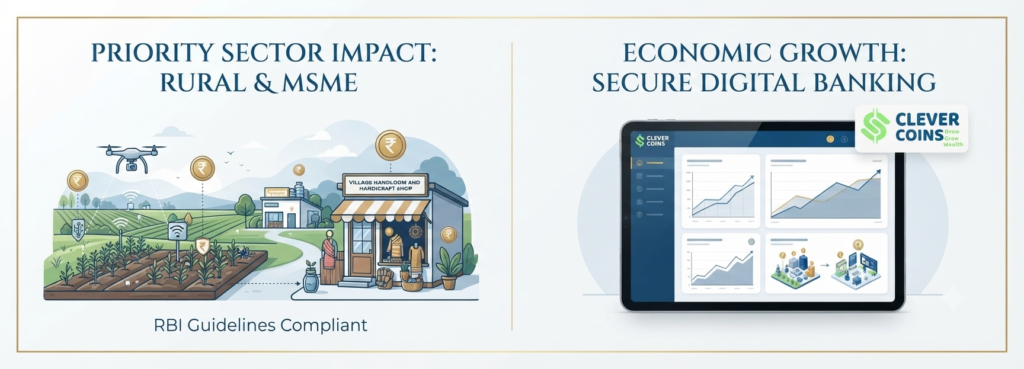
Priority Sector Lending (PSL) – RBI Guidelines: The Ultimate Comprehensive Guide
Authored by the Expert Content & Strategy Team at Clever Coins
Introduction to Priority Sector Lending (PSL)
The concept of Priority Sector Lending (PSL) represents a vital pillar of India’s economic architecture. Regulated strictly by the Reserve Bank of India (RBI), PSL is designed to channel institutional credit to segments of the economy that often lack access to formal banking channels due to perceived high risks, lack of collateral, or remote locations.
For commercial banks, meeting PSL mandates is not just a regulatory checkbox—it is a critical national responsibility directed toward fostering inclusive growth, eradicating rural poverty, generating employment, and empowering marginalized communities. At Clever Coins, we closely track these regulatory shifts to help businesses and financial institutions align with government frameworks smoothly and strategically.
Evolution and Objectives of the PSL Framework
The core philosophy behind Priority Sector Lending is rooted in social justice and balanced economic development. When commercial banks mobilize public savings, a designated portion of those funds must be redirected toward sectors deemed vital for national development.
Over the decades, the RBI has continuously refined the framework. The modern iteration of the guidelines incorporates updated targets, specialized sub-targets, stricter audit parameters, and expanded scopes—such as recognizing lending to cooperatives via the National Cooperative Development Corporation (NCDC).
Core Categories Under Priority Sector Lending
To qualify for PSL classification, bank credit must be directed toward specific sectors outlined by the RBI. These sectors form the backbone of grassroots economic activity:
1. Agriculture
Agriculture and its allied activities absorb a massive share of priority sector credit. This category is broadly split into:
Farm Credit: Loans to individual farmers, corporate farmers, producer companies of individual farmers, and Self-Help Groups (SHGs) or Joint Liability Groups (JLGs).
Agriculture Infrastructure: Loans for building storage facilities (warehouses, market yards, silos), cold storage units, soil conservation, and organic farming inputs.
Ancillary Activities: Loans up to specified limits for food and agro-processing, and setup of input supply networks.
2. Micro, Small, and Medium Enterprises (MSMEs)
MSMEs are engines of employment generation and manufacturing output. Loans extended to manufacturing and service enterprises conforming to the government’s investment and turnover criteria qualify seamlessly. This includes credit extended to retail and wholesale traders, khadi and village industries, and designated units under start-up frameworks (loans up to ₹50 crore).
3. Export Credit
Export credit extended by banks—comprising pre-shipment and post-shipment credit—qualifies for PSL within specified structural limits, enabling domestic exporters to remain competitive globally.
4. Education
Loans granted to individuals for educational purposes, including vocational courses pursued in India or abroad, qualify under priority sector guidelines, provided the institution or course is recognized by relevant government authorities.
5. Housing
Housing finance is crucial for asset creation among lower- and middle-income families. Loans to individuals for purchase/construction of dwelling units per family, repairs up to specified financial ceilings, and affordable housing projects are accommodated here.
6. Social Infrastructure
Bank credit extended for setting up schools, drinking water facilities, sanitation facilities, healthcare infrastructure (such as building or upgrading clinics and hospitals) in Tier II to Tier VI centers falls under this category.
7. Renewable Energy
Loans up to reasonable limits for solar-based power generators, biomass-based power generators, micro-hydel plants, and public lighting systems support India’s green transition and are classified directly under renewable energy PSL.
8. Weaker Sections
To ensure equity within priority sectors, sub-targets are mandated for “Weaker Sections”, which include:
Small and marginal farmers.
Artisans, village, and cottage industries where individual credit limits are minimal.
Beneficiaries of government-sponsored schemes like National Rural Livelihoods Mission (NRLM) and National Urban Livelihoods Mission (NULM).
Scheduled Castes (SCs) and Scheduled Tribes (STs).
Self-Help Groups (SHGs) and distressed farmers indebted to non-institutional lenders.
Target Structures and Sub-Targets Across Bank Types
Different categories of banks face distinct target thresholds calculated as a percentage of Adjusted Net Bank Credit (ANBC) or Credit Equivalent of Off-Balance Sheet Exposures (CEOBE), whichever is higher.
| Bank Category | Overall PSL Target (% of ANBC/CEOBE) | Agriculture Target | Small & Marginal Farmers | Weaker Sections Target |
| Domestic Commercial Banks (Excl. RRBs & SFBs) & Foreign Banks (20+ Branches) | 40% | 18% | 10% | 12% |
| Foreign Banks (<20 Branches) | 40% (Up to 32% Export Credit) | Not Mandatory | Not Mandatory | Not Mandatory |
| Regional Rural Banks (RRBs) | 75% | 18% | 10% | 15% |
| Small Finance Banks (SFBs) | 75% | 18% | 10% | 12% |
Computation Mechanics: ANBC and Credit Equivalents
Calculating Adjusted Net Bank Credit (ANBC) forms the foundational mathematical step for all compliance reporting.
Net Bank Credit (NBC): Calculated as total bank credit inside India minus bills rediscounted with RBI and other approved financial institutions, plus investments in non-SLR bonds held in held-to-maturity (HTM) categories.
ANBC Adjustments: Bills discounted/rediscounted, and eligible deposits placed with NABARD, SIDBI, MUDRA, or NHB against PSL shortfalls are factored systematically into the final computation base.
Off-Balance Sheet Exposures: Foreign banks and commercial players factor Credit Equivalent of Off-Balance Sheet Exposures (CEOBE) into the denominator matrix as per updated risk management frameworks.
Modern Compliance Updates and Recent Adjustments
The Reserve Bank of India continually updates the framework to plug compliance gaps and adapt to dynamic financial ecosystems:
Prevention of Double-Counting: To avoid systemic arbitrage, banks extending loans to NBFCs, Housing Finance Companies (HFCs), or the National Cooperative Development Corporation (NCDC) for on-lending must secure external auditor certificates proving that the underlying assets have not been claimed for PSL benefits elsewhere.
Cooperative Sector Inclusion: Credit channeled via the NCDC to cooperative societies is explicitly integrated, broadening credit access for agrarian co-ops.
Zero Loan-Related Charges: In strict consumer-protection moves, RBI bars banks from levying any loan-related charges or guarantee fees on priority sector loans up to ₹50,000 to protect ultra-small borrowers from hidden costs.
Strict Audit Pathways: Reliance on external auditor certifications paired with internal sample testing ensures that securitized pools and direct asset assignments strictly mirror true priority sector characteristics.
Consequences of Non-Achievement
Failure to meet stipulated PSL targets attracts regulatory penalties. Banks with shortfalls are required to contribute funds to specialized development funds managed by financial institutions:
Shortfall in Agriculture/Overall PSL: Deposited into the Rural Infrastructure Development Fund (RIDF) maintained with NABARD.
Shortfall in MSME Lending: Directed to funds managed by SIDBI or MUDRA.
Shortfall in Housing Target: Allocated to the National Housing Bank (NHB).
Interest rates paid on these mandatory deposits are typically low, functioning as an economic disincentive for missing priority lending milestones. Alternatively, banks trade Priority Sector Lending Certificates (PSLCs) through RBI-approved portals to bridge shortfalls cleanly.
Conclusion
Priority Sector Lending remains a transformative bridge connecting India’s financial system with its real economy. For banks, navigating these guidelines demands rigorous data tracking, strategic portfolio diversification, and robust auditing. For borrowers and enterprises, understanding these provisions unlocks vital capital pools required for scaling operations.
At Clever Coins, we bridge the gap between complex regulatory mandates and actionable financial execution, ensuring your business stays compliant, optimized, and ready for sustainable growth.
- Phone: +91 77389 59862
- Email: client@clevercoins.org
- Address: Ideal Market, Mumbra, Thane-400612