
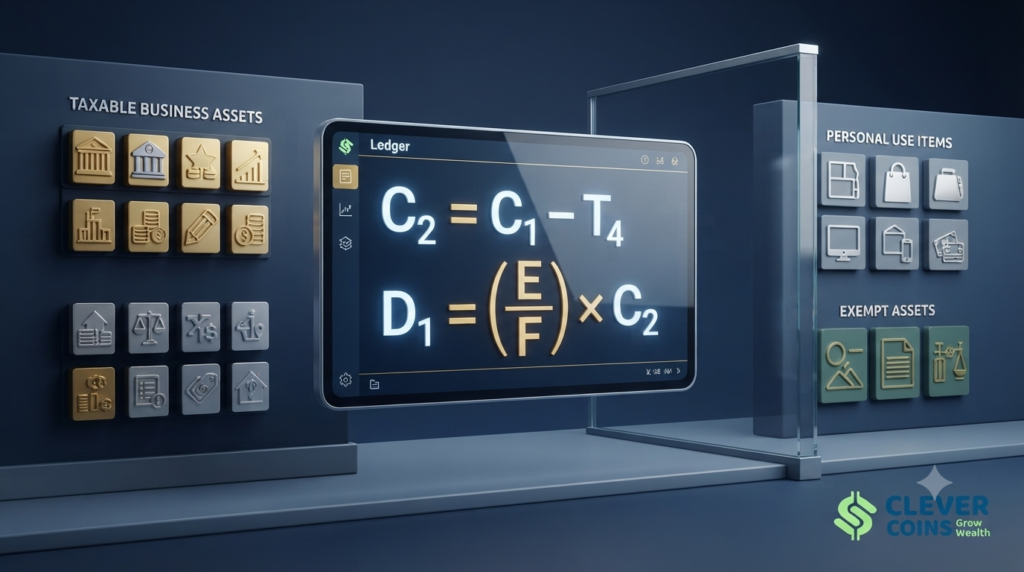
Reversal of ITC under Rule 42 and Rule 43: Formulas for Business vs. Exempted/Personal Use
Introduction: The Maze of Input Tax Credit and Mixed Use
Under the Goods and Services Tax (GST) regime, the concept of Input Tax Credit (ITC) is the lifeblood of working capital management. It is designed to prevent the cascading effect of taxes by allowing businesses to claim credit for the GST paid on purchases (inputs, input services, and capital goods). However, this privilege comes with a strict caveat: ITC is only available for outward supplies that are taxable and used strictly for business purposes.
What happens when a business operates in a hybrid model—where inputs, services, or capital assets are used interchangeably for taxable supplies, exempt supplies, and personal or non-business purposes? You cannot claim 100% of the credit.
This is where the statutory mandates of Rule 42 and Rule 43 of the CGST Rules, 2017 come into play. These rules provide mathematical formulas to segregate and reverse the proportionate credit attributable to non-business and exempt activities. For tax professionals, CFOs, and business owners, mastering these rules is essential to safeguarding cash flows, optimizing tax liabilities, and avoiding heavy interest and penalties during GST audits.
Understanding the Core Concept: What is ITC Reversal?
ITC Reversal refers to the process of paying back or reducing the input tax credit that a taxpayer has already claimed or is otherwise eligible to claim in their electronic credit ledger.
When a business procures goods or services, it initially claims the total GST paid. At the end of the tax period (or annually, depending on the rule specifics), if those inputs or assets are deployed for:
-
Exempt Supplies: Goods or services that attract a nil rate of tax or are specifically exempted under GST.
-
Non-Business / Personal Use: Goods or services utilized by promoters, directors, or employees for personal consumption, or activities unconnected with business.
…a proportional clawback mechanism must be triggered. Failing to execute this reversal attracts interest under Section 50 at 18% per annum, alongside potential penalties.
Rule 42: ITC Reversal on Inputs and Input Services
Rule 42 of the CGST Rules governs the methodology for determining the eligible ITC and executing reversals concerning inputs and input services. If you run a business that manufactures taxable goods while simultaneously trading in exempt agricultural produce or running a parallel exempt service, Rule 42 is your daily compliance manual.
Step-by-Step Breakdown of the Rule 42 Mechanism
The computation under Rule 42 flows through a structured, multi-step filtration process to isolate the “Common Credit” and apportion the reversal.
-
Step 1: Total Input Tax ($T$)
Quantify the total input tax charged on all inputs and input services during a tax period.
-
Step 2: Segregation of Ineligible/Exclusive Credits ($T_1, T_2, T_3$
-
-
$T_1$: ITC on inputs/input services intended strictly for non-business (personal) purposes. (Full reversal required).
-
$T_2$: ITC on inputs/input services used exclusively for making exempt supplies. (Full reversal required).
-
$T_3$: ITC on supplies that are ineligible for ITC under Section 17(5) (e.g., food and beverages, motor vehicles under specific conditions, club memberships).
-
-
Step 3: Derivation of Common Credit ($C_1$)
The remaining credit available after stripping away exclusive non-business and exempt credits is termed $C_1$:
$$C_1 = T – (T_1 + T_2 + T_3)$$ -
Step 4: Identification of Exclusive Taxable Credit ($T_4$)
Isolate the ITC pertaining exclusively to taxable supplies (including zero-rated supplies), denoted as $T_4$.
-
Step 5: Isolation of Final Common Credit ($C_2$)
Subtract $T_4$ from $C_1$ to arrive at $C_2$, which represents the true common credit used for both taxable and exempt/personal objectives:
$$C_2 = C_1 – T_4$$
The Crucial Rule 42 Reversal Formulas ($D_1$ and $D_2$)
From the common credit pool $C_2$, the taxpayer must calculate two vital reversal components:
-
Reversal for Exempt Supplies ($D_1$):
This attributes a share of the common credit to exempt turnover using the proportion of exempt supplies to total turnover:
$$D_1 = \left( \frac{E}{F} \right) \times C_2$$-
Where:
-
$E =$ Aggregate value of exempt supplies during the tax period.
-
$F =$ Total turnover in the State of the registered person during the tax period.
-
-
-
Reversal for Non-Business / Personal Use ($D_2$):
For personal or non-business utilization out of the common pool, the law mandates a flat statutory assumption:
$$D_2 = 5\% \text{ of } C_2$$
Final Eligible Credit Computation
The aggregate ITC that must be reversed for the tax period ($R_1$) is:
$$\text{Total Reversal} = D_1 + D_2$$The eligible credit that remains safely in your electronic credit ledger is subsequently adjusted.
Rule 43: ITC Reversal on Capital Goods
While Rule 42 handles fast-moving inventory, raw materials, and routine services, Rule 43 tackles heavy structural assets—Capital Goods (machinery, factory equipment, computer systems, and long-term infrastructure). Because capital assets have an extended lifespan, their ITC reversal mechanics are designed differently, spread across a designated life timeline.
Key Principles of Rule 43
-
Useful Life Assumption: Under GST, the useful life of any capital asset is legally deemed to be 5 years (60 months) from the date of invoice.
-
Full Claim Initially: The total ITC on capital goods ($T_c$) is initially credited to the electronic credit ledger.
-
Monthly Amortization of Common Credit ($T_m$): If capital goods are used exclusively for taxable supplies, full credit is retained. If used exclusively for exempt supplies, credit is blocked. If used alternatingly/commonly for both taxable and exempt supplies, the credit must be distributed monthly:
$$T_m = \frac{T_c}{60}$$
The Rule 43 Reversal Formula ($Te$)
The monthly common credit attributable to exempt supplies ($T_e$) that must be reversed every month during the 60-month lifecycle is calculated as:
$$Te = \left( \frac{E}{F} \right) \times Tm$$-
Where:
-
$T_m =$ Monthly common credit on capital goods ($T_c / 60$).
-
$E =$ Aggregate value of exempt supplies.
-
$F =$ Total turnover in the State.
-
This value ($T_e$) must be added to the output tax liability along with applicable interest every month for the entire 5-year duration if the asset continues to see mixed usage. Furthermore, if capital goods initially used exclusively for exempt supplies are later converted to taxable use, a proportionate credit can be claimed into the ledger by reversing the residual block.
Comparative Analysis: Rule 42 vs. Rule 43
Feature Dimension Rule 42 (Inputs & Input Services) Rule 43 (Capital Goods) Asset Class Target Short-term consumables, raw materials, professional and operational services. Long-term machinery, plant, computers, and infrastructure assets. Frequency of Calculation Computed monthly on a provisional basis, finalized annually by the due date of September following the end of the financial year. Calculated strictly every month throughout the asset’s deemed 60-month lifecycle. Non-Business Reversal Factor Explicit flat 5% mandatory addition ($D_2$) applied to the common pool. Integrated implicitly through standard turnover tracking or direct exclusive identification. Time Horizon Short-term operational cycle. Extended 5-year tracking window. Practical Scenario: Step-by-Step Calculation Walkthrough
Let us ground these formulas in a real-world business case study to make the mechanics transparent.
Scenario Parameters:
-
Company Name: Apex Pharma Solutions Ltd.
-
Total Input Tax ($T$) on Inputs/Services for the month: ₹5,00,000
-
ITC used exclusively for personal/non-business use ($T_1$): ₹20,000
-
ITC used exclusively for exempt supplies ($T_2$): ₹50,000
-
ITC blocked under Section 17(5) ($T_3$): ₹30,000
-
ITC used exclusively for taxable supplies ($T_4$): ₹2,50,000
-
Exempt Turnover for the month ($E$): ₹20,00,000
-
Total Turnover for the month ($F$): ₹1,00,00,000 (Exempt ratio = 20%)
Step 1: Compute Common Credit ($C_1$)
$$C_1 = T – (T_1 + T_2 + T_3)$$$$C_1 = 5,00,000 – (20,000 + 50,000 + 30,000) = ₹4,00,000$$Step 2: Compute Final Common Credit ($C_2$)
$$C_2 = C_1 – T_4$$$$C_2 = 4,00,000 – 2,50,000 = ₹1,50,000$$Step 3: Compute Reversals ($D_1$ and $D_2$)
-
Exempt Reversal ($D_1$):
$$D_1 = \left( \frac{20,00,000}{1,00,00,000} \right) \times 1,50,000 = 0.20 \times 1,50,000 = ₹30,000$$ -
Non-Business Reversal ($D_2$):
$$D_2 = 5\% \text{ of } C_2 = 0.05 \times 1,50,000 = ₹7,500$$
Step 4: Total Reversal & Net Eligible Credit
$$\text{Total ITC to be reversed} = D_1 + D_2 = 30,000 + 7,500 = ₹37,500$$$$\text{Net Eligible Common Credit} = C_2 – 37,500 = ₹1,12,500$$Annual Reversal Recalculation (The Rule 42(2) Twist)
Monthly calculations under Rule 42 are provisional. At the end of the financial year, businesses must run an annual calculation on or before the 30th day of September of the succeeding financial year.
-
If the aggregate annual reversal based on actual yearly turnover ratios exceeds the sum of monthly reversals already done, the difference must be paid back with interest at 18% per annum.
-
If the actual reversal is lower than what was monthly reversed, the differential amount can be re-claimed as ITC.
Common Compliance Pitfalls to Avoid
-
Ignoring the Annual True-Up: Many businesses treat monthly calculations as final, leading to severe audit notices when annual turnover ratios shift drastically.
-
Misclassifying Personal Use Expenses: Failing to isolate director or employee personal consumption items triggers direct penalties under $T_1$ tracking failures.
-
Forgetting Rule 43 Monthly Tracking: Capital asset tracking requires long-term record maintenance over 60 months; missing a single month’s calculation accumulates compounded liabilities.
-
Incorrect Turnover Proportions: Ensure that non-GST and high-sea sale turnovers are treated correctly per statutory inclusion or exclusion parameters when computing ratio $E/F$.
Conclusion: Best Practices for Seamless Execution
Navigating Rule 42 and Rule 43 requires meticulous data hygiene, robust ERP tagging for purchases (taxable vs. exempt vs. personal), and proactive reconciliations. By integrating automated tax compliance frameworks, businesses can accurately execute these formulas, protect working capital from unnecessary interest drains, and stay audit-ready year-round.
-
- Phone: +91 77389 59862
- Email: client@clevercoins.org
- Address: Ideal Market, Mumbra, Thane-400612
Related posts:
RERA Registration for Builders – Step by Step
Complete Guide to GST on Goods Transport by Road (GTA): Rules, Rates, and Compliance
ITR-1 (Sahaj) Filing Guide 2026
T+1 Settlement in India – What Changed
Comprehensive Guide to GST Audit by Tax Authorities: Process, Preparation, and Compliance
Adding Additional Places of Business (APOB): Complete Rules for Branches and Godowns
Educational Institutions and Coaching Centers: Scope of Exemption vs. Taxable Services
Receipt, Payment, and Refund Vouchers: When Are They Legally Required?
Related Party Transactions Compliance: The Ultimate Business Guide
GST on Works Contract – Budget 2026 Changes: The Ultimate Contractor Guide
Related posts:
 Comprehensive Guide: GST on Employee Benefits & CTC Components in India
 Comprehensive Marketing Team Deliverable: GSTR-2B – Auto-Drafted ITC Statement
 ISD – Input Service Distributor Mechanism: The Complete 2026 Compliance Guide
 GST on Goods Transport by Road (GTA): The Complete 2026 Compliance Guide

